 Add to Chrome
 Add to Firefox
 Add to Edge
Low-Complexity Tone Injection via Candidate Ranking for PAPR Reduction in OFDM and AFDM Systems
Apr 20, 2026
Tone injection (TI) is a promising distortionless PAPR reduction technique that incurs no spectral efficiency loss. However, state-of-the-art TI schemes based on random candidate generation or clipping noise spectrum suffer from fundamental limitations in PAPR performance. In this paper, we propose novel TI schemes compatible with both OFDM and AFDM systems. The proposed schemes iteratively update the TI sequence via a candidate ranking procedure guided by time-domain local peaks. This accurately selects effective candidates while achieving a complexity comparable to that of the fast Fourier transform. Depth-first search is further integrated to enhance PAPR performance by exploiting the tree structure of the process. Simulations demonstrate that the proposed schemes achieve over 1 dB PAPR gain over baseline TI schemes at comparable complexity. The gain is consistent across various numbers of subcarriers under controlled per-iteration complexities, confirming a superior performance-complexity trade-off for both OFDM and AFDM.

Region-Based Constellation Designs for Constructive Interference Precoding in MU-MIMO
Apr 04, 2026The performance of constructive interference precoding (CIP) for multi-user multi-antenna (MU-MIMO) systems is governed by the structure of the constructive interference (CI) regions, yet this is overlooked in conventional constellation design. This work proposes the region-based constellation (RBC) model to lay the foundation for CIP constellation design. An RBC directly defines the mapping between messages and their feasible regions, instead of deriving them from an existing constellation. To provide insight for RBC design, we study the limitations of quadrature-amplitude-modulation (QAM)-based CIP. Analytical results show that the restrictive CI regions of QAM symbols are systematically misaligned with the objective-minimising sign pattern, resulting in a significant gap to the theoretical performance limit. From the perspective of improving sign alignment, two novel RBC schemes with non-convex feasible regions are proposed, namely mirrored-ends QAM (ME-QAM) and real-extended ME-QAM. A low-complexity algorithm is also developed for the resulting mixed-integer quadratic program, achieving a complexity comparable to QAM-based CIP. Simulation results with constellation sizes $\{16,64\}$ demonstrate up to $4$~dB signal-to-noise-ratio gain of the proposed schemes over QAM-based CIP. The proposed RBC model is also applicable to other systems with non-bijective modulation, representing a promising direction for future research.
Block-Weighted Lasso for Joint Optimization of Memory Depth and Kernels in Wideband DPD
Apr 18, 2025The optimizations of both memory depth and kernel functions are critical for wideband digital pre-distortion (DPD). However, the memory depth is usually determined via exhaustive search over a wide range for the sake of linearization optimality, followed by the kernel selection of each memory depth, yielding excessive computational cost. In this letter, we aim to provide an efficient solution that jointly optimizes the memory depth and kernels while preserving reasonable linearization performance. Specifically, we propose to formulate this optimization as a blockweighted least absolute shrinkage and selection operator (Lasso) problem, where kernels are assigned regularization weights based on their polynomial orders. Then, a block coordinate descent algorithm is introduced to solve the block-weighted Lasso problem. Measurement results on a generalized memory polynomial (GMP) model demonstrates that our proposed solution reduces memory depth by 31.6% and kernel count by 85% compared to the full GMP, while achieving -46.4 dB error vector magnitude (EVM) for signals of 80 MHz bandwidth. In addition, the proposed solution outperforms both the full GMP and the GMP pruned by standard Lasso by at least 0.7 dB in EVM.
Exploiting Non-uniform Quantization for Enhanced ILC in Wideband Digital Pre-distortion
Feb 12, 2025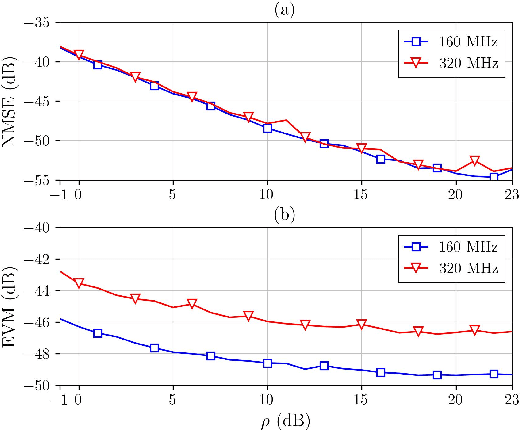
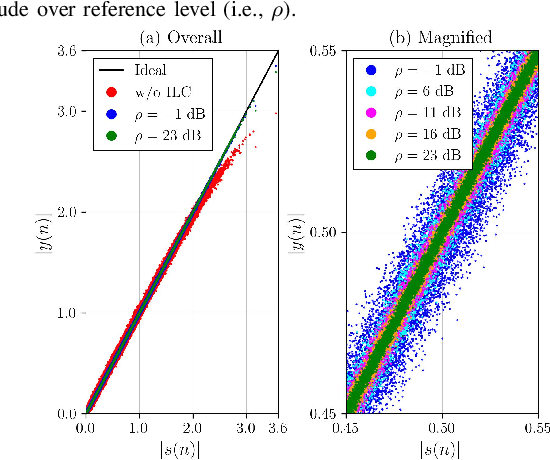
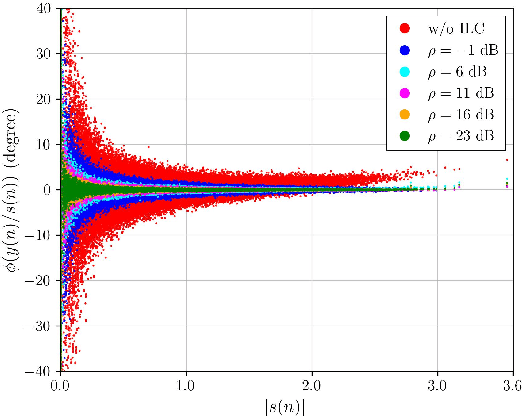
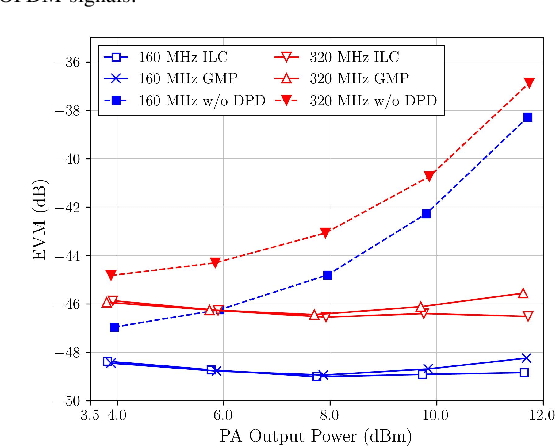
In this paper, it is identified that lowering the reference level at the vector signal analyzer can significantly improve the performance of iterative learning control (ILC). We present a mathematical explanation for this phenomenon, where the signals experience logarithmic transform prior to analogue-to-digital conversion, resulting in non-uniform quantization. This process reduces the quantization noise of low-amplitude signals that constitute a substantial portion of orthogonal frequency division multiplexing (OFDM) signals, thereby improving ILC performance. Measurement results show that compared to setting the reference level to the peak amplitude, lowering the reference level achieves 3 dB improvement on error vector magnitude (EVM) and 15 dB improvement on normalized mean square error (NMSE) for 320 MHz WiFi OFDM signals.
Accelerating Iteratively Linear Detectors in Multi-User (ELAA-)MIMO Systems with UW-SVD
Aug 16, 2024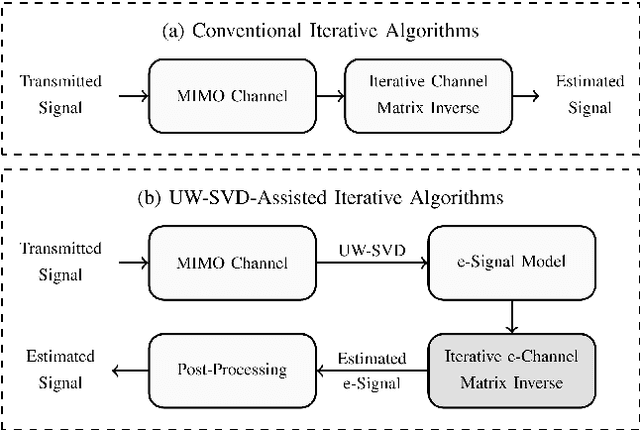

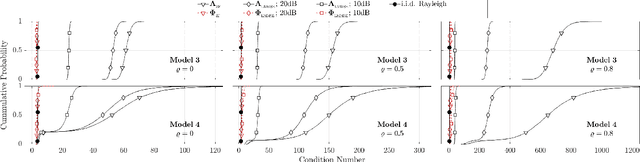

Current iterative multiple-input multiple-output (MIMO) detectors suffer from slow convergence when the wireless channel is ill-conditioned. The ill-conditioning is mainly caused by spatial correlation between channel columns corresponding to the same user equipment, known as intra-user interference. In addition, in the emerging MIMO systems using an extremely large aperture array (ELAA), spatial non-stationarity can make the channel even more ill-conditioned. In this paper, user-wise singular value decomposition (UW-SVD) is proposed to accelerate the convergence of iterative MIMO detectors. Its basic principle is to perform SVD on each user's sub-channel matrix to eliminate intra-user interference. Then, the MIMO signal model is effectively transformed into an equivalent signal (e-signal) model, comprising an e-channel matrix and an e-signal vector. Existing iterative algorithms can be used to recover the e-signal vector, which undergoes post-processing to obtain the signal vector. It is proven that the e-channel matrix is better conditioned than the original MIMO channel for spatially correlated (ELAA-)MIMO channels. This implies that UW-SVD can accelerate current iterative algorithms, which is confirmed by our simulation results. Specifically, it can speed up convergence by up to 10 times in both uncoded and coded systems.
Iterative Inversion of (ELAA-)MIMO Channels Using Symmetric Rank-$1$ Regularization
Feb 23, 2024While iterative matrix inversion methods excel in computational efficiency, memory optimization, and support for parallel and distributed computing when managing large matrices, their limitations are also evident in multiple-input multiple-output (MIMO) fading channels. These methods encounter challenges related to slow convergence and diminished accuracy, especially in ill-conditioned scenarios, hindering their application in future MIMO networks such as extra-large aperture array (ELAA). To address these challenges, this paper proposes a novel matrix regularization method termed symmetric rank-$1$ regularization (SR-$1$R). The proposed method functions by augmenting the channel matrix with a symmetric rank-$1$ matrix, with the primary goal of minimizing the condition number of the resultant regularized matrix. This significantly improves the matrix condition, enabling fast and accurate iterative inversion of the regularized matrix. Then, the inverse of the original channel matrix is obtained by applying the Sherman-Morrison transform on the outcome of iterative inversions. Our eigenvalue analysis unveils the best channel condition that can be achieved by an optimized SR-$1$R matrix. Moreover, a power iteration-assisted (PIA) approach is proposed to find the optimum SR-$1$R matrix without need of eigenvalue decomposition. The proposed approach exhibits logarithmic algorithm-depth in parallel computing for MIMO precoding. Finally, computer simulations demonstrate that SR-$1$R has the potential to reduce iterative iterations by up to $33\%$, while also significantly improve symbol error probability by approximately an order of magnitude.
On Chernoff Lower-Bound of Outage Threshold for Non-Central $χ^2$-Distributed Beamforming Gain in URLLC Systems
Dec 28, 2023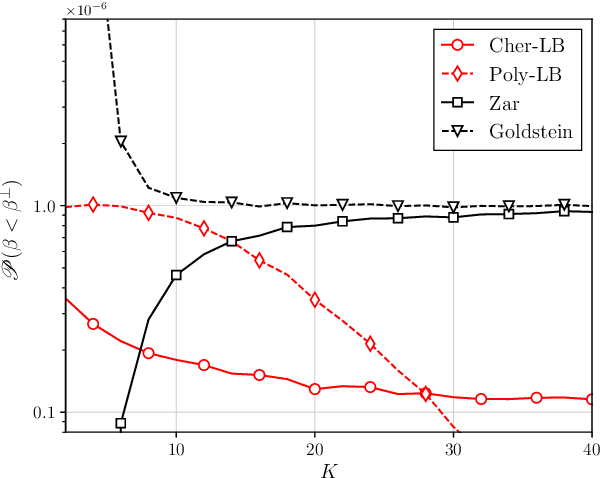

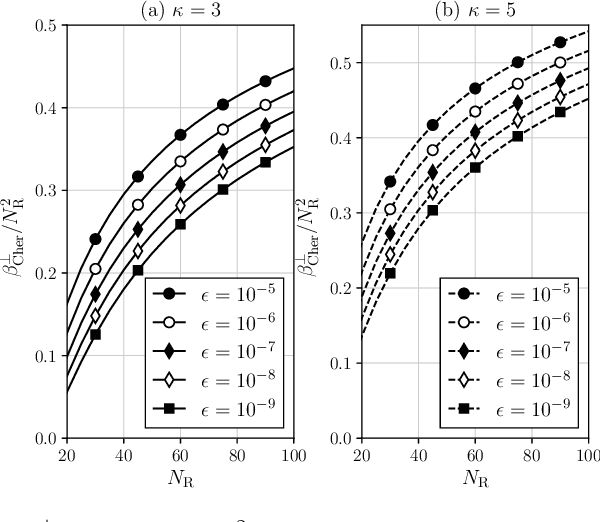
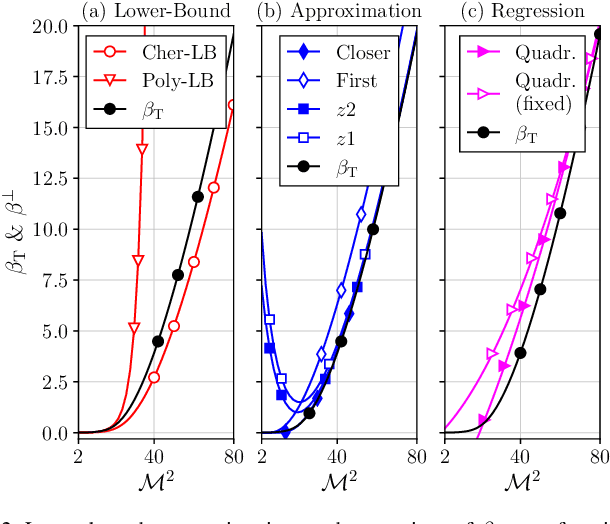
The cumulative distribution function (CDF) of a non-central $\chi^2$-distributed random variable (RV) is often used when measuring the outage probability of communication systems. For ultra-reliable low-latency communication (URLLC), it is important but mathematically challenging to determine the outage threshold for an extremely small outage target. This motivates us to investigate lower bounds of the outage threshold, and it is found that the one derived from the Chernoff inequality (named Cher-LB) is the most effective lower bound. This finding is associated with three rigorously established properties of the Cher-LB with respect to the mean, variance, reliability requirement, and degrees of freedom of the non-central $\chi^2$-distributed RV. The Cher-LB is then employed to predict the beamforming gain in URLLC for both conventional multi-antenna systems (i.e., MIMO) under first-order Markov time-varying channel and reconfigurable intellgent surface (RIS) systems. It is exhibited that, with the proposed Cher-LB, the pessimistic prediction of the beamforming gain is made sufficiently accurate for guaranteed reliability as well as the transmit-energy efficiency.
On Chernoff Lower-Bound of Outage Threshold for Non-Central $χ^2$-Distributed MIMO Beamforming Gain
Aug 24, 2023The cumulative distribution function (CDF) of a non-central $\chi^2$-distributed random variable (RV) is often used when measuring the outage probability of communication systems. For adaptive transmitters, it is important but mathematically challenging to determine the outage threshold for an extreme target outage probability (e.g., $10^{-5}$ or less). This motivates us to investigate lower bounds of the outage threshold, and it is found that the one derived from the Chernoff inequality (named Cher-LB) is the most {effective} lower bound. The Cher-LB is then employed to predict the multi-antenna transmitter beamforming-gain in ultra-reliable and low-latency communication, concerning the first-order Markov time-varying channel. It is exhibited that, with the proposed Cher-LB, pessimistic prediction of the beamforming gain is made sufficiently accurate for guaranteed reliability as well as the transmit-energy efficiency.
Sherman-Morrison Regularization for ELAA Iterative Linear Precoding
Jan 26, 2023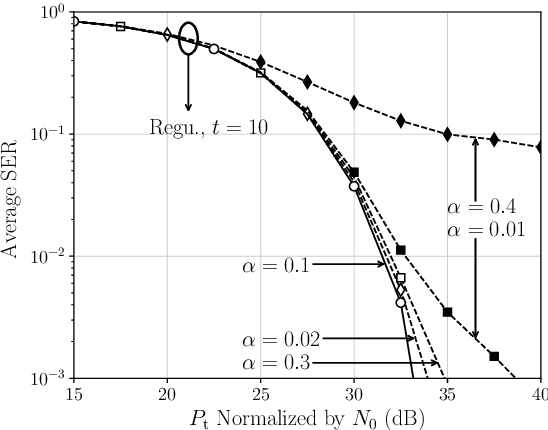
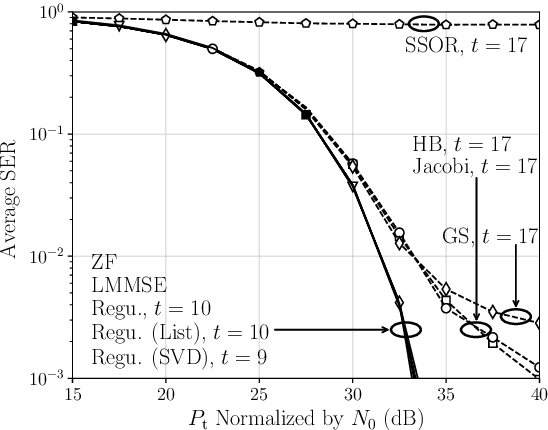
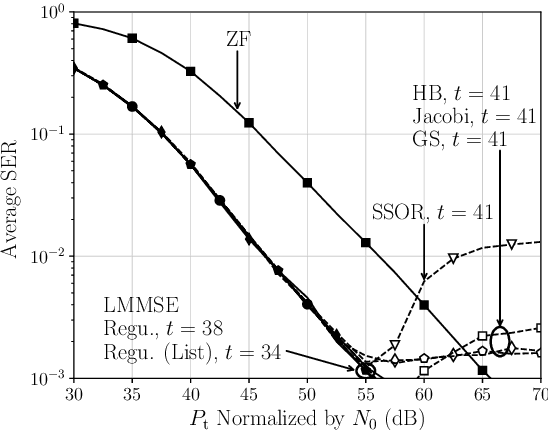
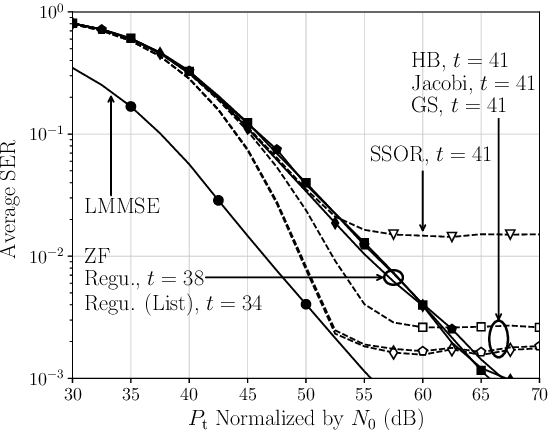
The design of iterative linear precoding is recently challenged by extremely large aperture array (ELAA) systems, where conventional preconditioning techniques could hardly improve the channel condition. In this paper, it is proposed to regularize the extreme singular values to improve the channel condition by deducting a rank-one matrix from the Wishart matrix of the channel. Our analysis proves the feasibility to reduce the largest singular value or to increase multiple small singular values with a rank-one matrix when the singular value decomposition of the channel is available. Knowing the feasibility, we propose a low-complexity approach where an approximation of the regularization matrix can be obtained based on the statistical property of the channel. It is demonstrated, through simulation results, that the proposed low-complexity approach significantly outperforms current preconditioning techniques in terms of reduced iteration number for more than $10\%$ in both ELAA systems as well as symmetric multi-antenna (i.e., MIMO) systems when the channel is i.i.d. Rayleigh fading.
Constellation-Oriented Perturbation for Scalable-Complexity MIMO Nonlinear Precoding
Aug 04, 2022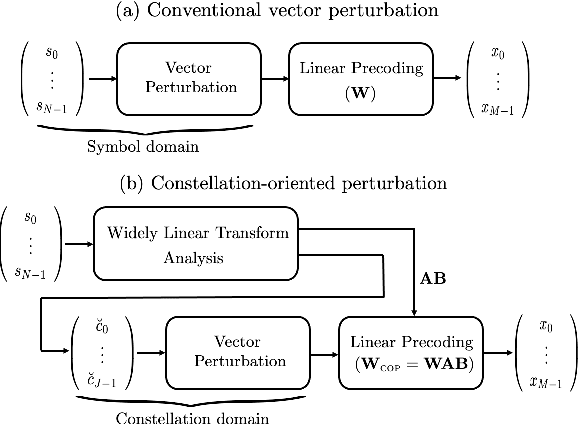
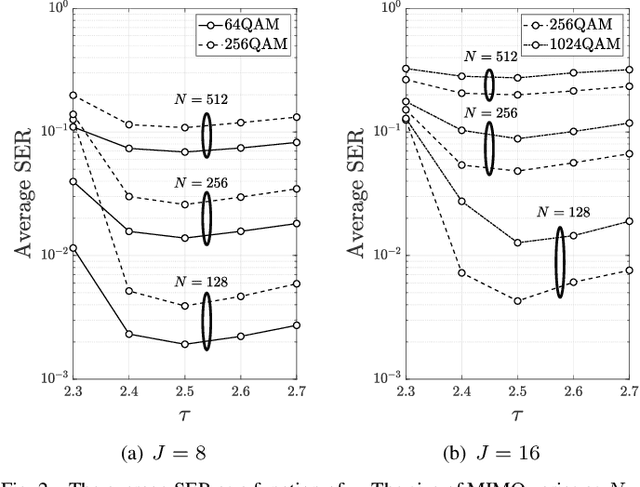
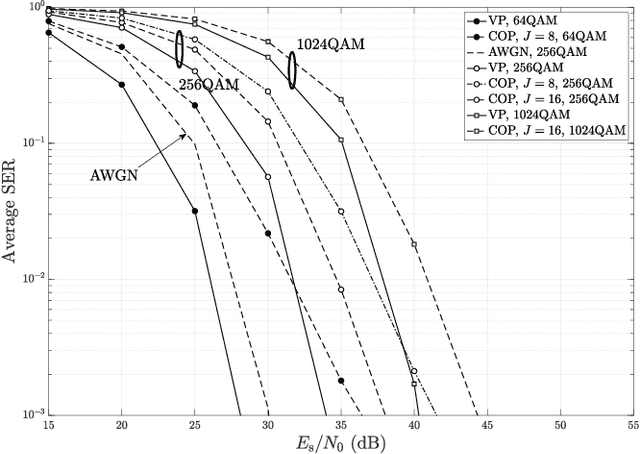
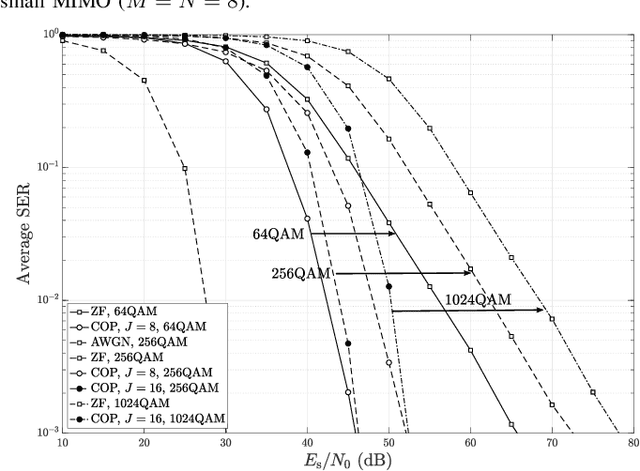
In this paper, a novel nonlinear precoding (NLP) technique, namely constellation-oriented perturbation (COP), is proposed to tackle the scalability problem inherent in conventional NLP techniques. The basic concept of COP is to apply vector perturbation (VP) in the constellation domain instead of symbol domain; as often used in conventional techniques. By this means, the computational complexity of COP is made independent to the size of multi-antenna (i.e., MIMO) networks. Instead, it is related to the size of symbol constellation. Through widely linear transform, it is shown that COP has its complexity flexibly scalable in the constellation domain to achieve a good complexity-performance tradeoff. Our computer simulations show that COP can offer very comparable performance with the optimum VP in small MIMO systems. Moreover, it significantly outperforms current sub-optimum VP approaches (such as degree-2 VP) in large MIMO whilst maintaining much lower computational complexity.