 Add to Chrome
 Add to Firefox
 Add to Edge
Progression Cognition Reinforcement Learning with Prioritized Experience for Multi-Vehicle Pursuit
Jun 08, 2023
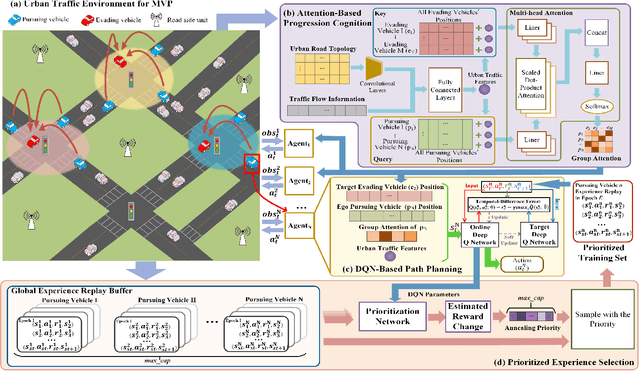
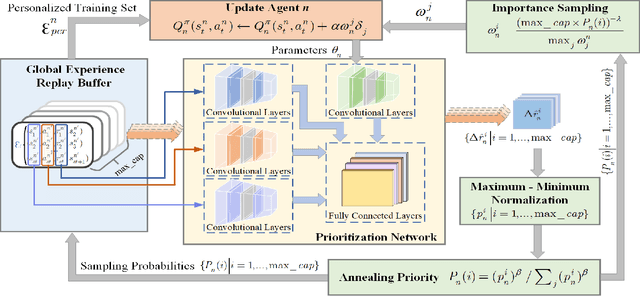
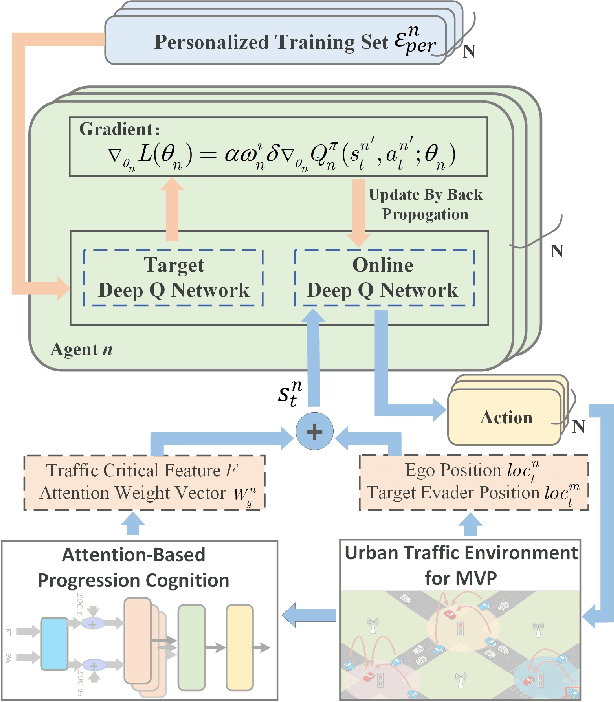
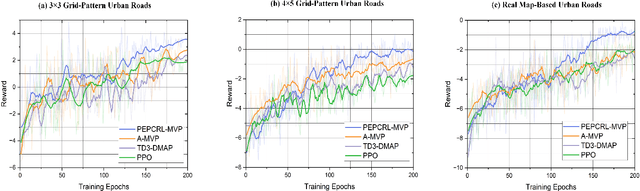
Multi-vehicle pursuit (MVP) such as autonomous police vehicles pursuing suspects is important but very challenging due to its mission and safety critical nature. While multi-agent reinforcement learning (MARL) algorithms have been proposed for MVP problem in structured grid-pattern roads, the existing algorithms use randomly training samples in centralized learning, which leads to homogeneous agents showing low collaboration performance. For the more challenging problem of pursuing multiple evading vehicles, these algorithms typically select a fixed target evading vehicle for pursuing vehicles without considering dynamic traffic situation, which significantly reduces pursuing success rate. To address the above problems, this paper proposes a Progression Cognition Reinforcement Learning with Prioritized Experience for MVP (PEPCRL-MVP) in urban multi-intersection dynamic traffic scenes. PEPCRL-MVP uses a prioritization network to assess the transitions in the global experience replay buffer according to the parameters of each MARL agent. With the personalized and prioritized experience set selected via the prioritization network, diversity is introduced to the learning process of MARL, which can improve collaboration and task related performance. Furthermore, PEPCRL-MVP employs an attention module to extract critical features from complex urban traffic environments. These features are used to develop progression cognition method to adaptively group pursuing vehicles. Each group efficiently target one evading vehicle in dynamic driving environments. Extensive experiments conducted with a simulator over unstructured roads of an urban area show that PEPCRL-MVP is superior to other state-of-the-art methods. Specifically, PEPCRL-MVP improves pursuing efficiency by 3.95% over TD3-DMAP and its success rate is 34.78% higher than that of MADDPG. Codes are open sourced.

COPR: Consistency-Oriented Pre-Ranking for Online Advertising
Jun 06, 2023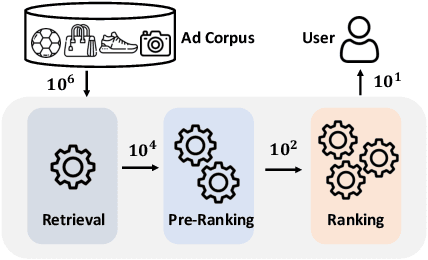

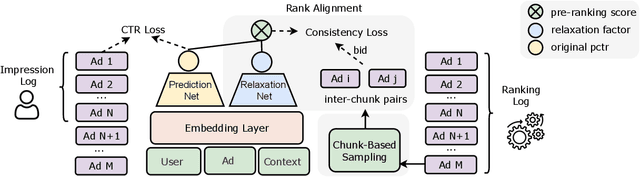

Cascading architecture has been widely adopted in large-scale advertising systems to balance efficiency and effectiveness. In this architecture, the pre-ranking model is expected to be a lightweight approximation of the ranking model, which handles more candidates with strict latency requirements. Due to the gap in model capacity, the pre-ranking and ranking models usually generate inconsistent ranked results, thus hurting the overall system effectiveness. The paradigm of score alignment is proposed to regularize their raw scores to be consistent. However, it suffers from inevitable alignment errors and error amplification by bids when applied in online advertising. To this end, we introduce a consistency-oriented pre-ranking framework for online advertising, which employs a chunk-based sampling module and a plug-and-play rank alignment module to explicitly optimize consistency of ECPM-ranked results. A $\Delta NDCG$-based weighting mechanism is adopted to better distinguish the importance of inter-chunk samples in optimization. Both online and offline experiments have validated the superiority of our framework. When deployed in Taobao display advertising system, it achieves an improvement of up to +12.3\% CTR and +5.6\% RPM.
Graphy Analysis Using a GPU-based Parallel Algorithm: Quantum Clustering
May 24, 2023The article introduces a new method for applying Quantum Clustering to graph structures. Quantum Clustering (QC) is a novel density-based unsupervised learning method that determines cluster centers by constructing a potential function. In this method, we use the Graph Gradient Descent algorithm to find the centers of clusters. GPU parallelization is utilized for computing potential values. We also conducted experiments on five widely used datasets and evaluated using four indicators. The results show superior performance of the method. Finally, we discuss the influence of $\sigma$ on the experimental results.
A Lightweight Domain Adversarial Neural Network Based on Knowledge Distillation for EEG-based Cross-subject Emotion Recognition
May 12, 2023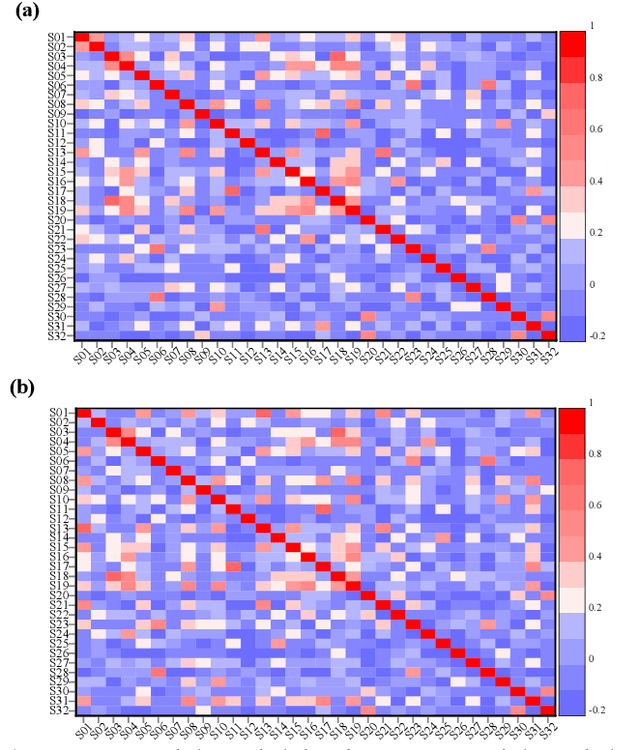
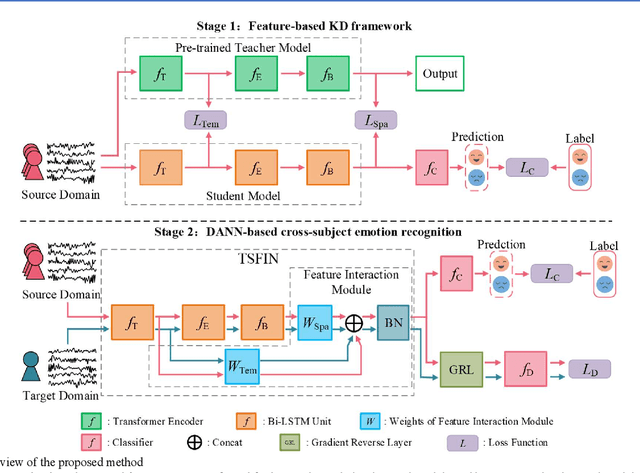
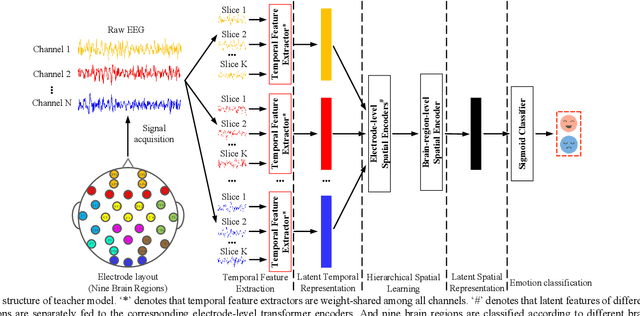
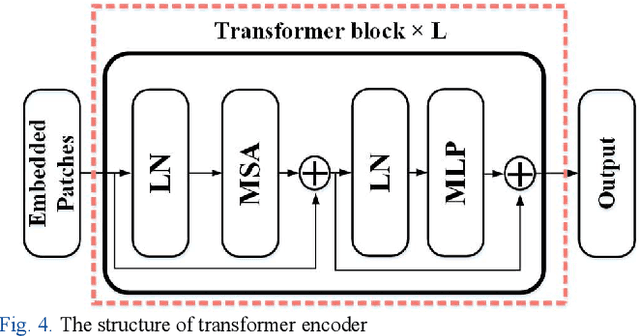
Individual differences of Electroencephalogram (EEG) could cause the domain shift which would significantly degrade the performance of cross-subject strategy. The domain adversarial neural networks (DANN), where the classification loss and domain loss jointly update the parameters of feature extractor, are adopted to deal with the domain shift. However, limited EEG data quantity and strong individual difference are challenges for the DANN with cumbersome feature extractor. In this work, we propose knowledge distillation (KD) based lightweight DANN to enhance cross-subject EEG-based emotion recognition. Specifically, the teacher model with strong context learning ability is utilized to learn complex temporal dynamics and spatial correlations of EEG, and robust lightweight student model is guided by the teacher model to learn more difficult domain-invariant features. In the feature-based KD framework, a transformer-based hierarchical temporalspatial learning model is served as the teacher model. The student model, which is composed of Bi-LSTM units, is a lightweight version of the teacher model. Hence, the student model could be supervised to mimic the robust feature representations of teacher model by leveraging complementary latent temporal features and spatial features. In the DANN-based cross-subject emotion recognition, we combine the obtained student model and a lightweight temporal-spatial feature interaction module as the feature extractor. And the feature aggregation is fed to the emotion classifier and domain classifier for domain-invariant feature learning. To verify the effectiveness of the proposed method, we conduct the subject-independent experiments on the public dataset DEAP with arousal and valence classification. The outstanding performance and t-SNE visualization of latent features verify the advantage and effectiveness of the proposed method.
Blockchained Federated Learning for Internet of Things: A Comprehensive Survey
May 08, 2023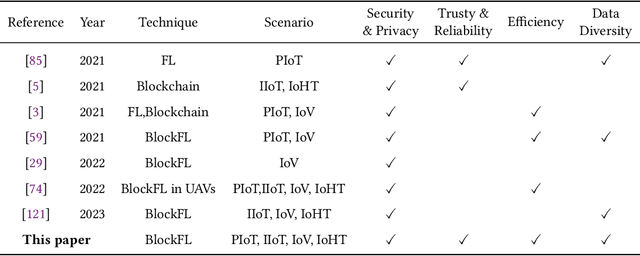
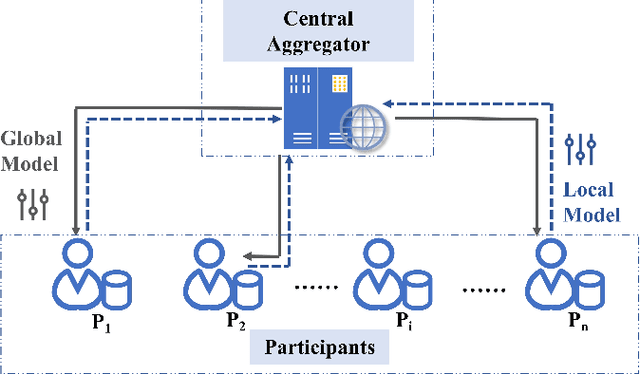
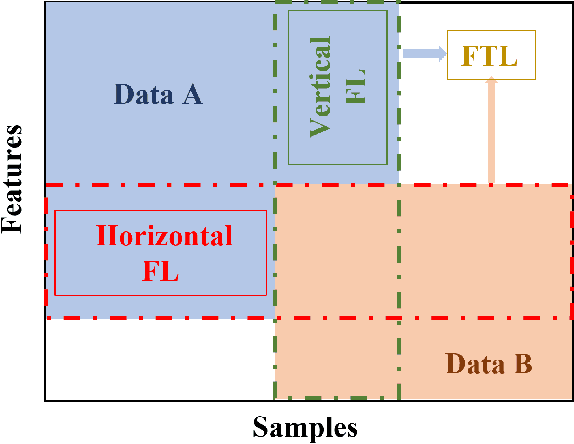

The demand for intelligent industries and smart services based on big data is rising rapidly with the increasing digitization and intelligence of the modern world. This survey comprehensively reviews Blockchained Federated Learning (BlockFL) that joins the benefits of both Blockchain and Federated Learning to provide a secure and efficient solution for the demand. We compare the existing BlockFL models in four Internet-of-Things (IoT) application scenarios: Personal IoT (PIoT), Industrial IoT (IIoT), Internet of Vehicles (IoV), and Internet of Health Things (IoHT), with a focus on security and privacy, trust and reliability, efficiency, and data heterogeneity. Our analysis shows that the features of decentralization and transparency make BlockFL a secure and effective solution for distributed model training, while the overhead and compatibility still need further study. It also reveals the unique challenges of each domain presents unique challenges, e.g., the requirement of accommodating dynamic environments in IoV and the high demands of identity and permission management in IoHT, in addition to some common challenges identified, such as privacy, resource constraints, and data heterogeneity. Furthermore, we examine the existing technologies that can benefit BlockFL, thereby helping researchers and practitioners to make informed decisions about the selection and development of BlockFL for various IoT application scenarios.
PGrad: Learning Principal Gradients For Domain Generalization
May 02, 2023Machine learning models fail to perform when facing out-of-distribution (OOD) domains, a challenging task known as domain generalization (DG). In this work, we develop a novel DG training strategy, we call PGrad, to learn a robust gradient direction, improving models' generalization ability on unseen domains. The proposed gradient aggregates the principal directions of a sampled roll-out optimization trajectory that measures the training dynamics across all training domains. PGrad's gradient design forces the DG training to ignore domain-dependent noise signals and updates all training domains with a robust direction covering main components of parameter dynamics. We further improve PGrad via bijection-based computational refinement and directional plus length-based calibrations. Our theoretical proof connects PGrad to the spectral analysis of Hessian in training neural networks. Experiments on DomainBed and WILDS benchmarks demonstrate that our approach effectively enables robust DG optimization and leads to smoothly decreased loss curves. Empirically, PGrad achieves competitive results across seven datasets, demonstrating its efficacy across both synthetic and real-world distributional shifts. Code is available at https://github.com/QData/PGrad.
Transformer with Selective Shuffled Position Embedding using ROI-Exchange Strategy for Early Detection of Knee Osteoarthritis
Apr 17, 2023Knee OsteoArthritis (KOA) is a prevalent musculoskeletal disorder that causes decreased mobility in seniors. The lack of sufficient data in the medical field is always a challenge for training a learning model due to the high cost of labelling. At present, deep neural network training strongly depends on data augmentation to improve the model's generalization capability and avoid over-fitting. However, existing data augmentation operations, such as rotation, gamma correction, etc., are designed based on the data itself, which does not substantially increase the data diversity. In this paper, we proposed a novel approach based on the Vision Transformer (ViT) model with Selective Shuffled Position Embedding (SSPE) and a ROI-exchange strategy to obtain different input sequences as a method of data augmentation for early detection of KOA (KL-0 vs KL-2). More specifically, we fixed and shuffled the position embedding of ROI and non-ROI patches, respectively. Then, for the input image, we randomly selected other images from the training set to exchange their ROI patches and thus obtained different input sequences. Finally, a hybrid loss function was derived using different loss functions with optimized weights. Experimental results show that our proposed approach is a valid method of data augmentation as it can significantly improve the model's classification performance.
RegionPLC: Regional Point-Language Contrastive Learning for Open-World 3D Scene Understanding
Apr 03, 2023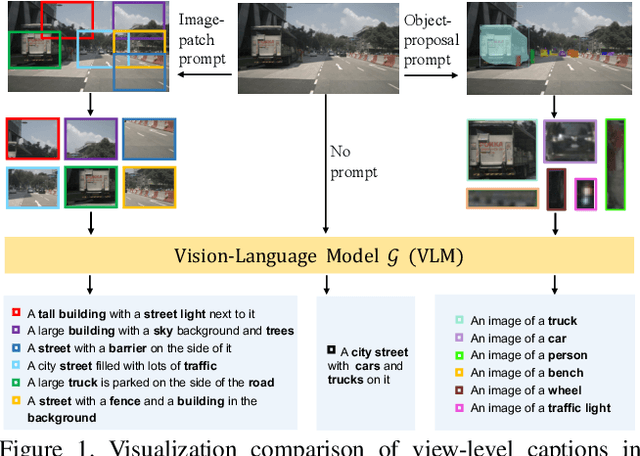
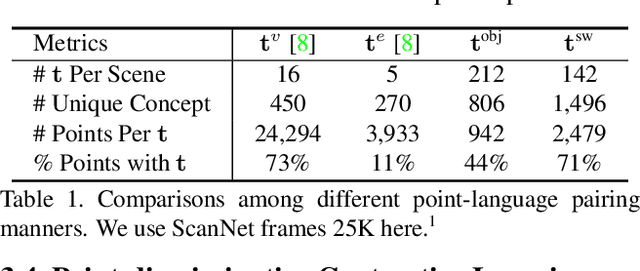
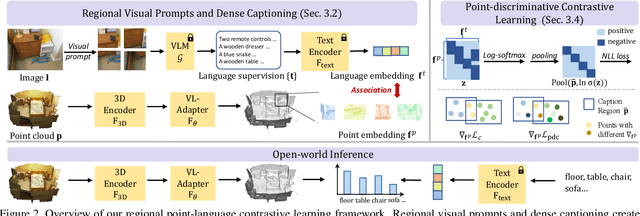
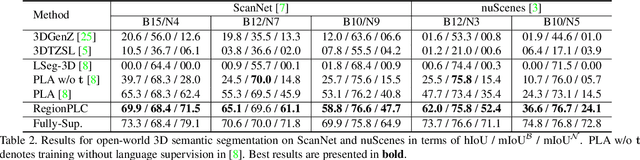
Existing 3D scene understanding tasks have achieved high performance on close-set benchmarks but fail to handle novel categories in real-world applications. To this end, we propose a Regional Point-Language Contrastive learning framework, namely RegionPLC, for open-world 3D scene understanding, which equips models trained on closed-set datasets with open-vocabulary recognition capabilities. We propose dense visual prompts to elicit region-level visual-language knowledge from 2D foundation models via captioning, which further allows us to build dense regional point-language associations. Then, we design a point-discriminative contrastive learning objective to enable point-independent learning from captions for dense scene understanding. We conduct extensive experiments on ScanNet, ScanNet200, and nuScenes datasets. Our RegionPLC significantly outperforms previous base-annotated 3D open-world scene understanding approaches by an average of 11.6\% and 6.6\% for semantic and instance segmentation, respectively. It also shows promising open-world results in absence of any human annotation with low training and inference costs. Code will be released.
A Confident Labelling Strategy Based on Deep Learning for Improving Early Detection of Knee OsteoArthritis
Mar 23, 2023Knee OsteoArthritis (KOA) is a prevalent musculoskeletal disorder that causes decreased mobility in seniors. The diagnosis provided by physicians is subjective, however, as it relies on personal experience and the semi-quantitative Kellgren-Lawrence (KL) scoring system. KOA has been successfully diagnosed by Computer-Aided Diagnostic (CAD) systems that use deep learning techniques like Convolutional Neural Networks (CNN). In this paper, we propose a novel Siamese-based network, and we introduce a new hybrid loss strategy for the early detection of KOA. The model extends the classical Siamese network by integrating a collection of Global Average Pooling (GAP) layers for feature extraction at each level. Then, to improve the classification performance, a novel training strategy that partitions each training batch into low-, medium- and high-confidence subsets, and a specific hybrid loss function are used for each new label attributed to each sample. The final loss function is then derived by combining the latter loss functions with optimized weights. Our test results demonstrate that our proposed approach significantly improves the detection performance.
VIMI: Vehicle-Infrastructure Multi-view Intermediate Fusion for Camera-based 3D Object Detection
Mar 20, 2023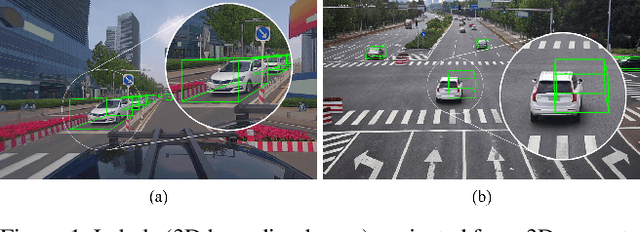
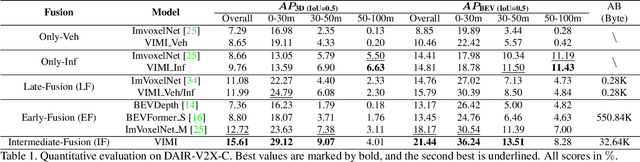
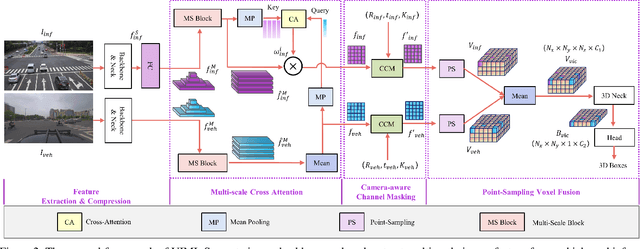
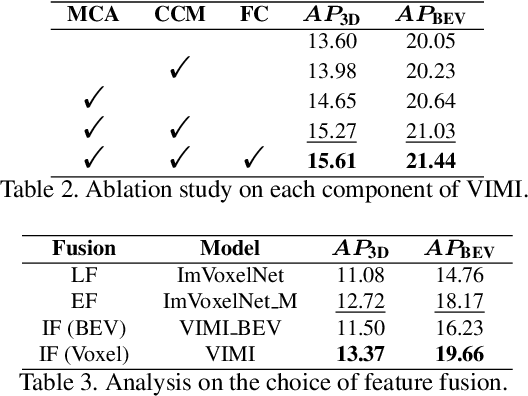
In autonomous driving, Vehicle-Infrastructure Cooperative 3D Object Detection (VIC3D) makes use of multi-view cameras from both vehicles and traffic infrastructure, providing a global vantage point with rich semantic context of road conditions beyond a single vehicle viewpoint. Two major challenges prevail in VIC3D: 1) inherent calibration noise when fusing multi-view images, caused by time asynchrony across cameras; 2) information loss when projecting 2D features into 3D space. To address these issues, We propose a novel 3D object detection framework, Vehicles-Infrastructure Multi-view Intermediate fusion (VIMI). First, to fully exploit the holistic perspectives from both vehicles and infrastructure, we propose a Multi-scale Cross Attention (MCA) module that fuses infrastructure and vehicle features on selective multi-scales to correct the calibration noise introduced by camera asynchrony. Then, we design a Camera-aware Channel Masking (CCM) module that uses camera parameters as priors to augment the fused features. We further introduce a Feature Compression (FC) module with channel and spatial compression blocks to reduce the size of transmitted features for enhanced efficiency. Experiments show that VIMI achieves 15.61% overall AP_3D and 21.44% AP_BEV on the new VIC3D dataset, DAIR-V2X-C, significantly outperforming state-of-the-art early fusion and late fusion methods with comparable transmission cost.