 Add to Chrome
 Add to Firefox
 Add to Edge
SoK: Agentic Skills -- Beyond Tool Use in LLM Agents
Feb 24, 2026
Agentic systems increasingly rely on reusable procedural capabilities, \textit{a.k.a., agentic skills}, to execute long-horizon workflows reliably. These capabilities are callable modules that package procedural knowledge with explicit applicability conditions, execution policies, termination criteria, and reusable interfaces. Unlike one-off plans or atomic tool calls, skills operate (and often do well) across tasks. This paper maps the skill layer across the full lifecycle (discovery, practice, distillation, storage, composition, evaluation, and update) and introduces two complementary taxonomies. The first is a system-level set of \textbf{seven design patterns} capturing how skills are packaged and executed in practice, from metadata-driven progressive disclosure and executable code skills to self-evolving libraries and marketplace distribution. The second is an orthogonal \textbf{representation $\times$ scope} taxonomy describing what skills \emph{are} (natural language, code, policy, hybrid) and what environments they operate over (web, OS, software engineering, robotics). We analyze the security and governance implications of skill-based agents, covering supply-chain risks, prompt injection via skill payloads, and trust-tiered execution, grounded by a case study of the ClawHavoc campaign in which nearly 1{,}200 malicious skills infiltrated a major agent marketplace, exfiltrating API keys, cryptocurrency wallets, and browser credentials at scale. We further survey deterministic evaluation approaches, anchored by recent benchmark evidence that curated skills can substantially improve agent success rates while self-generated skills may degrade them. We conclude with open challenges toward robust, verifiable, and certifiable skills for real-world autonomous agents.

PoLO: Proof-of-Learning and Proof-of-Ownership at Once with Chained Watermarking
May 18, 2025Machine learning models are increasingly shared and outsourced, raising requirements of verifying training effort (Proof-of-Learning, PoL) to ensure claimed performance and establishing ownership (Proof-of-Ownership, PoO) for transactions. When models are trained by untrusted parties, PoL and PoO must be enforced together to enable protection, attribution, and compensation. However, existing studies typically address them separately, which not only weakens protection against forgery and privacy breaches but also leads to high verification overhead. We propose PoLO, a unified framework that simultaneously achieves PoL and PoO using chained watermarks. PoLO splits the training process into fine-grained training shards and embeds a dedicated watermark in each shard. Each watermark is generated using the hash of the preceding shard, certifying the training process of the preceding shard. The chained structure makes it computationally difficult to forge any individual part of the whole training process. The complete set of watermarks serves as the PoL, while the final watermark provides the PoO. PoLO offers more efficient and privacy-preserving verification compared to the vanilla PoL solutions that rely on gradient-based trajectory tracing and inadvertently expose training data during verification, while maintaining the same level of ownership assurance of watermark-based PoO schemes. Our evaluation shows that PoLO achieves 99% watermark detection accuracy for ownership verification, while preserving data privacy and cutting verification costs to just 1.5-10% of traditional methods. Forging PoLO demands 1.1-4x more resources than honest proof generation, with the original proof retaining over 90% detection accuracy even after attacks.
ByCAN: Reverse Engineering Controller Area Network (CAN) Messages from Bit to Byte Level
Aug 17, 2024
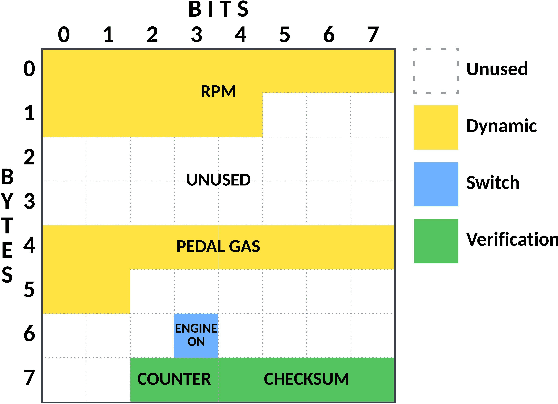

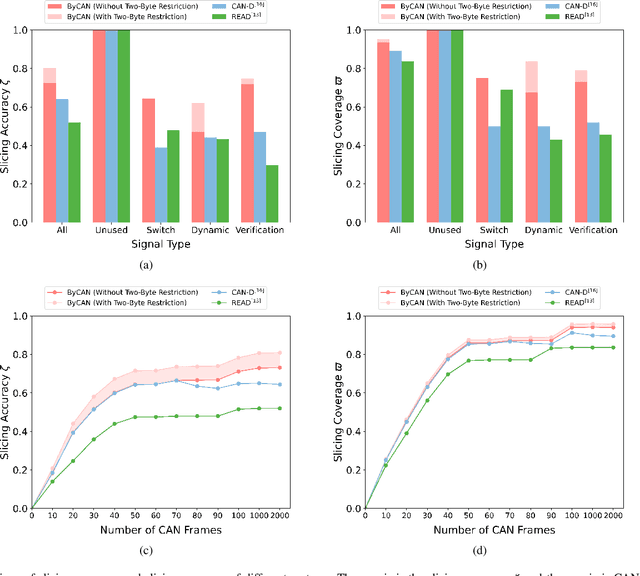
As the primary standard protocol for modern cars, the Controller Area Network (CAN) is a critical research target for automotive cybersecurity threats and autonomous applications. As the decoding specification of CAN is a proprietary black-box maintained by Original Equipment Manufacturers (OEMs), conducting related research and industry developments can be challenging without a comprehensive understanding of the meaning of CAN messages. In this paper, we propose a fully automated reverse-engineering system, named ByCAN, to reverse engineer CAN messages. ByCAN outperforms existing research by introducing byte-level clusters and integrating multiple features at both byte and bit levels. ByCAN employs the clustering and template matching algorithms to automatically decode the specifications of CAN frames without the need for prior knowledge. Experimental results demonstrate that ByCAN achieves high accuracy in slicing and labeling performance, i.e., the identification of CAN signal boundaries and labels. In the experiments, ByCAN achieves slicing accuracy of 80.21%, slicing coverage of 95.21%, and labeling accuracy of 68.72% for general labels when analyzing the real-world CAN frames.
A Secure Aggregation for Federated Learning on Long-Tailed Data
Jul 17, 2023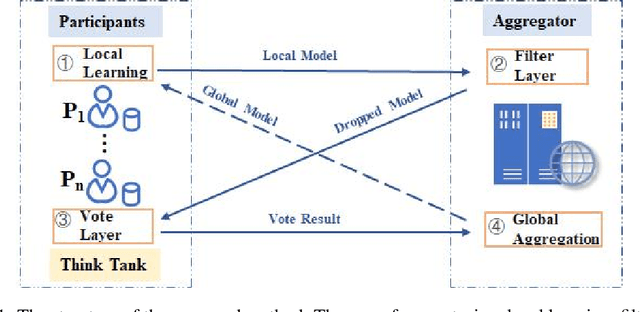
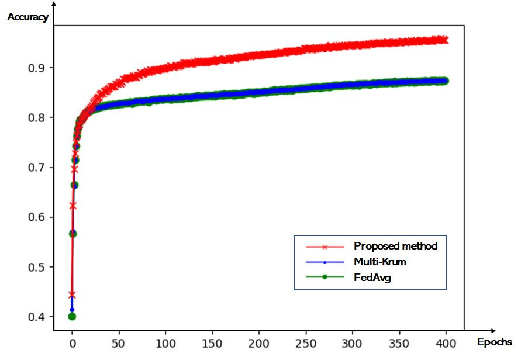

As a distributed learning, Federated Learning (FL) faces two challenges: the unbalanced distribution of training data among participants, and the model attack by Byzantine nodes. In this paper, we consider the long-tailed distribution with the presence of Byzantine nodes in the FL scenario. A novel two-layer aggregation method is proposed for the rejection of malicious models and the advisable selection of valuable models containing tail class data information. We introduce the concept of think tank to leverage the wisdom of all participants. Preliminary experiments validate that the think tank can make effective model selections for global aggregation.
Blockchained Federated Learning for Internet of Things: A Comprehensive Survey
May 08, 2023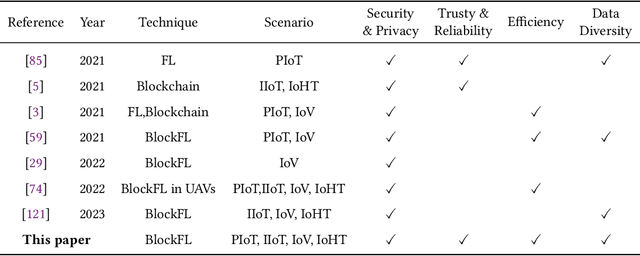
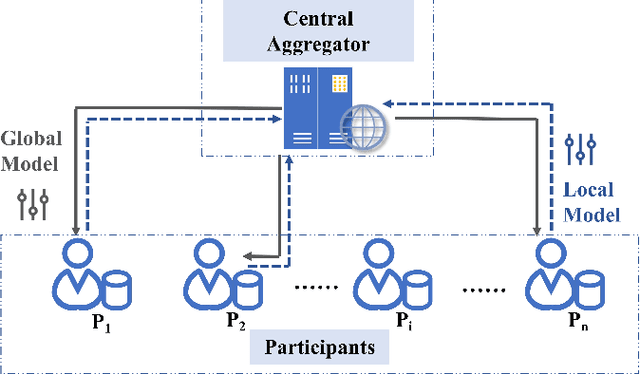

The demand for intelligent industries and smart services based on big data is rising rapidly with the increasing digitization and intelligence of the modern world. This survey comprehensively reviews Blockchained Federated Learning (BlockFL) that joins the benefits of both Blockchain and Federated Learning to provide a secure and efficient solution for the demand. We compare the existing BlockFL models in four Internet-of-Things (IoT) application scenarios: Personal IoT (PIoT), Industrial IoT (IIoT), Internet of Vehicles (IoV), and Internet of Health Things (IoHT), with a focus on security and privacy, trust and reliability, efficiency, and data heterogeneity. Our analysis shows that the features of decentralization and transparency make BlockFL a secure and effective solution for distributed model training, while the overhead and compatibility still need further study. It also reveals the unique challenges of each domain presents unique challenges, e.g., the requirement of accommodating dynamic environments in IoV and the high demands of identity and permission management in IoHT, in addition to some common challenges identified, such as privacy, resource constraints, and data heterogeneity. Furthermore, we examine the existing technologies that can benefit BlockFL, thereby helping researchers and practitioners to make informed decisions about the selection and development of BlockFL for various IoT application scenarios.