 Add to Chrome
 Add to Firefox
 Add to Edge
Reference-based Painterly Inpainting via Diffusion: Crossing the Wild Reference Domain Gap
Jul 20, 2023
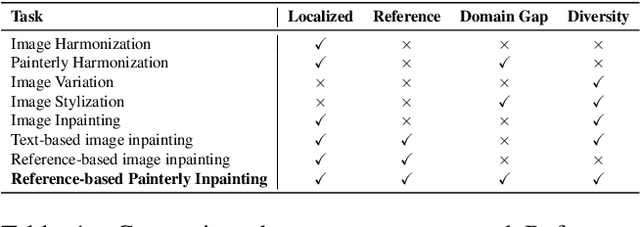
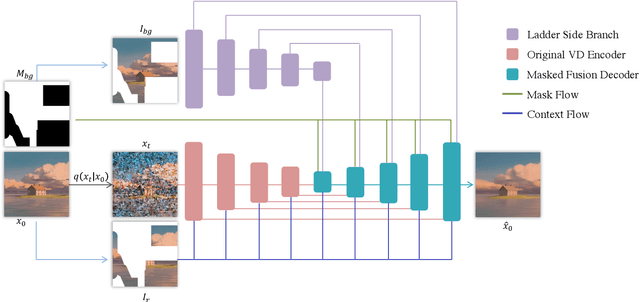
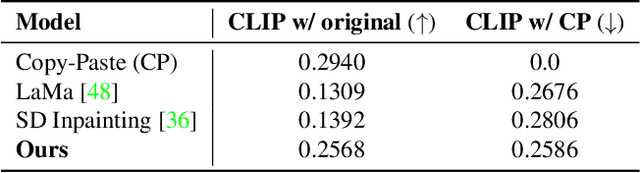
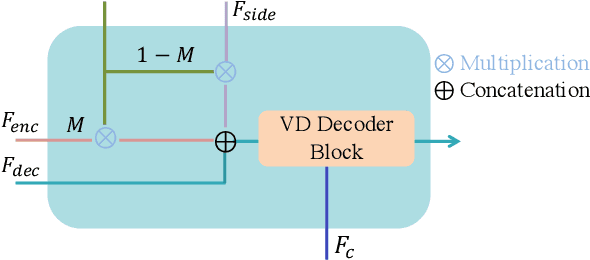
Have you ever imagined how it would look if we placed new objects into paintings? For example, what would it look like if we placed a basketball into Claude Monet's ``Water Lilies, Evening Effect''? We propose Reference-based Painterly Inpainting, a novel task that crosses the wild reference domain gap and implants novel objects into artworks. Although previous works have examined reference-based inpainting, they are not designed for large domain discrepancies between the target and the reference, such as inpainting an artistic image using a photorealistic reference. This paper proposes a novel diffusion framework, dubbed RefPaint, to ``inpaint more wildly'' by taking such references with large domain gaps. Built with an image-conditioned diffusion model, we introduce a ladder-side branch and a masked fusion mechanism to work with the inpainting mask. By decomposing the CLIP image embeddings at inference time, one can manipulate the strength of semantic and style information with ease. Experiments demonstrate that our proposed RefPaint framework produces significantly better results than existing methods. Our method enables creative painterly image inpainting with reference objects that would otherwise be difficult to achieve. Project page: https://vita-group.github.io/RefPaint/

Polynomial Width is Sufficient for Set Representation with High-dimensional Features
Jul 19, 2023Set representation has become ubiquitous in deep learning for modeling the inductive bias of neural networks that are insensitive to the input order. DeepSets is the most widely used neural network architecture for set representation. It involves embedding each set element into a latent space with dimension $L$, followed by a sum pooling to obtain a whole-set embedding, and finally mapping the whole-set embedding to the output. In this work, we investigate the impact of the dimension $L$ on the expressive power of DeepSets. Previous analyses either oversimplified high-dimensional features to be one-dimensional features or were limited to analytic activations, thereby diverging from practical use or resulting in $L$ that grows exponentially with the set size $N$ and feature dimension $D$. To investigate the minimal value of $L$ that achieves sufficient expressive power, we present two set-element embedding layers: (a) linear + power activation (LP) and (b) linear + exponential activations (LE). We demonstrate that $L$ being poly$(N, D)$ is sufficient for set representation using both embedding layers. We also provide a lower bound of $L$ for the LP embedding layer. Furthermore, we extend our results to permutation-equivariant set functions and the complex field.
H$_2$O: Heavy-Hitter Oracle for Efficient Generative Inference of Large Language Models
Jul 19, 2023Large Language Models (LLMs), despite their recent impressive accomplishments, are notably cost-prohibitive to deploy, particularly for applications involving long-content generation, such as dialogue systems and story writing. Often, a large amount of transient state information, referred to as the KV cache, is stored in GPU memory in addition to model parameters, scaling linearly with the sequence length and batch size. In this paper, we introduce a novel approach for implementing the KV cache which significantly reduces its memory footprint. Our approach is based on the noteworthy observation that a small portion of tokens contributes most of the value when computing attention scores. We call these tokens Heavy Hitters (H$_2$). Through a comprehensive investigation, we find that (i) the emergence of H$_2$ is natural and strongly correlates with the frequent co-occurrence of tokens in the text, and (ii) removing them results in significant performance degradation. Based on these insights, we propose Heavy Hitter Oracle (H$_2$O), a KV cache eviction policy that dynamically retains a balance of recent and H$_2$ tokens. We formulate the KV cache eviction as a dynamic submodular problem and prove (under mild assumptions) a theoretical guarantee for our novel eviction algorithm which could help guide future work. We validate the accuracy of our algorithm with OPT, LLaMA, and GPT-NeoX across a wide range of tasks. Our implementation of H$_2$O with 20% heavy hitters improves the throughput over three leading inference systems DeepSpeed Zero-Inference, Hugging Face Accelerate, and FlexGen by up to 29$\times$, 29$\times$, and 3$\times$ on OPT-6.7B and OPT-30B. With the same batch size, H2O can reduce the latency by up to 1.9$\times$. The code is available at https://github.com/FMInference/H2O.
Zero-Shot Neural Architecture Search: Challenges, Solutions, and Opportunities
Jul 05, 2023Recently, zero-shot (or training-free) Neural Architecture Search (NAS) approaches have been proposed to liberate the NAS from training requirements. The key idea behind zero-shot NAS approaches is to design proxies that predict the accuracies of the given networks without training network parameters. The proxies proposed so far are usually inspired by recent progress in theoretical deep learning and have shown great potential on several NAS benchmark datasets. This paper aims to comprehensively review and compare the state-of-the-art (SOTA) zero-shot NAS approaches, with an emphasis on their hardware awareness. To this end, we first review the mainstream zero-shot proxies and discuss their theoretical underpinnings. We then compare these zero-shot proxies through large-scale experiments and demonstrate their effectiveness in both hardware-aware and hardware-oblivious NAS scenarios. Finally, we point out several promising ideas to design better proxies. Our source code and the related paper list are available on https://github.com/SLDGroup/survey-zero-shot-nas.
FarSight: A Physics-Driven Whole-Body Biometric System at Large Distance and Altitude
Jun 29, 2023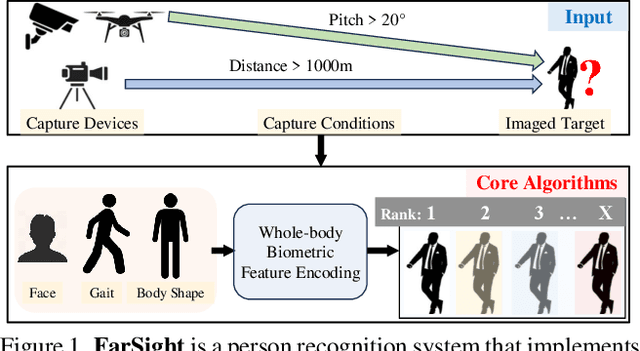
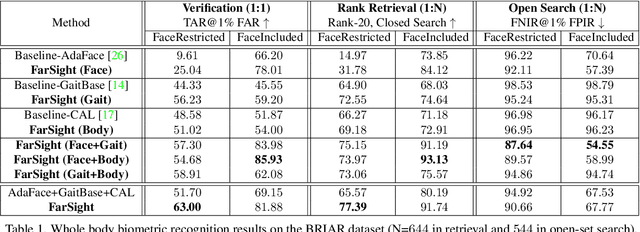
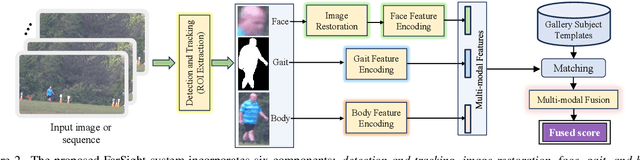
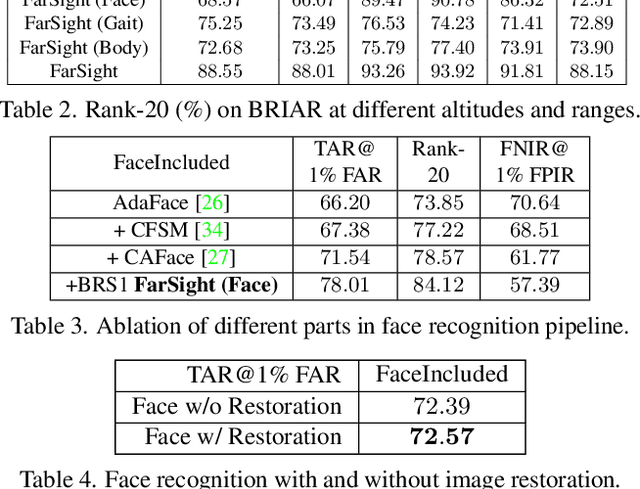
Whole-body biometric recognition is an important area of research due to its vast applications in law enforcement, border security, and surveillance. This paper presents the end-to-end design, development and evaluation of FarSight, an innovative software system designed for whole-body (fusion of face, gait and body shape) biometric recognition. FarSight accepts videos from elevated platforms and drones as input and outputs a candidate list of identities from a gallery. The system is designed to address several challenges, including (i) low-quality imagery, (ii) large yaw and pitch angles, (iii) robust feature extraction to accommodate large intra-person variabilities and large inter-person similarities, and (iv) the large domain gap between training and test sets. FarSight combines the physics of imaging and deep learning models to enhance image restoration and biometric feature encoding. We test FarSight's effectiveness using the newly acquired IARPA Biometric Recognition and Identification at Altitude and Range (BRIAR) dataset. Notably, FarSight demonstrated a substantial performance increase on the BRIAR dataset, with gains of +11.82% Rank-20 identification and +11.3% TAR@1% FAR.
Graph Ladling: Shockingly Simple Parallel GNN Training without Intermediate Communication
Jun 18, 2023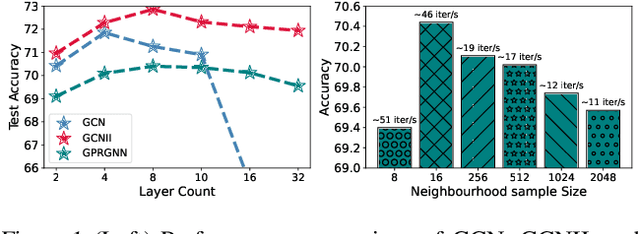

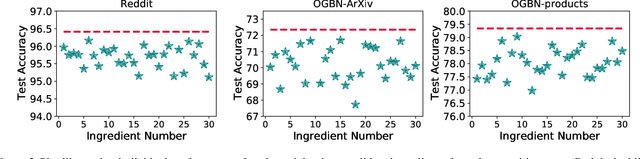
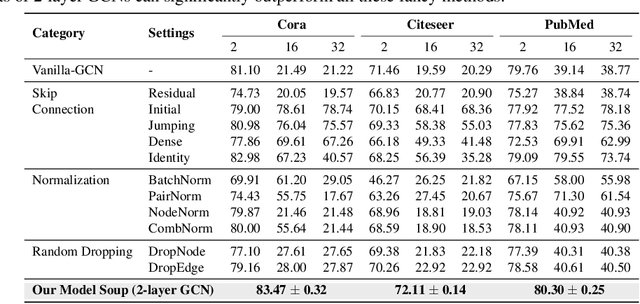
Graphs are omnipresent and GNNs are a powerful family of neural networks for learning over graphs. Despite their popularity, scaling GNNs either by deepening or widening suffers from prevalent issues of unhealthy gradients, over-smoothening, information squashing, which often lead to sub-standard performance. In this work, we are interested in exploring a principled way to scale GNNs capacity without deepening or widening, which can improve its performance across multiple small and large graphs. Motivated by the recent intriguing phenomenon of model soups, which suggest that fine-tuned weights of multiple large-language pre-trained models can be merged to a better minima, we argue to exploit the fundamentals of model soups to mitigate the aforementioned issues of memory bottleneck and trainability during GNNs scaling. More specifically, we propose not to deepen or widen current GNNs, but instead present a data-centric perspective of model soups tailored for GNNs, i.e., to build powerful GNNs by dividing giant graph data to build independently and parallelly trained multiple comparatively weaker GNNs without any intermediate communication, and combining their strength using a greedy interpolation soup procedure to achieve state-of-the-art performance. Moreover, we provide a wide variety of model soup preparation techniques by leveraging state-of-the-art graph sampling and graph partitioning approaches that can handle large graph data structures. Our extensive experiments across many real-world small and large graphs, illustrate the effectiveness of our approach and point towards a promising orthogonal direction for GNN scaling. Codes are available at: \url{https://github.com/VITA-Group/graph_ladling}.
Instant Soup: Cheap Pruning Ensembles in A Single Pass Can Draw Lottery Tickets from Large Models
Jun 18, 2023Large pre-trained transformers have been receiving explosive attention in the past few years, due to their wide adaptability for numerous downstream applications via fine-tuning, but their exponentially increasing parameter counts are becoming a primary hurdle to even just fine-tune them without industry-standard hardware. Recently, Lottery Ticket Hypothesis (LTH) and its variants, have been exploited to prune these large pre-trained models generating subnetworks that can achieve similar performance as their dense counterparts, but LTH pragmatism is enormously inhibited by repetitive full training and pruning routine of iterative magnitude pruning (IMP) which worsens with increasing model size. Motivated by the recent observations of model soups, which suggest that fine-tuned weights of multiple models can be merged to a better minima, we propose Instant Soup Pruning (ISP) to generate lottery ticket quality subnetworks, using a fraction of the original IMP cost by replacing the expensive intermediate pruning stages of IMP with computationally efficient weak mask generation and aggregation routine. More specifically, during the mask generation stage, ISP takes a small handful of iterations using varying training protocols and data subsets to generate many weak and noisy subnetworks, and superpose them to average out the noise creating a high-quality denoised subnetwork. Our extensive experiments and ablation on two popular large-scale pre-trained models: CLIP (unexplored in pruning till date) and BERT across multiple benchmark vision and language datasets validate the effectiveness of ISP compared to several state-of-the-art pruning methods. Codes are available at: \url{https://github.com/VITA-Group/instant_soup}
Learning to Estimate 6DoF Pose from Limited Data: A Few-Shot, Generalizable Approach using RGB Images
Jun 13, 2023The accurate estimation of six degrees-of-freedom (6DoF) object poses is essential for many applications in robotics and augmented reality. However, existing methods for 6DoF pose estimation often depend on CAD templates or dense support views, restricting their usefulness in realworld situations. In this study, we present a new cascade framework named Cas6D for few-shot 6DoF pose estimation that is generalizable and uses only RGB images. To address the false positives of target object detection in the extreme few-shot setting, our framework utilizes a selfsupervised pre-trained ViT to learn robust feature representations. Then, we initialize the nearest top-K pose candidates based on similarity score and refine the initial poses using feature pyramids to formulate and update the cascade warped feature volume, which encodes context at increasingly finer scales. By discretizing the pose search range using multiple pose bins and progressively narrowing the pose search range in each stage using predictions from the previous stage, Cas6D can overcome the large gap between pose candidates and ground truth poses, which is a common failure mode in sparse-view scenarios. Experimental results on the LINEMOD and GenMOP datasets demonstrate that Cas6D outperforms state-of-the-art methods by 9.2% and 3.8% accuracy (Proj-5) under the 32-shot setting compared to OnePose++ and Gen6D.
The Emergence of Essential Sparsity in Large Pre-trained Models: The Weights that Matter
Jun 06, 2023Large pre-trained transformers are show-stealer in modern-day deep learning, and it becomes crucial to comprehend the parsimonious patterns that exist within them as they grow in scale. With exploding parameter counts, Lottery Ticket Hypothesis (LTH) and its variants, have lost their pragmatism in sparsifying them due to high computation and memory bottleneck of the repetitive train-prune-retrain routine of iterative magnitude pruning (IMP) which worsens with increasing model size. In this paper, we comprehensively study induced sparse patterns across multiple large pre-trained vision and language transformers. We propose the existence of -- essential sparsity defined with a sharp dropping point beyond which the performance declines much faster w.r.t the rise of sparsity level, when we directly remove weights with the smallest magnitudes in one-shot. In the sparsity-performance curve We also present an intriguing emerging phenomenon of abrupt sparsification during the pre-training of BERT, i.e., BERT suddenly becomes heavily sparse in pre-training after certain iterations. Moreover, our observations also indicate a counter-intuitive finding that BERT trained with a larger amount of pre-training data tends to have a better ability to condense knowledge in comparatively relatively fewer parameters. Lastly, we investigate the effect of the pre-training loss on essential sparsity and discover that self-supervised learning (SSL) objectives trigger stronger emergent sparsification properties than supervised learning (SL). Our codes are available at \url{https://github.com/VITA-Group/essential\_sparsity}.
Edge-MoE: Memory-Efficient Multi-Task Vision Transformer Architecture with Task-level Sparsity via Mixture-of-Experts
May 30, 2023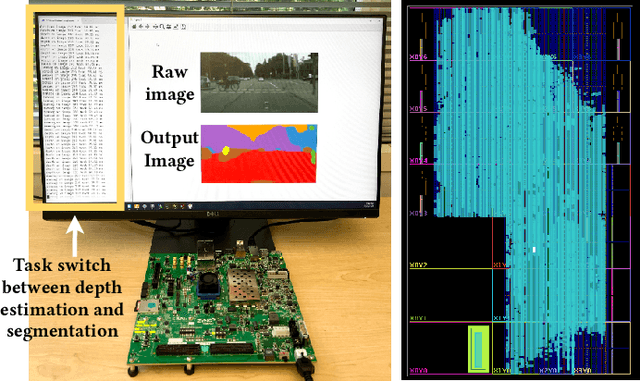
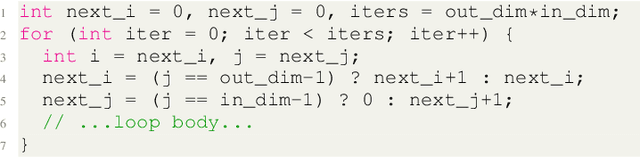
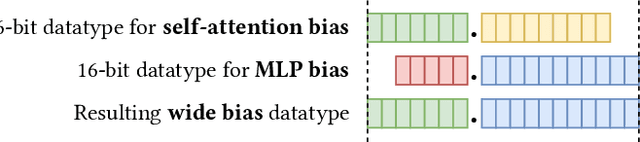
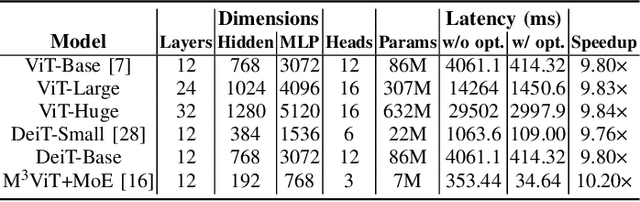
Computer vision researchers are embracing two promising paradigms: Vision Transformers (ViTs) and Multi-task Learning (MTL), which both show great performance but are computation-intensive, given the quadratic complexity of self-attention in ViT and the need to activate an entire large MTL model for one task. M$^3$ViT is the latest multi-task ViT model that introduces mixture-of-experts (MoE), where only a small portion of subnetworks ("experts") are sparsely and dynamically activated based on the current task. M$^3$ViT achieves better accuracy and over 80% computation reduction but leaves challenges for efficient deployment on FPGA. Our work, dubbed Edge-MoE, solves the challenges to introduce the first end-to-end FPGA accelerator for multi-task ViT with a collection of architectural innovations, including (1) a novel reordering mechanism for self-attention, which requires only constant bandwidth regardless of the target parallelism; (2) a fast single-pass softmax approximation; (3) an accurate and low-cost GELU approximation; (4) a unified and flexible computing unit that is shared by almost all computational layers to maximally reduce resource usage; and (5) uniquely for M$^3$ViT, a novel patch reordering method to eliminate memory access overhead. Edge-MoE achieves 2.24x and 4.90x better energy efficiency comparing with GPU and CPU, respectively. A real-time video demonstration is available online, along with our code written using High-Level Synthesis, which will be open-sourced.