 Add to Chrome
 Add to Firefox
 Add to Edge
Distributed MoE-based Uplink Detection for Cell-Free Communication Systems
Jun 01, 2026
Cell-free Massive multiple input and multiple output (MIMO) is recognized as a key technology for beyond-5G networks, where distributed access points (APs) jointly serve user equipments (UEs) to address the inherent inter-cell interference issue inherent in cellular systems. While conventional distributed signal detection methods offer a practical balance between performance and fronthaul load, they are fundamentally limited by linear processing constraints. In this paper, we propose a novel deep learning based uplink detection framework by introducing the distributed mixture of experts detection network (DMoE-DetNet). In this architecture, each AP acts as a local expert employing convolutional neural networks (CNNs) for non-linear feature extraction, and transmits the local minimum mean square error (MMSE) detection results and statistical channel information to the central processing unit (CPU). In the CPU, an attention-based encoder module captures complex spatio-temporal dependencies among users for global feature fusion, with a gating network at the central processor dynamically weighting the contributions from different APs. At last, a linear detector outputs the symbol probability. Simulation results demonstrate that the proposed DMoE-DetNet significantly outperforms conventional linear processing based cell-free signal detection methods in terms of symbol error rate, showcasing the potential of artificial intelligence-enabled communication systems.

Towards Semantic-based Agent Communication Networks: Vision, Technologies, and Challenges
Mar 25, 2026The International Telecommunication Union (ITU) identifies "Artificial Intelligence (AI) and Communication" as one of six key usage scenarios for 6G. Agentic AI, characterized by its ca-pabilities in multi-modal environmental sensing, complex task coordination, and continuous self-optimization, is anticipated to drive the evolution toward agent-based communication net-works. Semantic communication (SemCom), in turn, has emerged as a transformative paradigm that offers task-oriented efficiency, enhanced reliability in complex environments, and dynamic adaptation in resource allocation. However, comprehensive reviews that trace their technologi-cal evolution in the contexts of agent communications remain scarce. Addressing this gap, this paper systematically explores the role of semantics in agent communication networks. We first propose a novel architecture for semantic-based agent communication networks, structured into three layers, four entities, and four stages. Three wireless agent network layers define the logical structure and organization of entity interactions: the intention extraction and understanding layer, the semantic encoding and processing layer, and the distributed autonomy and collabora-tion layer. Across these layers, four AI agent entities, namely embodied agents, communication agents, network agents, and application agents, coexist and perform distinct tasks. Furthermore, four operational stages of semantic-enhanced agentic AI systems, namely perception, memory, reasoning, and action, form a cognitive cycle guiding agent behavior. Based on the proposed architecture, we provide a comprehensive review of the state-of-the-art on how semantics en-hance agent communication networks. Finally, we identify key challenges and present potential solutions to offer directional guidance for future research in this emerging field.
Rateless DeepJSCC for Broadcast Channels: a Rate-Distortion-Complexity Tradeoff
Mar 23, 2026In recent years, numerous data-intensive broadcasting applications have emerged at the wireless edge, calling for a flexible tradeoff between distortion, transmission rate, and processing complexity. While deep learning-based joint source-channel coding (DeepJSCC) has been identified as a potential solution to data-intensive communications, most of these schemes are confined to worst-case solutions, lack adaptive complexity, and are inefficient in broadcast settings. To overcome these limitations, this paper introduces nonlinear transform rateless source-channel coding (NTRSCC), a variable-length JSCC framework for broadcast channels based on rateless codes. In particular, we integrate learned source transformations with physical-layer LT codes, develop unequal protection schemes that exploit decoder side information, and devise approximations to enable end-to-end optimization of rateless parameters. Our framework enables heterogeneous receivers to adaptively adjust their received number of rateless symbols and decoding iterations in belief propagation, thereby achieving a controllable tradeoff between distortion, rate, and decoding complexity. Simulation results demonstrate that the proposed method enhances image broadcast quality under stringent communication and processing budgets over heterogeneous edge devices.
BeamCKMDiff: Beam-Aware Channel Knowledge Map Construction via Diffusion Transformer
Jan 15, 2026Channel knowledge map (CKM) is emerging as a critical enabler for environment-aware 6G networks, offering a site-specific database to significantly reduce pilot overhead. However, existing CKM construction methods typically rely on sparse sampling measurements and are restricted to either omnidirectional maps or discrete codebooks, hindering the exploitation of beamforming gain. To address these limitations, we propose BeamCKMDiff, a generative framework for constructing high-fidelity CKMs conditioned on arbitrary continuous beamforming vectors without site-specific sampling. Specifically, we incorporate a novel adaptive layer normalization (adaLN) mechanism into the noise prediction network of the Diffusion Transformer (DiT). This mechanism injects continuous beam embeddings as {global control parameters}, effectively steering the generative process to capture the complex coupling between beam patterns and environmental geometries. Simulation results demonstrate that BeamCKMDiff significantly outperforms state-of-the-art baselines, achieving superior reconstruction accuracy in capturing main lobes and side lobes.
A Novel Symbol Level Precoding based AFDM Transmission Framework: Offloading Equalization Burden to Transmitter Side
Aug 17, 2025Affine Frequency Division Multiplexing (AFDM) has attracted considerable attention for its robustness to Doppler effects. However, its high receiver-side computational complexity remains a major barrier to practical deployment. To address this, we propose a novel symbol-level precoding (SLP)-based AFDM transmission framework, which shifts the signal processing burden in downlink communications from user side to the base station (BS), enabling direct symbol detection without requiring channel estimation or equalization at the receiver. Specifically, in the uplink phase, we propose a Sparse Bayesian Learning (SBL) based channel estimation algorithm by exploiting the inherent sparsity of affine frequency (AF) domain channels. In particular, the sparse prior is modeled via a hierarchical Laplace distribution, and parameters are iteratively updated using the Expectation-Maximization (EM) algorithm. We also derive the Bayesian Cramer-Rao Bound (BCRB) to characterize the theoretical performance limit. In the downlink phase, the BS employs the SLP technology to design the transmitted waveform based on the estimated uplink channel state information (CSI) and channel reciprocity. The resulting optimization problem is formulated as a second-order cone programming (SOCP) problem, and its dual problem is investigated by Lagrangian function and Karush-Kuhn-Tucker conditions. Simulation results demonstrate that the proposed SBL estimator outperforms traditional orthogonal matching pursuit (OMP) in accuracy and robustness to off-grid effects, while the SLP-based waveform design scheme achieves performance comparable to conventional AFDM receivers while significantly reducing the computational complexity at receiver, validating the practicality of our approach.
Wireless Channel Identification via Conditional Diffusion Model
Jun 14, 2025The identification of channel scenarios in wireless systems plays a crucial role in channel modeling, radio fingerprint positioning, and transceiver design. Traditional methods to classify channel scenarios are based on typical statistical characteristics of channels, such as K-factor, path loss, delay spread, etc. However, statistic-based channel identification methods cannot accurately differentiate implicit features induced by dynamic scatterers, thus performing very poorly in identifying similar channel scenarios. In this paper, we propose a novel channel scenario identification method, formulating the identification task as a maximum a posteriori (MAP) estimation. Furthermore, the MAP estimation is reformulated by a maximum likelihood estimation (MLE), which is then approximated and solved by the conditional generative diffusion model. Specifically, we leverage a transformer network to capture hidden channel features in multiple latent noise spaces within the reverse process of the conditional generative diffusion model. These detailed features, which directly affect likelihood functions in MLE, enable highly accurate scenario identification. Experimental results show that the proposed method outperforms traditional methods, including convolutional neural networks (CNNs), back-propagation neural networks (BPNNs), and random forest-based classifiers, improving the identification accuracy by more than 10%.
Towards Intelligent Edge Sensing for ISCC Network: Joint Multi-Tier DNN Partitioning and Beamforming Design
Apr 30, 2025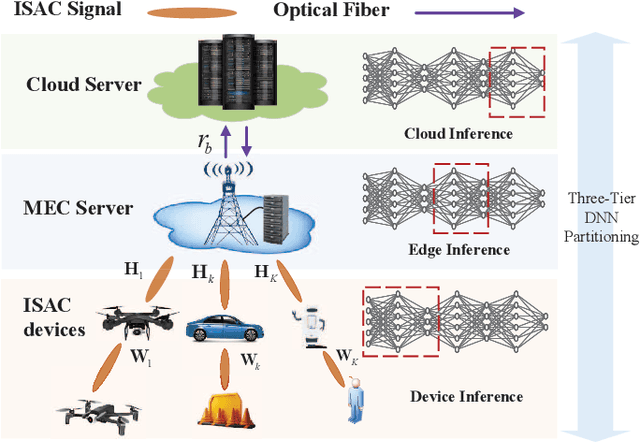
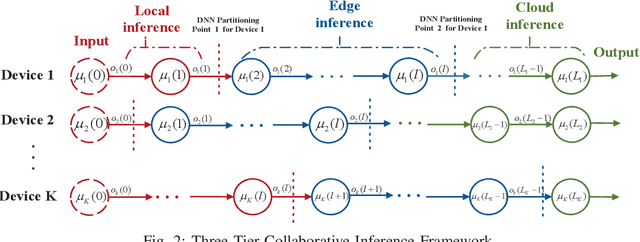
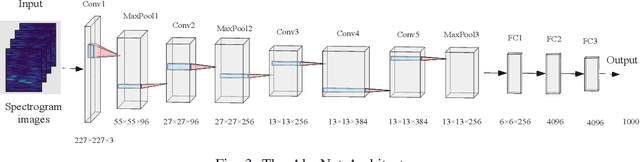
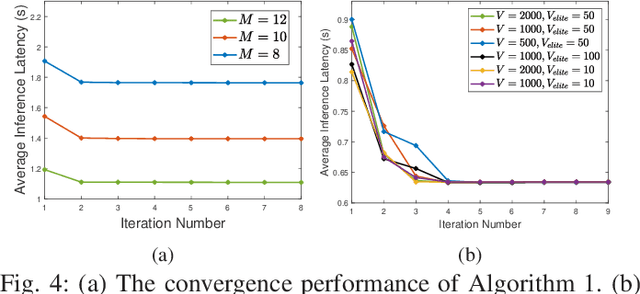
The combination of Integrated Sensing and Communication (ISAC) and Mobile Edge Computing (MEC) enables devices to simultaneously sense the environment and offload data to the base stations (BS) for intelligent processing, thereby reducing local computational burdens. However, transmitting raw sensing data from ISAC devices to the BS often incurs substantial fronthaul overhead and latency. This paper investigates a three-tier collaborative inference framework enabled by Integrated Sensing, Communication, and Computing (ISCC), where cloud servers, MEC servers, and ISAC devices cooperatively execute different segments of a pre-trained deep neural network (DNN) for intelligent sensing. By offloading intermediate DNN features, the proposed framework can significantly reduce fronthaul transmission load. Furthermore, multiple-input multiple-output (MIMO) technology is employed to enhance both sensing quality and offloading efficiency. To minimize the overall sensing task inference latency across all ISAC devices, we jointly optimize the DNN partitioning strategy, ISAC beamforming, and computational resource allocation at the MEC servers and devices, subject to sensing beampattern constraints. We also propose an efficient two-layer optimization algorithm. In the inner layer, we derive closed-form solutions for computational resource allocation using the Karush-Kuhn-Tucker conditions. Moreover, we design the ISAC beamforming vectors via an iterative method based on the majorization-minimization and weighted minimum mean square error techniques. In the outer layer, we develop a cross-entropy based probabilistic learning algorithm to determine an optimal DNN partitioning strategy. Simulation results demonstrate that the proposed framework substantially outperforms existing two-tier schemes in inference latency.
Deep Learning-Enabled ISAC-OTFS Pre-equalization Design for Aerial-Terrestrial Networks
Dec 06, 2024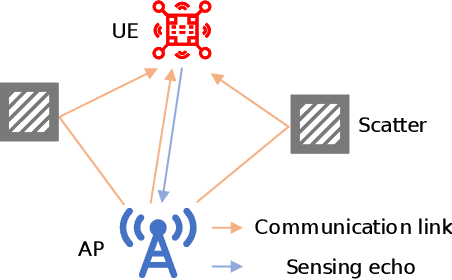
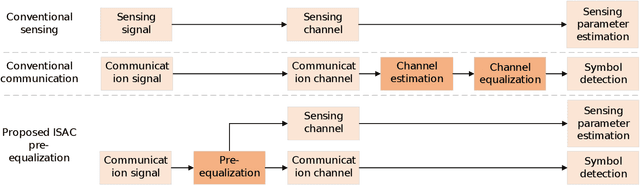
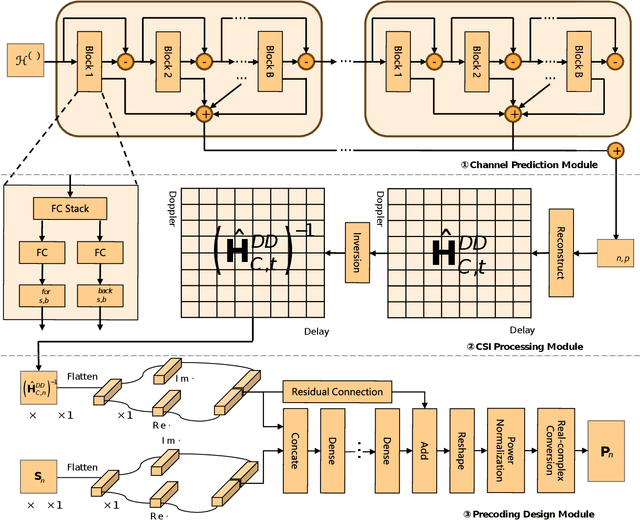
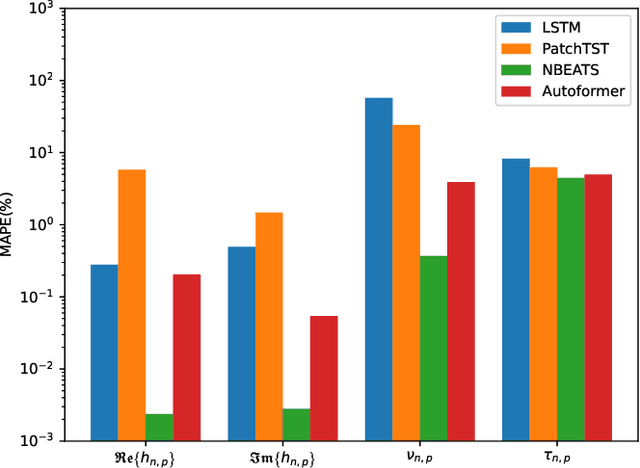
Orthogonal time frequency space (OTFS) modulation has been viewed as a promising technique for integrated sensing and communication (ISAC) systems and aerial-terrestrial networks, due to its delay-Doppler domain transmission property and strong Doppler-resistance capability. However, it also suffers from high processing complexity at the receiver. In this work, we propose a novel pre-equalization based ISAC-OTFS transmission framework, where the terrestrial base station (BS) executes pre-equalization based on its estimated channel state information (CSI). In particular, the mean square error of OTFS symbol demodulation and Cramer-Rao lower bound of sensing parameter estimation are derived, and their weighted sum is utilized as the metric for optimizing the pre-equalization matrix. To address the formulated problem while taking the time-varying CSI into consideration, a deep learning enabled channel prediction-based pre-equalization framework is proposed, where a parameter-level channel prediction module is utilized to decouple OTFS channel parameters, and a low-dimensional prediction network is leveraged to correct outdated CSI. A CSI processing module is then used to initialize the input of the pre-equalization module. Finally, a residual-structured deep neural network is cascaded to execute pre-equalization. Simulation results show that under the proposed framework, the demodulation complexity at the receiver as well as the pilot overhead for channel estimation, are significantly reduced, while the symbol detection performance approaches those of conventional minimum mean square error equalization and perfect CSI.
IMNet: Interference-Aware Channel Knowledge Map Construction and Localization
Dec 02, 2024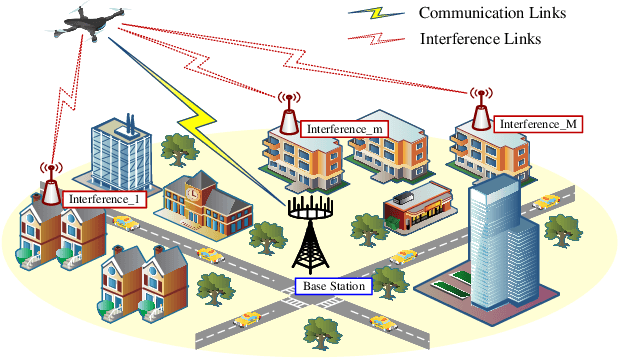
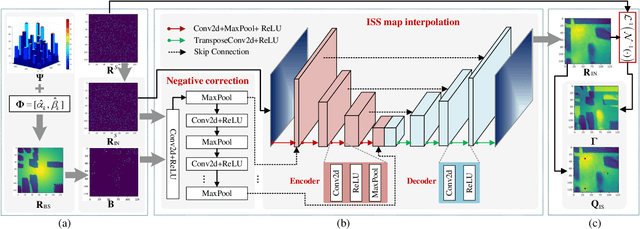
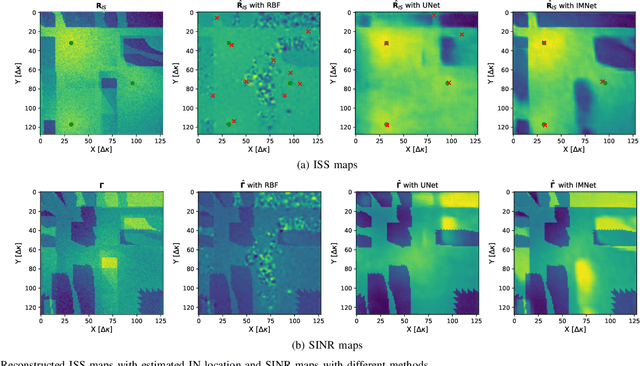
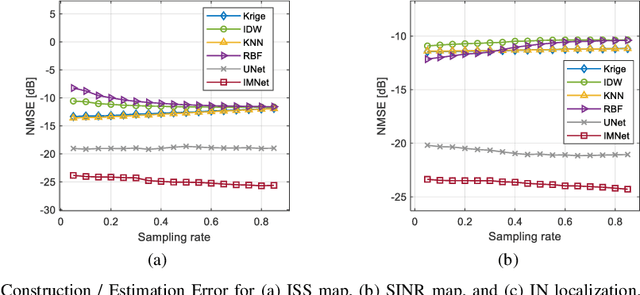
This paper presents a novel two-stage method for constructing channel knowledge maps (CKMs) specifically for A2G (Aerial-to-Ground) channels in the presence of non-cooperative interfering nodes (INs). We first estimate the interfering signal strength (ISS) at sampling locations based on total received signal strength measurements and the desired communication signal strength (DSS) map constructed with environmental topology. Next, an ISS map construction network (IMNet) is proposed, where a negative value correction module is included to enable precise reconstruction. Subsequently, we further execute signal-to-interference-plus-noise ratio map construction and IN localization. Simulation results demonstrate lower construction error of the proposed IMNet compared to baselines in the presence of interference.
Mutual Information-oriented ISAC Beamforming Design under Statistical CSI
Nov 20, 2024Existing integrated sensing and communication (ISAC) beamforming design were mostly designed under perfect instantaneous channel state information (CSI), limiting their use in practical dynamic environments. In this paper, we study the beamforming design for multiple-input multiple-output (MIMO) ISAC systems based on statistical CSI, with the weighted mutual information (MI) comprising sensing and communication perspectives adopted as the performance metric. In particular, the operator-valued free probability theory is utilized to derive the closed-form expression for the weighted MI under statistical CSI. Subsequently, an efficient projected gradient ascent (PGA) algorithm is proposed to optimize the transmit beamforming matrix with the aim of maximizing the weighted MI.Numerical results validate that the derived closed-form expression matches well with the Monte Carlo simulation results and the proposed optimization algorithm is able to improve the weighted MI significantly. We also illustrate the trade-off between sensing and communication MI.