 Add to Chrome
 Add to Firefox
 Add to Edge
Rateless DeepJSCC for Broadcast Channels: a Rate-Distortion-Complexity Tradeoff
Mar 23, 2026
In recent years, numerous data-intensive broadcasting applications have emerged at the wireless edge, calling for a flexible tradeoff between distortion, transmission rate, and processing complexity. While deep learning-based joint source-channel coding (DeepJSCC) has been identified as a potential solution to data-intensive communications, most of these schemes are confined to worst-case solutions, lack adaptive complexity, and are inefficient in broadcast settings. To overcome these limitations, this paper introduces nonlinear transform rateless source-channel coding (NTRSCC), a variable-length JSCC framework for broadcast channels based on rateless codes. In particular, we integrate learned source transformations with physical-layer LT codes, develop unequal protection schemes that exploit decoder side information, and devise approximations to enable end-to-end optimization of rateless parameters. Our framework enables heterogeneous receivers to adaptively adjust their received number of rateless symbols and decoding iterations in belief propagation, thereby achieving a controllable tradeoff between distortion, rate, and decoding complexity. Simulation results demonstrate that the proposed method enhances image broadcast quality under stringent communication and processing budgets over heterogeneous edge devices.

Non-Orthogonal HARQ-CC over SDR: A GNU Radio-Based Implementation
Mar 04, 2026Hybrid Automatic Repeat Request (HARQ) schemes typically allocate all available resources to retransmit failed packets to ensure reliability. However, under stringent delay constraints, these schemes often exhibit low spectral efficiency and increased transmission latency. To address these challenges, this paper proposes an efficient Non-Orthogonal HARQ with Chase Combining (N-HARQ-CC) transmission strategy. Specifically, the proposed approach allocates a larger portion of retransmission resources to new data packets, reserving only a small fraction for retransmitting previously erroneous packets. This is based on the observation that only a small number of information bits are typically incorrect, enabling surplus communication resources to be utilized for transmitting new messages. The N-HARQ-CC scheme retransmits the same redundant version of a failed packet and employs Maximum Ratio Combining (MRC) for decoding. To minimize complex packet scheduling and decoding complexity, the proposed scheme limits superposition to at most two messages per transmission round. At the receiver, Successive Interference Cancellation (SIC) is used to decouple the superimposed messages. The proposed N-HARQ-CC system was implemented using GNU Radio and USRP platforms for validation. Compared to conventional Type-I HARQ and HARQ-CC schemes, the proposed scheme achieves a significant improvement in spectral efficiency of approximately 0.5 bps/Hz, aligning with the low-latency requirements of 6G networks.
Graph Convolutional Network Enabled Power-Constrained HARQ Strategy for URLLC
Aug 04, 2023


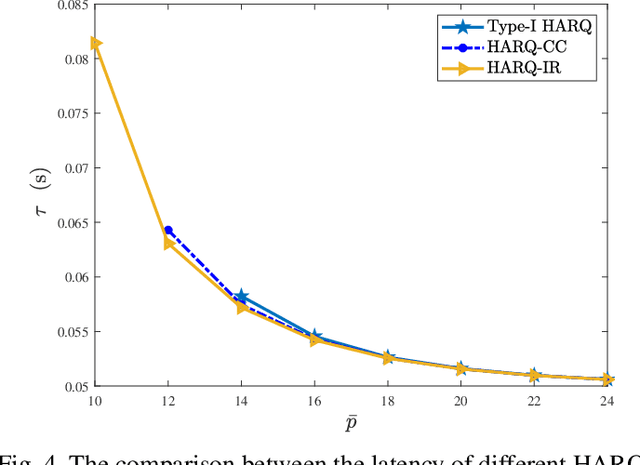
In this paper, a power-constrained hybrid automatic repeat request (HARQ) transmission strategy is developed to support ultra-reliable low-latency communications (URLLC). In particular, we aim to minimize the delivery latency of HARQ schemes over time-correlated fading channels, meanwhile ensuring the high reliability and limited power consumption. To ease the optimization, the simple asymptotic outage expressions of HARQ schemes are adopted. Furthermore, by noticing the non-convexity of the latency minimization problem and the intricate connection between different HARQ rounds, the graph convolutional network (GCN) is invoked for the optimal power solution owing to its powerful ability of handling the graph data. The primal-dual learning method is then leveraged to train the GCN weights. Consequently, the numerical results are presented for verification together with the comparisons among three HARQ schemes in terms of the latency and the reliability, where the three HARQ schemes include Type-I HARQ, HARQ with chase combining (HARQ-CC), and HARQ with incremental redundancy (HARQ-IR). To recapitulate, it is revealed that HARQ-IR offers the lowest latency while guaranteeing the demanded reliability target under a stringent power constraint, albeit at the price of high coding complexity.
Performance Analysis and Optimal Design of HARQ-IR-Aided Terahertz Communications
Apr 22, 2023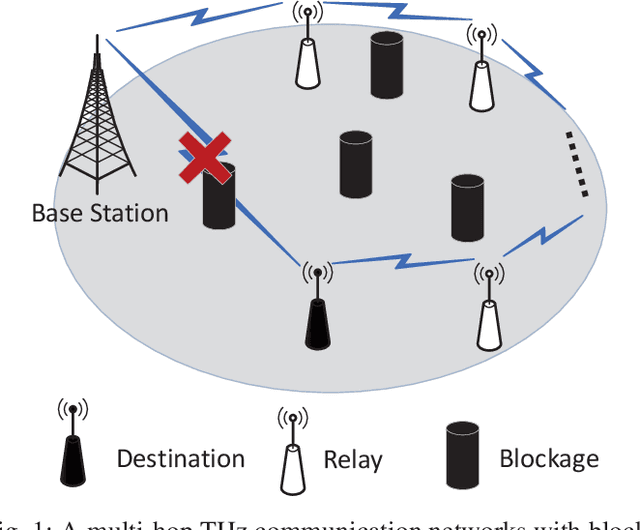
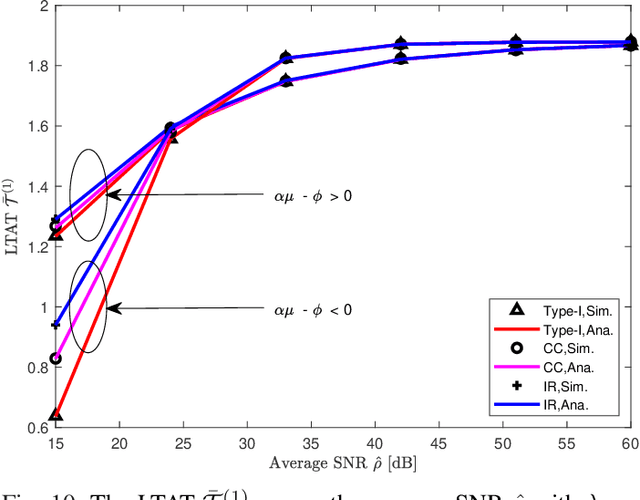
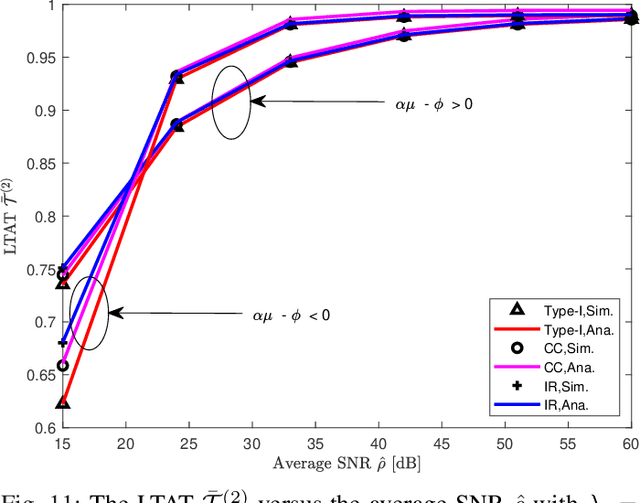
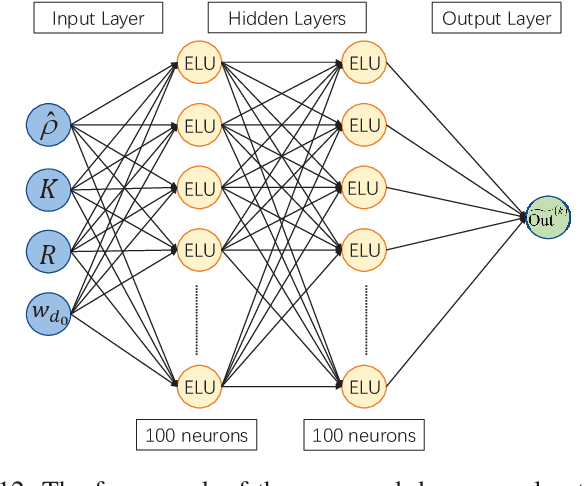
Terahertz (THz) communications are envisioned to be a promising technology for 6G thanks to its broad bandwidth. However, the large path loss, antenna misalignment, and atmospheric influence of THz communications severely deteriorate its reliability. To address this, hybrid automatic repeat request (HARQ) is recognized as an effective technique to ensure reliable THz communications. This paper delves into the performance analysis of HARQ with incremental redundancy (HARQ-IR)-aided THz communications in the presence/absence of blockage. More specifically, the analytical expression of the outage probability of HARQ-IR-aided THz communications is derived, with which the asymptotic outage analysis is enabled to gain meaningful insights, including diversity order, power allocation gain, modulation and coding gain, etc. Then the long term average throughput (LTAT) is expressed in terms of the outage probability based on renewal theory. Moreover, to combat the blockage effects, a multi-hop HARQ-IR-aided THz communication scheme is proposed and its performance is examined. To demonstrate the superiority of the proposed scheme, the other two HARQ-aided schemes, i.e., Type-I HARQ and HARQ with chase combining (HARQ-CC), are used for benchmarking in the simulations. In addition, a deep neural network (DNN) based outage evaluation framework with low computational complexity is devised to reap the benefits of using both asymptotic and simulation results in low and high outage regimes, respectively. This novel outage evaluation framework is finally employed for the optimal rate selection, which outperforms the asymptotic based optimization.