 Add to Chrome
 Add to Firefox
 Add to Edge
Personalized Lower-limb Exoskeleton Assistance via Preference-based Bayesian Optimization
Aug 10, 2026
A significant challenge in exoskeleton robotics is the need to dynamically adapt control profiles to individual motion preferences, thereby ensuring both efficient and comfortable assistance. Currently, since user experience can serve as a comprehensive metric for evaluating the effectiveness of assistance, user preference-based optimization methods have been widely studied for parameter tuning. However, the existing methods rely heavily on extensive human-robot online interactions and suffer from slow optimization speed, which not only induces user fatigue but also compromises optimization effectiveness. Therefore, this paper aims to explore an efficient preference-based optimization framework for personalized exoskeleton assistance that can learn optimal parameters with minimal interaction. We propose a preference-based Bayesian optimization (PbBO) approach that can improve sample efficiency by leveraging knowledge about the sampling distribution of candidate sets. For optimizing six control parameters, PbBO can converge to user-preferred parameters with 90.7% validation accuracy via 20 iterations. Moreover, the hierarchical controller is designed to generate personalized torque for different tasks and achieve interaction torque tracking in real time. The results of treadmill and outdoor experiments demonstrate that the optimized parameters can reduce metabolic rate by 14.5%-15.4%, heart rate by 6.3%-7.6%, and muscle activation by 6.7%-31.5% compared to unassisted walking.

Broad Learning System Based on Maximum Correntropy Criterion
Dec 24, 2019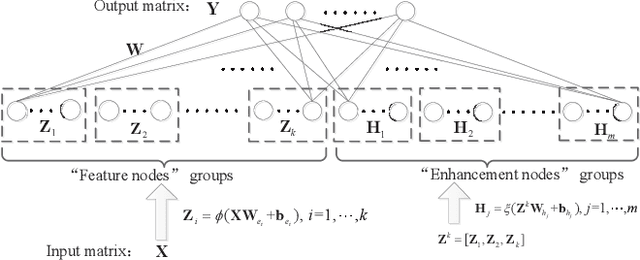
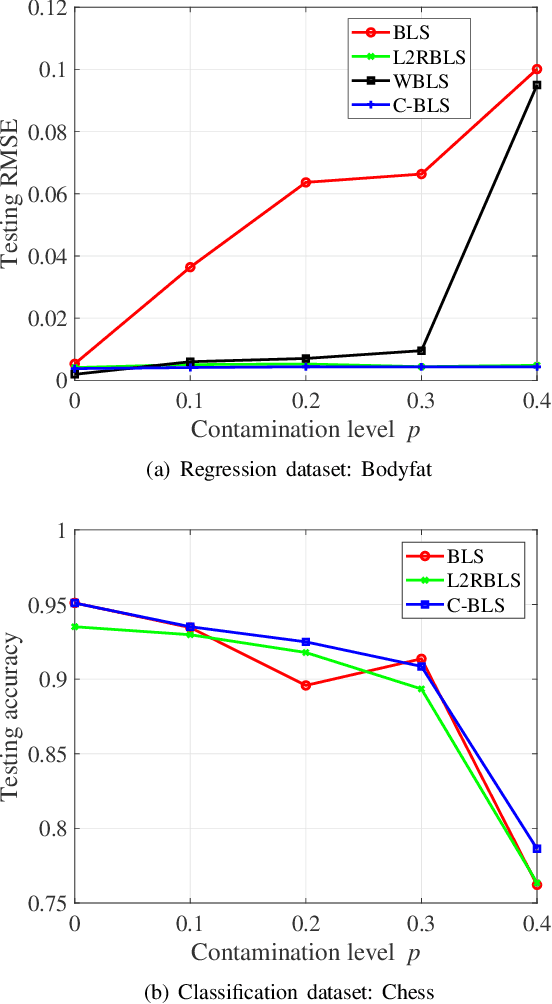
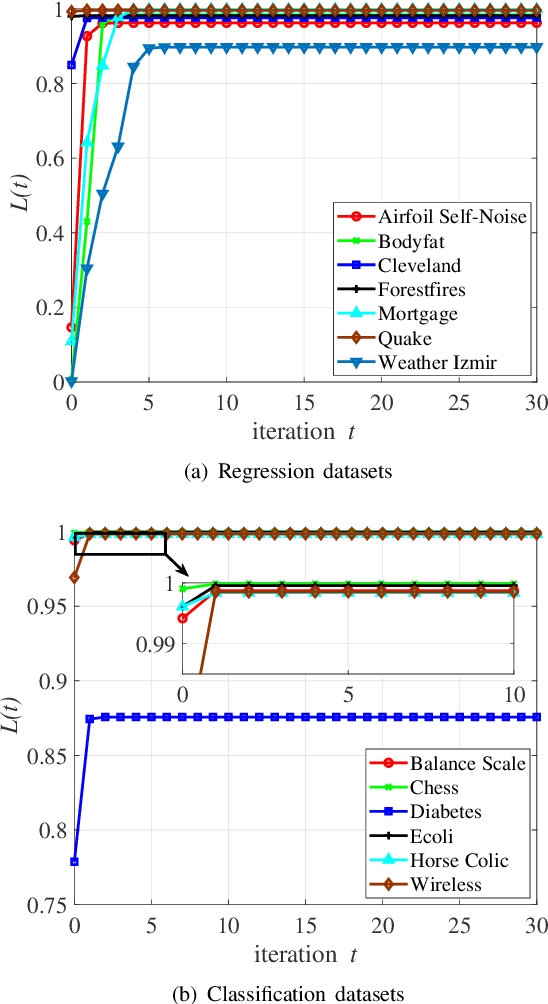
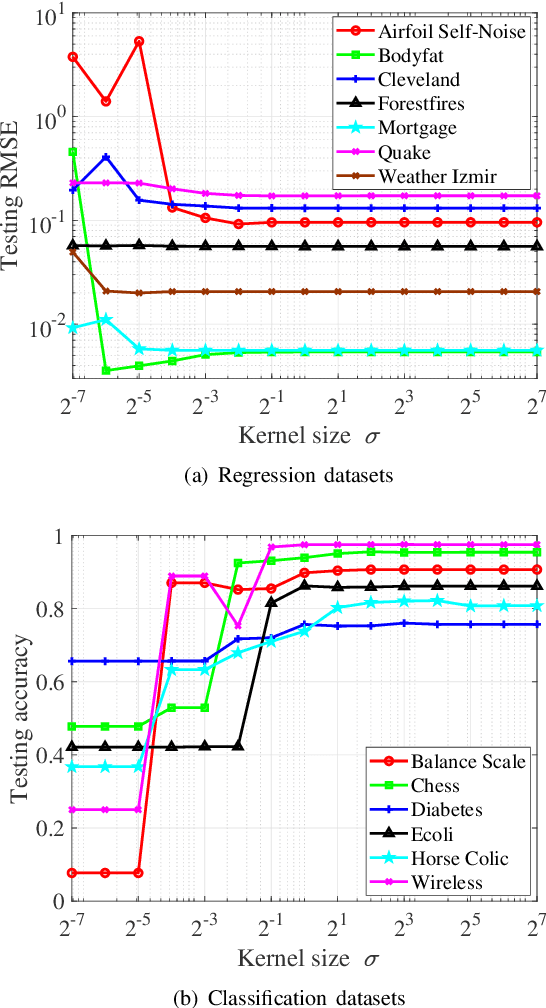
As an effective and efficient discriminative learning method, Broad Learning System (BLS) has received increasing attention due to its outstanding performance in various regression and classification problems. However, the standard BLS is derived under the minimum mean square error (MMSE) criterion, which is, of course, not always a good choice due to its sensitivity to outliers. To enhance the robustness of BLS, we propose in this work to adopt the maximum correntropy criterion (MCC) to train the output weights, obtaining a correntropy based broad learning system (C-BLS). Thanks to the inherent superiorities of MCC, the proposed C-BLS is expected to achieve excellent robustness to outliers while maintaining the original performance of the standard BLS in Gaussian or noise-free environment. In addition, three alternative incremental learning algorithms, derived from a weighted regularized least-squares solution rather than pseudoinverse formula, for C-BLS are developed.With the incremental learning algorithms, the system can be updated quickly without the entire retraining process from the beginning, when some new samples arrive or the network deems to be expanded. Experiments on various regression and classification datasets are reported to demonstrate the desirable performance of the new methods.