 Add to Chrome
 Add to Firefox
 Add to Edge
Personalized Lower-limb Exoskeleton Assistance via Preference-based Bayesian Optimization
Aug 10, 2026
A significant challenge in exoskeleton robotics is the need to dynamically adapt control profiles to individual motion preferences, thereby ensuring both efficient and comfortable assistance. Currently, since user experience can serve as a comprehensive metric for evaluating the effectiveness of assistance, user preference-based optimization methods have been widely studied for parameter tuning. However, the existing methods rely heavily on extensive human-robot online interactions and suffer from slow optimization speed, which not only induces user fatigue but also compromises optimization effectiveness. Therefore, this paper aims to explore an efficient preference-based optimization framework for personalized exoskeleton assistance that can learn optimal parameters with minimal interaction. We propose a preference-based Bayesian optimization (PbBO) approach that can improve sample efficiency by leveraging knowledge about the sampling distribution of candidate sets. For optimizing six control parameters, PbBO can converge to user-preferred parameters with 90.7% validation accuracy via 20 iterations. Moreover, the hierarchical controller is designed to generate personalized torque for different tasks and achieve interaction torque tracking in real time. The results of treadmill and outdoor experiments demonstrate that the optimized parameters can reduce metabolic rate by 14.5%-15.4%, heart rate by 6.3%-7.6%, and muscle activation by 6.7%-31.5% compared to unassisted walking.

ExoTraj: A General Lower-limb Exoskeleton Assistance Policy for Complex Environments
Jun 15, 2026Adaptive torque prediction in dynamic exoskeleton scenarios requires expensive motion capture systems, which are infeasible in complex outdoor environments. Trajectory prediction has emerged as one of the effective approaches to address such an issue. However, the core challenges of exoskeleton trajectory prediction are twofold: establishing the mapping from multi-modal features to trajectory information; constructing the mapping from trajectory to torque. For the former, most existing methods perform only single-step prediction and neglect inter-subject trajectory variability, thereby limiting the trajectory optimization space and prediction generalization. To address this, this paper proposes a fast flow matching method that enables accurate trajectory prediction and better generalization for real-time performance, where trajectory generation errors and encoded observations are used to guide the training direction. For the second challenge, due to the high dynamics of the human-robot system and the strong coupling between perception and control, simple control methods struggle to achieve efficient assistance based on the predicted trajectory. This paper utilizes model predictive control and designs a novel optimization objective to optimize torque, ensuring the exoskeleton achieves comfortable and robust assistance. By integrating the above two components, the unified policy, denoted as ExoTraj, is developed to enable adaptive assistance in complex outdoor scenarios without high data acquisition cost. Experimental results show that compared to traditional methods, ExoTraj reduces cross-subject prediction error by 14.0% during the online phase and maintains robustness against external noise. Relative to the zero torque condition, ExoTraj decreases metabolic rate by 11.5-24.4%, heart rate by 1.7-19.5%, and peak muscle activation levels by 10.9-41.3%, respectively.
PC2P: Multi-Agent Path Finding via Personalized-Enhanced Communication and Crowd Perception
Jan 06, 2026Distributed Multi-Agent Path Finding (MAPF) integrated with Multi-Agent Reinforcement Learning (MARL) has emerged as a prominent research focus, enabling real-time cooperative decision-making in partially observable environments through inter-agent communication. However, due to insufficient collaborative and perceptual capabilities, existing methods are inadequate for scaling across diverse environmental conditions. To address these challenges, we propose PC2P, a novel distributed MAPF method derived from a Q-learning-based MARL framework. Initially, we introduce a personalized-enhanced communication mechanism based on dynamic graph topology, which ascertains the core aspects of ``who" and ``what" in interactive process through three-stage operations: selection, generation, and aggregation. Concurrently, we incorporate local crowd perception to enrich agents' heuristic observation, thereby strengthening the model's guidance for effective actions via the integration of static spatial constraints and dynamic occupancy changes. To resolve extreme deadlock issues, we propose a region-based deadlock-breaking strategy that leverages expert guidance to implement efficient coordination within confined areas. Experimental results demonstrate that PC2P achieves superior performance compared to state-of-the-art distributed MAPF methods in varied environments. Ablation studies further confirm the effectiveness of each module for overall performance.
LEASE: Offline Preference-based Reinforcement Learning with High Sample Efficiency
Dec 30, 2024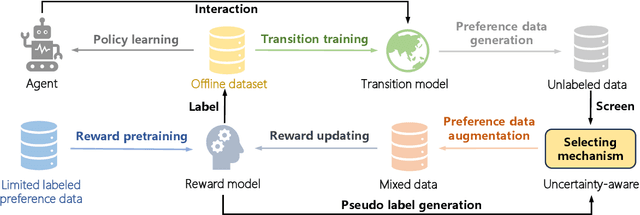

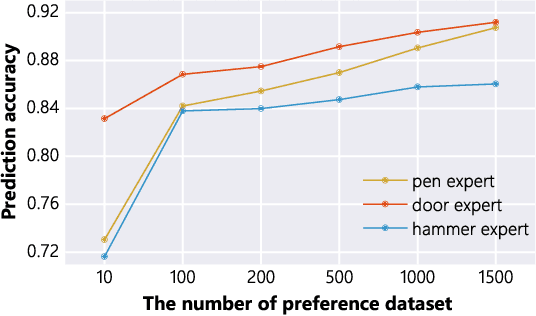

Offline preference-based reinforcement learning (PbRL) provides an effective way to overcome the challenges of designing reward and the high costs of online interaction. However, since labeling preference needs real-time human feedback, acquiring sufficient preference labels is challenging. To solve this, this paper proposes a offLine prEference-bAsed RL with high Sample Efficiency (LEASE) algorithm, where a learned transition model is leveraged to generate unlabeled preference data. Considering the pretrained reward model may generate incorrect labels for unlabeled data, we design an uncertainty-aware mechanism to ensure the performance of reward model, where only high confidence and low variance data are selected. Moreover, we provide the generalization bound of reward model to analyze the factors influencing reward accuracy, and demonstrate that the policy learned by LEASE has theoretical improvement guarantee. The developed theory is based on state-action pair, which can be easily combined with other offline algorithms. The experimental results show that LEASE can achieve comparable performance to baseline under fewer preference data without online interaction.
A Weight-aware-based Multi-source Unsupervised Domain Adaptation Method for Human Motion Intention Recognition
Apr 19, 2024Accurate recognition of human motion intention (HMI) is beneficial for exoskeleton robots to improve the wearing comfort level and achieve natural human-robot interaction. A classifier trained on labeled source subjects (domains) performs poorly on unlabeled target subject since the difference in individual motor characteristics. The unsupervised domain adaptation (UDA) method has become an effective way to this problem. However, the labeled data are collected from multiple source subjects that might be different not only from the target subject but also from each other. The current UDA methods for HMI recognition ignore the difference between each source subject, which reduces the classification accuracy. Therefore, this paper considers the differences between source subjects and develops a novel theory and algorithm for UDA to recognize HMI, where the margin disparity discrepancy (MDD) is extended to multi-source UDA theory and a novel weight-aware-based multi-source UDA algorithm (WMDD) is proposed. The source domain weight, which can be adjusted adaptively by the MDD between each source subject and target subject, is incorporated into UDA to measure the differences between source subjects. The developed multi-source UDA theory is theoretical and the generalization error on target subject is guaranteed. The theory can be transformed into an optimization problem for UDA, successfully bridging the gap between theory and algorithm. Moreover, a lightweight network is employed to guarantee the real-time of classification and the adversarial learning between feature generator and ensemble classifiers is utilized to further improve the generalization ability. The extensive experiments verify theoretical analysis and show that WMDD outperforms previous UDA methods on HMI recognition tasks.