 Add to Chrome
 Add to Firefox
 Add to Edge
Cognition-Inspired Dual-Stream Semantic Enhancement for Vision-Based Dynamic Emotion Modeling
Apr 14, 2026
The human brain constructs emotional percepts not by processing facial expressions in isolation, but through a dynamic, hierarchical integration of sensory input with semantic and contextual knowledge. However, existing vision-based dynamic emotion modeling approaches often neglect emotion perception and cognitive theories. To bridge this gap between machine and human emotion perception, we propose cognition-inspired Dual-stream Semantic Enhancement (DuSE). Our model instantiates a dual-stream cognitive architecture. The first stream, a Hierarchical Temporal Prompt Cluster (HTPC), operationalizes the cognitive priming effect. It simulates how linguistic cues pre-sensitize neural pathways, modulating the processing of incoming visual stimuli by aligning textual semantics with fine-grained temporal features of facial dynamics. The second stream, a Latent Semantic Emotion Aggregator (LSEA), computationally models the knowledge integration process, akin to the mechanism described by the Conceptual Act Theory. It aggregates sensory inputs and synthesizes them with learned conceptual knowledge, reflecting the role of the hippocampus and default mode network in constructing a coherent emotional experience. By explicitly modeling these neuro-cognitive mechanisms, DuSE provides a more neurally plausible and robust framework for dynamic facial expression recognition (DFER). Extensive experiments on challenging in-the-wild benchmarks validate our cognition-centric approach, demonstrating that emulating the brain's strategies for emotion processing yields state-of-the-art performance and enhances model interpretability.

ARGen: Affect-Reinforced Generative Augmentation towards Vision-based Dynamic Emotion Perception
Apr 14, 2026Dynamic facial expression recognition in the wild remains challenging due to data scarcity and long-tail distributions, which hinder models from effectively learning the temporal dynamics of scarce emotions. To address these limitations, we propose ARGen, an Affect-Reinforced Generative Augmentation Framework that enables data-adaptive dynamic expression generation for robust emotion perception. ARGen operates in two stages: Affective Semantic Injection (ASI) and Adaptive Reinforcement Diffusion (ARD). The ASI stage establishes affective knowledge alignment through facial Action Units and employs a retrieval-augmented prompt generation strategy to synthesize consistent and fine-grained affective descriptions via large-scale visual-language models, thereby injecting interpretable emotional priors into the generation process. The ARD stage integrates text-conditioned image-to-video diffusion with reinforcement learning, introducing inter-frame conditional guidance and a multi-objective reward function to jointly optimize expression naturalness, facial integrity, and generative efficiency. Extensive experiments on both generation and recognition tasks verify that ARGen substantially enhances synthesis fidelity and improves recognition performance, establishing an interpretable and generalizable generative augmentation paradigm for vision-based affective computing.
Commonality in Few: Few-Shot Multimodal Anomaly Detection via Hypergraph-Enhanced Memory
Nov 16, 2025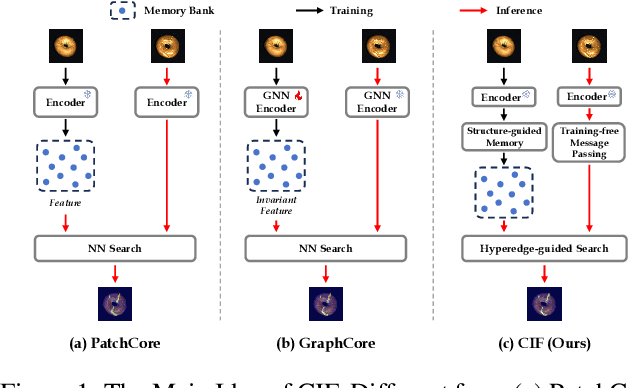
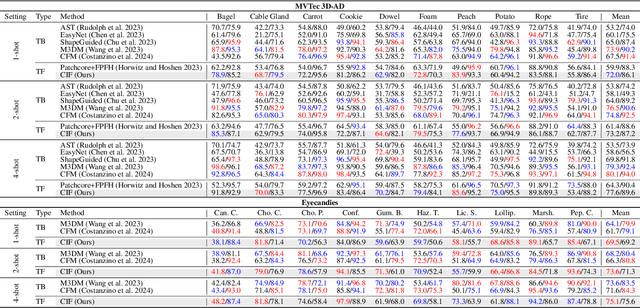
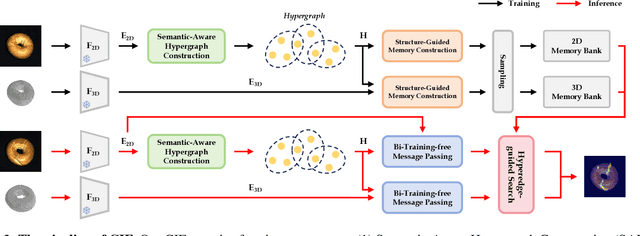
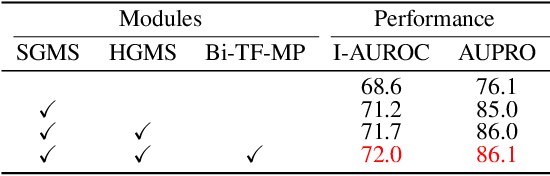
Few-shot multimodal industrial anomaly detection is a critical yet underexplored task, offering the ability to quickly adapt to complex industrial scenarios. In few-shot settings, insufficient training samples often fail to cover the diverse patterns present in test samples. This challenge can be mitigated by extracting structural commonality from a small number of training samples. In this paper, we propose a novel few-shot unsupervised multimodal industrial anomaly detection method based on structural commonality, CIF (Commonality In Few). To extract intra-class structural information, we employ hypergraphs, which are capable of modeling higher-order correlations, to capture the structural commonality within training samples, and use a memory bank to store this intra-class structural prior. Firstly, we design a semantic-aware hypergraph construction module tailored for single-semantic industrial images, from which we extract common structures to guide the construction of the memory bank. Secondly, we use a training-free hypergraph message passing module to update the visual features of test samples, reducing the distribution gap between test features and features in the memory bank. We further propose a hyperedge-guided memory search module, which utilizes structural information to assist the memory search process and reduce the false positive rate. Experimental results on the MVTec 3D-AD dataset and the Eyecandies dataset show that our method outperforms the state-of-the-art (SOTA) methods in few-shot settings. Code is available at https://github.com/Sunny5250/CIF.