 Add to Chrome
 Add to Firefox
 Add to Edge
4D-WAM: Infusing Spatiotemporal Awareness into World Action Models through Trajectory Fields
Aug 12, 2026
Building on recent advances in world models, World Action Models (WAMs) jointly model video prediction and action generation. However, they typically represent videos in 2D pixel space, creating a representation gap with 3D space in which robotic actions are executed. Recent 3D approaches introduce 3D information, but fail to fully exploit the dynamics of 3D structures. In this work, we propose 4D-WAM, a model-agnostic training strategy that injects spatiotemporal knowledge from 3D trajectory fields into WAMs through representation alignment. To this end, we introduce two complementary objectives: 1) motion alignment, which aligns temporal feature variations across adjacent frames and encourages the model to build local 4D awareness during training, and 2) destination alignment, which guides the model to infer the final destination from the source frame by minimizing the gap between their attention-like similarity distributions. Together, these objectives provide both local motion supervision and long-horizon goal guidance, enabling WAMs to learn trajectory-level spatiotemporal representations. Extensive in-distribution and out-of-distribution experiments across different base models demonstrate the model's improvements in spatial understanding, execution precision, robustness, generalization, and versatility.

Is Forward Prediction Enough? Physical State Grounding for JEPA World Models
Aug 07, 2026Learning structured and control-relevant latent representations remains a key challenge for world models. Recent JEPA-based world models learn action-conditioned predictive latent dynamics from observation sequences. However, their forward-prediction objectives do not explicitly enforce reliable identifiability of robot-centric physical state from individual latents or state changes from latent pairs, which can limit downstream planning and policy performance. We propose PSG-JEPA, a physically grounded JEPA world model that shapes its latent space with two complementary grounding objectives beyond forward prediction: grounding individual latents in robot proprioceptive state, and grounding latent pairs in multi-horizon joint-angle changes. Both objectives are applied only during training, leaving the inference architecture and computational cost unchanged. To comprehensively evaluate PSG-JEPA, we conduct experiments at three levels: (1) latent identifiability via probing, (2) goal-conditioned planning on frozen latents, and (3) policy learning in simulation and on a real robot. Experiments demonstrate that our PSG-JEPA consistently outperforms state-of-the-art latent world-model baselines at all three levels.
DyPES-VLA: Learning Shared Dynamics Priors and Embodiment-Specific Control for Cross-Embodiment Manipulation
Aug 06, 2026Vision-Language-Action (VLA) models have become a powerful paradigm for robot manipulation, but training a single generalist policy for heterogeneous robot embodiments remains an open problem. Existing methods have two main limitations. First, they underuse dynamics priors shared across diverse visual and interaction data, limiting cross-embodiment transfer. Second, they require extensive manual preprocessing to convert embodiment-specific actions into a common format. To overcome these limitations, we propose DyPES-VLA, a cross-embodiment VLA that learns shared Dynamics Priors and Embodiment-Specific control. First, we learn shared dynamics priors by training the vision-language model (VLM) with a future-prediction objective on cross-embodiment data, driving the shared query representation to capture object motion, contact, and interaction-induced scene changes. Second, an embodiment-specific Mixture-of-Experts (MoE) action head translates these shared dynamics priors into executable controls directly in each embodiment's native action space, without manually pre-aligning heterogeneous actions into a common format. This head shares attention layers to capture common temporal action structures, while its embodiment-specific feed-forward experts resolve the unique kinematic constraints and control semantics of distinct embodiments. As a generalist policy, our \ourmethod achieves state-of-the-art performance across simulation and real-world evaluations, reaching 98.0% success on LIBERO, 59.25% on RoboCasa-GR1, and 89.02% on RoboTwin~2.0.
Physics informed cell representations for variational formulation of multiscale problems
May 27, 2024With the rapid advancement of graphical processing units, Physics-Informed Neural Networks (PINNs) are emerging as a promising tool for solving partial differential equations (PDEs). However, PINNs are not well suited for solving PDEs with multiscale features, particularly suffering from slow convergence and poor accuracy. To address this limitation of PINNs, this article proposes physics-informed cell representations for resolving multiscale Poisson problems using a model architecture consisting of multilevel multiresolution grids coupled with a multilayer perceptron (MLP). The grid parameters (i.e., the level-dependent feature vectors) and the MLP parameters (i.e., the weights and biases) are determined using gradient-descent based optimization. The variational (weak) form based loss function accelerates computation by allowing the linear interpolation of feature vectors within grid cells. This cell-based MLP model also facilitates the use of a decoupled training scheme for Dirichlet boundary conditions and a parameter-sharing scheme for periodic boundary conditions, delivering superior accuracy compared to conventional PINNs. Furthermore, the numerical examples highlight improved speed and accuracy in solving PDEs with nonlinear or high-frequency boundary conditions and provide insights into hyperparameter selection. In essence, by cell-based MLP model along with the parallel tiny-cuda-nn library, our implementation improves convergence speed and numerical accuracy.
Group-Aware Robot Navigation in Crowded Environments
Dec 22, 2020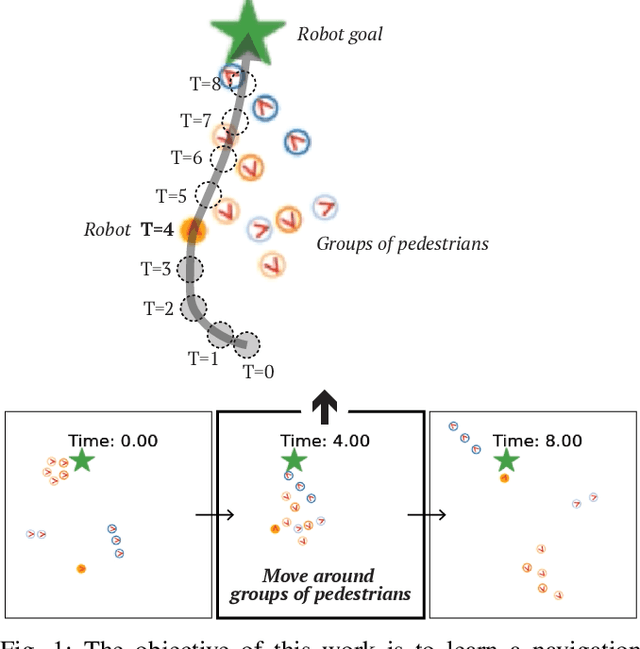
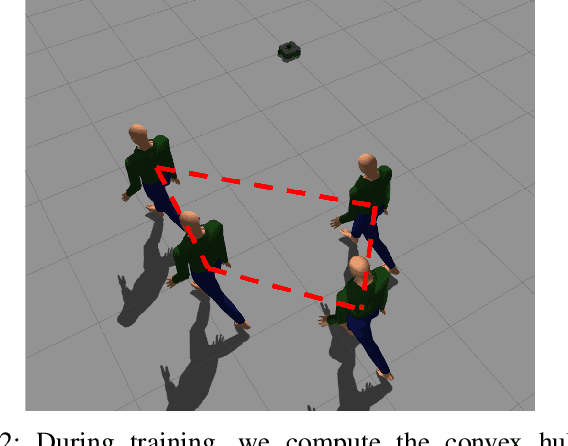
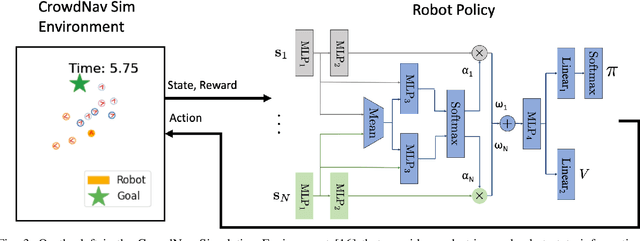
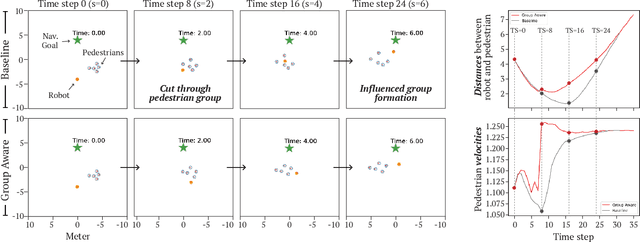
Human-aware robot navigation promises a range of applications in which mobile robots bring versatile assistance to people in common human environments. While prior research has mostly focused on modeling pedestrians as independent, intentional individuals, people move in groups; consequently, it is imperative for mobile robots to respect human groups when navigating around people. This paper explores learning group-aware navigation policies based on dynamic group formation using deep reinforcement learning. Through simulation experiments, we show that group-aware policies, compared to baseline policies that neglect human groups, achieve greater robot navigation performance (e.g., fewer collisions), minimize violation of social norms and discomfort, and reduce the robot's movement impact on pedestrians. Our results contribute to the development of social navigation and the integration of mobile robots into human environments.
A Novel Co-design Peta-scale Heterogeneous Cluster for Deep Learning Training
May 18, 2018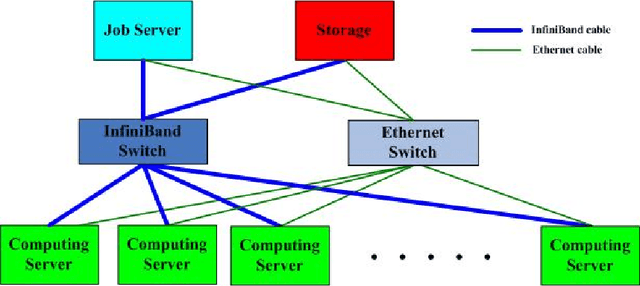
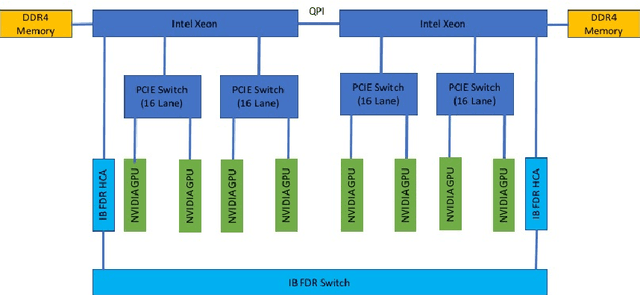
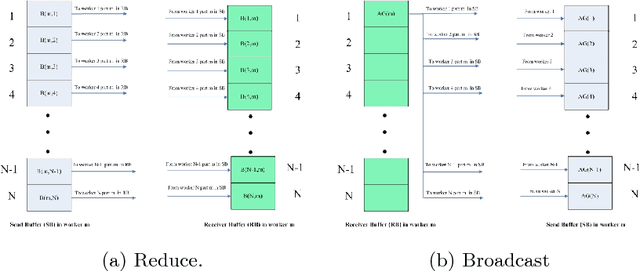
Large scale deep Convolution Neural Networks (CNNs) increasingly demands the computing power. It is key for researchers to own a great powerful computing platform to leverage deep learning (DL) advancing.On the other hand, as the commonly-used accelerator, the commodity GPUs cards of new generations are more and more expensive. Consequently, it is of importance to design an affordable distributed heterogeneous system that provides powerful computational capacity and develop a well-suited software that efficiently utilizes its computational capacity. In this paper, we present our co-design distributed system including a peta-scale GPU cluster, called "Manoa". Based on properties and topology of Manoa, we first propose job server framework and implement it, named "MiMatrix". The central node of MiMatrix, referred to as the job server, undertakes all of controlling, scheduling and monitoring, and I/O tasks without weight data transfer for AllReduce processing in each iteration. Therefore, MiMatrix intrinsically solves the bandwidth bottleneck of central node in parameter server framework that is widely used in distributed DL tasks. Meanwhile, we also propose a new AllReduce algorithm, GPUDirect RDMA-Aware AllReduce~(GDRAA), in which both computation and handshake message are O(1) and the number of synchronization is two in each iteration that is a theoretical minimum number. Owe to the dedicated co-design distributed system, MiMatrix efficiently makes use of the Manoa's computational capacity and bandwidth. We benchmark Manoa Resnet50 and Resenet101 on Imagenet-1K dataset. Some of results have demonstrated state-of-the-art.