 Add to Chrome
 Add to Firefox
 Add to Edge
Min Generalized Sliced Gromov Wasserstein: A Scalable Path to Gromov Wasserstein
May 13, 2026
We propose min Generalized Sliced Gromov--Wasserstein (min-GSGW), a sliced formulation for the Gromov--Wasserstein (GW) problem using expressive generalized slicers. The key idea is to learn coupled nonlinear slicers that assign compatible push-forward values to both input measures, so that monotone coupling in the projected domain lifts to a transport plan evaluated against the GW objective in the original spaces. The resulting plan induces a GW objective value, and min-GSGW minimizes this cost directly in the original spaces. We further show that min-GSGW is rigid-motion invariant, a crucial property for geometric matching and shape analysis tasks. Our contributions are threefold: 1) we introduce generalized slicers into the sliced GW framework, 2) we construct a slicing-based efficient GW transport plan; and 3) we develop an amortized variant that replaces per-instance optimization with a learned slicer for unseen input pairs. We perform experiments on animal mesh matching, horse mesh interpolation, and ShapeNet part transfer. Results show that min-GSGW produces meaningful geometric correspondences and GW objective values at substantially lower computational cost than existing GW solvers.

ConQuR: Corner Aligned Activation Quantization via Optimized Rotations for LLMs
May 11, 2026Large language models (LLMs) are costly to deploy due to their large memory footprint and high inference cost. Weight-activation quantization can reduce these costs, but low-bit activation quantization remains difficult because activation outliers induce large quantization error. Recent rotation-based methods address this by applying orthogonal transformations that redistribute activation magnitude across dimensions, but existing approaches either require expensive end-to-end rotation training or rely on stored activation corpora, introducing significant compute or storage overhead. We propose a lightweight post-training rotation calibration method for LLM activation quantization. Our method learns orthogonal rotations that align normalized activations with the corners of an inscribed hypercube, encouraging activation energy to be distributed more evenly across dimensions. This objective admits an efficient closed-form update via the orthogonal Procrustes problem, avoiding gradient-based optimization over the orthogonal group. We further introduce an online calibration procedure that updates rotations as calibration samples are processed, eliminating the need to store activations on disk and allowing rotations to adapt to quantized activation distributions during calibration. Experiments on Llama-2 and Llama-3 models from 3B to 70B parameters show that our method achieves competitive or improved performance across perplexity benchmarks and common sense reasoning tasks while avoiding both costly end-to-end training and large offline activation storage.
Sinkhorn-Drifting Generative Models
Mar 12, 2026We establish a theoretical link between the recently proposed "drifting" generative dynamics and gradient flows induced by the Sinkhorn divergence. In a particle discretization, the drift field admits a cross-minus-self decomposition: an attractive term toward the target distribution and a repulsive/self-correction term toward the current model, both expressed via one-sided normalized Gibbs kernels. We show that Sinkhorn divergence yields an analogous cross-minus-self structure, but with each term defined by entropic optimal-transport couplings obtained through two-sided Sinkhorn scaling (i.e., enforcing both marginals). This provides a precise sense in which drifting acts as a surrogate for a Sinkhorn-divergence gradient flow, interpolating between one-sided normalization and full two-sided Sinkhorn scaling. Crucially, this connection resolves an identifiability gap in prior drifting formulations: leveraging the definiteness of the Sinkhorn divergence, we show that zero drift (equilibrium of the dynamics) implies that the model and target measures match. Experiments show that Sinkhorn drifting reduces sensitivity to kernel temperature and improves one-step generative quality, trading off additional training time for a more stable optimization, without altering the inference procedure used by drift methods. These theoretical gains translate to strong low-temperature improvements in practice: on FFHQ-ALAE at the lowest temperature setting we evaluate, Sinkhorn drifting reduces mean FID from 187.7 to 37.1 and mean latent EMD from 453.3 to 144.4, while on MNIST it preserves full class coverage across the temperature sweep. Project page: https://mint-vu.github.io/SinkhornDrifting/
Vector-Quantized Soft Label Compression for Dataset Distillation
Mar 04, 2026Dataset distillation is an emerging technique for reducing the computational and storage costs of training machine learning models by synthesizing a small, informative subset of data that captures the essential characteristics of a much larger dataset. Recent methods pair synthetic samples and their augmentations with soft labels from a teacher model, enabling student models to generalize effectively despite the small size of the distilled dataset. While soft labels are critical for effective distillation, the storage and communication overhead they incur, especially when accounting for augmentations, is often overlooked. In practice, each distilled sample is associated with multiple soft labels, making them the dominant contributor to storage costs, particularly in large-class settings such as ImageNet-1K. In this paper, we present a rigorous analysis of bit requirements across dataset distillation frameworks, quantifying the storage demands of both distilled samples and their soft labels. To address the overhead, we introduce a vector-quantized autoencoder (VQAE) for compressing soft labels, achieving substantial compression while preserving the effectiveness of the distilled data. We validate our method on both vision and language distillation benchmarks. On ImageNet-1K, our proposed VQAE achieves 30--40x additional compression over RDED, LPLD, SRE2L, and CDA baselines while retaining over $90\%$ of their original performance.
Zero Sum SVD: Balancing Loss Sensitivity for Low Rank LLM Compression
Feb 02, 2026Advances in large language models have driven strong performance across many tasks, but their memory and compute costs still hinder deployment. SVD-based compression reduces storage and can speed up inference via low-rank factors, yet performance depends on how rank is allocated under a global compression ratio. Prior methods often use homogeneous ranks for similarly sized matrices, despite large differences in loss sensitivity, or rely on expensive iterative pre-truncation optimization to determine per matrix ranks. We propose \textbf{Zero Sum SVD} (\textbf{ZS-SVD}), a post-training method that performs \emph{global} singular component selection using activation whitening and first-order calibration loss estimates in whitened coordinates. \textbf{ZS-SVD} prunes components across the whole model with a \textbf{zero sum} rule that keeps the cumulative predicted loss change near zero, automatically yielding heterogeneous ranks without solving a rank allocation optimization. Motivated by evidence that gradients near pretrained solutions exhibit low rank structure, we also introduce an optional lightweight correction that applies a \textbf{single} projected gradient update after truncation, followed by re-truncation. Extensive experiments across multiple LLM architectures show consistent gains across diverse benchmarks and compression ratios. Code is available at https://github.com/mint-vu/Zero-Sum-SVD
LUNA: Linear Universal Neural Attention with Generalization Guarantees
Dec 08, 2025


Scaling attention faces a critical bottleneck: the $\mathcal{O}(n^2)$ quadratic computational cost of softmax attention, which limits its application in long-sequence domains. While linear attention mechanisms reduce this cost to $\mathcal{O}(n)$, they typically rely on fixed random feature maps, such as random Fourier features or hand-crafted functions. This reliance on static, data-agnostic kernels creates a fundamental trade-off, forcing practitioners to sacrifice significant model accuracy for computational efficiency. We introduce \textsc{LUNA}, a kernelized linear attention mechanism that eliminates this trade-off, retaining linear cost while matching and surpassing the accuracy of quadratic attention. \textsc{LUNA} is built on the key insight that the kernel feature map itself should be learned rather than fixed a priori. By parameterizing the kernel, \textsc{LUNA} learns a feature basis tailored to the specific data and task, overcoming the expressive limitations of fixed-feature methods. \textsc{Luna} implements this with a learnable feature map that induces a positive-definite kernel and admits a streaming form, yielding linear time and memory scaling in the sequence length. Empirical evaluations validate our approach across diverse settings. On the Long Range Arena (LRA), \textsc{Luna} achieves state-of-the-art average accuracy among efficient Transformers under compute parity, using the same parameter count, training steps, and approximate FLOPs. \textsc{Luna} also excels at post-hoc conversion: replacing softmax in fine-tuned BERT and ViT-B/16 checkpoints and briefly fine-tuning recovers most of the original performance, substantially outperforming fixed linearizations.
Transport Based Mean Flows for Generative Modeling
Sep 26, 2025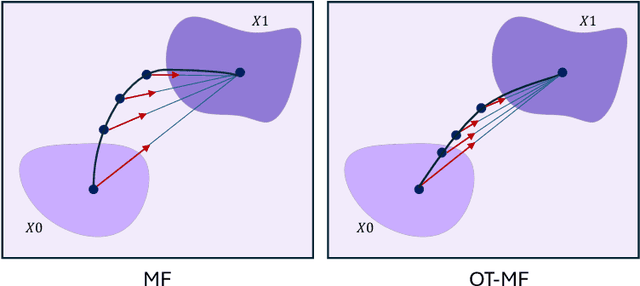
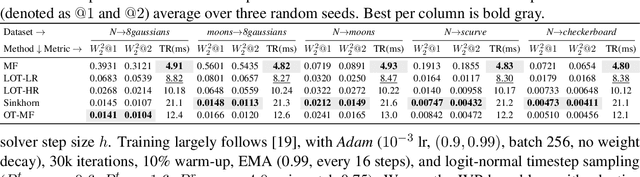
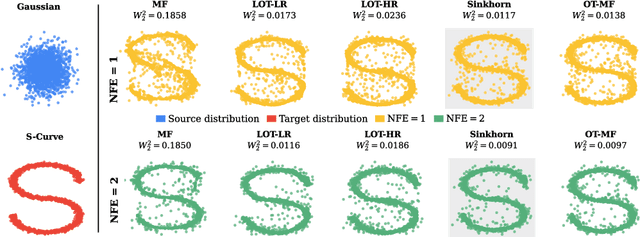
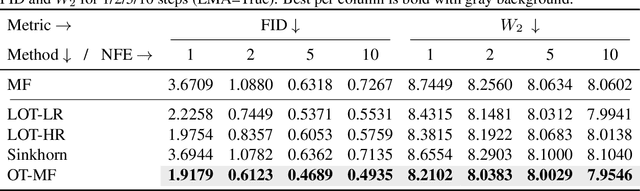
Flow-matching generative models have emerged as a powerful paradigm for continuous data generation, achieving state-of-the-art results across domains such as images, 3D shapes, and point clouds. Despite their success, these models suffer from slow inference due to the requirement of numerous sequential sampling steps. Recent work has sought to accelerate inference by reducing the number of sampling steps. In particular, Mean Flows offer a one-step generation approach that delivers substantial speedups while retaining strong generative performance. Yet, in many continuous domains, Mean Flows fail to faithfully approximate the behavior of the original multi-step flow-matching process. In this work, we address this limitation by incorporating optimal transport-based sampling strategies into the Mean Flow framework, enabling one-step generators that better preserve the fidelity and diversity of the original multi-step flow process. Experiments on controlled low-dimensional settings and on high-dimensional tasks such as image generation, image-to-image translation, and point cloud generation demonstrate that our approach achieves superior inference accuracy in one-step generative modeling.
Neural-Augmented Kelvinlet: Real-Time Soft Tissue Deformation with Multiple Graspers
Jun 06, 2025Fast and accurate simulation of soft tissue deformation is a critical factor for surgical robotics and medical training. In this paper, we introduce a novel physics-informed neural simulator that approximates soft tissue deformations in a realistic and real-time manner. Our framework integrates Kelvinlet-based priors into neural simulators, making it the first approach to leverage Kelvinlets for residual learning and regularization in data-driven soft tissue modeling. By incorporating large-scale Finite Element Method (FEM) simulations of both linear and nonlinear soft tissue responses, our method improves neural network predictions across diverse architectures, enhancing accuracy and physical consistency while maintaining low latency for real-time performance. We demonstrate the effectiveness of our approach by performing accurate surgical maneuvers that simulate the use of standard laparoscopic tissue grasping tools with high fidelity. These results establish Kelvinlet-augmented learning as a powerful and efficient strategy for real-time, physics-aware soft tissue simulation in surgical applications.
Collaborative Learning in Agentic Systems: A Collective AI is Greater Than the Sum of Its Parts
Jun 05, 2025Agentic AI has gained significant interest as a research paradigm focused on autonomy, self-directed learning, and long-term reliability of decision making. Real-world agentic systems operate in decentralized settings on a large set of tasks or data distributions with constraints such as limited bandwidth, asynchronous execution, and the absence of a centralized model or even common objectives. We posit that exploiting previously learned skills, task similarities, and communication capabilities in a collective of agentic AI are challenging but essential elements to enabling scalability, open-endedness, and beneficial collaborative learning dynamics. In this paper, we introduce Modular Sharing and Composition in Collective Learning (MOSAIC), an agentic algorithm that allows multiple agents to independently solve different tasks while also identifying, sharing, and reusing useful machine-learned knowledge, without coordination, synchronization, or centralized control. MOSAIC combines three mechanisms: (1) modular policy composition via neural network masks, (2) cosine similarity estimation using Wasserstein embeddings for knowledge selection, and (3) asynchronous communication and policy integration. Results on a set of RL benchmarks show that MOSAIC has a greater sample efficiency than isolated learners, i.e., it learns significantly faster, and in some cases, finds solutions to tasks that cannot be solved by isolated learners. The collaborative learning and sharing dynamics are also observed to result in the emergence of ideal curricula of tasks, from easy to hard. These findings support the case for collaborative learning in agentic systems to achieve better and continuously evolving performance both at the individual and collective levels.
Knowledge Distillation and Dataset Distillation of Large Language Models: Emerging Trends, Challenges, and Future Directions
Apr 20, 2025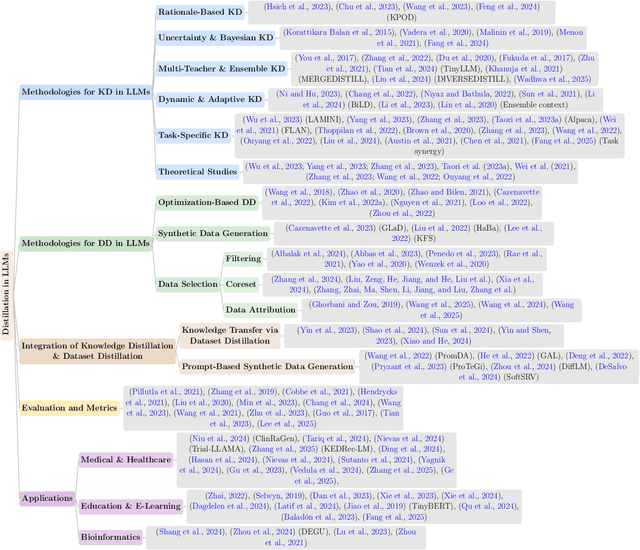

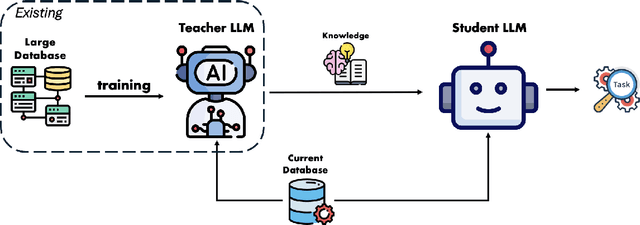
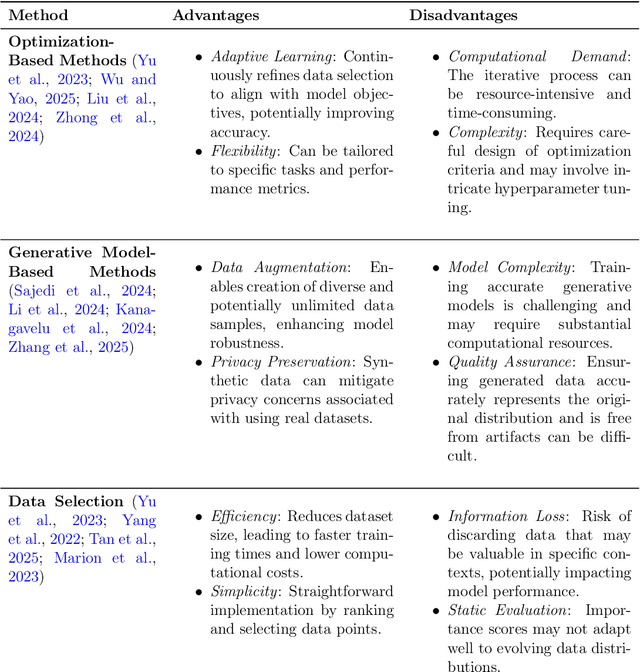
The exponential growth of Large Language Models (LLMs) continues to highlight the need for efficient strategies to meet ever-expanding computational and data demands. This survey provides a comprehensive analysis of two complementary paradigms: Knowledge Distillation (KD) and Dataset Distillation (DD), both aimed at compressing LLMs while preserving their advanced reasoning capabilities and linguistic diversity. We first examine key methodologies in KD, such as task-specific alignment, rationale-based training, and multi-teacher frameworks, alongside DD techniques that synthesize compact, high-impact datasets through optimization-based gradient matching, latent space regularization, and generative synthesis. Building on these foundations, we explore how integrating KD and DD can produce more effective and scalable compression strategies. Together, these approaches address persistent challenges in model scalability, architectural heterogeneity, and the preservation of emergent LLM abilities. We further highlight applications across domains such as healthcare and education, where distillation enables efficient deployment without sacrificing performance. Despite substantial progress, open challenges remain in preserving emergent reasoning and linguistic diversity, enabling efficient adaptation to continually evolving teacher models and datasets, and establishing comprehensive evaluation protocols. By synthesizing methodological innovations, theoretical foundations, and practical insights, our survey charts a path toward sustainable, resource-efficient LLMs through the tighter integration of KD and DD principles.