 Add to Chrome
 Add to Firefox
 Add to Edge
RoPeSLR: 3D RoPE-driven Sparse-LowRank Attention for Efficient Diffusion Transformers
May 20, 2026
Diffusion Transformers (DiTs) have revolutionized high-fidelity video generation, yet their $\mathcal{O}(L^2)$ attention complexity poses a formidable bottleneck for long-sequence synthesis. While recent sparse-linear attention hybrids aim to mitigate this, their performance severely degrades at extreme sparsity due to the "RoPE Dilemma": standard linear attention fails to preserve the orthogonal relative-position structure of 3D Rotary Position Embeddings (RoPE), neutralizing vital distance awareness. To address this, we propose \textbf{RoPeSLR}, a 3D RoPE-guided Sparse-LowRank attention framework. We establish that under empirically validated assumptions, the DiT attention manifold admits a decoupling into a high-frequency semantic spike set (bounded by $\mathcal{O}(L^{3/2})$ sparsity) and an extreme low-rank ($\mathcal{O}(d_h \log L)$) background continuum. Guided by this structural prior, RoPeSLR eschews standard linear attention for a head-wise low-rank parameterization equipped with a learnable 3D Absolute Positional Embedding (PE) injection, seamlessly synthesizing long-range relative distance decay. By guaranteeing sub-quadratic sparsity and sub-linear rank growth, RoPeSLR is exceptionally suited for scaling to ultra-long video inference. Extensive evaluations validate this scalable superiority: at 90\% sparsity, RoPeSLR achieves up to $10\times$ fewer FLOPs on Wan2.1-1.3B and delivers a $2.26\times$ end-to-end inference speedup on the ultra-long 100K+ token sequences of HunyuanVideo-13B, all while maintaining near-lossless generation fidelity (less than 1.3\% average VBench degradation).

MineLand: Simulating Large-Scale Multi-Agent Interactions with Limited Multimodal Senses and Physical Needs
Mar 28, 2024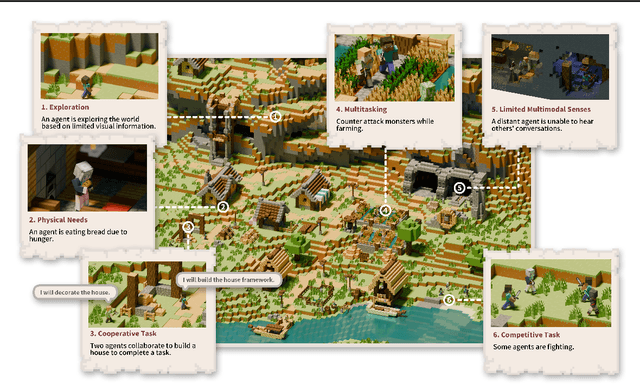
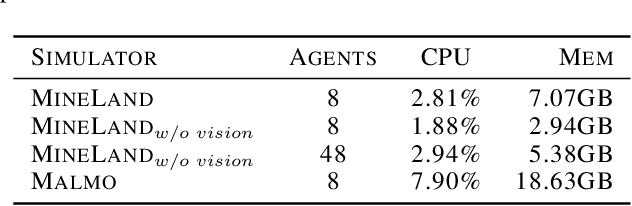
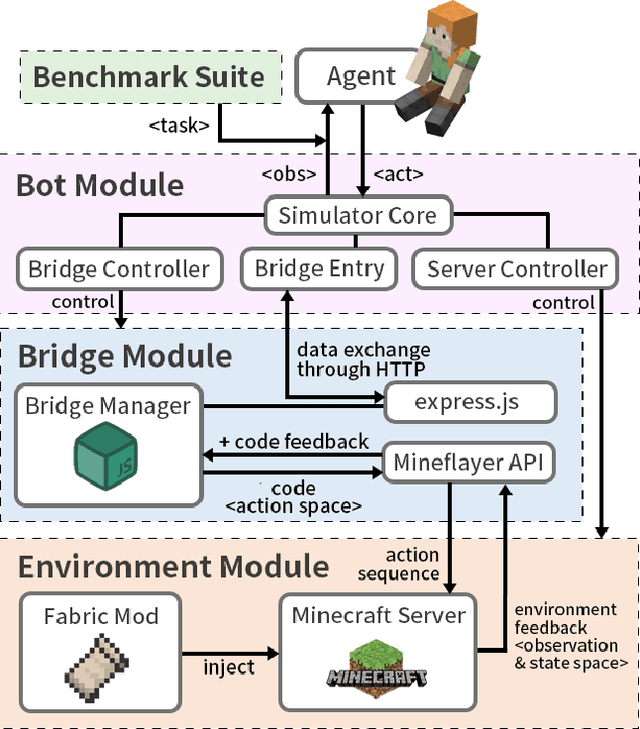

Conventional multi-agent simulators often assume perfect information and limitless capabilities, hindering the ecological validity of social interactions. We propose a multi-agent Minecraft simulator, MineLand, that bridges this gap by introducing limited multimodal senses and physical needs. Our simulator supports up to 48 agents with limited visual, auditory, and environmental awareness, forcing them to actively communicate and collaborate to fulfill physical needs like food and resources. This fosters dynamic and valid multi-agent interactions. We further introduce an AI agent framework, Alex, inspired by multitasking theory, enabling agents to handle intricate coordination and scheduling. Our experiments demonstrate that the simulator, the corresponding benchmark, and the AI agent framework contribute to more ecological and nuanced collective behavior. The source code of MineLand and Alex is openly available at https://github.com/cocacola-lab/MineLand.