 Add to Chrome
 Add to Firefox
 Add to Edge
Neural B-frame Video Compression with Bi-directional Reference Harmonization
Nov 12, 2025
Neural video compression (NVC) has made significant progress in recent years, while neural B-frame video compression (NBVC) remains underexplored compared to P-frame compression. NBVC can adopt bi-directional reference frames for better compression performance. However, NBVC's hierarchical coding may complicate continuous temporal prediction, especially at some hierarchical levels with a large frame span, which could cause the contribution of the two reference frames to be unbalanced. To optimize reference information utilization, we propose a novel NBVC method, termed Bi-directional Reference Harmonization Video Compression (BRHVC), with the proposed Bi-directional Motion Converge (BMC) and Bi-directional Contextual Fusion (BCF). BMC converges multiple optical flows in motion compression, leading to more accurate motion compensation on a larger scale. Then BCF explicitly models the weights of reference contexts under the guidance of motion compensation accuracy. With more efficient motions and contexts, BRHVC can effectively harmonize bi-directional references. Experimental results indicate that our BRHVC outperforms previous state-of-the-art NVC methods, even surpassing the traditional coding, VTM-RA (under random access configuration), on the HEVC datasets. The source code is released at https://github.com/kwai/NVC.

Ultra Lowrate Image Compression with Semantic Residual Coding and Compression-aware Diffusion
May 13, 2025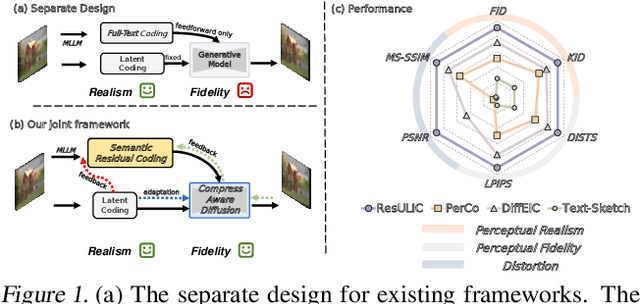
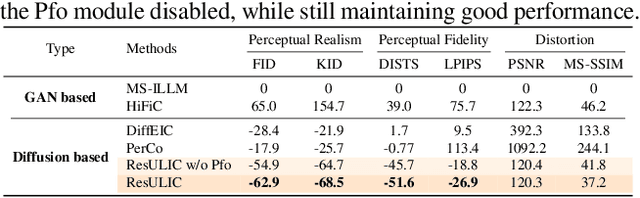
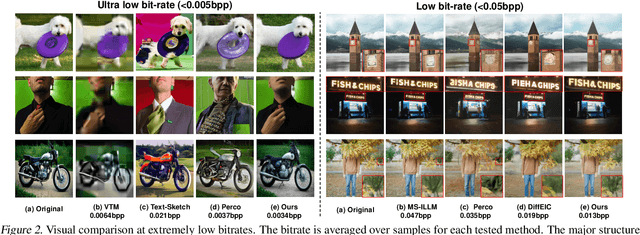
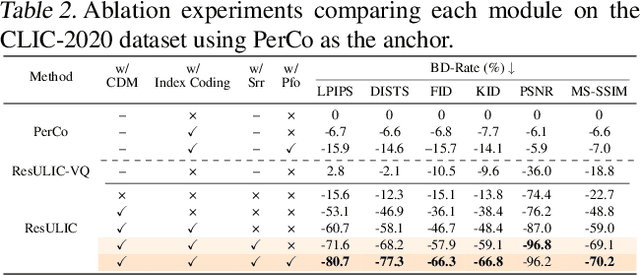
Existing multimodal large model-based image compression frameworks often rely on a fragmented integration of semantic retrieval, latent compression, and generative models, resulting in suboptimal performance in both reconstruction fidelity and coding efficiency. To address these challenges, we propose a residual-guided ultra lowrate image compression named ResULIC, which incorporates residual signals into both semantic retrieval and the diffusion-based generation process. Specifically, we introduce Semantic Residual Coding (SRC) to capture the semantic disparity between the original image and its compressed latent representation. A perceptual fidelity optimizer is further applied for superior reconstruction quality. Additionally, we present the Compression-aware Diffusion Model (CDM), which establishes an optimal alignment between bitrates and diffusion time steps, improving compression-reconstruction synergy. Extensive experiments demonstrate the effectiveness of ResULIC, achieving superior objective and subjective performance compared to state-of-the-art diffusion-based methods with - 80.7%, -66.3% BD-rate saving in terms of LPIPS and FID. Project page is available at https: //njuvision.github.io/ResULIC/.
Evaluating the Performance of ChatGPT for Spam Email Detection
Feb 23, 2024Email continues to be a pivotal and extensively utilized communication medium within professional and commercial domains. Nonetheless, the prevalence of spam emails poses a significant challenge for users, disrupting their daily routines and diminishing productivity. Consequently, accurately identifying and filtering spam based on content has become crucial for cybersecurity. Recent advancements in natural language processing, particularly with large language models like ChatGPT, have shown remarkable performance in tasks such as question answering and text generation. However, its potential in spam identification remains underexplored. To fill in the gap, this study attempts to evaluate ChatGPT's capabilities for spam identification in both English and Chinese email datasets. We employ ChatGPT for spam email detection using in-context learning, which requires a prompt instruction and a few demonstrations. We also investigate how the training example size affects the performance of ChatGPT. For comparison, we also implement five popular benchmark methods, including naive Bayes, support vector machines (SVM), logistic regression (LR), feedforward dense neural networks (DNN), and BERT classifiers. Though extensive experiments, the performance of ChatGPT is significantly worse than deep supervised learning methods in the large English dataset, while it presents superior performance on the low-resourced Chinese dataset, even outperforming BERT in this case.