 Add to Chrome
 Add to Firefox
 Add to Edge
Fewer Clarifications, Better Code: Benchmarking Cross-Session Personalized Ambiguity Adaptation in Coding Assistants
Jul 29, 2026
AI-assisted coding increasingly translates informal user intent into executable software, yet coding requests often contain ambiguities that recur in user-specific ways across tasks and sessions. Existing disambiguation methods typically address each ambiguous request in isolation within the current coding session, often through eliciting additional clarification. However, whether resolved session history from the same user can serve as memory for resolving recurring personalized ambiguity in a newly opened session remains underexplored. We formulate personalized ambiguity adaptation as a new task: given a user's previously resolved coding sessions and a new ambiguous request, an assistant should identify the recurring ambiguity pattern, produce the intended executable solution, and minimize clarification. To benchmark this task, we introduce CAPA, which characterizes personalized coding ambiguity through six mechanisms and injects these mechanisms into unambiguous executable tasks using a controlled three-stage generation pipeline. CAPA contains 600 coding sessions across 60 balanced user--ambiguity cells, including 300 held-out evaluation sessions. We evaluate 12 recent LLMs under no-history and same-user-history conditions using executable success, first-turn success, and turns-to-completion. Our analyses examine task difficulty, user identity, and memory-based history use, and we further propose same-user history gating as a lightweight inference-time method. CAPA provides a foundation for developing long-term coding assistants that better align generated code with user intent while reducing repeated clarification.

Are LLMs Ready for Scientific Discovery? A Capability-Oriented Benchmark for AI Scientists
Jul 13, 2026Existing benchmarks for scientific data analysis evaluate LLMs primarily on code execution or workflow completion, overlooking that scientific analysis serves to support distinct types of scientific claims: hypothesis exploration, statistical inference, mechanistic explanation, each with different assumptions and validity criteria. We introduce SDABench, a benchmark that reorganizes evaluation around six capabilities (descriptive, exploratory, inferential, predictive, causal, and mechanistic) across five domains (Biology, Chemistry, Environment, Geography, Physics). SDABench comprises 527 real-data instances (SDA-Real) and 6000 synthetic instances (SDA-Synth), each in both multiple-choice and open-ended formats, constructed through an automated pipeline. Evaluating 15 representative LLMs, we find that models handle descriptive analysis well but degrade sharply on tasks requiring assumption selection, latent-process modeling, or mechanistic reasoning. SDABench further provides a five-stage error analysis framework that locates where LLMs fail: more advanced models more reliably identify the relevant scope and variables, but still struggle to select appropriate analytical procedures, model variable relationships, and draw valid conclusions.
DiscipLink: Unfolding Interdisciplinary Information Seeking Process via Human-AI Co-Exploration
Aug 01, 2024


Interdisciplinary studies often require researchers to explore literature in diverse branches of knowledge. Yet, navigating through the highly scattered knowledge from unfamiliar disciplines poses a significant challenge. In this paper, we introduce DiscipLink, a novel interactive system that facilitates collaboration between researchers and large language models (LLMs) in interdisciplinary information seeking (IIS). Based on users' topics of interest, DiscipLink initiates exploratory questions from the perspectives of possible relevant fields of study, and users can further tailor these questions. DiscipLink then supports users in searching and screening papers under selected questions by automatically expanding queries with disciplinary-specific terminologies, extracting themes from retrieved papers, and highlighting the connections between papers and questions. Our evaluation, comprising a within-subject comparative experiment and an open-ended exploratory study, reveals that DiscipLink can effectively support researchers in breaking down disciplinary boundaries and integrating scattered knowledge in diverse fields. The findings underscore the potential of LLM-powered tools in fostering information-seeking practices and bolstering interdisciplinary research.
FARPLS: A Feature-Augmented Robot Trajectory Preference Labeling System to Assist Human Labelers' Preference Elicitation
Mar 10, 2024Preference-based learning aims to align robot task objectives with human values. One of the most common methods to infer human preferences is by pairwise comparisons of robot task trajectories. Traditional comparison-based preference labeling systems seldom support labelers to digest and identify critical differences between complex trajectories recorded in videos. Our formative study (N = 12) suggests that individuals may overlook non-salient task features and establish biased preference criteria during their preference elicitation process because of partial observations. In addition, they may experience mental fatigue when given many pairs to compare, causing their label quality to deteriorate. To mitigate these issues, we propose FARPLS, a Feature-Augmented Robot trajectory Preference Labeling System. FARPLS highlights potential outliers in a wide variety of task features that matter to humans and extracts the corresponding video keyframes for easy review and comparison. It also dynamically adjusts the labeling order according to users' familiarities, difficulties of the trajectory pair, and level of disagreements. At the same time, the system monitors labelers' consistency and provides feedback on labeling progress to keep labelers engaged. A between-subjects study (N = 42, 105 pairs of robot pick-and-place trajectories per person) shows that FARPLS can help users establish preference criteria more easily and notice more relevant details in the presented trajectories than the conventional interface. FARPLS also improves labeling consistency and engagement, mitigating challenges in preference elicitation without raising cognitive loads significantly
Competent but Rigid: Identifying the Gap in Empowering AI to Participate Equally in Group Decision-Making
Feb 17, 2023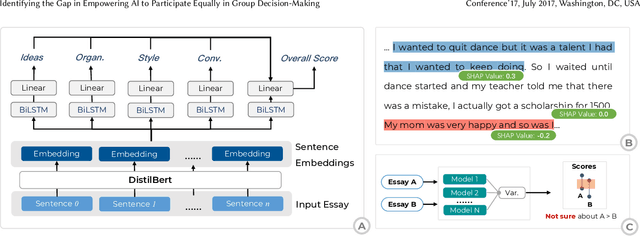

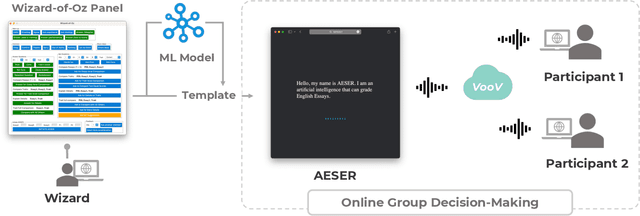
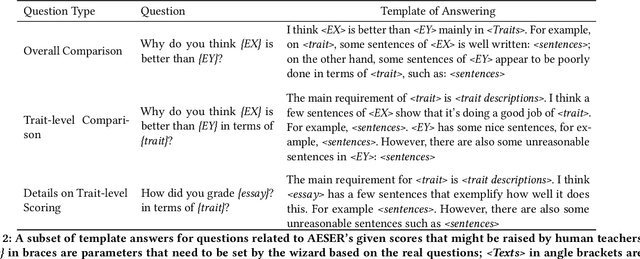
Existing research on human-AI collaborative decision-making focuses mainly on the interaction between AI and individual decision-makers. There is a limited understanding of how AI may perform in group decision-making. This paper presents a wizard-of-oz study in which two participants and an AI form a committee to rank three English essays. One novelty of our study is that we adopt a speculative design by endowing AI equal power to humans in group decision-making.We enable the AI to discuss and vote equally with other human members. We find that although the voice of AI is considered valuable, AI still plays a secondary role in the group because it cannot fully follow the dynamics of the discussion and make progressive contributions. Moreover, the divergent opinions of our participants regarding an "equal AI" shed light on the possible future of human-AI relations.
Who Should I Trust: AI or Myself? Leveraging Human and AI Correctness Likelihood to Promote Appropriate Trust in AI-Assisted Decision-Making
Jan 14, 2023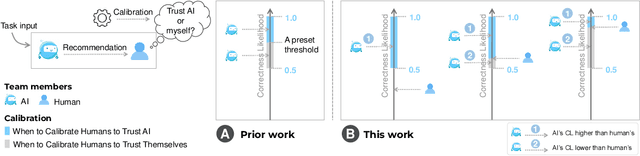
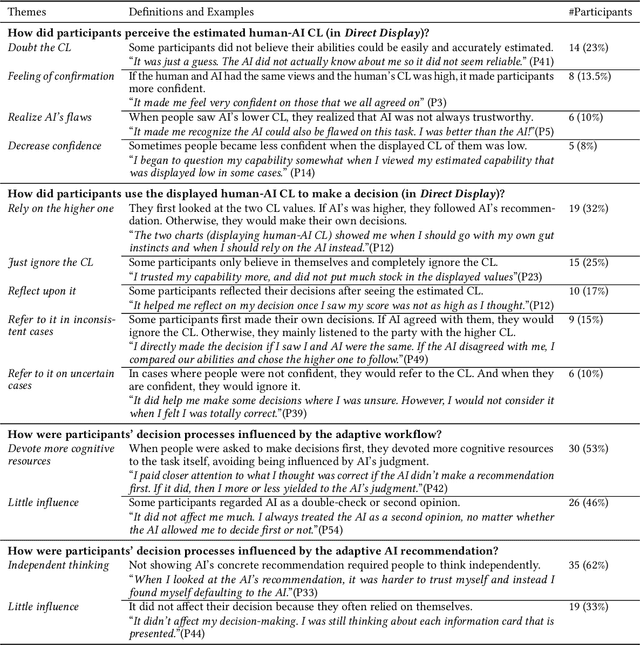


In AI-assisted decision-making, it is critical for human decision-makers to know when to trust AI and when to trust themselves. However, prior studies calibrated human trust only based on AI confidence indicating AI's correctness likelihood (CL) but ignored humans' CL, hindering optimal team decision-making. To mitigate this gap, we proposed to promote humans' appropriate trust based on the CL of both sides at a task-instance level. We first modeled humans' CL by approximating their decision-making models and computing their potential performance in similar instances. We demonstrated the feasibility and effectiveness of our model via two preliminary studies. Then, we proposed three CL exploitation strategies to calibrate users' trust explicitly/implicitly in the AI-assisted decision-making process. Results from a between-subjects experiment (N=293) showed that our CL exploitation strategies promoted more appropriate human trust in AI, compared with only using AI confidence. We further provided practical implications for more human-compatible AI-assisted decision-making.
Branch Ranking for Efficient Mixed-Integer Programming via Offline Ranking-based Policy Learning
Jul 26, 2022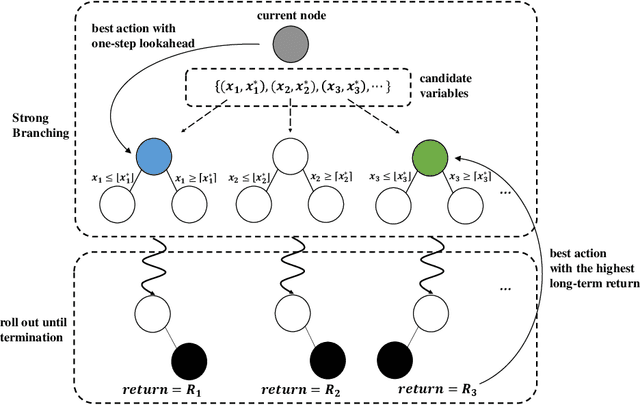
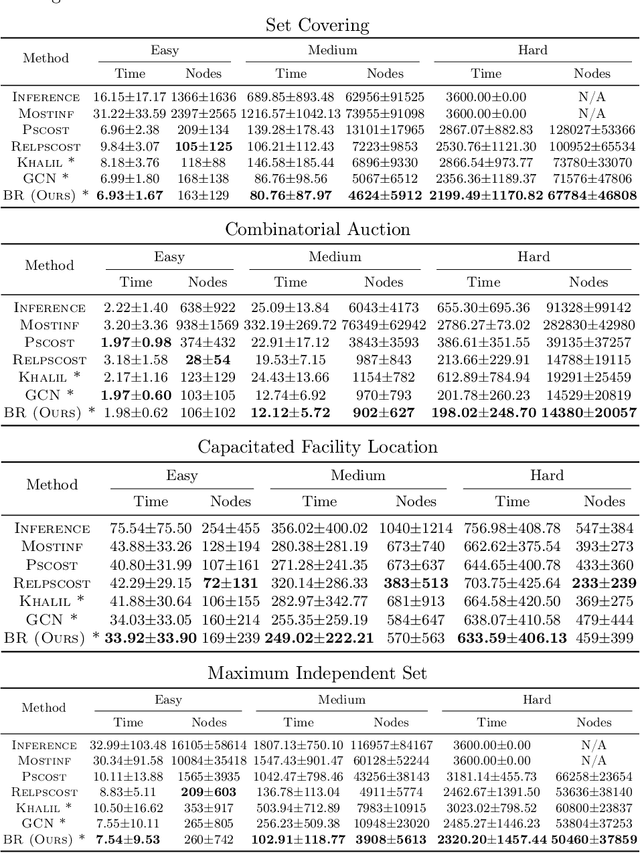
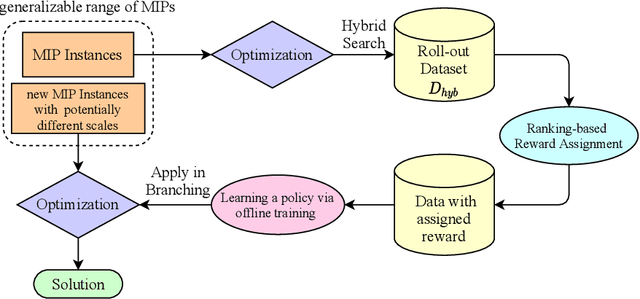

Deriving a good variable selection strategy in branch-and-bound is essential for the efficiency of modern mixed-integer programming (MIP) solvers. With MIP branching data collected during the previous solution process, learning to branch methods have recently become superior over heuristics. As branch-and-bound is naturally a sequential decision making task, one should learn to optimize the utility of the whole MIP solving process instead of being myopic on each step. In this work, we formulate learning to branch as an offline reinforcement learning (RL) problem, and propose a long-sighted hybrid search scheme to construct the offline MIP dataset, which values the long-term utilities of branching decisions. During the policy training phase, we deploy a ranking-based reward assignment scheme to distinguish the promising samples from the long-term or short-term view, and train the branching model named Branch Ranking via offline policy learning. Experiments on synthetic MIP benchmarks and real-world tasks demonstrate that Branch Rankink is more efficient and robust, and can better generalize to large scales of MIP instances compared to the widely used heuristics and state-of-the-art learning-based branching models.