 Add to Chrome
 Add to Firefox
 Add to Edge
Are GUI Agents Focused Enough? Automated Distraction via Semantic-level UI Element Injection
Apr 09, 2026
Existing red-teaming studies on GUI agents have important limitations. Adversarial perturbations typically require white-box access, which is unavailable for commercial systems, while prompt injection is increasingly mitigated by stronger safety alignment. To study robustness under a more practical threat model, we propose Semantic-level UI Element Injection, a red-teaming setting that overlays safety-aligned and harmless UI elements onto screenshots to misdirect the agent's visual grounding. Our method uses a modular Editor-Overlapper-Victim pipeline and an iterative search procedure that samples multiple candidate edits, keeps the best cumulative overlay, and adapts future prompt strategies based on previous failures. Across five victim models, our optimized attacks improve attack success rate by up to 4.4x over random injection on the strongest victims. Moreover, elements optimized on one source model transfer effectively to other target models, indicating model-agnostic vulnerabilities. After the first successful attack, the victim still clicks the attacker-controlled element in more than 15% of later independent trials, versus below 1% for random injection, showing that the injected element acts as a persistent attractor rather than simple visual clutter.

SPA-Bench: A Comprehensive Benchmark for SmartPhone Agent Evaluation
Oct 19, 2024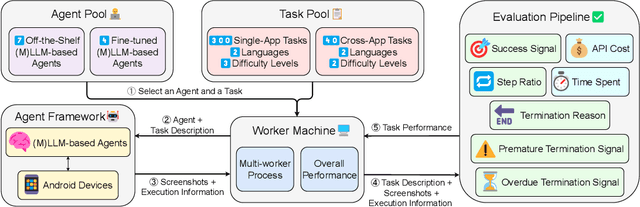

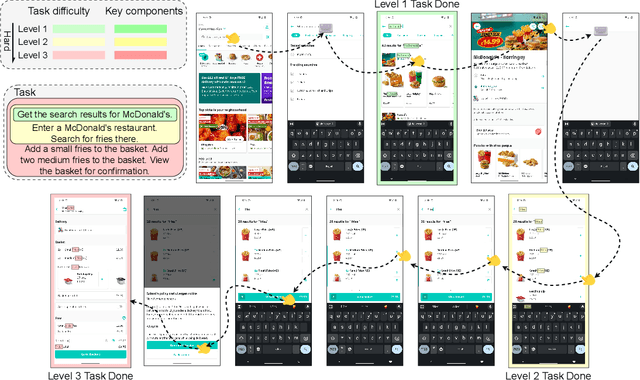

Smartphone agents are increasingly important for helping users control devices efficiently, with (Multimodal) Large Language Model (MLLM)-based approaches emerging as key contenders. Fairly comparing these agents is essential but challenging, requiring a varied task scope, the integration of agents with different implementations, and a generalisable evaluation pipeline to assess their strengths and weaknesses. In this paper, we present SPA-Bench, a comprehensive SmartPhone Agent Benchmark designed to evaluate (M)LLM-based agents in an interactive environment that simulates real-world conditions. SPA-Bench offers three key contributions: (1) A diverse set of tasks covering system and third-party apps in both English and Chinese, focusing on features commonly used in daily routines; (2) A plug-and-play framework enabling real-time agent interaction with Android devices, integrating over ten agents with the flexibility to add more; (3) A novel evaluation pipeline that automatically assesses agent performance across multiple dimensions, encompassing seven metrics related to task completion and resource consumption. Our extensive experiments across tasks and agents reveal challenges like interpreting mobile user interfaces, action grounding, memory retention, and execution costs. We propose future research directions to ease these difficulties, moving closer to real-world smartphone agent applications.