 Add to Chrome
 Add to Firefox
 Add to Edge
ConsisVLA-4D: Advancing Spatiotemporal Consistency in Efficient 3D-Perception and 4D-Reasoning for Robotic Manipulation
May 06, 2026
Current Vision-Language-Action (VLA) models primarily focus on mapping 2D observations to actions, but exhibit notable limitations in spatiotemporal perception and reasoning: 1) spatial representations often rely on additional sensors, introducing substantial computational overhead; 2) visual reasoning is typically limited to future-frame prediction, lacking alignment with the instruction-grounded scene and thus compromising spatiotemporal consistency. To address these challenges, we propose ConsisVLA-4D, a unified and efficient framework that enhances spatiotemporal consistency in 3D perception and 4D reasoning. Specifically, we design: 1) CV-Aligner, which ensures cross-view object semantic consistency by filtering instruction-relevant regions and aligning object identities across multiple viewpoints; 2) CO-Fuser, which guarantees cross-object spatial geometric consistency by eliminating spatial relation ambiguities between objects across views using compact latent representations. Building upon these, we introduce 3) CS-Thinker to achieve cross-scene spatiotemporal consistency as actions unfold. It learns implicit knowledge of local dynamics from object-semantic tokens of CV-Aligner and global depth from geometric tokens of CO-Fuser, thereby enhancing efficient visual reasoning under scene variations. Extensive experiments demonstrate that, benefiting from its efficient spatiotemporal consistency design, ConsisVLA-4D achieves 21.6% and 41.5% performance improvements, along with 2.3-fold and 2.4-fold inference speedups compared to OpenVLA on the LIBERO benchmark and real-world platforms, respectively.ConsisVLA-4D is open-sourced and publicly available at

SPA-Bench: A Comprehensive Benchmark for SmartPhone Agent Evaluation
Oct 19, 2024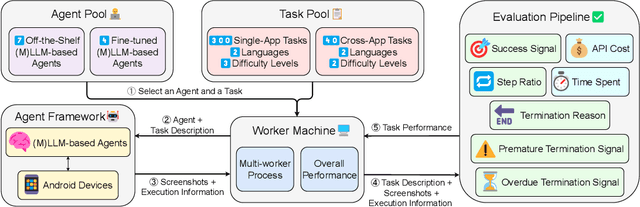

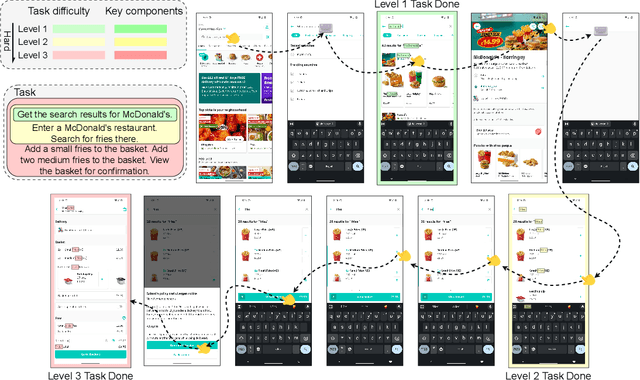

Smartphone agents are increasingly important for helping users control devices efficiently, with (Multimodal) Large Language Model (MLLM)-based approaches emerging as key contenders. Fairly comparing these agents is essential but challenging, requiring a varied task scope, the integration of agents with different implementations, and a generalisable evaluation pipeline to assess their strengths and weaknesses. In this paper, we present SPA-Bench, a comprehensive SmartPhone Agent Benchmark designed to evaluate (M)LLM-based agents in an interactive environment that simulates real-world conditions. SPA-Bench offers three key contributions: (1) A diverse set of tasks covering system and third-party apps in both English and Chinese, focusing on features commonly used in daily routines; (2) A plug-and-play framework enabling real-time agent interaction with Android devices, integrating over ten agents with the flexibility to add more; (3) A novel evaluation pipeline that automatically assesses agent performance across multiple dimensions, encompassing seven metrics related to task completion and resource consumption. Our extensive experiments across tasks and agents reveal challenges like interpreting mobile user interfaces, action grounding, memory retention, and execution costs. We propose future research directions to ease these difficulties, moving closer to real-world smartphone agent applications.