 Add to Chrome
 Add to Firefox
 Add to Edge
Transformer learns the cross-task prior and regularization for in-context learning
May 17, 2025
Transformers have shown a remarkable ability for in-context learning (ICL), making predictions based on contextual examples. However, while theoretical analyses have explored this prediction capability, the nature of the inferred context and its utility for downstream predictions remain open questions. This paper aims to address these questions by examining ICL for inverse linear regression (ILR), where context inference can be characterized by unsupervised learning of underlying weight vectors. Focusing on the challenging scenario of rank-deficient inverse problems, where context length is smaller than the number of unknowns in the weight vectors and regularization is necessary, we introduce a linear transformer to learn the inverse mapping from contextual examples to the underlying weight vector. Our findings reveal that the transformer implicitly learns both a prior distribution and an effective regularization strategy, outperforming traditional ridge regression and regularization methods. A key insight is the necessity of low task dimensionality relative to the context length for successful learning. Furthermore, we numerically verify that the error of the transformer estimator scales linearly with the noise level, the ratio of task dimension to context length, and the condition number of the input data. These results not only demonstrate the potential of transformers for solving ill-posed inverse problems, but also provide a new perspective towards understanding the knowledge extraction mechanism within transformers.

MiMo: Unlocking the Reasoning Potential of Language Model -- From Pretraining to Posttraining
May 12, 2025We present MiMo-7B, a large language model born for reasoning tasks, with optimization across both pre-training and post-training stages. During pre-training, we enhance the data preprocessing pipeline and employ a three-stage data mixing strategy to strengthen the base model's reasoning potential. MiMo-7B-Base is pre-trained on 25 trillion tokens, with additional Multi-Token Prediction objective for enhanced performance and accelerated inference speed. During post-training, we curate a dataset of 130K verifiable mathematics and programming problems for reinforcement learning, integrating a test-difficulty-driven code-reward scheme to alleviate sparse-reward issues and employing strategic data resampling to stabilize training. Extensive evaluations show that MiMo-7B-Base possesses exceptional reasoning potential, outperforming even much larger 32B models. The final RL-tuned model, MiMo-7B-RL, achieves superior performance on mathematics, code and general reasoning tasks, surpassing the performance of OpenAI o1-mini. The model checkpoints are available at https://github.com/xiaomimimo/MiMo.
Monotone Peridynamic Neural Operator for Nonlinear Material Modeling with Conditionally Unique Solutions
May 02, 2025

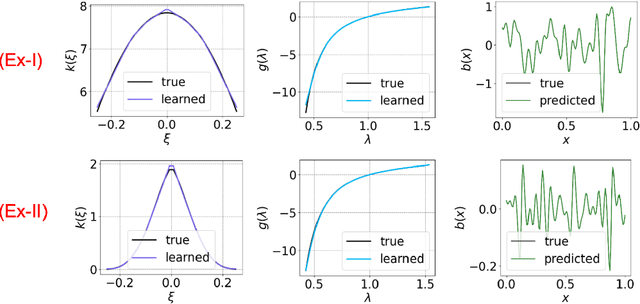
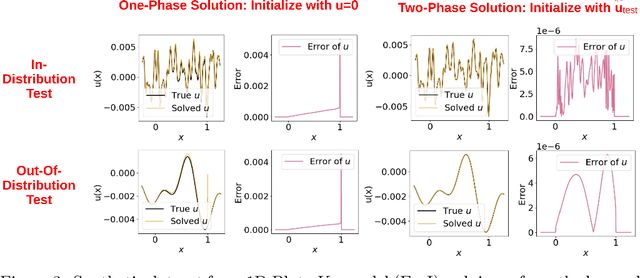
Data-driven methods have emerged as powerful tools for modeling the responses of complex nonlinear materials directly from experimental measurements. Among these methods, the data-driven constitutive models present advantages in physical interpretability and generalizability across different boundary conditions/domain settings. However, the well-posedness of these learned models is generally not guaranteed a priori, which makes the models prone to non-physical solutions in downstream simulation tasks. In this study, we introduce monotone peridynamic neural operator (MPNO), a novel data-driven nonlocal constitutive model learning approach based on neural operators. Our approach learns a nonlocal kernel together with a nonlinear constitutive relation, while ensuring solution uniqueness through a monotone gradient network. This architectural constraint on gradient induces convexity of the learnt energy density function, thereby guaranteeing solution uniqueness of MPNO in small deformation regimes. To validate our approach, we evaluate MPNO's performance on both synthetic and real-world datasets. On synthetic datasets with manufactured kernel and constitutive relation, we show that the learnt model converges to the ground-truth as the measurement grid size decreases both theoretically and numerically. Additionally, our MPNO exhibits superior generalization capabilities than the conventional neural networks: it yields smaller displacement solution errors in down-stream tasks with new and unseen loadings. Finally, we showcase the practical utility of our approach through applications in learning a homogenized model from molecular dynamics data, highlighting its expressivity and robustness in real-world scenarios.
Collab-RAG: Boosting Retrieval-Augmented Generation for Complex Question Answering via White-Box and Black-Box LLM Collaboration
Apr 07, 2025Retrieval-Augmented Generation (RAG) systems often struggle to handle multi-hop question-answering tasks accurately due to irrelevant context retrieval and limited complex reasoning capabilities. We introduce Collab-RAG, a collaborative training framework that leverages mutual enhancement between a white-box small language model (SLM) and a blackbox large language model (LLM) for RAG. Specifically, the SLM decomposes complex queries into simpler sub-questions, thus enhancing the accuracy of the retrieval and facilitating more effective reasoning by the black-box LLM. Concurrently, the black-box LLM provides feedback signals to improve the SLM's decomposition capability. We observe that Collab-RAG relies solely on supervision from an affordable black-box LLM without additional distillation from frontier LLMs, yet demonstrates strong generalization across multiple black-box LLMs. Experimental evaluations across five multi-hop QA datasets demonstrate that Collab-RAG substantially outperforms existing black-box-only and SLM fine-tuning baselines by 1.8%-14.2% on average. In particular, our fine-tuned 3B SLM surpasses a frozen 32B LLM in question decomposition, highlighting the efficiency of Collab-RAG in improving reasoning and retrieval for complex questions. The code of Collab-RAG is available on https://github.com/ritaranx/Collab-RAG/.
RingMoE: Mixture-of-Modality-Experts Multi-Modal Foundation Models for Universal Remote Sensing Image Interpretation
Apr 04, 2025The rapid advancement of foundation models has revolutionized visual representation learning in a self-supervised manner. However, their application in remote sensing (RS) remains constrained by a fundamental gap: existing models predominantly handle single or limited modalities, overlooking the inherently multi-modal nature of RS observations. Optical, synthetic aperture radar (SAR), and multi-spectral data offer complementary insights that significantly reduce the inherent ambiguity and uncertainty in single-source analysis. To bridge this gap, we introduce RingMoE, a unified multi-modal RS foundation model with 14.7 billion parameters, pre-trained on 400 million multi-modal RS images from nine satellites. RingMoE incorporates three key innovations: (1) A hierarchical Mixture-of-Experts (MoE) architecture comprising modal-specialized, collaborative, and shared experts, effectively modeling intra-modal knowledge while capturing cross-modal dependencies to mitigate conflicts between modal representations; (2) Physics-informed self-supervised learning, explicitly embedding sensor-specific radiometric characteristics into the pre-training objectives; (3) Dynamic expert pruning, enabling adaptive model compression from 14.7B to 1B parameters while maintaining performance, facilitating efficient deployment in Earth observation applications. Evaluated across 23 benchmarks spanning six key RS tasks (i.e., classification, detection, segmentation, tracking, change detection, and depth estimation), RingMoE outperforms existing foundation models and sets new SOTAs, demonstrating remarkable adaptability from single-modal to multi-modal scenarios. Beyond theoretical progress, it has been deployed and trialed in multiple sectors, including emergency response, land management, marine sciences, and urban planning.
Revealing the Implicit Noise-based Imprint of Generative Models
Mar 12, 2025With the rapid advancement of vision generation models, the potential security risks stemming from synthetic visual content have garnered increasing attention, posing significant challenges for AI-generated image detection. Existing methods suffer from inadequate generalization capabilities, resulting in unsatisfactory performance on emerging generative models. To address this issue, this paper presents a novel framework that leverages noise-based model-specific imprint for the detection task. Specifically, we propose a novel noise-based imprint simulator to capture intrinsic patterns imprinted in images generated by different models. By aggregating imprints from various generative models, imprints of future models can be extrapolated to expand training data, thereby enhancing generalization and robustness. Furthermore, we design a new pipeline that pioneers the use of noise patterns, derived from a noise-based imprint extractor, alongside other visual features for AI-generated image detection, resulting in a significant improvement in performance. Our approach achieves state-of-the-art performance across three public benchmarks including GenImage, Synthbuster and Chameleon.
An optimal Petrov-Galerkin framework for operator networks
Mar 06, 2025The optimal Petrov-Galerkin formulation to solve partial differential equations (PDEs) recovers the best approximation in a specified finite-dimensional (trial) space with respect to a suitable norm. However, the recovery of this optimal solution is contingent on being able to construct the optimal weighting functions associated with the trial basis. While explicit constructions are available for simple one- and two-dimensional problems, such constructions for a general multidimensional problem remain elusive. In the present work, we revisit the optimal Petrov-Galerkin formulation through the lens of deep learning. We propose an operator network framework called Petrov-Galerkin Variationally Mimetic Operator Network (PG-VarMiON), which emulates the optimal Petrov-Galerkin weak form of the underlying PDE. The PG-VarMiON is trained in a supervised manner using a labeled dataset comprising the PDE data and the corresponding PDE solution, with the training loss depending on the choice of the optimal norm. The special architecture of the PG-VarMiON allows it to implicitly learn the optimal weighting functions, thus endowing the proposed operator network with the ability to generalize well beyond the training set. We derive approximation error estimates for PG-VarMiON, highlighting the contributions of various error sources, particularly the error in learning the true weighting functions. Several numerical results are presented for the advection-diffusion equation to demonstrate the efficacy of the proposed method. By embedding the Petrov-Galerkin structure into the network architecture, PG-VarMiON exhibits greater robustness and improved generalization compared to other popular deep operator frameworks, particularly when the training data is limited.
Accurate Expert Predictions in MoE Inference via Cross-Layer Gate
Feb 17, 2025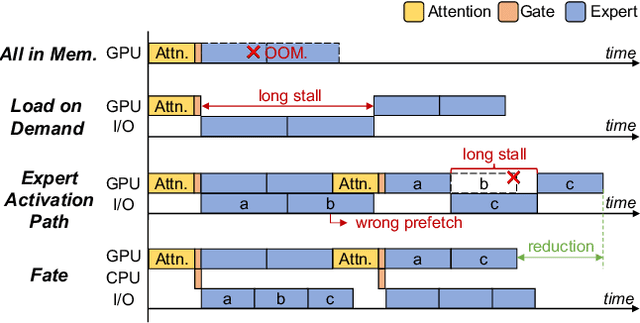
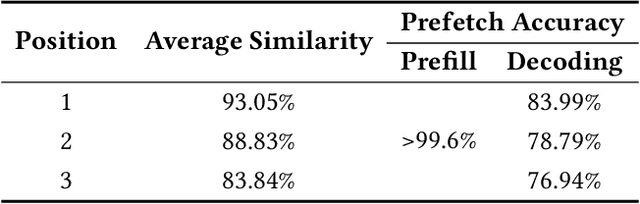
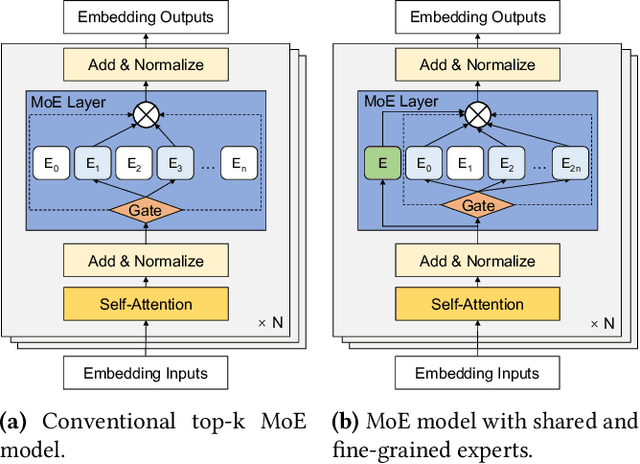
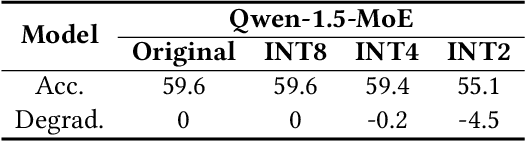
Large Language Models (LLMs) have demonstrated impressive performance across various tasks, and their application in edge scenarios has attracted significant attention. However, sparse-activated Mixture-of-Experts (MoE) models, which are well suited for edge scenarios, have received relatively little attention due to their high memory demands. Offload-based methods have been proposed to address this challenge, but they face difficulties with expert prediction. Inaccurate expert predictions can result in prolonged inference delays. To promote the application of MoE models in edge scenarios, we propose Fate, an offloading system designed for MoE models to enable efficient inference in resource-constrained environments. The key insight behind Fate is that gate inputs from adjacent layers can be effectively used for expert prefetching, achieving high prediction accuracy without additional GPU overhead. Furthermore, Fate employs a shallow-favoring expert caching strategy that increases the expert hit rate to 99\%. Additionally, Fate integrates tailored quantization strategies for cache optimization and IO efficiency. Experimental results show that, compared to Load on Demand and Expert Activation Path-based method, Fate achieves up to 4.5x and 1.9x speedups in prefill speed and up to 4.1x and 2.2x speedups in decoding speed, respectively, while maintaining inference quality. Moreover, Fate's performance improvements are scalable across different memory budgets.
Klotski: Efficient Mixture-of-Expert Inference via Expert-Aware Multi-Batch Pipeline
Feb 09, 2025Mixture of Experts (MoE), with its distinctive sparse structure, enables the scaling of language models up to trillions of parameters without significantly increasing computational costs. However, the substantial parameter size presents a challenge for inference, as the expansion in GPU memory cannot keep pace with the growth in parameters. Although offloading techniques utilise memory from the CPU and disk and parallelise the I/O and computation for efficiency, the computation for each expert in MoE models is often less than the I/O, resulting in numerous bubbles in the pipeline. Therefore, we propose Klotski, an efficient MoE inference engine that significantly reduces pipeline bubbles through a novel expert-aware multi-batch pipeline paradigm. The proposed paradigm uses batch processing to extend the computation time of the current layer to overlap with the loading time of the next layer. Although this idea has been effectively applied to dense models, more batches may activate more experts in the MoE, leading to longer loading times and more bubbles. Thus, unlike traditional approaches, we balance computation and I/O time and minimise bubbles by orchestrating their inference orders based on their heterogeneous computation and I/O requirements and activation patterns under different batch numbers. Moreover, to adapt to different hardware environments and models, we design a constraint-sensitive I/O-compute planner and a correlation-aware expert prefetcher for a schedule that minimises pipeline bubbles. Experimental results demonstrate that Klotski achieves a superior throughput-latency trade-off compared to state-of-the-art techniques, with throughput improvements of up to 85.12x.
Leveraging Chain of Thought towards Empathetic Spoken Dialogue without Corresponding Question-Answering Data
Jan 19, 2025


Empathetic dialogue is crucial for natural human-computer interaction, allowing the dialogue system to respond in a more personalized and emotionally aware manner, improving user satisfaction and engagement. The emergence of large language models (LLMs) has revolutionized dialogue generation by harnessing their powerful capabilities and shown its potential in multimodal domains. Many studies have integrated speech with text-based LLMs to take speech question as input and output text response. However, the lack of spoken question-answering datasets that include speech style information to supervised fine-tuning (SFT) limits the performance of these systems. As a result, while these systems excel at understanding speech content, they often struggle to generate empathetic responses. In response, we propose a novel approach that circumvents the need for question-answering data, called Listen, Perceive, and Express (LPE). Our method employs a two-stage training process, initially guiding the LLM to listen the content and perceive the emotional aspects of speech. Subsequently, we utilize Chain-of-Thought (CoT) prompting to unlock the model's potential for expressing empathetic responses based on listened spoken content and perceived emotional cues. We employ experiments to prove the effectiveness of proposed method. To our knowledge, this is the first attempt to leverage CoT for speech-based dialogue.