 Add to Chrome
 Add to Firefox
 Add to Edge
Beyond Domains: Reusing Web Skills via Transferable Interaction Patterns
Jun 16, 2026
Large language model (LLM) web agents are usually deployed as tool callers: each turn, the model reads a fresh page observation and emits one structured tool action. When every action is a low-level primitive, horizons grow quickly and so do policy-facing LLM completions, dominating latency and cost on benchmarks such as Mind2Web and WebArena. Recent systems therefore wrap repeated interaction fragments as web skills: callable tools built from successful trajectories or induced programs, so one call can replace several primitives. However, prior skill libraries are still triggered mainly by instruction similarity or coarse site metadata, which yields low skill reuse on held-out sites and leaves much of the potential step and token reduction on the table. We present SkillMigrator, an agent that learns reusable web skills and transfers them across sites by matching layout structure rather than specific element references. Each induced skill is stored as a transferable interaction pattern (TIP): the skill paired with a structural sketch of the snapshot at induction time. At test time, SkillMigrator retrieves TIPs by layout similarity and grounds their references on the live page. The rest of the stack is standard: accessibility-snapshot observations with stable references, and fixed tool calling over primitives plus skill invocations. Compared with the state-of-the-art approaches, SkillMigrator reduces the average LLM-action count on successful trajectories by 8-10% across both WebArena and Mind2Web at matched success rate.

From Coarse to Fine: Managing Temporal Granularity in Spatio-Temporal Data for Fine-Grained Traffic Prediction
Jun 08, 2026Efficient acquisition, storage, and utilization of traffic data are critical challenges in spatio-temporal data management. Most traffic data systems collect and store observations at fixed, coarse-grained temporal intervals to reduce storage and computation costs. However, such coarse-grained data severely limits downstream applications that require predictions at a finer temporal granularity. Collecting and maintaining fine-grained traffic data across all locations and time periods would impose a substantial burden on database storage and preprocessing pipelines. To address this temporal granularity mismatch, we formulate a novel problem: predicting fine-grained future traffic using coarse-grained sampled data. We propose the Spatial-Temporal Refinement Predictor (STRP), a granularity-aware framework for spatio-temporal data systems. STRP integrates two components: Tree Convolution for efficient and interpretable spatial dependency modeling, and Inverse Dilated Convolution for progressive temporal extrapolation. STRP supports two practical prediction settings: window-based and duration-based, to handle different forms of granularity mismatch. Experiments on six benchmark datasets show that STRP significantly outperforms state-of-the-art baselines in both accuracy and efficiency. Our work offers a practical and interpretable approach to managing granularity mismatches in spatio-temporal traffic data systems.
LoopGuard: Breaking Self-Reinforcing Attention Loops via Dynamic KV Cache Intervention
Apr 11, 2026Through systematic experiments on long-context generation, we observe a damaging failure mode in which decoding can collapse into persistent repetition loops. We find that this degeneration is driven by collapsed attention patterns, where a subset of heads locks onto a narrow suffix of the history, and is further stabilized by inference-time KV cache reuse. Crucially, since many existing KV cache policies rely on attention-based importance, this collapse can produce spuriously high scores for repetitive tokens, causing cache management to inadvertently amplify repetition. To study this phenomenon in a controlled and reproducible manner, we introduce LoopBench, a benchmark with explicit loop-inducing conditions and loop-oriented metrics that quantify repetition severity and generation instability beyond downstream task scores. Building on these insights, we propose LoopGuard, a lightweight, plug-in KV cache guard that detects loop onset online and disrupts the feedback cycle by pruning repetitive tail spans under a fixed cache budget. Experiments on LoopBench show that LoopGuard reduces loop incidence by over 90 percentage points, while restoring output diversity and reducing token waste.
Head-wise Modality Specialization within MLLMs for Robust Fake News Detection under Missing Modality
Apr 08, 2026Multimodal fake news detection (MFND) aims to verify news credibility by jointly exploiting textual and visual evidence. However, real-world news dissemination frequently suffers from missing modality due to deleted images, corrupted screenshots, and similar issues. Thus, robust detection in this scenario requires preserving strong verification ability for each modality, which is challenging in MFND due to insufficient learning of the low-contribution modality and scarce unimodal annotations. To address this issue, we propose Head-wise Modality Specialization within Multimodal Large Language Models (MLLMs) for robust MFND under missing modality. Specifically, we first systematically study attention heads in MLLMs and their relationship with performance under missing modality, showing that modality-critical heads serve as key carriers of unimodal verification ability through their modality specialization. Based on this observation, to better preserve verification ability for the low-contribution modality, we introduce a head-wise specialization mechanism that explicitly allocates these heads to different modalities and preserves their specialization through lower-bound attention constraints. Furthermore, to better exploit scarce unimodal annotations, we propose a Unimodal Knowledge Retention strategy that prevents these heads from drifting away from the unimodal knowledge learned from limited supervision. Experiments show that our method improves robustness under missing modality while preserving performance with full multimodal input.
E3-Rewrite: Learning to Rewrite SQL for Executability, Equivalence,and Efficiency
Aug 12, 2025SQL query rewriting aims to reformulate a query into a more efficient form while preserving equivalence. Most existing methods rely on predefined rewrite rules. However, such rule-based approaches face fundamental limitations: (1) fixed rule sets generalize poorly to novel query patterns and struggle with complex queries; (2) a wide range of effective rewriting strategies cannot be fully captured by declarative rules. To overcome these issues, we propose using large language models (LLMs) to generate rewrites. LLMs can capture complex strategies, such as evaluation reordering and CTE rewriting. Despite this potential, directly applying LLMs often results in suboptimal or non-equivalent rewrites due to a lack of execution awareness and semantic grounding. To address these challenges, We present E3-Rewrite, an LLM-based SQL rewriting framework that produces executable, equivalent, and efficient queries. It integrates two core components: a context construction module and a reinforcement learning framework. First, the context module leverages execution plans and retrieved demonstrations to build bottleneck-aware prompts that guide inference-time rewriting. Second, we design a reward function targeting executability, equivalence, and efficiency, evaluated via syntax checks, equivalence verification, and cost estimation. Third, to ensure stable multi-objective learning, we adopt a staged curriculum that first emphasizes executability and equivalence, then gradually incorporates efficiency. Extensive experiments show that E3-Rewrite achieves up to a 25.6\% reduction in query execution time compared to state-of-the-art methods across multiple SQL benchmarks. Moreover, it delivers up to 24.4\% more successful rewrites, expanding coverage to complex queries that previous systems failed to handle.
Adaptation Method for Misinformation Identification
Apr 19, 2025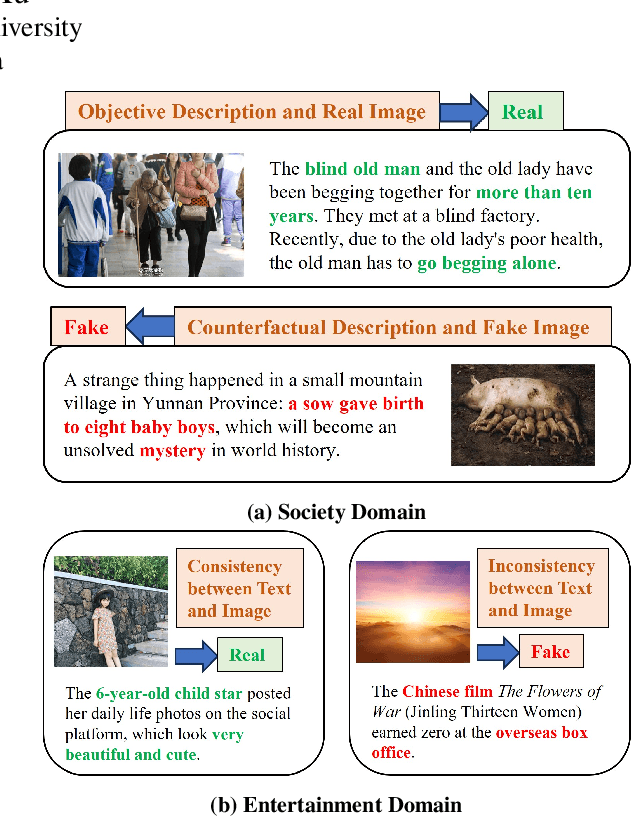
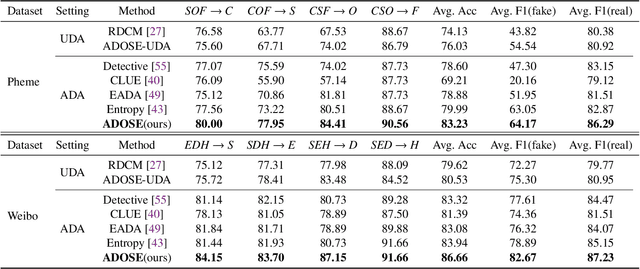
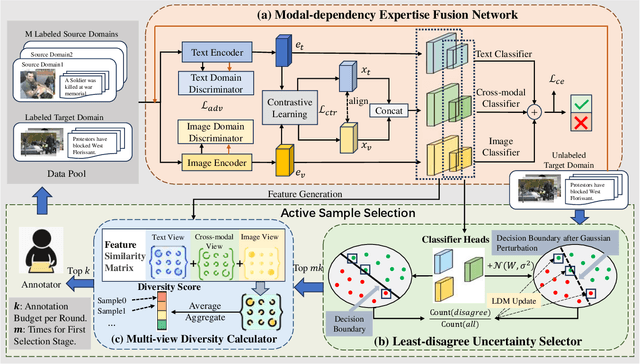
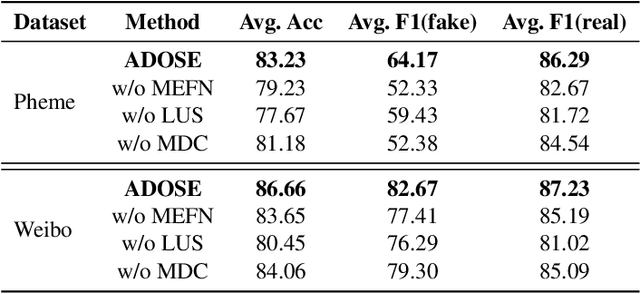
Multimodal fake news detection plays a crucial role in combating online misinformation. Unfortunately, effective detection methods rely on annotated labels and encounter significant performance degradation when domain shifts exist between training (source) and test (target) data. To address the problems, we propose ADOSE, an Active Domain Adaptation (ADA) framework for multimodal fake news detection which actively annotates a small subset of target samples to improve detection performance. To identify various deceptive patterns in cross-domain settings, we design multiple expert classifiers to learn dependencies across different modalities. These classifiers specifically target the distinct deception patterns exhibited in fake news, where two unimodal classifiers capture knowledge errors within individual modalities while one cross-modal classifier identifies semantic inconsistencies between text and images. To reduce annotation costs from the target domain, we propose a least-disagree uncertainty selector with a diversity calculator for selecting the most informative samples. The selector leverages prediction disagreement before and after perturbations by multiple classifiers as an indicator of uncertain samples, whose deceptive patterns deviate most from source domains. It further incorporates diversity scores derived from multi-view features to ensure the chosen samples achieve maximal coverage of target domain features. The extensive experiments on multiple datasets show that ADOSE outperforms existing ADA methods by 2.72\% $\sim$ 14.02\%, indicating the superiority of our model.
Individual brain parcellation: Review of methods, validations and applications
Jul 01, 2024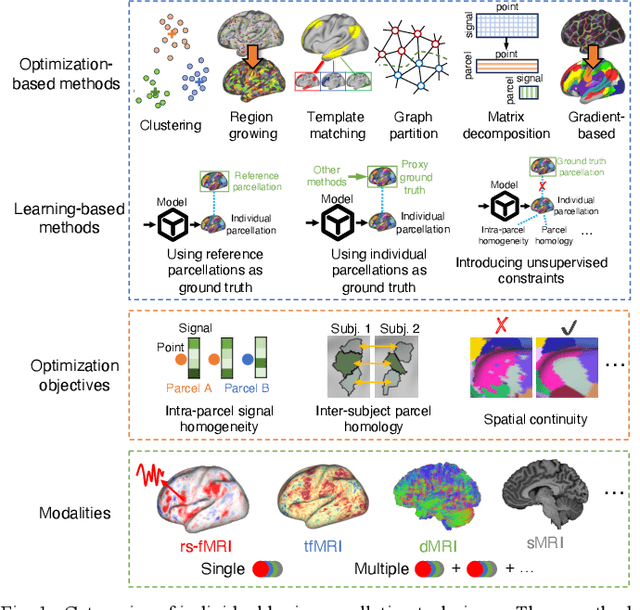
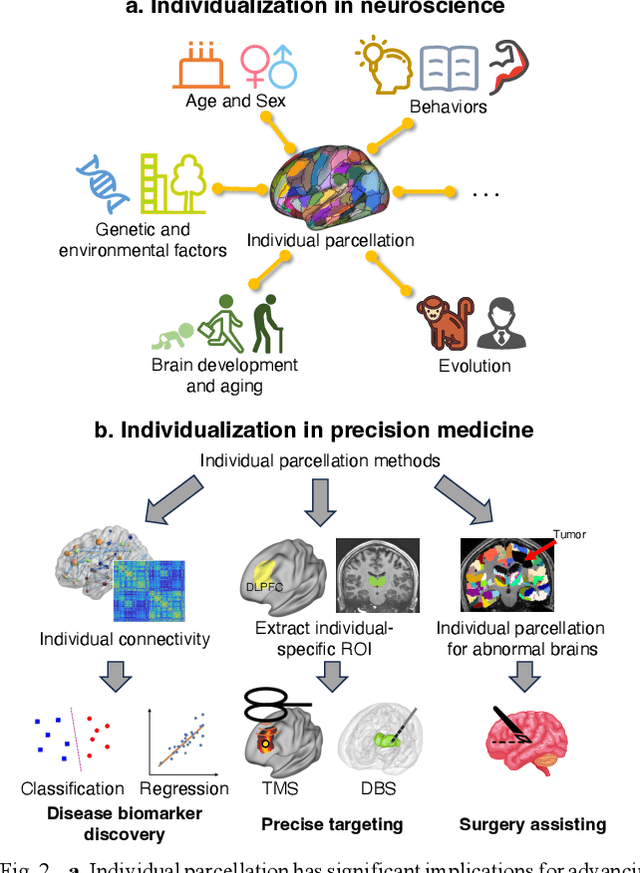
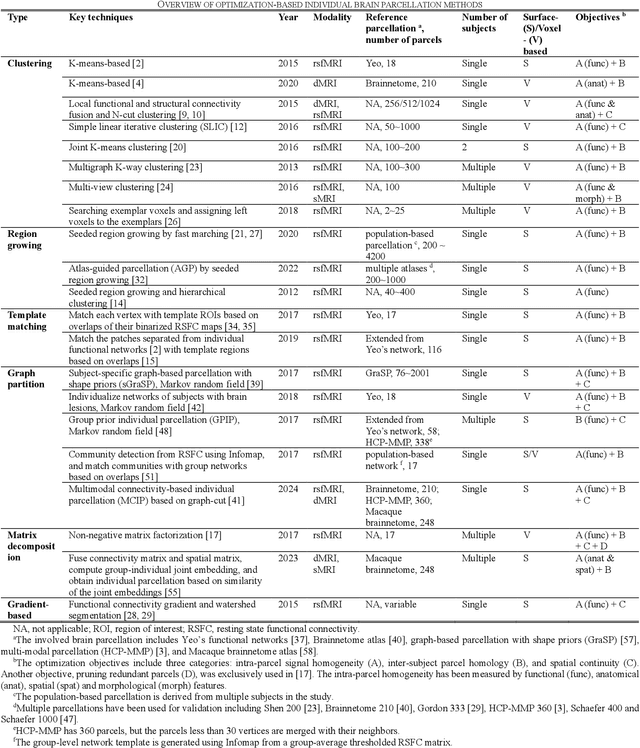
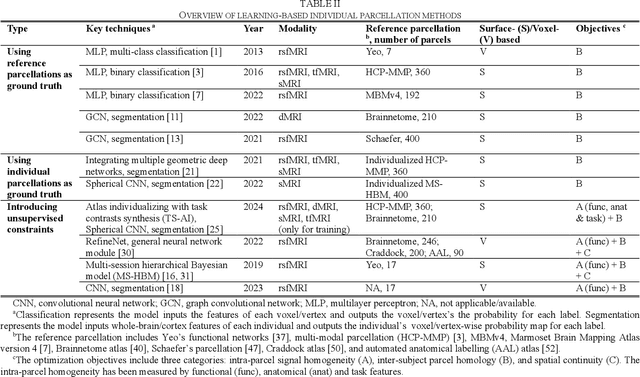
Individual brains vary greatly in morphology, connectivity and organization. The applicability of group-level parcellations is limited by the rapid development of precision medicine today because they do not take into account the variation of parcels at the individual level. Accurate mapping of brain functional regions at the individual level is pivotal for a comprehensive understanding of the variations in brain function and behaviors, early and precise identification of brain abnormalities, as well as personalized treatments for neuropsychiatric disorders. With the development of neuroimaging and machine learning techniques, studies on individual brain parcellation are booming. In this paper, we offer an overview of recent advances in the methodologies of individual brain parcellation, including optimization- and learning-based methods. Comprehensive evaluation metrics to validate individual brain mapping have been introduced. We also review the studies of how individual brain mapping promotes neuroscience research and clinical medicine. Finally, we summarize the major challenges and important future directions of individualized brain parcellation. Collectively, we intend to offer a thorough overview of individual brain parcellation methods, validations, and applications, along with highlighting the current challenges that call for an urgent demand for integrated platforms that integrate datasets, methods, and validations.
A Survey on Contribution Evaluation in Vertical Federated Learning
May 03, 2024Vertical Federated Learning (VFL) has emerged as a critical approach in machine learning to address privacy concerns associated with centralized data storage and processing. VFL facilitates collaboration among multiple entities with distinct feature sets on the same user population, enabling the joint training of predictive models without direct data sharing. A key aspect of VFL is the fair and accurate evaluation of each entity's contribution to the learning process. This is crucial for maintaining trust among participating entities, ensuring equitable resource sharing, and fostering a sustainable collaboration framework. This paper provides a thorough review of contribution evaluation in VFL. We categorize the vast array of contribution evaluation techniques along the VFL lifecycle, granularity of evaluation, privacy considerations, and core computational methods. We also explore various tasks in VFL that involving contribution evaluation and analyze their required evaluation properties and relation to the VFL lifecycle phases. Finally, we present a vision for the future challenges of contribution evaluation in VFL. By providing a structured analysis of the current landscape and potential advancements, this paper aims to guide researchers and practitioners in the design and implementation of more effective, efficient, and privacy-centric VFL solutions. Relevant literature and open-source resources have been compiled and are being continuously updated at the GitHub repository: \url{https://github.com/cuiyuebing/VFL_CE}.
Unifying Lane-Level Traffic Prediction from a Graph Structural Perspective: Benchmark and Baseline
Mar 22, 2024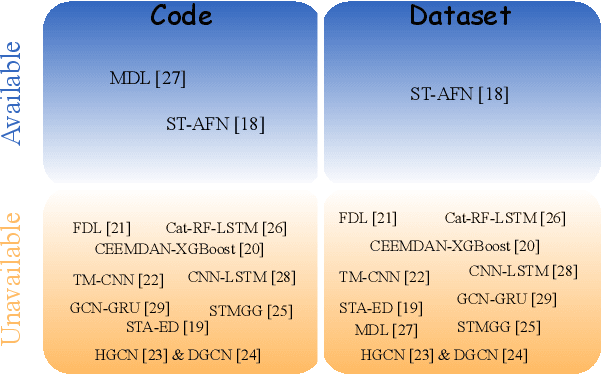
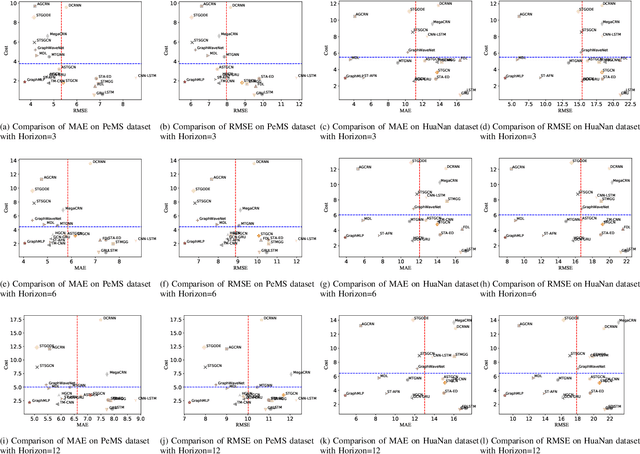
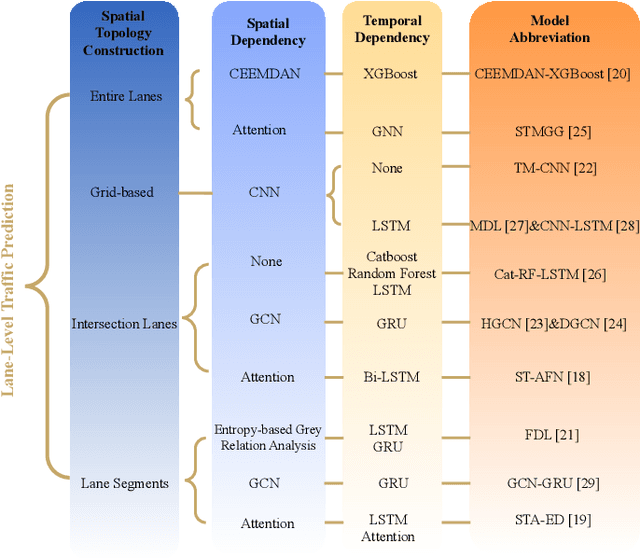
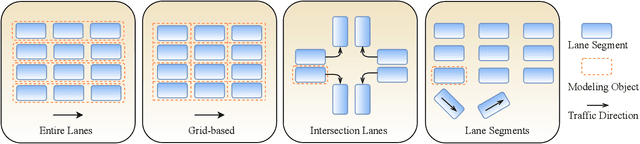
Traffic prediction has long been a focal and pivotal area in research, witnessing both significant strides from city-level to road-level predictions in recent years. With the advancement of Vehicle-to-Everything (V2X) technologies, autonomous driving, and large-scale models in the traffic domain, lane-level traffic prediction has emerged as an indispensable direction. However, further progress in this field is hindered by the absence of comprehensive and unified evaluation standards, coupled with limited public availability of data and code. This paper extensively analyzes and categorizes existing research in lane-level traffic prediction, establishes a unified spatial topology structure and prediction tasks, and introduces a simple baseline model, GraphMLP, based on graph structure and MLP networks. We have replicated codes not publicly available in existing studies and, based on this, thoroughly and fairly assessed various models in terms of effectiveness, efficiency, and applicability, providing insights for practical applications. Additionally, we have released three new datasets and corresponding codes to accelerate progress in this field, all of which can be found on https://github.com/ShuhaoLii/TITS24LaneLevel-Traffic-Benchmark.
A Bargaining-based Approach for Feature Trading in Vertical Federated Learning
Feb 23, 2024Vertical Federated Learning (VFL) has emerged as a popular machine learning paradigm, enabling model training across the data and the task parties with different features about the same user set while preserving data privacy. In production environment, VFL usually involves one task party and one data party. Fair and economically efficient feature trading is crucial to the commercialization of VFL, where the task party is considered as the data consumer who buys the data party's features. However, current VFL feature trading practices often price the data party's data as a whole and assume transactions occur prior to the performing VFL. Neglecting the performance gains resulting from traded features may lead to underpayment and overpayment issues. In this study, we propose a bargaining-based feature trading approach in VFL to encourage economically efficient transactions. Our model incorporates performance gain-based pricing, taking into account the revenue-based optimization objectives of both parties. We analyze the proposed bargaining model under perfect and imperfect performance information settings, proving the existence of an equilibrium that optimizes the parties' objectives. Moreover, we develop performance gain estimation-based bargaining strategies for imperfect performance information scenarios and discuss potential security issues and solutions. Experiments on three real-world datasets demonstrate the effectiveness of the proposed bargaining model.