 Add to Chrome
 Add to Firefox
 Add to Edge
MedSAM2-Anatomy: Training-Free Inference-Time Optimization for Musculoskeletal Segmentation
Jul 31, 2026
High-resolution 3D segmentation of hip and shoulder anatomy from CT and MRI is essential for surgical planning, yet frozen segmentation models often fail under domain shift. CNN-based expert models are fully automatic but lack adaptability, whereas promptable foundation models generalize better but require manual prompting. We present MedSAM2-Anatomy, a training-free inference-time optimization framework that improves frozen segmentation models without retraining or human interaction. A frozen expert model generates anatomical priors that are automatically converted into multiple prompt hypotheses for a frozen 3D foundation model. Candidate masks are fused while anatomically implausible priors are rejected. No model weights are updated and no manual prompts are required. TotalSegmentator and MedSAM2 are used as representative expert and foundation models, allowing the contribution of the inference policy to be isolated. Evaluation on the independent Balgrist-V0 CT and MRI cohorts shows that inference-time optimization increases median Dice from 0.71 to 0.92 on hip MRI and from 0.89 to 0.92 on shoulder CT, while reducing median HD95 on hip MRI from 22.0 mm to 5.0 mm. On public TotalSegmentator benchmarks, the expert model remains strongest, indicating that the optimal fusion strategy depends on the reliability of the expert prior. These results demonstrate that training-free inference-time optimization provides a practical strategy for improving frozen segmentation models without manual prompting.

Benchmarking the CoW with the TopCoW Challenge: Topology-Aware Anatomical Segmentation of the Circle of Willis for CTA and MRA
Dec 29, 2023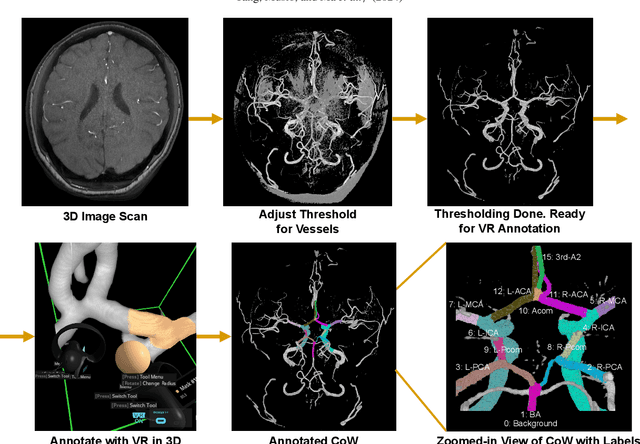
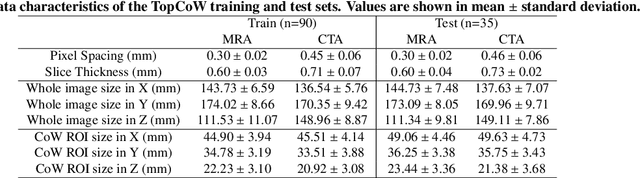
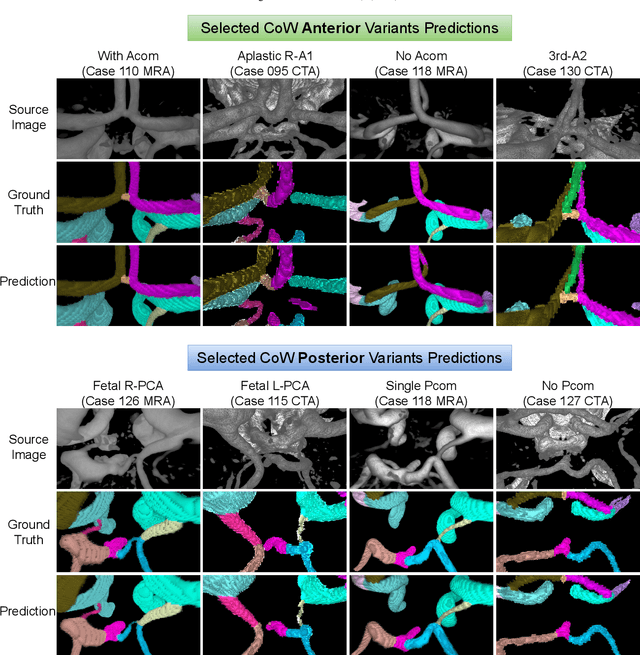
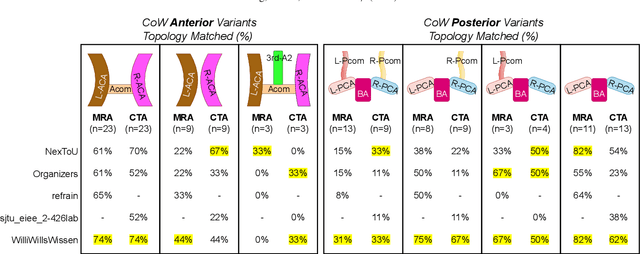
The Circle of Willis (CoW) is an important network of arteries connecting major circulations of the brain. Its vascular architecture is believed to affect the risk, severity, and clinical outcome of serious neuro-vascular diseases. However, characterizing the highly variable CoW anatomy is still a manual and time-consuming expert task. The CoW is usually imaged by two angiographic imaging modalities, magnetic resonance angiography (MRA) and computed tomography angiography (CTA), but there exist limited public datasets with annotations on CoW anatomy, especially for CTA. Therefore we organized the TopCoW Challenge in 2023 with the release of an annotated CoW dataset and invited submissions worldwide for the CoW segmentation task, which attracted over 140 registered participants from four continents. TopCoW dataset was the first public dataset with voxel-level annotations for CoW's 13 vessel components, made possible by virtual-reality (VR) technology. It was also the first dataset with paired MRA and CTA from the same patients. TopCoW challenge aimed to tackle the CoW characterization problem as a multiclass anatomical segmentation task with an emphasis on topological metrics. The top performing teams managed to segment many CoW components to Dice scores around 90%, but with lower scores for communicating arteries and rare variants. There were also topological mistakes for predictions with high Dice scores. Additional topological analysis revealed further areas for improvement in detecting certain CoW components and matching CoW variant's topology accurately. TopCoW represented a first attempt at benchmarking the CoW anatomical segmentation task for MRA and CTA, both morphologically and topologically.