 Add to Chrome
 Add to Firefox
 Add to Edge
Robust Beamforming for Pinching-Antenna Systems
Dec 19, 2025
Pinching-antenna system (PASS) mitigates large-scale path loss by enabling flexible placement of pinching antennas (PAs) along the dielectric waveguide. However, most existing studies assume perfect channel state information (CSI), overlooking the impact of channel uncertainty. This paper addresses this gap by proposing a robust beamforming framework for both lossy and lossless waveguides. For baseband beamforming, the lossy case yields an second-order cone programming-based solution, while the lossless case admits a closed-form solution via maximum ratio transmission. The PAs' positions in both cases are optimized through the Gauss-Seidel-based method. Numerical results validate the effectiveness of the proposed algorithm and demonstrate that PASS exhibits superior robustness against channel uncertainty compared with conventional fixed-antenna systems. Notably, its worst-case achievable rate can even exceed the fixed-antenna baseline under perfect CSI.

User Localization and Channel Estimation for Pinching-Antenna Systems (PASS)
Dec 16, 2025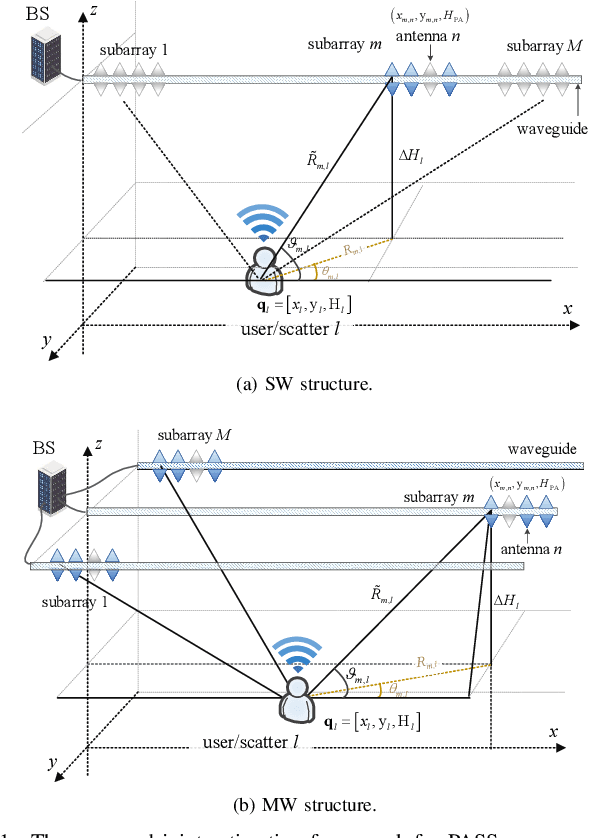
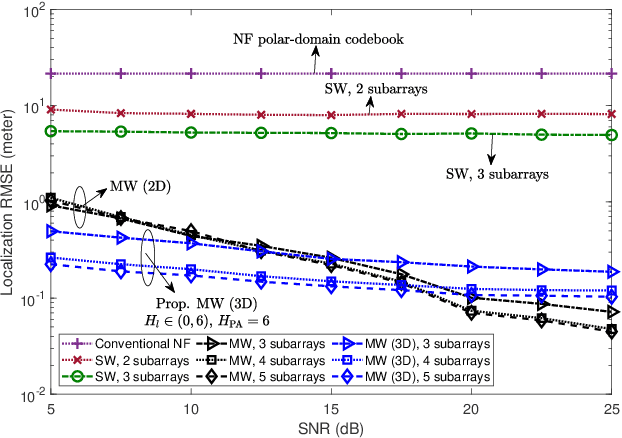
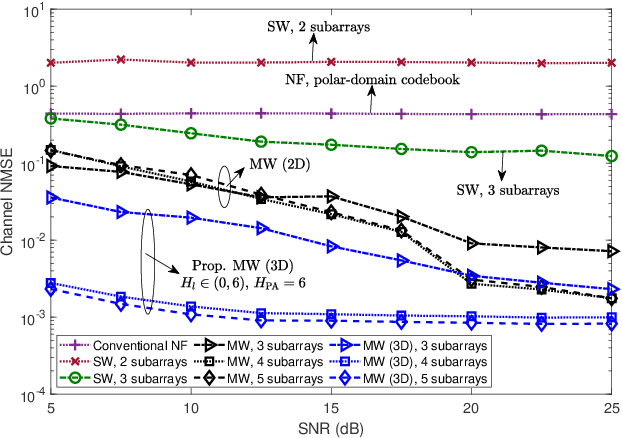
This letter proposes a novel user localization and channel estimation framework for pinching-antenna systems (PASS), where pinching antennas are grouped into subarrays on each waveguide to cooperatively estimate user/scatterer locations, thus reconstructing channels. Both single-waveguide (SW) and multi-waveguide (MW) structures are considered. SW consists of multiple alternatingly activated subarrays, while MW deploys one subarray on each waveguide to enable concurrent subarray measurements. For the 2D scenarios with a fixed user/scatter height, an orthogonal matching pursuit-based geometry-consistent localization (OMP-GCL) algorithm is proposed, which leverages inter-subarray geometric relationships and compressed sensing for precise estimation. Theoretical analysis on Cramér-Rao lower bound (CRLB) demonstrates that: 1) The estimation accuracy can be improved by increasing the geometric diversity through multi-subarray deployment; and 2) SW provides a limited geometric diversity within a $180^\circ$ half space and leads to angle ambiguity, while MW enables full-space observations and reduces overheads. The OMP-GCL algorithm is further extended to 3D scenarios, where user and scatter heights are also estimated. Numerical results validate the theoretical analysis, and verify that MW achieves centimeter- and decimeter-level localization accuracy in 2D and 3D scenarios with only three waveguides.
Segmented Waveguide-Enabled Pinching-Antenna Systems (SWANs) for ISAC
Dec 08, 2025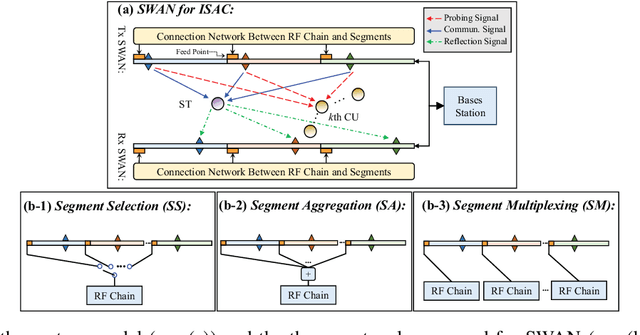
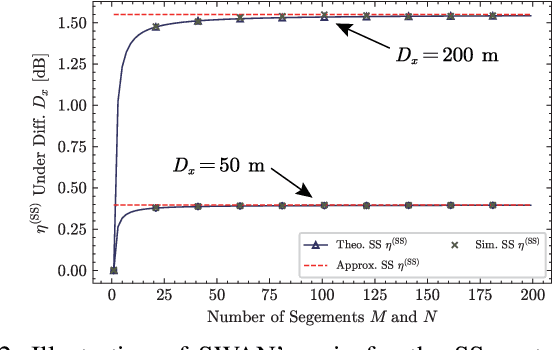
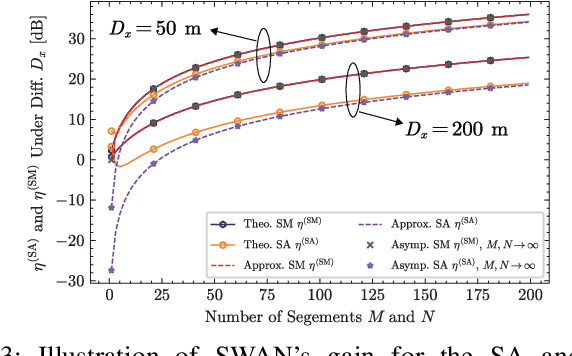
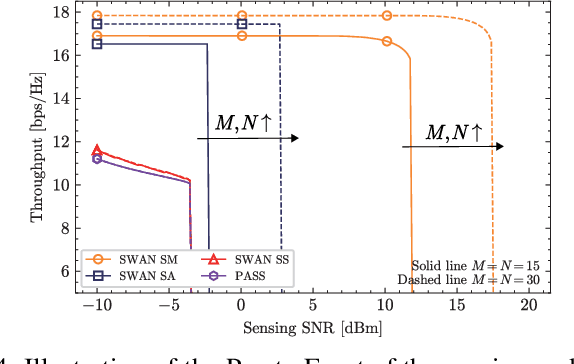
A segmented waveguide-enabled pinching-antenna system (SWAN)-assisted integrated sensing and communications (ISAC) framework is proposed. Unlike conventional pinching antenna systems (PASS), which use a single long waveguide, SWAN divides the waveguide into multiple short segments, each with a dedicated feed point. Thanks to the segmented structure, SWAN enhances sensing performance by significantly simplifying the reception model and reducing the in-waveguide propagation loss. To balance performance and complexity, three segment controlling protocols are proposed for the transceivers, namely i) \emph{segment selection} to select a single segment for signal transceiving, ii) \emph{segment aggregation} to aggregate signals from all segments using a single RF chain, and iii) \emph{segment multiplexing} to jointly process the signals from all segments using individual RF chains. The theoretical sensing performance limit is first analyzed for different protocols, unveiling how the sensing performance gain of SWAN scales with the number of segments. Based on this performance limit, the Pareto fronts of sensing and communication performance are characterized for the simple one-user one-target case, which is then extended to the general multi-user single-target case based on time-division multiple access (TDMA). Numerical results are presented to verify the correctness of the derivations and the effectiveness of the proposed algorithms, which jointly confirm the advantages of SWAN-assisted ISAC.
Tri-Hybrid Beamforming Design for Fully-Connected Pinching Antenna Systems
Nov 18, 2025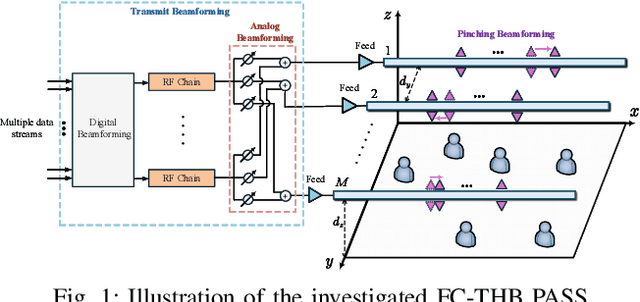
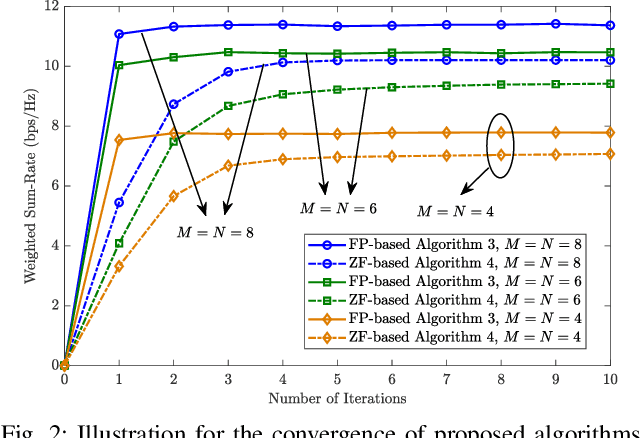
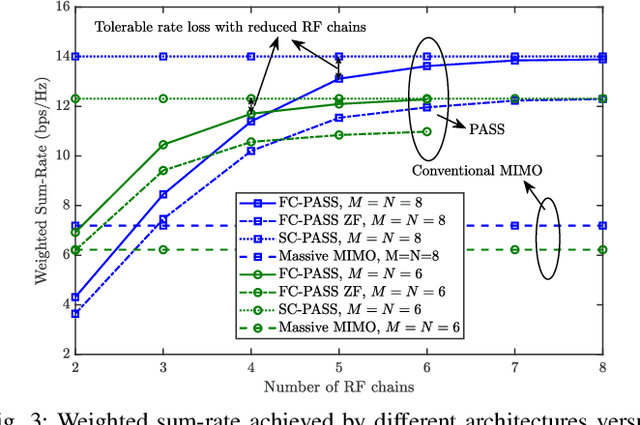
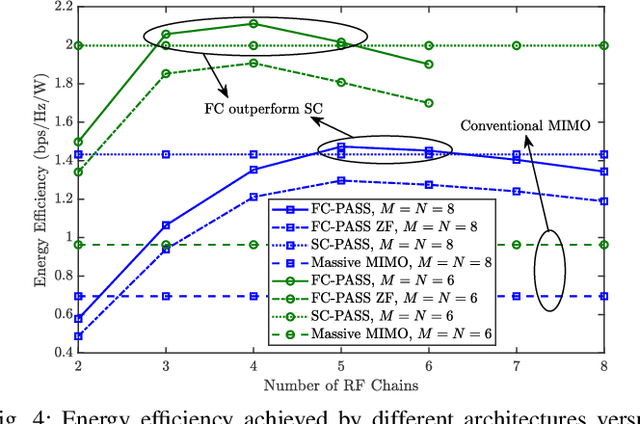
A novel fully-connected (FC) tri-hybrid beamforming (THB) architecture is proposed for pinching antenna systems (PASS). In contrast to conventional sub-connected (SC) PASS, the proposed FC architecture employs a tunable phase-shifter network to interconnect all radio frequency (RF) chains with all waveguides. This facilitates a THB framework that integrates conventional hybrid analog-digital beamforming with pinching beamforming. A weighted sum-rate (WSR) optimization problem is then formulated to jointly optimize the transmit beamformers and pinching antenna (PA) positions. Two algorithms are developed to address this challenging non-convex problem. 1) Fractional programming (FP)-based algorithm: This algorithm directly maximizes the WSR using an FP-based alternating optimization framework. Particularly, a success-history based adaptive differential evolution (SHADE) method is proposed to optimize PA positions, effectively addressing the intractable multimodal objective function. 2) Zero-forcing (ZF)-based algorithm: To reduce design complexity, zero-forcing is employed for transmit beamforming. The PA positions are subsequently optimized to maximize the WSR via a modified SHADE method. Simulation results validate the effectiveness of the proposed algorithms, revealing that the FC-THB PASS achieves WSR comparable to the SC architecture while delivering superior energy efficiency with fewer RF chains.
Enabling Wireless Power Transfer (WPT) in Pinching Antenna Systems (PASS)
Nov 14, 2025A novel pinching antenna system (PASS) enabled wireless power transfer (WPT) framework is proposed, where energy harvesting receivers (EHRs) and information decoding receivers (IDRs) coexist. By activating pinching antennas (PAs) near both receivers and flexibly adjusting PAs' power radiation ratios, both energy harvesting efficiency and communication quality can be enhanced. A bi-level optimization problem is formulated to overcome the strong coupling between optimization variables. The upper level jointly optimizes transmit beamforming, PA positions, and feasible interval of power radiation ratios for power conversion efficiency (PCE) maximization under rate requirements, while the lower level refines power radiation ratio for the sum rate maximization. Efficient solutions are developed for both two-user and multi-user scenarios. 1) For the two-user case, where an EHR and an IDR coexist, the alternating optimization (AO)-based and weighted minimum mean square error (WMMSE)-based algorithms are developed to achieve the stationary solutions of transmit beamforming, PA positions, and power radiation ratios. 2) For the multi-user case, a quadratic transform-Lagrangian dual transform (QT-LDT) algorithm is proposed to iteratively update PCE and sum rate by optimizing PA positions and power radiation ratios individually. Closed-form solutions are derived for both maximization problems. Numerical simulation results demonstrate that the proposed PASS-WPT framework significantly outperforms conventional MIMO and the baseline PASS with fixed power radiation, which demonstrates that: i) Compared to the conventional MIMO and baseline PASS, the proposed PASS-WPT framework achieves 81.45% and 43.19% improvements in PCE of EHRs, and ii) also increases the sum rate by 77.81% and 31.91% for IDRs.
LLM Enabled Beam Training for Pinching Antenna Systems (PASS)
Nov 12, 2025To enable intelligent beam training, a large language model (LLM)-enabled beam training framework is proposed for the pinching antenna system (PASS) in downlink multi-user multiple-input multiple-output (MIMO) communications. A novel LLM-based beam training supervised learning mechanism is developed, allowing context-aware and environment-adaptive probing for PASS to reduce overheads. Both single-user and multi-user cases are considered. 1) For single-user case, the LLM-based pinching beamforming codebook generation problem is formulated to maximize the beamforming gain. Then, the optimal transmit beamforming is obtained by maximum ratio transmission (MRT). 2) For multi-user case, a joint codebook generation and beam selection problem is formulated based on the system sum rate under the minimum mean square error (MMSE) transmit beamforming. The training labels for pinching beamforming are constructed by selecting the beam combination that maximizes system performance from each user's Top-S candidate beams. Based on pretrained Generative Pre-trained Transformers (GPTs), the LLM is trained in an end-to-end fashion to minimize the cross-entropy loss. Simulation results demonstrate that: i) For single-user case, the proposed LLM-enabled PASS attains over 95% Top-1 accuracy in beam selection and achieves 51.92% improvements in beamforming gains compared to conventional method. ii) For multi-user case, the proposed LLM-enabled PASS framework significantly outperforms both the LLM-based massive MIMO and conventional PASS beam training, achieving up to 57.14% and 33.33% improvements in sum rate, respectively.
Performance Analysis of Wireless-Powered Pinching Antenna Systems
Nov 05, 2025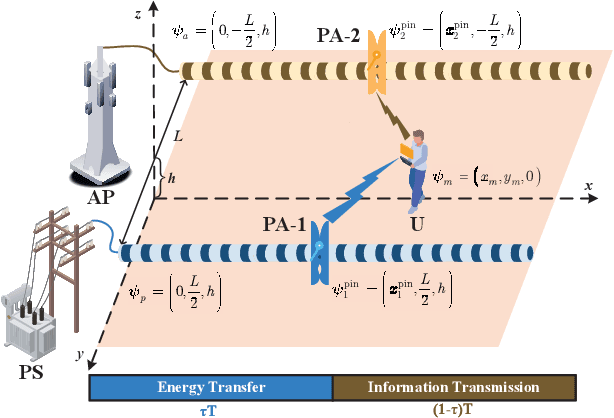
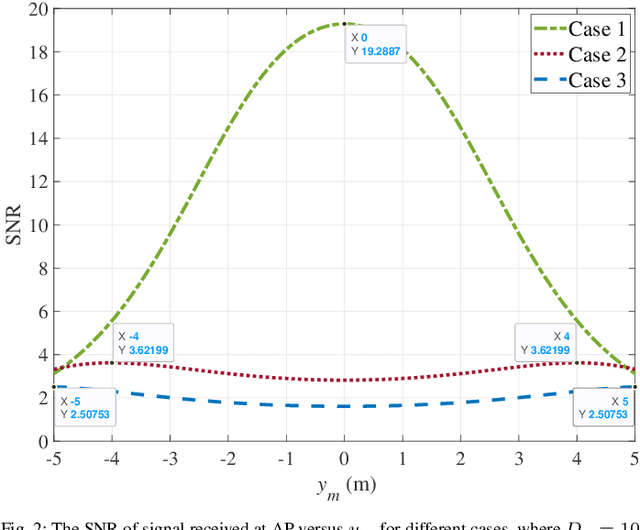


Pinching antenna system (PAS) serves as a groundbreaking paradigm that enhances wireless communications by flexibly adjusting the position of pinching antenna (PA) and establishing a strong line-of-sight (LoS) link, thereby reducing the free-space path loss. This paper introduces the concept of wireless-powered PAS, and investigates the reliability of wireless-powered PAS to explore the advantages of PA in improving the performance of wireless-powered communication (WPC) system. In addition, we derive the closed-form expressions of outage probability and ergodic rate for the practical lossy waveguide case and ideal lossless waveguide case, respectively, and analyze the optimal deployment of waveguides and user to provide valuable insights for guiding their deployments. The results show that an increase in the absorption coefficient and in the dimensions of the user area leads to higher in-waveguide and free-space propagation losses, respectively, which in turn increase the outage probability and reduce the ergodic rate of the wireless-powered PAS. However, the performance of wireless-powered PAS is severely affected by the absorption coefficient and the waveguide length, e.g., under conditions of high absorption coefficient and long waveguide, the outage probability of wireless-powered PAS is even worse than that of traditional WPC system. While the ergodic rate of wireless-powered PAS is better than that of traditional WPC system under conditions of high absorption coefficient and long waveguide. Interestingly, the wireless-powered PAS has the optimal time allocation factor and optimal distance between power station (PS) and access point (AP) to minimize the outage probability or maximize the ergodic rate. Moreover, the system performance of PS and AP separated at the optimal distance between PS and AP is superior to that of PS and AP integrated into a hybrid access point.
PASS-Enhanced MEC: Joint Optimization of Task Offloading and Uplink PASS Beamforming
Oct 27, 2025A pinching-antenna system (PASS)-enhanced mobile edge computing (MEC) architecture is investigated to improve the task offloading efficiency and latency performance in dynamic wireless environments. By leveraging dielectric waveguides and flexibly adjustable pinching antennas, PASS establishes short-distance line-of-sight (LoS) links while effectively mitigating the significant path loss and potential signal blockage, making it a promising solution for high-frequency MEC systems. We formulate a network latency minimization problem to joint optimize uplink PASS beamforming and task offloading. The resulting problem is modeled as a Markov decision process (MDP) and solved via the deep reinforcement learning (DRL) method. To address the instability introduced by the $\max$ operator in the objective function, we propose a load balancing-aware proximal policy optimization (LBPPO) algorithm. LBPPO incorporates both node-level and waveguide-level load balancing information into the policy design, maintaining computational and transmission delay equilibrium, respectively. Simulation results demonstrate that the proposed PASS-enhanced MEC with adaptive uplink PASS beamforming exhibit stronger convergence capability than fixed-PA baselines and conventional MIMO-assisted MEC, especially in scenarios with a large number of UEs or high transmit power.
Joint DOA and Attitude Sensing Based on Tri-Polarized Continuous Aperture Array
Oct 02, 2025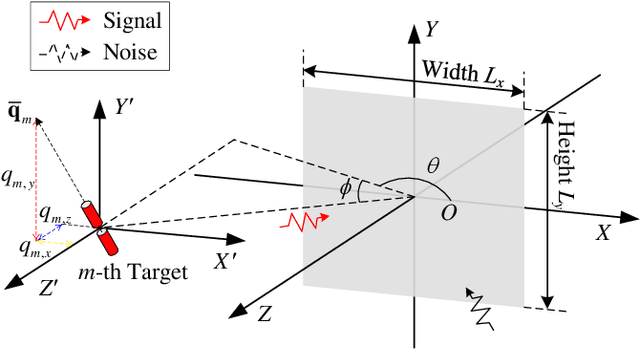
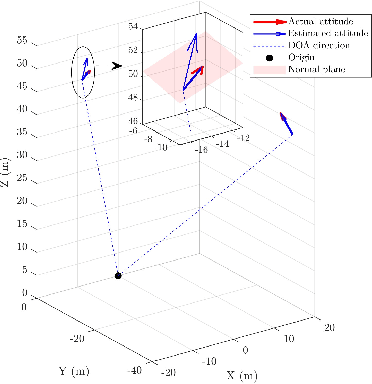
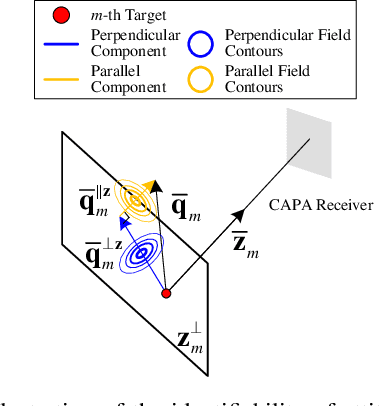
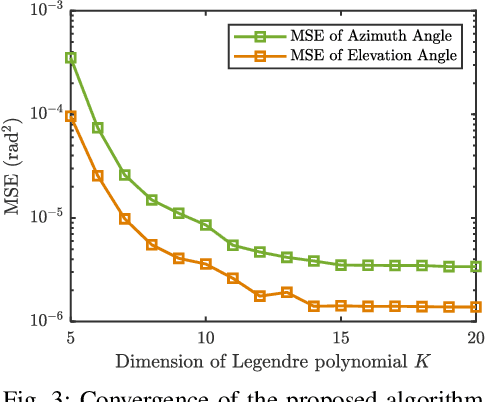
This paper investigates joint direction-of-arrival (DOA) and attitude sensing using tri-polarized continuous aperture arrays (CAPAs). By employing electromagnetic (EM) information theory, the spatially continuous received signals in tri-polarized CAPA are modeled, thereby enabling accurate DOA and attitude estimation. To facilitate subspace decomposition for continuous operators, an equivalent continuous-discrete transformation technique is developed. Moreover, both self- and cross-covariances of tri-polarized signals are exploited to construct a tri-polarized spectrum, significantly enhancing DOA estimation performance. Theoretical analyses reveal that the identifiability of attitude information fundamentally depends on the availability of prior target snapshots. Accordingly, two attitude estimation algorithms are proposed: one capable of estimating partial attitude information without prior knowledge, and the other achieving full attitude estimation when such knowledge is available. Numerical results demonstrate the feasibility and superiority of the proposed framework.
CRB minimization for PASS Assisted ISAC
Sep 26, 2025A multiple waveguide PASS assisted integrated sensing and communication (ISAC) system is proposed, where the base station (BS) is equipped with transmitting pinching antennas (PAs) and receiving uniform linear array (ULA) antennas. The PASS-transmitting-ULA-receiving (PTUR) BS transmits the communication and sensing signals through the stretched PAs on waveguides and collects the echo sensing signals with the mounted ULA. Based on this configuration, a target sensing Cramer Rao Bound (CRB) minimization problem is formulated under communication quality-of-service (QoS) constraints, power budget constraints, and PA deployment constraints. An alternating optimization (AO) method is employed to address the formulated non-convex optimization problem. Simulation results demonstrate that the proposed PASS assisted ISAC framework achieves superior performance over benchmark schemes.