 Add to Chrome
 Add to Firefox
 Add to Edge
Transmit Pinching-Antenna Systems (T-PASS): Connecting Wired to Wireless Communications
Mar 04, 2026
A transmit pinching-antenna system (T-PASS) framework is proposed, in which a single pinched waveguide is employed to jointly serve one wired user equipment (UE) and multiple wireless UEs. The signal radiated by the pinching antennas (PAs) is used to serve the wireless UEs, whereas the residual guided signal at the waveguide termination is used to serve the wired UE. To facilitate T-PASS transmission and mitigate inter-user interference, a hybrid non-orthogonal multiple access (NOMA) scheme is introduced. Wireless UEs are scheduled by time-division multiple access (TDMA), and, in each slot, the scheduled wireless UE is paired with the wired UE through power-domain NOMA. Within this framework, the PA positions, PA radiation coefficients, power allocation, and TDMA time-slot allocation are jointly optimized to maximize a weighted sum rate (WSR). i) For the two-user case with one wired UE and one wireless UE, the optimal PA position and successive interference cancellation (SIC) decoding order are derived. Closed-form optimal power allocation is obtained, and a near-optimal PA radiation coefficient is determined through a low-complexity one-dimensional search. ii) For the multiuser case with one wired UE and multiple wireless UEs, four protocols with different PA-position and PA-radiation configurations are proposed. For each protocol, a low-complexity element-wise alternating optimization algorithm is developed to optimize the PA positions and radiation coefficients, while closed-form solutions are derived for the optimal power allocation and time-slot allocation. Numerical results are presented to show that: i) under typical T-PASS configurations, the wired UE is selected as the strong user in the optimal SIC decoding order; ii) the proposed T-PASS framework achieves a significantly higher WSR than conventional wireless-only PASS.

Energy-Based Cell Association in Nonuniform Renewable Energy-Powered Cellular Networks: Analysis and Optimization of Carbon Efficiency
Jan 19, 2026The increasing global push for carbon reduction highlights the importance of integrating renewable energy into the supply chain of cellular networks. However, due to the stochastic nature of renewable energy generation and the uneven load distribution across base stations, the utilization rate of renewable energy remains low. To address these challenges, this paper investigates the trade-off between carbon emissions and downlink throughput in cellular networks, offering insights into optimizing both network performance and sustainability. The renewable energy state of base station batteries and the number of occupied channels are modeled as a quasi-birth-death process. We construct models for the probability of channel blocking, average successful transmission probability for users, downlink throughput, carbon emissions, and carbon efficiency based on stochastic geometry. Based on these analyses, an energy-based cell association scheme is proposed to optimize the carbon efficiency of cellular networks. The results show that, compared to the closest cell association scheme, the energy-based cell association scheme is capable of reducing the carbon emissions of the network by 13.0% and improving the carbon efficiency by 11.3%.
Enabling Wireless Power Transfer (WPT) in Pinching Antenna Systems (PASS)
Nov 14, 2025A novel pinching antenna system (PASS) enabled wireless power transfer (WPT) framework is proposed, where energy harvesting receivers (EHRs) and information decoding receivers (IDRs) coexist. By activating pinching antennas (PAs) near both receivers and flexibly adjusting PAs' power radiation ratios, both energy harvesting efficiency and communication quality can be enhanced. A bi-level optimization problem is formulated to overcome the strong coupling between optimization variables. The upper level jointly optimizes transmit beamforming, PA positions, and feasible interval of power radiation ratios for power conversion efficiency (PCE) maximization under rate requirements, while the lower level refines power radiation ratio for the sum rate maximization. Efficient solutions are developed for both two-user and multi-user scenarios. 1) For the two-user case, where an EHR and an IDR coexist, the alternating optimization (AO)-based and weighted minimum mean square error (WMMSE)-based algorithms are developed to achieve the stationary solutions of transmit beamforming, PA positions, and power radiation ratios. 2) For the multi-user case, a quadratic transform-Lagrangian dual transform (QT-LDT) algorithm is proposed to iteratively update PCE and sum rate by optimizing PA positions and power radiation ratios individually. Closed-form solutions are derived for both maximization problems. Numerical simulation results demonstrate that the proposed PASS-WPT framework significantly outperforms conventional MIMO and the baseline PASS with fixed power radiation, which demonstrates that: i) Compared to the conventional MIMO and baseline PASS, the proposed PASS-WPT framework achieves 81.45% and 43.19% improvements in PCE of EHRs, and ii) also increases the sum rate by 77.81% and 31.91% for IDRs.
LLM Enabled Beam Training for Pinching Antenna Systems (PASS)
Nov 12, 2025To enable intelligent beam training, a large language model (LLM)-enabled beam training framework is proposed for the pinching antenna system (PASS) in downlink multi-user multiple-input multiple-output (MIMO) communications. A novel LLM-based beam training supervised learning mechanism is developed, allowing context-aware and environment-adaptive probing for PASS to reduce overheads. Both single-user and multi-user cases are considered. 1) For single-user case, the LLM-based pinching beamforming codebook generation problem is formulated to maximize the beamforming gain. Then, the optimal transmit beamforming is obtained by maximum ratio transmission (MRT). 2) For multi-user case, a joint codebook generation and beam selection problem is formulated based on the system sum rate under the minimum mean square error (MMSE) transmit beamforming. The training labels for pinching beamforming are constructed by selecting the beam combination that maximizes system performance from each user's Top-S candidate beams. Based on pretrained Generative Pre-trained Transformers (GPTs), the LLM is trained in an end-to-end fashion to minimize the cross-entropy loss. Simulation results demonstrate that: i) For single-user case, the proposed LLM-enabled PASS attains over 95% Top-1 accuracy in beam selection and achieves 51.92% improvements in beamforming gains compared to conventional method. ii) For multi-user case, the proposed LLM-enabled PASS framework significantly outperforms both the LLM-based massive MIMO and conventional PASS beam training, achieving up to 57.14% and 33.33% improvements in sum rate, respectively.
Modeling and Optimization of Transistor Voltage Amplifiers Based on Stochastic Thermodynamics
Apr 27, 2025As transistor sizes reach the mesoscopic scale, the limitations of traditional methods in ensuring thermodynamic consistency have made power dissipation optimization in transistor amplifiers a critical challenge. Based on stochastic thermodynamics, a transistor voltage amplifier model is first proposed as a new insight to investigate nonlinear relationships between the power dissipation and voltage gain for complementary symmetric voltage amplifier circuits (CSVACs). Utilizing the proposed model, the phenomenon, i.e., the power dissipation exponentially increases with the increase of voltage gain in CSVACs, is first clarified by an analytical expression to quantify the impact of voltage gain and input signal amplitude on the power dissipation. Considering the characteristic of power dissipation, a new multistage architecture is proposed to reduce the power dissipation in CSVACs. To optimize the power dissipation by adjusting the number of stages and the voltage gain at each stage, an optimal multistage scheme is proposed for multistage CSVACs. Simulation and experimental results show up to 99.36% and 94.59% power dissipation reduction compared with traditional CSVACs by the proposed optimal multistage scheme, respectively.
Prompt-Assisted Semantic Interference Cancellation on Moderate Interference Channels
Aug 08, 2024The performance of conventional interference management strategies degrades when interference power is comparable to signal power. We consider a new perspective on interference management using semantic communication. Specifically, a multi-user semantic communication system is considered on moderate interference channels (ICs), for which a novel framework of deep learning-based prompt-assisted semantic interference cancellation (DeepPASIC) is proposed. Each transmitted signal is partitioned into common and private parts. The common parts of different users are transmitted simultaneously in a shared medium, resulting in superposition. The private part, on the other hand, serves as a prompt to assist in canceling the interference suffered by the common part at the semantic level. Simulation results demonstrate that the proposed DeepPASIC outperforms conventional interference management strategies under moderate interference conditions.
Entropy-Based Energy Dissipation Analysis of Mobile Communication Systems
Apr 14, 2023Compared with the energy efficiency of conventional mobile communication systems, the energy efficiency of fifth generation (5G) communication systems has been improved more than 30 times. However, the energy consumption of 5G communication systems is 3 times of the energy consumption of fourth generation (4G) communication systems when the wireless traffic is increased more than 100 times in the last decade. It is anticipated that the traffic of future sixth generation (6G) communication systems will keep an exponential growth in the next decade. It is a key issue how much space is left for improving of energy efficiency in mobile communication systems. To answer the question, an entropy-based energy dissipation model based on nonequilibrium thermodynamics is first proposed for mobile communication systems. Moreover, the theoretical minimal energy dissipation limits are derived for typical modulations in mobile communication systems. Simulation results show that the practical energy dissipation of information processing and information transmission is three and seven orders of magnitude away from the theoretical minimal energy dissipation limits in mobile communication systems, respectively. These results provide some guidelines for energy efficiency optimization in future mobile communication systems.
Modelling and Optimization of OAM-MIMO Communication Systems with Unaligned Antennas
Dec 09, 2021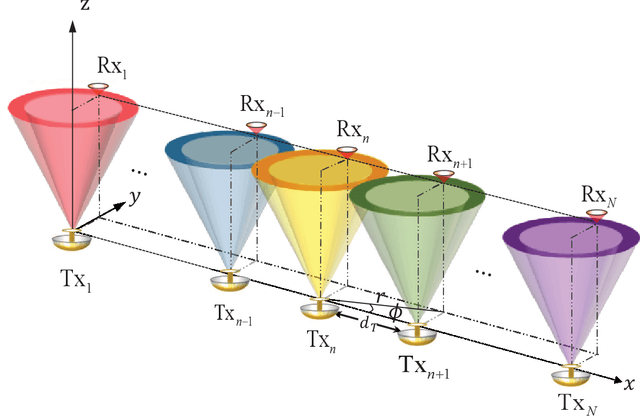
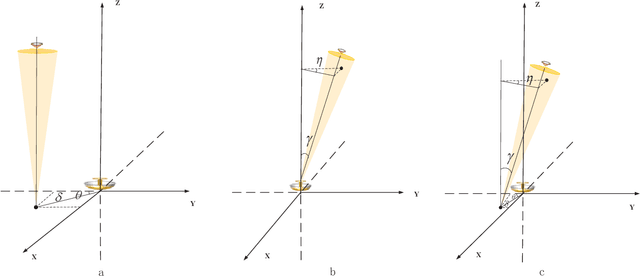
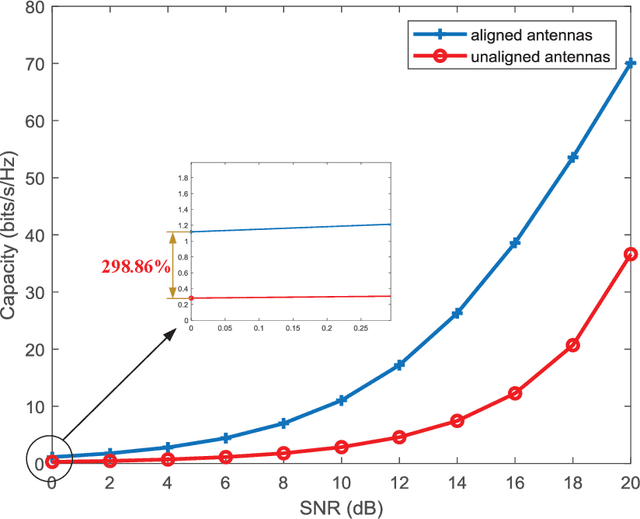
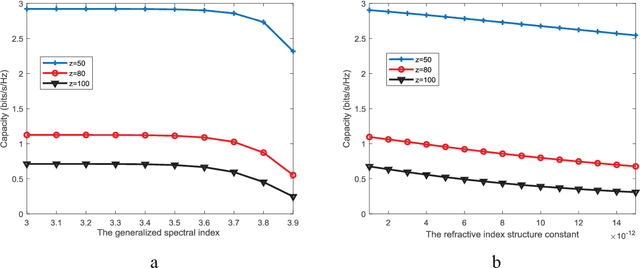
The orbital angular momentum (OAM) wireless communication technique is emerging as one of potential techniques for the Sixth generation (6G) wireless communication system. The most advantage of OAM wireless communication technique is the natural orthogonality among different OAM states. However, one of the most disadvantages is the crosstalk among different OAM states which is widely caused by the atmospheric turbulence and misalignment between transmitting and receiving antennas. Considering the OAM-based multiple-input multiple-output (OAM-MIMO) transmission system with unaligned antennas, a new channel model is proposed for performance analysis. Moreover, a purity model of the OAM-MIMO transmission system with unaligned antennas is derived for the non-Kolmogorov turbulence. Furthermore, error probability and capacity models are derived for OAM-MIMO transmission systems with unaligned antennas. To overcome the disadvantage caused by unaligned antennas and non-Kolmogorov turbulence, a new optimization algorithm of OAM state interval is proposed to improve the capacity of OAM-MIMO transmission system. Numerical results indicate that the capacity of OAM-MIMO transmission system is improved by the optimization algorithm. Specifically, the capacity increment of OAM-MIMO transmission system adopting the optimization algorithm is up to 28.7% and 320.3% when the angle of deflection between transmitting and receiving antennas is -24 dB and -5 dB, respectively.