 Add to Chrome
 Add to Firefox
 Add to Edge
Bridging Standardized Codebook and Site-Specific Beamforming: A Unified Limited-Feedback Framework
Apr 16, 2026
A site-specific Type-II codebook design is proposed for downlink massive multiple-input multiple-output (MIMO) limited-feedback beamforming. The key idea is to embed a learned site-specific propagation prior into the Type-II channel state information (CSI) feedback pipeline. Specifically, the base station (BS) uses a low-overhead reference signal received power (RSRP) fingerprint collected during synchronization signal block (SSB) probing to infer a user equipment (UE)-dependent dominant beam subspace before explicit CSI acquisition. The UE then estimates and feeds back only the low-dimensional effective channel coefficients within this inferred subspace, thereby avoiding full-dimensional online subspace discovery while retaining a rich multi-beam representation capability. To analyze the proposed design and compare it with standardized feedback mechanisms, a unified subspace-projection framework is developed by jointly characterizing CSI acquisition, UE-side compression, BS-side reconstruction, and effective spectral efficiency. Under this framework, Type-I, Type-II, port-selection feedback, and the proposed scheme are interpreted as different ways of inducing a feedback representation subspace. The probing codebook and the BS-side subspace inference network are then formulated as a coupled task-oriented design problem and are optimized end-to-end by maximizing the normalized CSI-capture efficiency. Extensive simulation results demonstrate that the proposed feedback scheme achieves Type-II-comparable CSI-capture capability with substantially lower online overhead and UE-side complexity, thereby improving the effective spectral efficiency.

Generative Site-Specific Beamforming via Information-Maximizing Codebook
Feb 13, 2026A novel generative site-specific beamforming (GenSSBF) framework is proposed, which integrates a site-information-maximizing (SIM) codebook with a conditional flow matching (CFM)-based beam generator. By this framework, the site-specific radio propagation environment is learned at the base station (BS), enabling the generation of high fidelity communication beams from coarse reference-signal-received-power (RSRP) feedback provided by user equipments (UEs). In the proposed design, a low-dimensional SIM probing codebook is first constructed by maximizing the mutual information between the RSRP feedback and the site-specific channel. This design not only reduces the initial beam sweeping overhead, but also enhances the amount of channel state information conveyed through UE feedback. By treating the RSRP feedback as a conditional prior, a CFM-based generative model is further developed to explicitly capture the uncertainty in beam generation. Specifically, a small set of UE-specific candidate beams is generated by inferring the learned generative model and sampling from the corresponding posterior distribution, after which the final data transmission beam is selected by the UE. Extensive simulation results demonstrate the effectiveness of both the proposed SIM codebook and the CFM-based beam generator. The proposed GenSSBF framework achieves beamforming performance nearly identical to maximum ratio transmission while requiring only eight probing beams and eight candidate beams.
Tri-Hybrid Beamforming Design for Fully-Connected Pinching Antenna Systems
Nov 18, 2025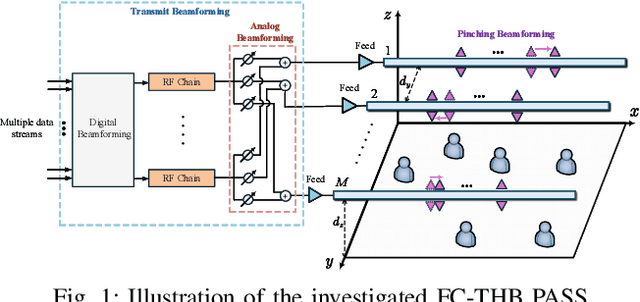
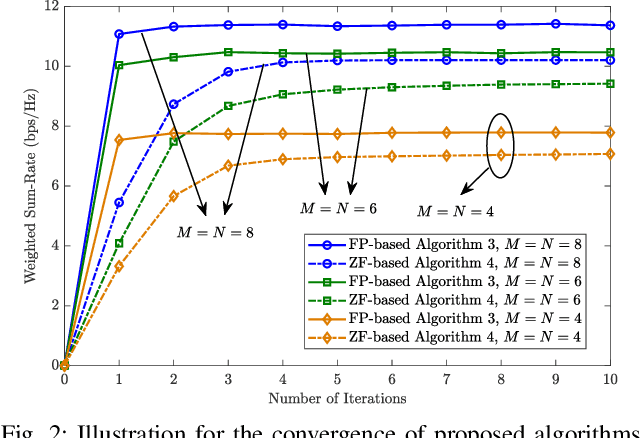
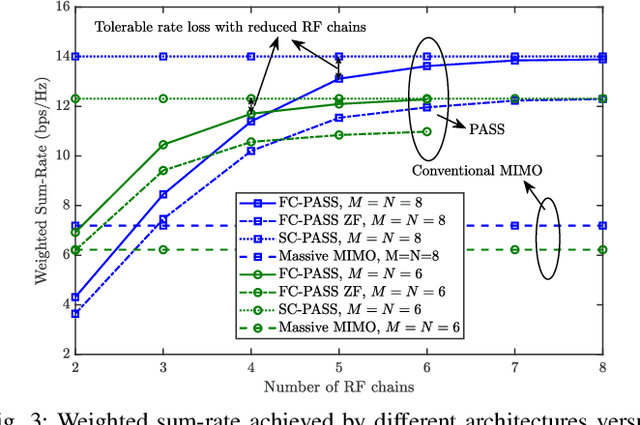
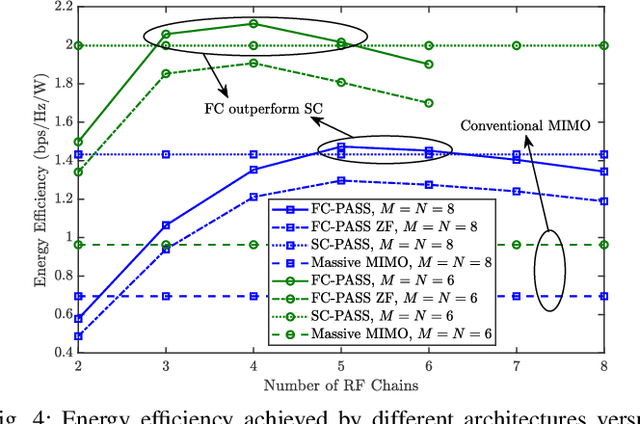
A novel fully-connected (FC) tri-hybrid beamforming (THB) architecture is proposed for pinching antenna systems (PASS). In contrast to conventional sub-connected (SC) PASS, the proposed FC architecture employs a tunable phase-shifter network to interconnect all radio frequency (RF) chains with all waveguides. This facilitates a THB framework that integrates conventional hybrid analog-digital beamforming with pinching beamforming. A weighted sum-rate (WSR) optimization problem is then formulated to jointly optimize the transmit beamformers and pinching antenna (PA) positions. Two algorithms are developed to address this challenging non-convex problem. 1) Fractional programming (FP)-based algorithm: This algorithm directly maximizes the WSR using an FP-based alternating optimization framework. Particularly, a success-history based adaptive differential evolution (SHADE) method is proposed to optimize PA positions, effectively addressing the intractable multimodal objective function. 2) Zero-forcing (ZF)-based algorithm: To reduce design complexity, zero-forcing is employed for transmit beamforming. The PA positions are subsequently optimized to maximize the WSR via a modified SHADE method. Simulation results validate the effectiveness of the proposed algorithms, revealing that the FC-THB PASS achieves WSR comparable to the SC architecture while delivering superior energy efficiency with fewer RF chains.