 Add to Chrome
 Add to Firefox
 Add to Edge
Vertical Pinching Antenna Systems (V-PAS) Aided UAV Communications
Jul 25, 2026
To address the limitation that existing horizontal pinching antenna systems (PAS) are primarily designed for ground users and confined to two-dimensional (2D) coverage, this paper proposes deploying a pinching antenna (PA) along the facade of urban buildings to construct a vertical pinching antenna system (V-PAS) for ultra-low-altitude unmanned aerial vehicle (UAV) communications. The proposed architecture employs a dielectric waveguide continuously deployed along the full height of buildings, extending the coverage capability of PAS from the 2D plane to three-dimensional (3D) airspace, ensuring a stable line-of-sight (LoS) link. We define the concept of pinching multiplicative path loss (PMPL) to characterize the cascaded multiplicative attenuation of the waveguide and free-space path losses. It is found that PMPL is insensitive to vertical distance, rendering V-PAS highly adaptive to building heights. Furthermore, accurate and asymptotic closed-form expressions for outage probability and ergodic rate under lossy waveguide conditions are derived, respectively, and the symmetry and optimality of system performance with respect to the midpoint of the access point (AP) height are discovered and proved. The results show that V-PAS achieves performance advantages over the benchmark without PA in most ultra-low-altitude UAV communication scenarios. Only under extremely high transmission power and large UAV operational area may the outage probability of V-PAS with a lossy waveguide be inferior to that of the benchmark without PA, but the ergodic rate of V-PAS still maintains an advantage. By contrast, V-PAS with a lossless waveguide outperforms the benchmark without PA in UAV communications, representing the theoretical performance upper bound of V-PAS.

Pinching Antenna-aided NOMA Systems with Internal Eavesdropping
Dec 25, 2025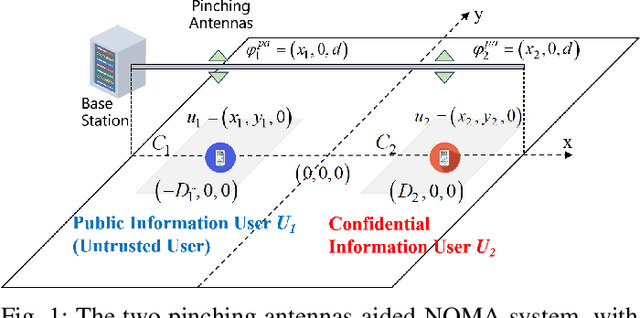
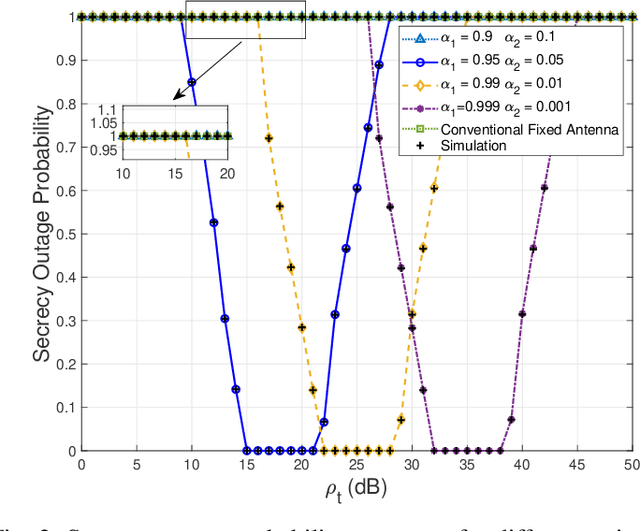
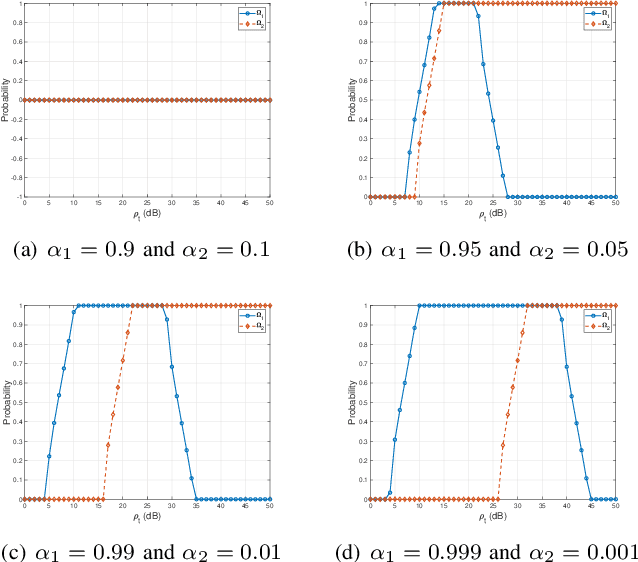
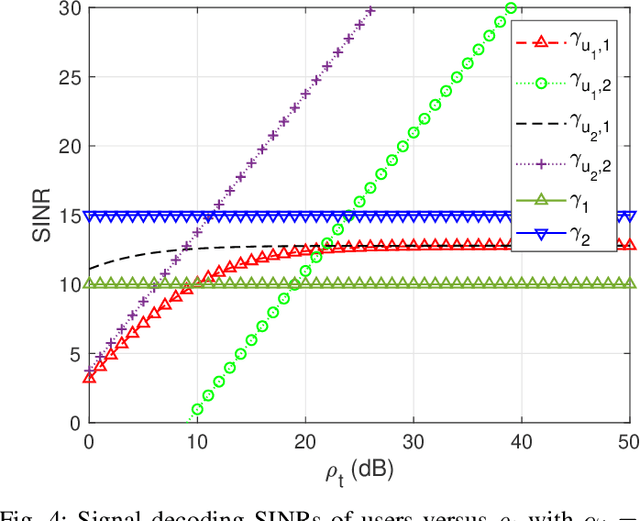
As a novel member of flexible antennas, the pinching antenna (PA) is realized by integrating small dielectric particles on a waveguide, offering unique regulatory capabilities on constructing line-of-sight (LoS) links and enhancing transceiver channels, reducing path loss and signal blockage. Meanwhile, non-orthogonal multiple access (NOMA) has become a potential technology of next-generation communications due to its remarkable advantages in spectrum efficiency and user access capability. The integration of PA and NOMA enables synergistic leveraging of PA's channel regulation capability and NOMA's multi-user multiplexing advantage, forming a complementary technical framework to deliver high-performance communication solutions. However, the use of successive interference cancellation (SIC) introduces significant security risks to power-domain NOMA systems when internal eavesdropping is present. To this end, this paper investigates the physical layer security of a PA-aided NOMA system where a nearby user is considered as an internal eavesdropper. We enhance the security of the NOMA system through optimizing the radiated power of PAs and analyze the secrecy performance by deriving the closed-form expressions for the secrecy outage probability (SOP). Furthermore, we extend the characterization of PA flexibility beyond deployment and scale adjustment to include flexible regulation of PA coupling length. Based on two conventional PA power models, i.e., the equal power model and the proportional power model, we propose a flexible power strategy to achieve secure transmission. The results highlight the potential of the PA-aided NOMA system in mitigating internal eavesdropping risks, and provide an effective strategy for optimizing power allocation and cell range of user activity.
Performance Analysis of Wireless-Powered Pinching Antenna Systems
Nov 05, 2025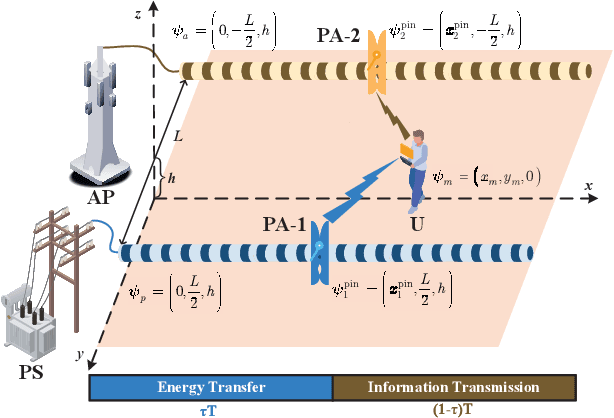
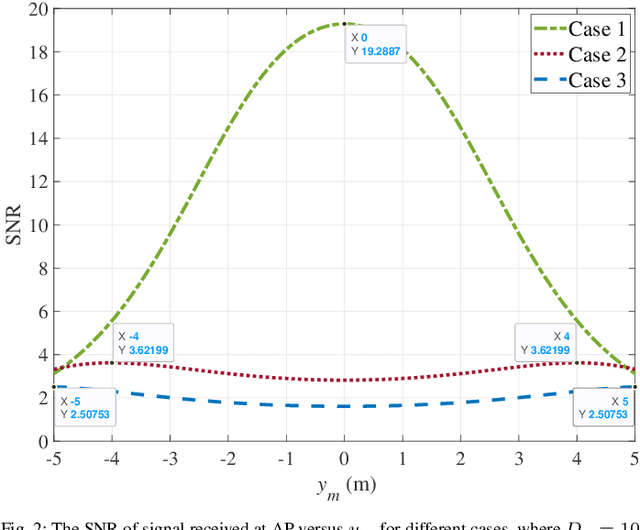


Pinching antenna system (PAS) serves as a groundbreaking paradigm that enhances wireless communications by flexibly adjusting the position of pinching antenna (PA) and establishing a strong line-of-sight (LoS) link, thereby reducing the free-space path loss. This paper introduces the concept of wireless-powered PAS, and investigates the reliability of wireless-powered PAS to explore the advantages of PA in improving the performance of wireless-powered communication (WPC) system. In addition, we derive the closed-form expressions of outage probability and ergodic rate for the practical lossy waveguide case and ideal lossless waveguide case, respectively, and analyze the optimal deployment of waveguides and user to provide valuable insights for guiding their deployments. The results show that an increase in the absorption coefficient and in the dimensions of the user area leads to higher in-waveguide and free-space propagation losses, respectively, which in turn increase the outage probability and reduce the ergodic rate of the wireless-powered PAS. However, the performance of wireless-powered PAS is severely affected by the absorption coefficient and the waveguide length, e.g., under conditions of high absorption coefficient and long waveguide, the outage probability of wireless-powered PAS is even worse than that of traditional WPC system. While the ergodic rate of wireless-powered PAS is better than that of traditional WPC system under conditions of high absorption coefficient and long waveguide. Interestingly, the wireless-powered PAS has the optimal time allocation factor and optimal distance between power station (PS) and access point (AP) to minimize the outage probability or maximize the ergodic rate. Moreover, the system performance of PS and AP separated at the optimal distance between PS and AP is superior to that of PS and AP integrated into a hybrid access point.
Secure Wireless-Powered zeRIS Communications
Mar 10, 2025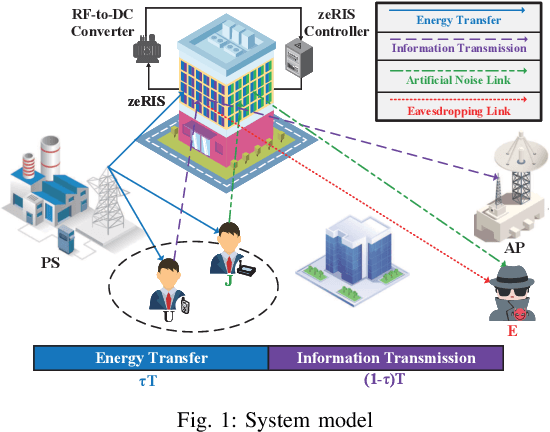
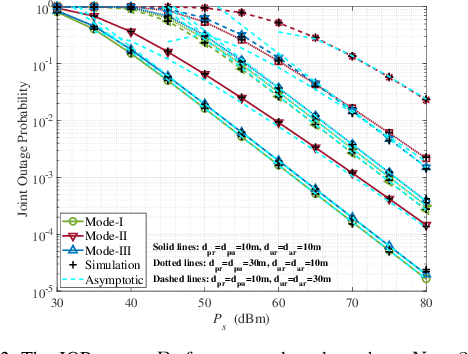
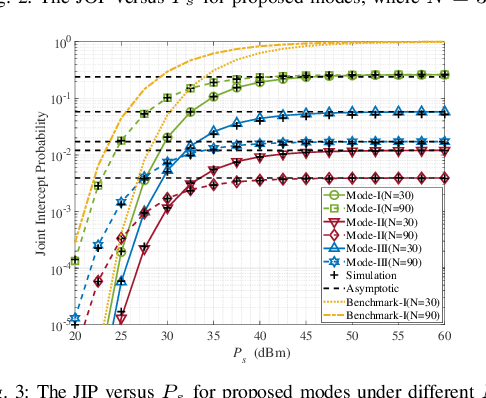
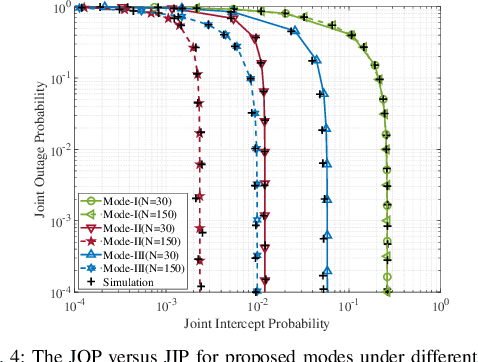
This paper introduces the concept of wireless-powered zero-energy reconfigurable intelligent surface (zeRIS), and investigates a wireless-powered zeRIS aided communication system in terms of security, reliability and energy efficiency. In particular, we propose three new wireless-powered zeRIS modes: 1) in mode-I, N reconfigurable reflecting elements are adjusted to the optimal phase shift design of information user to maximize the reliability of the system; 2) in mode-II, N reconfigurable reflecting elements are adjusted to the optimal phase shift design of cooperative jamming user to maximize the security of the system; 3) in mode-III, N1 and N2 (N1+N2=N) reconfigurable reflecting elements are respectively adjusted to the optimal phase shift designs of information user and cooperative jamming user to balance the reliability and security of the system. Then, we propose three new metrics, i.e., joint outage probability (JOP), joint intercept probability (JIP), and secrecy energy efficiency (SEE), and analyze their closed-form expressions in three modes, respectively. The results show that under high transmission power, all the diversity gains of three modes are 1, and the JOPs of mode-I, mode-II and mode-III are improved by increasing the number of zeRIS elements, which are related to N2, N, and N^2_1, respectively. In addition, mode-I achieves the best JOP, while mode-II achieves the best JIP among three modes. We exploit two security-reliability trade-off (SRT) metrics, i.e., JOP versus JIP, and normalized joint intercept and outage probability (JIOP), to reveal the SRT performance of the proposed three modes. It is obtained that mode-II outperforms the other two modes in the JOP versus JIP, while mode-III and mode-II achieve the best performance of normalized JIOP at low and high transmission power, respectively.