 Add to Chrome
 Add to Firefox
 Add to Edge
Segmented Waveguide-Enabled Pinching-Antenna Systems (SWANs) for ISAC
Paper and Code
Dec 08, 2025
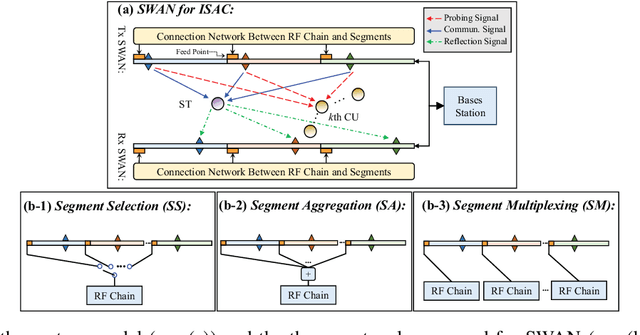
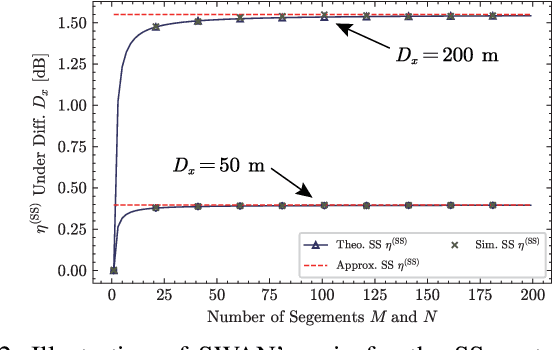
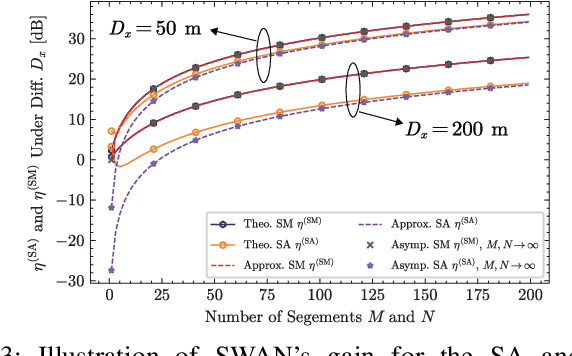
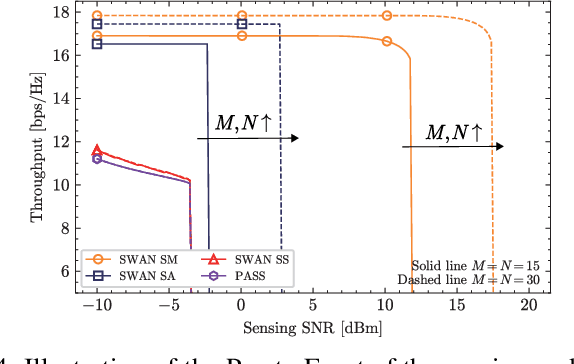
A segmented waveguide-enabled pinching-antenna system (SWAN)-assisted integrated sensing and communications (ISAC) framework is proposed. Unlike conventional pinching antenna systems (PASS), which use a single long waveguide, SWAN divides the waveguide into multiple short segments, each with a dedicated feed point. Thanks to the segmented structure, SWAN enhances sensing performance by significantly simplifying the reception model and reducing the in-waveguide propagation loss. To balance performance and complexity, three segment controlling protocols are proposed for the transceivers, namely i) \emph{segment selection} to select a single segment for signal transceiving, ii) \emph{segment aggregation} to aggregate signals from all segments using a single RF chain, and iii) \emph{segment multiplexing} to jointly process the signals from all segments using individual RF chains. The theoretical sensing performance limit is first analyzed for different protocols, unveiling how the sensing performance gain of SWAN scales with the number of segments. Based on this performance limit, the Pareto fronts of sensing and communication performance are characterized for the simple one-user one-target case, which is then extended to the general multi-user single-target case based on time-division multiple access (TDMA). Numerical results are presented to verify the correctness of the derivations and the effectiveness of the proposed algorithms, which jointly confirm the advantages of SWAN-assisted ISAC.
