 Add to Chrome
 Add to Firefox
 Add to Edge
Disentangling Likes and Dislikes in Personalized Generative Explainable Recommendation
Oct 17, 2024
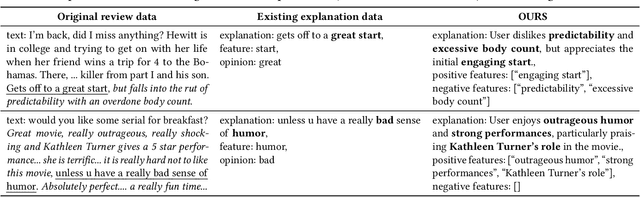
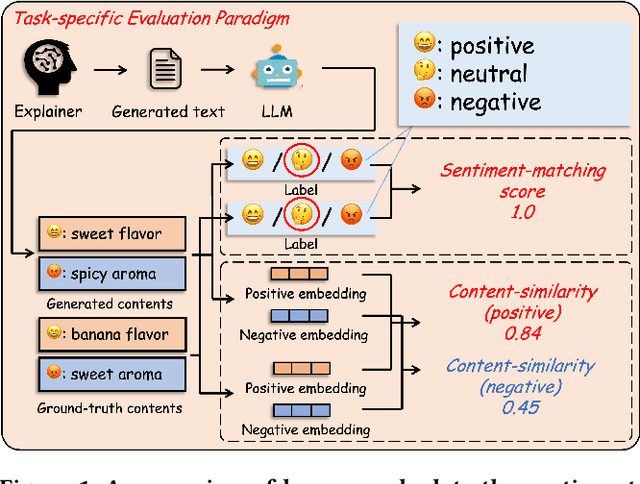
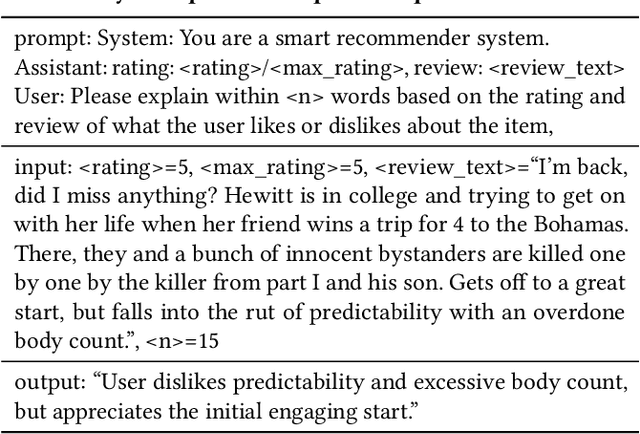
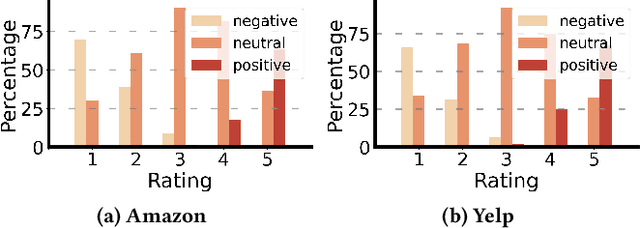
Recent research on explainable recommendation generally frames the task as a standard text generation problem, and evaluates models simply based on the textual similarity between the predicted and ground-truth explanations. However, this approach fails to consider one crucial aspect of the systems: whether their outputs accurately reflect the users' (post-purchase) sentiments, i.e., whether and why they would like and/or dislike the recommended items. To shed light on this issue, we introduce new datasets and evaluation methods that focus on the users' sentiments. Specifically, we construct the datasets by explicitly extracting users' positive and negative opinions from their post-purchase reviews using an LLM, and propose to evaluate systems based on whether the generated explanations 1) align well with the users' sentiments, and 2) accurately identify both positive and negative opinions of users on the target items. We benchmark several recent models on our datasets and demonstrate that achieving strong performance on existing metrics does not ensure that the generated explanations align well with the users' sentiments. Lastly, we find that existing models can provide more sentiment-aware explanations when the users' (predicted) ratings for the target items are directly fed into the models as input. We will release our code and datasets upon acceptance.

Dynamic Multimodal Evaluation with Flexible Complexity by Vision-Language Bootstrapping
Oct 11, 2024
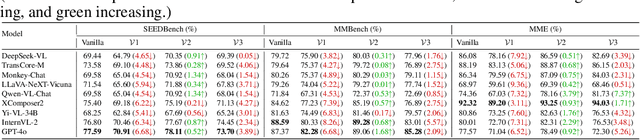
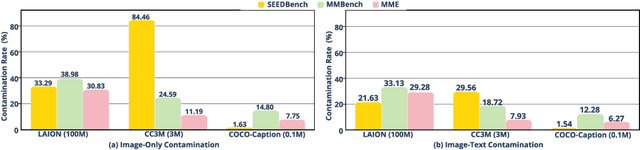

Large Vision-Language Models (LVLMs) have demonstrated remarkable capabilities across multimodal tasks such as visual perception and reasoning, leading to good performance on various multimodal evaluation benchmarks. However, these benchmarks keep a static nature and overlap with the pre-training data, resulting in fixed complexity constraints and data contamination issues. This raises the concern regarding the validity of the evaluation. To address these two challenges, we introduce a dynamic multimodal evaluation protocol called Vision-Language Bootstrapping (VLB). VLB provides a robust and comprehensive assessment for LVLMs with reduced data contamination and flexible complexity. To this end, VLB dynamically generates new visual question-answering samples through a multimodal bootstrapping module that modifies both images and language, while ensuring that newly generated samples remain consistent with the original ones by a judge module. By composing various bootstrapping strategies, VLB offers dynamic variants of existing benchmarks with diverse complexities, enabling the evaluation to co-evolve with the ever-evolving capabilities of LVLMs. Extensive experimental results across multiple benchmarks, including SEEDBench, MMBench, and MME, show that VLB significantly reduces data contamination and exposes performance limitations of LVLMs.
Towards Trustworthy Knowledge Graph Reasoning: An Uncertainty Aware Perspective
Oct 11, 2024Recently, Knowledge Graphs (KGs) have been successfully coupled with Large Language Models (LLMs) to mitigate their hallucinations and enhance their reasoning capability, such as in KG-based retrieval-augmented frameworks. However, current KG-LLM frameworks lack rigorous uncertainty estimation, limiting their reliable deployment in high-stakes applications. Directly incorporating uncertainty quantification into KG-LLM frameworks presents challenges due to their complex architectures and the intricate interactions between the knowledge graph and language model components. To address this gap, we propose a new trustworthy KG-LLM framework, Uncertainty Aware Knowledge-Graph Reasoning (UAG), which incorporates uncertainty quantification into the KG-LLM framework. We design an uncertainty-aware multi-step reasoning framework that leverages conformal prediction to provide a theoretical guarantee on the prediction set. To manage the error rate of the multi-step process, we additionally introduce an error rate control module to adjust the error rate within the individual components. Extensive experiments show that our proposed UAG can achieve any pre-defined coverage rate while reducing the prediction set/interval size by 40% on average over the baselines.
Reconstruction of Particle Flow Energy Distribution Using Deep Learning Algorithms
Oct 08, 2024In high-energy particle physics, extracting information from complex detector signals is crucial for energy reconstruction. Recent advancements involve using deep learning to process calorimeter images from various sub-detectors in experiments like the Large Hadron Collider (LHC) for energy map reconstruction. This paper compares classical algorithms\-MLP, CNN, U-Net, and RNN\-with variants that include self-attention and 3D convolution modules to evaluate their effectiveness in reconstructing the initial energy distribution. Additionally, a test dataset of jet events is utilized to analyze and compare models' performance in handling anomalous high-energy events. The analysis highlights the effectiveness of deep learning techniques for energy image reconstruction and explores their potential in this area.
Accelerating Auto-regressive Text-to-Image Generation with Training-free Speculative Jacobi Decoding
Oct 02, 2024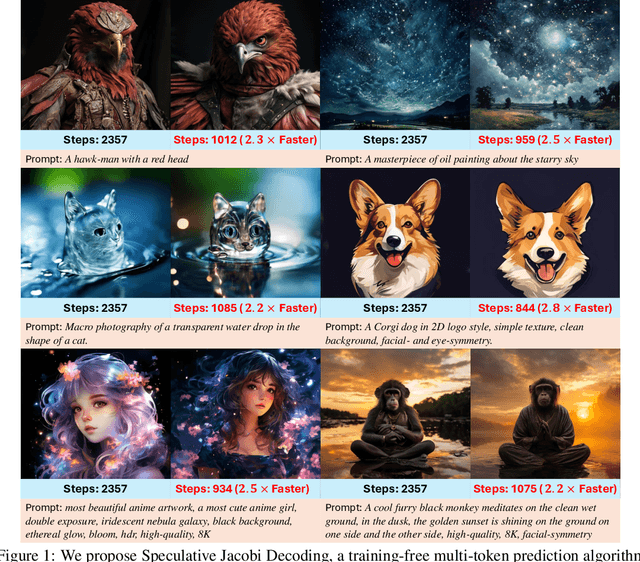
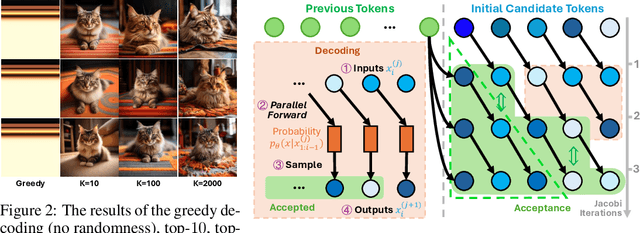
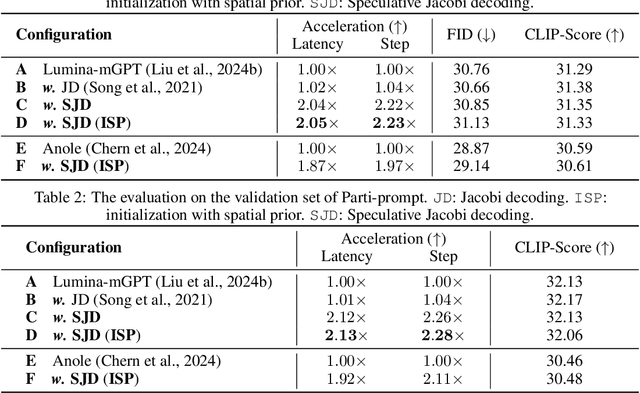
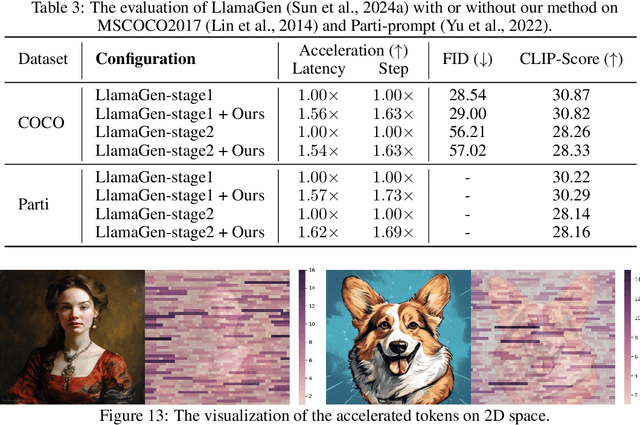
The current large auto-regressive models can generate high-quality, high-resolution images, but these models require hundreds or even thousands of steps of next-token prediction during inference, resulting in substantial time consumption. In existing studies, Jacobi decoding, an iterative parallel decoding algorithm, has been used to accelerate the auto-regressive generation and can be executed without training. However, the Jacobi decoding relies on a deterministic criterion to determine the convergence of iterations. Thus, it works for greedy decoding but is incompatible with sampling-based decoding which is crucial for visual quality and diversity in the current auto-regressive text-to-image generation. In this paper, we propose a training-free probabilistic parallel decoding algorithm, Speculative Jacobi Decoding (SJD), to accelerate auto-regressive text-to-image generation. By introducing a probabilistic convergence criterion, our SJD accelerates the inference of auto-regressive text-to-image generation while maintaining the randomness in sampling-based token decoding and allowing the model to generate diverse images. Specifically, SJD facilitates the model to predict multiple tokens at each step and accepts tokens based on the probabilistic criterion, enabling the model to generate images with fewer steps than the conventional next-token-prediction paradigm. We also investigate the token initialization strategies that leverage the spatial locality of visual data to further improve the acceleration ratio under specific scenarios. We conduct experiments for our proposed SJD on multiple auto-regressive text-to-image generation models, showing the effectiveness of model acceleration without sacrificing the visual quality.
Self-Updatable Large Language Models with Parameter Integration
Oct 01, 2024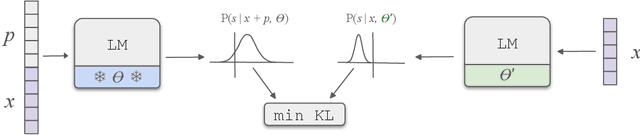

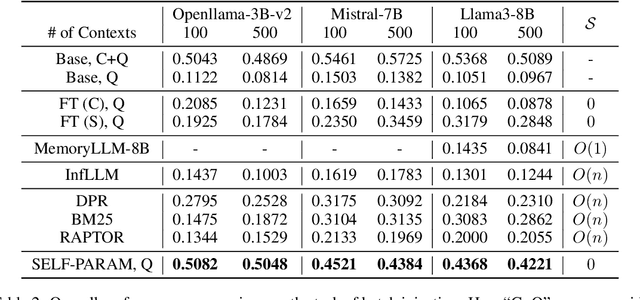
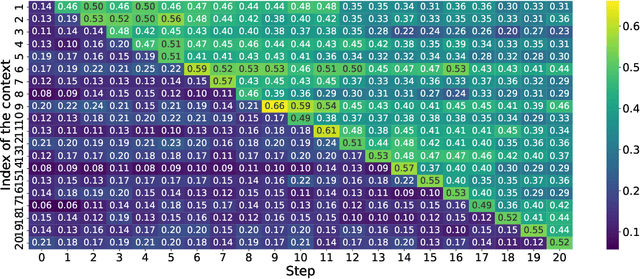
Despite significant advancements in large language models (LLMs), the rapid and frequent integration of small-scale experiences, such as interactions with surrounding objects, remains a substantial challenge. Two critical factors in assimilating these experiences are (1) Efficacy: the ability to accurately remember recent events; (2) Retention: the capacity to recall long-past experiences. Current methods either embed experiences within model parameters using continual learning, model editing, or knowledge distillation techniques, which often struggle with rapid updates and complex interactions, or rely on external storage to achieve long-term retention, thereby increasing storage requirements. In this paper, we propose SELF-PARAM (Self-Updatable Large Language Models with Parameter Integration). SELF-PARAM requires no extra parameters while ensuring near-optimal efficacy and long-term retention. Our method employs a training objective that minimizes the Kullback-Leibler (KL) divergence between the predictions of an original model (with access to contextual information) and a target model (without such access). By generating diverse question-answer pairs related to the knowledge and minimizing the KL divergence across this dataset, we update the target model to internalize the knowledge seamlessly within its parameters. Evaluations on question-answering and conversational recommendation tasks demonstrate that SELF-PARAM significantly outperforms existing methods, even when accounting for non-zero storage requirements. This advancement paves the way for more efficient and scalable integration of experiences in large language models by embedding knowledge directly into model parameters.
Multi-Designated Detector Watermarking for Language Models
Sep 26, 2024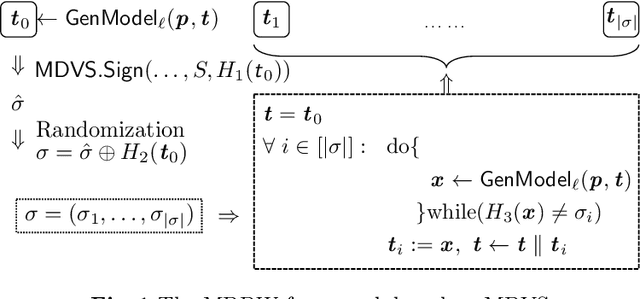
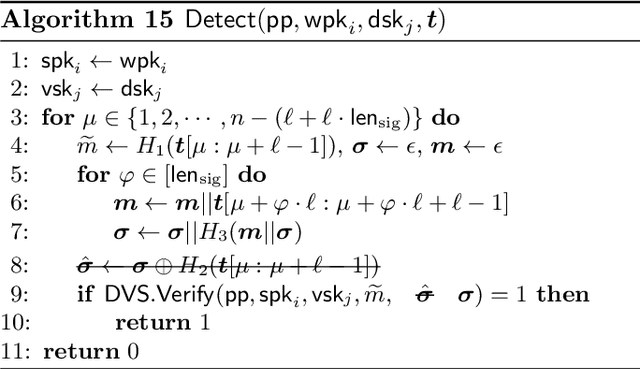
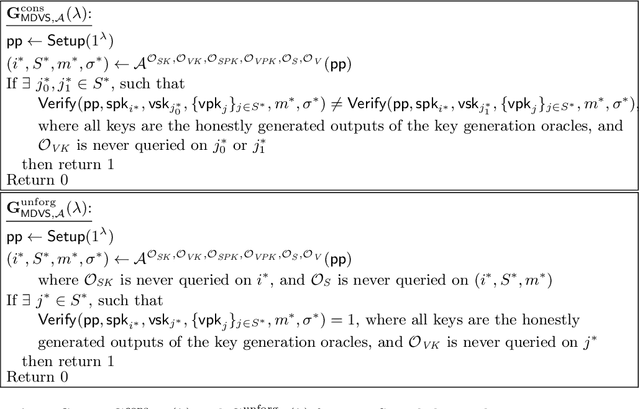
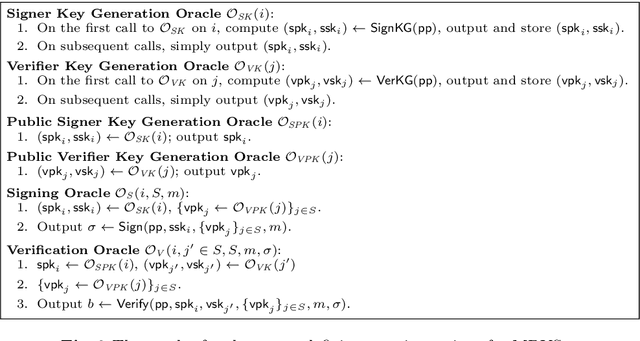
In this paper, we initiate the study of \emph{multi-designated detector watermarking (MDDW)} for large language models (LLMs). This technique allows model providers to generate watermarked outputs from LLMs with two key properties: (i) only specific, possibly multiple, designated detectors can identify the watermarks, and (ii) there is no perceptible degradation in the output quality for ordinary users. We formalize the security definitions for MDDW and present a framework for constructing MDDW for any LLM using multi-designated verifier signatures (MDVS). Recognizing the significant economic value of LLM outputs, we introduce claimability as an optional security feature for MDDW, enabling model providers to assert ownership of LLM outputs within designated-detector settings. To support claimable MDDW, we propose a generic transformation converting any MDVS to a claimable MDVS. Our implementation of the MDDW scheme highlights its advanced functionalities and flexibility over existing methods, with satisfactory performance metrics.
Towards the Mitigation of Confirmation Bias in Semi-supervised Learning: a Debiased Training Perspective
Sep 26, 2024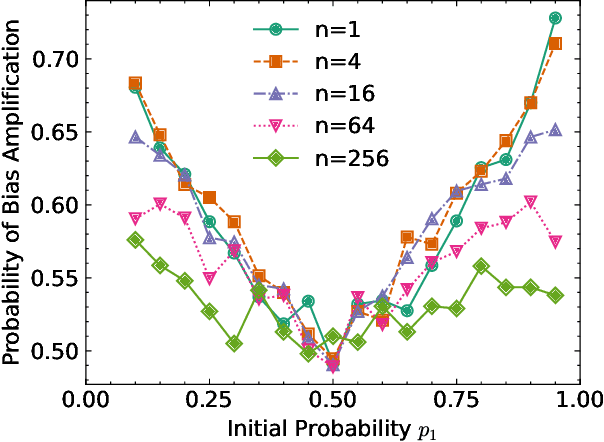
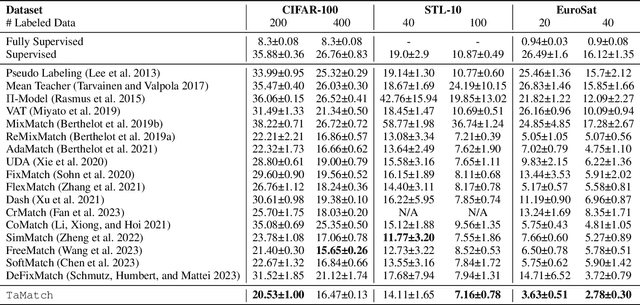
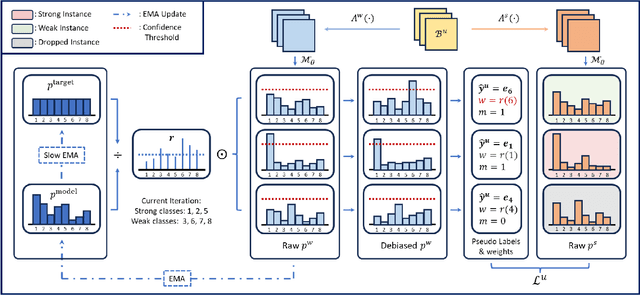
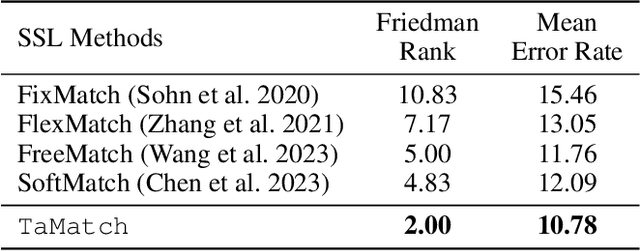
Semi-supervised learning (SSL) commonly exhibits confirmation bias, where models disproportionately favor certain classes, leading to errors in predicted pseudo labels that accumulate under a self-training paradigm. Unlike supervised settings, which benefit from a rich, static data distribution, SSL inherently lacks mechanisms to correct this self-reinforced bias, necessitating debiased interventions at each training step. Although the generation of debiased pseudo labels has been extensively studied, their effective utilization remains underexplored. Our analysis indicates that data from biased classes should have a reduced influence on parameter updates, while more attention should be given to underrepresented classes. To address these challenges, we introduce TaMatch, a unified framework for debiased training in SSL. TaMatch employs a scaling ratio derived from both a prior target distribution and the model's learning status to estimate and correct bias at each training step. This ratio adjusts the raw predictions on unlabeled data to produce debiased pseudo labels. In the utilization phase, these labels are differently weighted according to their predicted class, enhancing training equity and minimizing class bias. Additionally, TaMatch dynamically adjust the target distribution in response to the model's learning progress, facilitating robust handling of practical scenarios where the prior distribution is unknown. Empirical evaluations show that TaMatch significantly outperforms existing state-of-the-art methods across a range of challenging image classification tasks, highlighting the critical importance of both the debiased generation and utilization of pseudo labels in SSL.
Behavior evolution-inspired approach to walking gait reinforcement training for quadruped robots
Sep 25, 2024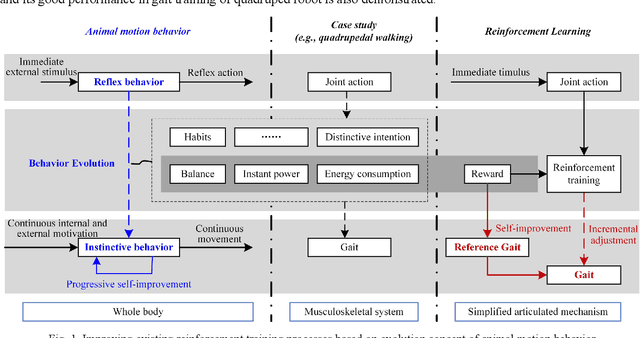
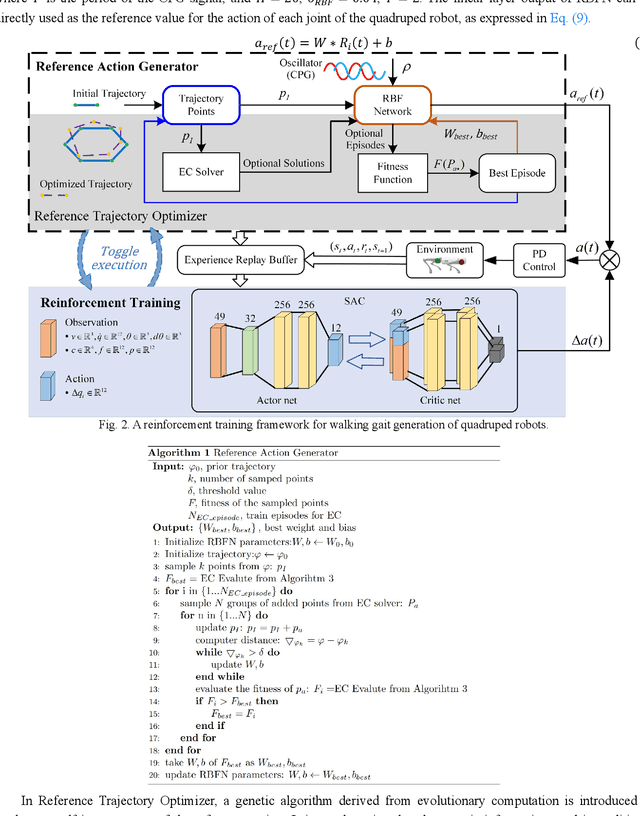
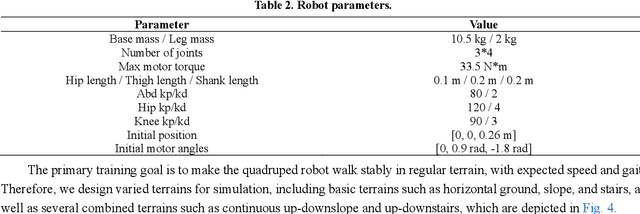
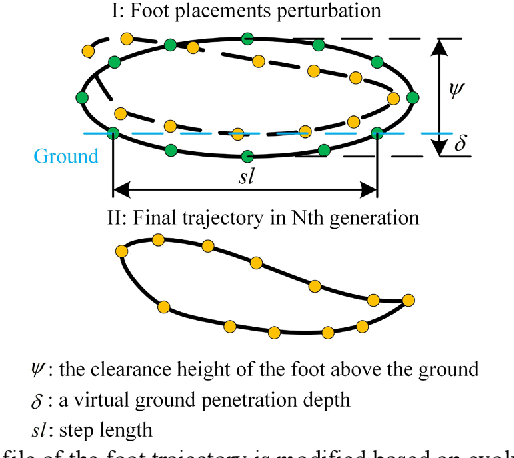
Reinforcement learning method is extremely competitive in gait generation techniques for quadrupedal robot, which is mainly due to the fact that stochastic exploration in reinforcement training is beneficial to achieve an autonomous gait. Nevertheless, although incremental reinforcement learning is employed to improve training success and movement smoothness by relying on the continuity inherent during limb movements, challenges remain in adapting gait policy to diverse terrain and external disturbance. Inspired by the association between reinforcement learning and the evolution of animal motion behavior, a self-improvement mechanism for reference gait is introduced in this paper to enable incremental learning of action and self-improvement of reference action together to imitate the evolution of animal motion behavior. Further, a new framework for reinforcement training of quadruped gait is proposed. In this framework, genetic algorithm is specifically adopted to perform global probabilistic search for the initial value of the arbitrary foot trajectory to update the reference trajectory with better fitness. Subsequently, the improved reference gait is used for incremental reinforcement learning of gait. The above process is repeatedly and alternatively executed to finally train the gait policy. The analysis considering terrain, model dimensions, and locomotion condition is presented in detail based on simulation, and the results show that the framework is significantly more adaptive to terrain compared to regular incremental reinforcement learning.
Multi-UAV Pursuit-Evasion with Online Planning in Unknown Environments by Deep Reinforcement Learning
Sep 25, 2024

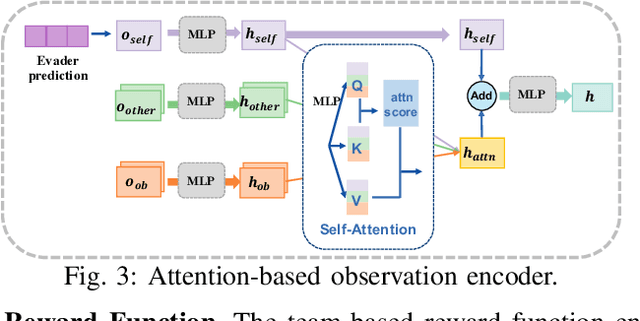

Multi-UAV pursuit-evasion, where pursuers aim to capture evaders, poses a key challenge for UAV swarm intelligence. Multi-agent reinforcement learning (MARL) has demonstrated potential in modeling cooperative behaviors, but most RL-based approaches remain constrained to simplified simulations with limited dynamics or fixed scenarios. Previous attempts to deploy RL policy to real-world pursuit-evasion are largely restricted to two-dimensional scenarios, such as ground vehicles or UAVs at fixed altitudes. In this paper, we address multi-UAV pursuit-evasion by considering UAV dynamics and physical constraints. We introduce an evader prediction-enhanced network to tackle partial observability in cooperative strategy learning. Additionally, we propose an adaptive environment generator within MARL training, enabling higher exploration efficiency and better policy generalization across diverse scenarios. Simulations show our method significantly outperforms all baselines in challenging scenarios, generalizing to unseen scenarios with a 100% capture rate. Finally, we derive a feasible policy via a two-stage reward refinement and deploy the policy on real quadrotors in a zero-shot manner. To our knowledge, this is the first work to derive and deploy an RL-based policy using collective thrust and body rates control commands for multi-UAV pursuit-evasion in unknown environments. The open-source code and videos are available at https://sites.google.com/view/pursuit-evasion-rl.