 Add to Chrome
 Add to Firefox
 Add to Edge
Intern-S2-Preview: Scientific Agentic Foundation Model
Aug 13, 2026
Scientific discovery increasingly requires AI systems that can reason over scientific evidence of heterogeneous modalities, interact with scientific tools and environments, and sustain progress across long task horizons. We present Intern-S2-Preview, a series of scientific agentic foundation models designed to support multimodal scientific understanding, reasoning, generation, and long-horizon tasks. The training pipeline begins with scientific multimodal pre-training over rendered scientific documents, interleaved image-text data, and diverse scientific corpora. Starting from the pretrained checkpoint, we apply a unified post-training pipeline consisting of supervised fine-tuning, scalable multi-task reinforcement learning (RL), black- and white-box agentic RL, and on-policy distillation. This pipeline is supported by practical techniques that improve rollout and training stability and efficiency, including partial rollout with off-policy correction, adaptive length regularization, online speculative decoding, robust multi-task optimization, and trace-aware experience assembly for agentic tasks. At the architecture level, Intern-S2-Preview-397B extends time series modelling from efficient long-sequence understanding to numerical forecasting, while Memory Decoder is studied as a separate memory-augmented path for rapid scientific specialization without modifying the frozen 397B backbone. Evaluations across scientific, multimodal, agentic, and general-purpose benchmarks show that Intern-S2-Preview-397B achieves competitive or leading results in multiple settings. The time series modules improve scientific signal understanding and forecasting on SciTS, while the separate Intern-MemDec-4B extension improves the Biology-Instructions average score from 56.92 to 60.32 without modifying the frozen 397B backbone.

SciExplore: Evaluating Autonomous Agents from Scientific Navigation to Information Integration
Jul 23, 2026Scientific research involves complex information-seeking and reasoning workflows across heterogeneous sources. However, existing benchmarks primarily emphasize general-domain retrieval or static scientific question answering, and therefore fail to assess key capabilities required in realistic scientific research workflows. We introduce SciExplore, a benchmark designed to evaluate scientific information-seeking and reasoning capabilities of LLMs and agents. SciExplore comprises four task types covering 103 expert-curated tasks across more than ten scientific disciplines: scientific database navigation, ambiguous literature retrieval, missing reference completion, and cross-source structured knowledge synthesis, which probe progressively higher-level abilities from entity-level reasoning and document-level identification to evidence-level grounding and domain-level synthesis. We evaluate over ten state-of-the-art LLMs and autonomous agents on SciExplore, revealing substantial performance gaps with performance degrading sharply as task complexity increases and extremely low accuracy on the most challenging structured synthesis tasks. These results highlight significant limitations of current models and agents in realistic scientific information-seeking scenarios.
MF-Speech: Achieving Fine-Grained and Compositional Control in Speech Generation via Factor Disentanglement
Nov 19, 2025Generating expressive and controllable human speech is one of the core goals of generative artificial intelligence, but its progress has long been constrained by two fundamental challenges: the deep entanglement of speech factors and the coarse granularity of existing control mechanisms. To overcome these challenges, we have proposed a novel framework called MF-Speech, which consists of two core components: MF-SpeechEncoder and MF-SpeechGenerator. MF-SpeechEncoder acts as a factor purifier, adopting a multi-objective optimization strategy to decompose the original speech signal into highly pure and independent representations of content, timbre, and emotion. Subsequently, MF-SpeechGenerator functions as a conductor, achieving precise, composable and fine-grained control over these factors through dynamic fusion and Hierarchical Style Adaptive Normalization (HSAN). Experiments demonstrate that in the highly challenging multi-factor compositional speech generation task, MF-Speech significantly outperforms current state-of-the-art methods, achieving a lower word error rate (WER=4.67%), superior style control (SECS=0.5685, Corr=0.68), and the highest subjective evaluation scores(nMOS=3.96, sMOS_emotion=3.86, sMOS_style=3.78). Furthermore, the learned discrete factors exhibit strong transferability, demonstrating their significant potential as a general-purpose speech representation.
HumanVid: Demystifying Training Data for Camera-controllable Human Image Animation
Jul 28, 2024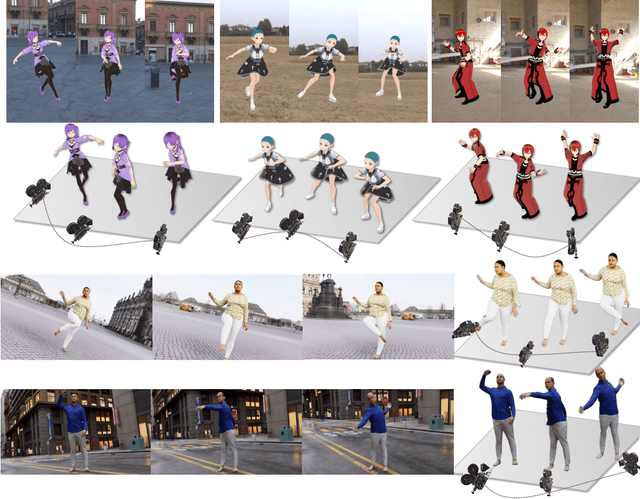
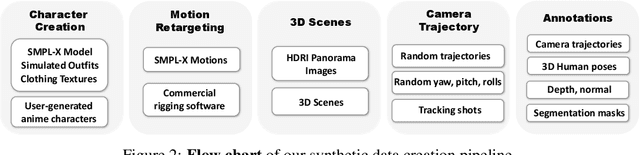
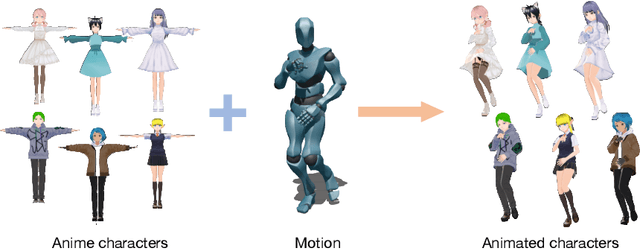
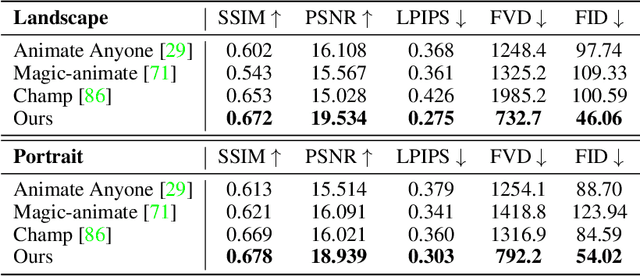
Human image animation involves generating videos from a character photo, allowing user control and unlocking potential for video and movie production. While recent approaches yield impressive results using high-quality training data, the inaccessibility of these datasets hampers fair and transparent benchmarking. Moreover, these approaches prioritize 2D human motion and overlook the significance of camera motions in videos, leading to limited control and unstable video generation. To demystify the training data, we present HumanVid, the first large-scale high-quality dataset tailored for human image animation, which combines crafted real-world and synthetic data. For the real-world data, we compile a vast collection of copyright-free real-world videos from the internet. Through a carefully designed rule-based filtering strategy, we ensure the inclusion of high-quality videos, resulting in a collection of 20K human-centric videos in 1080P resolution. Human and camera motion annotation is accomplished using a 2D pose estimator and a SLAM-based method. For the synthetic data, we gather 2,300 copyright-free 3D avatar assets to augment existing available 3D assets. Notably, we introduce a rule-based camera trajectory generation method, enabling the synthetic pipeline to incorporate diverse and precise camera motion annotation, which can rarely be found in real-world data. To verify the effectiveness of HumanVid, we establish a baseline model named CamAnimate, short for Camera-controllable Human Animation, that considers both human and camera motions as conditions. Through extensive experimentation, we demonstrate that such simple baseline training on our HumanVid achieves state-of-the-art performance in controlling both human pose and camera motions, setting a new benchmark. Code and data will be publicly available at https://github.com/zhenzhiwang/HumanVid/.
Sagiri: Low Dynamic Range Image Enhancement with Generative Diffusion Prior
Jun 13, 2024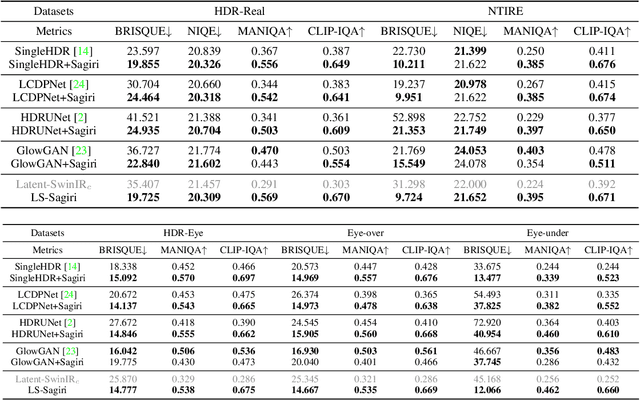

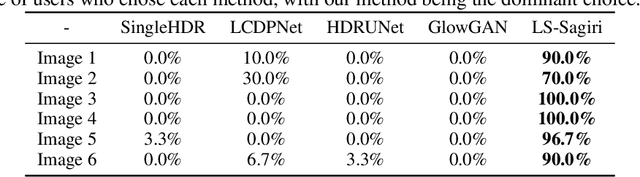
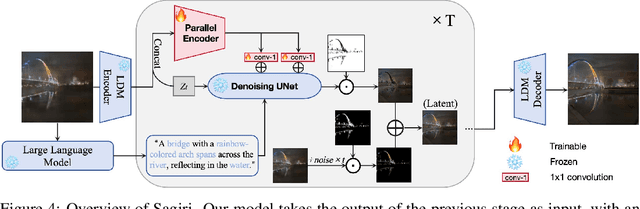
Capturing High Dynamic Range (HDR) scenery using 8-bit cameras often suffers from over-/underexposure, loss of fine details due to low bit-depth compression, skewed color distributions, and strong noise in dark areas. Traditional LDR image enhancement methods primarily focus on color mapping, which enhances the visual representation by expanding the image's color range and adjusting the brightness. However, these approaches fail to effectively restore content in dynamic range extremes, which are regions with pixel values close to 0 or 255. To address the full scope of challenges in HDR imaging and surpass the limitations of current models, we propose a novel two-stage approach. The first stage maps the color and brightness to an appropriate range while keeping the existing details, and the second stage utilizes a diffusion prior to generate content in dynamic range extremes lost during capture. This generative refinement module can also be used as a plug-and-play module to enhance and complement existing LDR enhancement models. The proposed method markedly improves the quality and details of LDR images, demonstrating superior performance through rigorous experimental validation. The project page is at https://sagiri0208.github.io
PIA: Your Personalized Image Animator via Plug-and-Play Modules in Text-to-Image Models
Dec 21, 2023Recent advancements in personalized text-to-image (T2I) models have revolutionized content creation, empowering non-experts to generate stunning images with unique styles. While promising, adding realistic motions into these personalized images by text poses significant challenges in preserving distinct styles, high-fidelity details, and achieving motion controllability by text. In this paper, we present PIA, a Personalized Image Animator that excels in aligning with condition images, achieving motion controllability by text, and the compatibility with various personalized T2I models without specific tuning. To achieve these goals, PIA builds upon a base T2I model with well-trained temporal alignment layers, allowing for the seamless transformation of any personalized T2I model into an image animation model. A key component of PIA is the introduction of the condition module, which utilizes the condition frame and inter-frame affinity as input to transfer appearance information guided by the affinity hint for individual frame synthesis in the latent space. This design mitigates the challenges of appearance-related image alignment within and allows for a stronger focus on aligning with motion-related guidance.