 Add to Chrome
 Add to Firefox
 Add to Edge
Automatic Summarization of Doctor-Patient Encounter Dialogues Using Large Language Model through Prompt Tuning
Mar 19, 2024
Automatic text summarization (ATS) is an emerging technology to assist clinicians in providing continuous and coordinated care. This study presents an approach to summarize doctor-patient dialogues using generative large language models (LLMs). We developed prompt-tuning algorithms to instruct generative LLMs to summarize clinical text. We examined the prompt-tuning strategies, the size of soft prompts, and the few-short learning ability of GatorTronGPT, a generative clinical LLM developed using 277 billion clinical and general English words with up to 20 billion parameters. We compared GatorTronGPT with a previous solution based on fine-tuning of a widely used T5 model, using a clinical benchmark dataset MTS-DIALOG. The experimental results show that the GatorTronGPT- 20B model achieved the best performance on all evaluation metrics. The proposed solution has a low computing cost as the LLM parameters are not updated during prompt-tuning. This study demonstrates the efficiency of generative clinical LLMs for clinical ATS through prompt tuning.

Improving Generalizability of Extracting Social Determinants of Health Using Large Language Models through Prompt-tuning
Mar 19, 2024
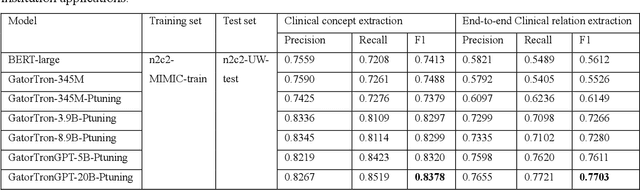

The progress in natural language processing (NLP) using large language models (LLMs) has greatly improved patient information extraction from clinical narratives. However, most methods based on the fine-tuning strategy have limited transfer learning ability for cross-domain applications. This study proposed a novel approach that employs a soft prompt-based learning architecture, which introduces trainable prompts to guide LLMs toward desired outputs. We examined two types of LLM architectures, including encoder-only GatorTron and decoder-only GatorTronGPT, and evaluated their performance for the extraction of social determinants of health (SDoH) using a cross-institution dataset from the 2022 n2c2 challenge and a cross-disease dataset from the University of Florida (UF) Health. The results show that decoder-only LLMs with prompt tuning achieved better performance in cross-domain applications. GatorTronGPT achieved the best F1 scores for both datasets, outperforming traditional fine-tuned GatorTron by 8.9% and 21.8% in a cross-institution setting, and 5.5% and 14.5% in a cross-disease setting.
Narrative Feature or Structured Feature? A Study of Large Language Models to Identify Cancer Patients at Risk of Heart Failure
Mar 18, 2024Cancer treatments are known to introduce cardiotoxicity, negatively impacting outcomes and survivorship. Identifying cancer patients at risk of heart failure (HF) is critical to improving cancer treatment outcomes and safety. This study examined machine learning (ML) models to identify cancer patients at risk of HF using electronic health records (EHRs), including traditional ML, Time-Aware long short-term memory (T-LSTM), and large language models (LLMs) using novel narrative features derived from the structured medical codes. We identified a cancer cohort of 12,806 patients from the University of Florida Health, diagnosed with lung, breast, and colorectal cancers, among which 1,602 individuals developed HF after cancer. The LLM, GatorTron-3.9B, achieved the best F1 scores, outperforming the traditional support vector machines by 39%, the T-LSTM deep learning model by 7%, and a widely used transformer model, BERT, by 5.6%. The analysis shows that the proposed narrative features remarkably increased feature density and improved performance.
Gemini 1.5: Unlocking multimodal understanding across millions of tokens of context
Mar 08, 2024In this report, we present the latest model of the Gemini family, Gemini 1.5 Pro, a highly compute-efficient multimodal mixture-of-experts model capable of recalling and reasoning over fine-grained information from millions of tokens of context, including multiple long documents and hours of video and audio. Gemini 1.5 Pro achieves near-perfect recall on long-context retrieval tasks across modalities, improves the state-of-the-art in long-document QA, long-video QA and long-context ASR, and matches or surpasses Gemini 1.0 Ultra's state-of-the-art performance across a broad set of benchmarks. Studying the limits of Gemini 1.5 Pro's long-context ability, we find continued improvement in next-token prediction and near-perfect retrieval (>99%) up to at least 10M tokens, a generational leap over existing models such as Claude 2.1 (200k) and GPT-4 Turbo (128k). Finally, we highlight surprising new capabilities of large language models at the frontier; when given a grammar manual for Kalamang, a language with fewer than 200 speakers worldwide, the model learns to translate English to Kalamang at a similar level to a person who learned from the same content.
Me LLaMA: Foundation Large Language Models for Medical Applications
Feb 20, 2024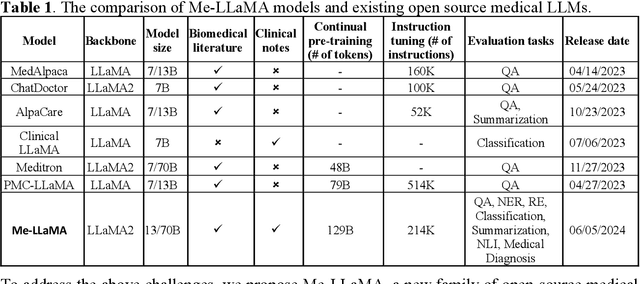
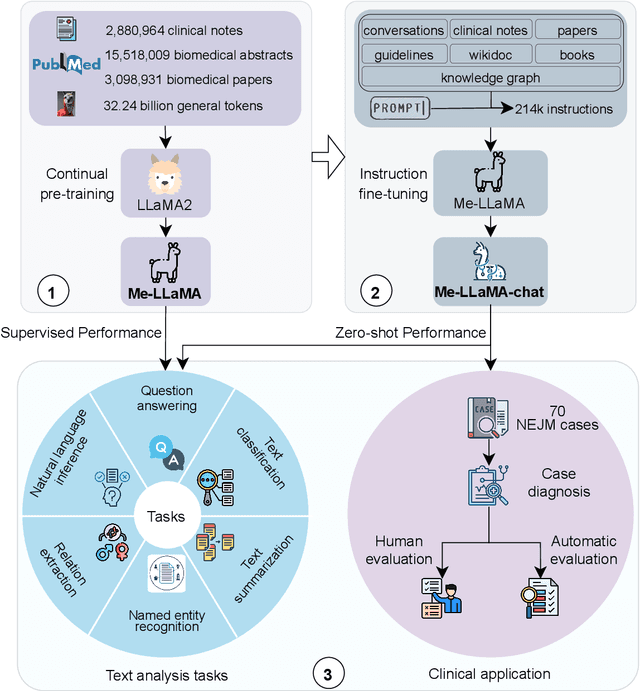
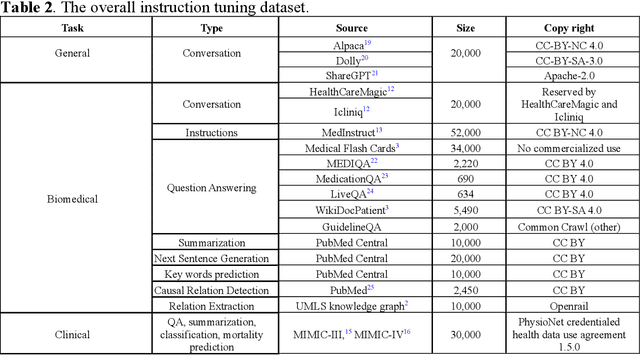
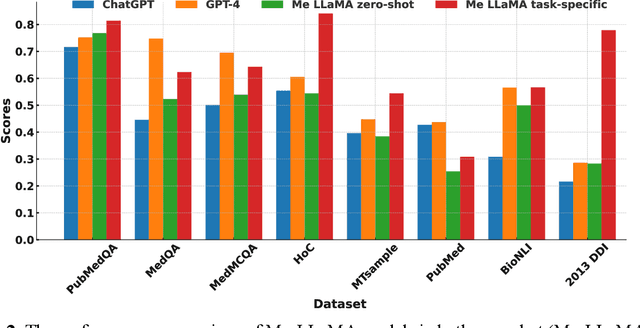
Recent large language models (LLMs) like ChatGPT and LLaMA have shown great promise in many AI applications. However, their performance on medical tasks is suboptimal and can be further improved by training on large domain-specific datasets. This study introduces Me LLaMA, a medical LLM family including foundation models - Me LLaMA 13/70B and their chat-enhanced versions - Me LLaMA 13/70B-chat, developed through the continual pre-training and instruction tuning of LLaMA2 using large medical data. Our domain-specific data suite for training and evaluation, includes a large-scale continual pre-training dataset with 129B tokens, an instruction tuning dataset with 214k samples, and a medical evaluation benchmark (MIBE) across six tasks with 14 datasets. Our extensive evaluation using MIBE shows that Me LLaMA models surpass existing open-source medical LLMs in zero-shot and few-shot learning and outperform commercial giants like ChatGPT on 6 out of 8 datasets and GPT-4 in 3 out of 8 datasets. In addition, we empirically investigated the catastrophic forgetting problem, and our results show that Me LLaMA models outperform other medical LLMs. Me LLaMA is one of the first and largest open-source foundational LLMs designed for the medical domain, using both biomedical and clinical data. It exhibits superior performance across both general and medical tasks compared to other medical LLMs, rendering it an attractive choice for medical AI applications. All resources are available at: https://github.com/BIDS-Xu-Lab/Me-LLaMA.
Gemini: A Family of Highly Capable Multimodal Models
Dec 19, 2023This report introduces a new family of multimodal models, Gemini, that exhibit remarkable capabilities across image, audio, video, and text understanding. The Gemini family consists of Ultra, Pro, and Nano sizes, suitable for applications ranging from complex reasoning tasks to on-device memory-constrained use-cases. Evaluation on a broad range of benchmarks shows that our most-capable Gemini Ultra model advances the state of the art in 30 of 32 of these benchmarks - notably being the first model to achieve human-expert performance on the well-studied exam benchmark MMLU, and improving the state of the art in every one of the 20 multimodal benchmarks we examined. We believe that the new capabilities of Gemini models in cross-modal reasoning and language understanding will enable a wide variety of use cases and we discuss our approach toward deploying them responsibly to users.
Generative Large Language Models Are All-purpose Text Analytics Engines: Text-to-text Learning Is All Your Need
Dec 11, 2023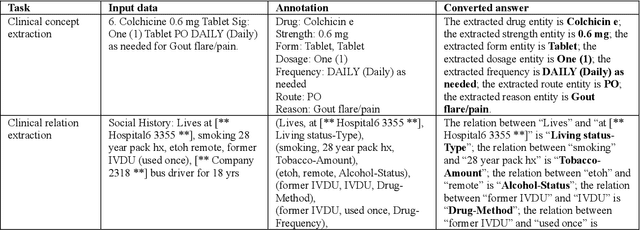
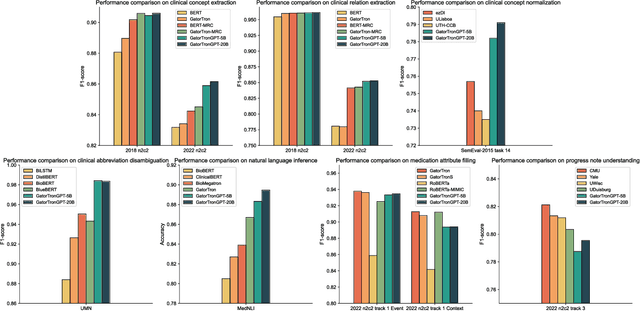
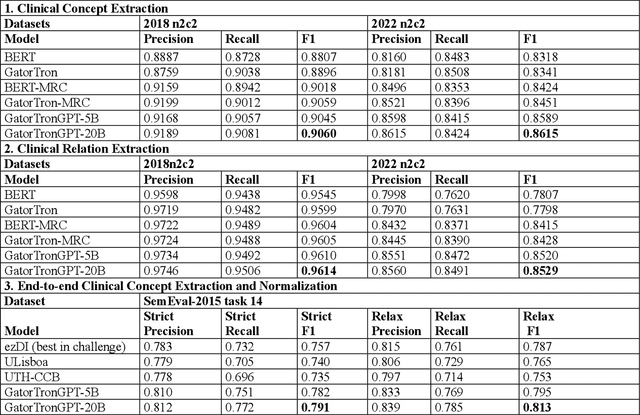
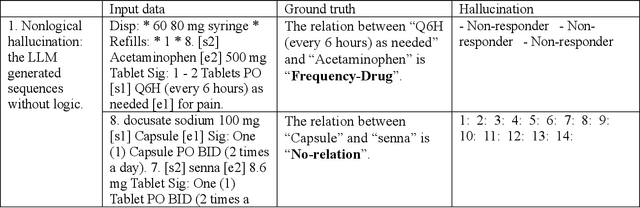
Objective To solve major clinical natural language processing (NLP) tasks using a unified text-to-text learning architecture based on a generative large language model (LLM) via prompt tuning. Methods We formulated 7 key clinical NLP tasks as text-to-text learning and solved them using one unified generative clinical LLM, GatorTronGPT, developed using GPT-3 architecture and trained with up to 20 billion parameters. We adopted soft prompts (i.e., trainable vectors) with frozen LLM, where the LLM parameters were not updated (i.e., frozen) and only the vectors of soft prompts were updated, known as prompt tuning. We added additional soft prompts as a prefix to the input layer, which were optimized during the prompt tuning. We evaluated the proposed method using 7 clinical NLP tasks and compared them with previous task-specific solutions based on Transformer models. Results and Conclusion The proposed approach achieved state-of-the-art performance for 5 out of 7 major clinical NLP tasks using one unified generative LLM. Our approach outperformed previous task-specific transformer models by ~3% for concept extraction and 7% for relation extraction applied to social determinants of health, 3.4% for clinical concept normalization, 3.4~10% for clinical abbreviation disambiguation, and 5.5~9% for natural language inference. Our approach also outperformed a previously developed prompt-based machine reading comprehension (MRC) model, GatorTron-MRC, for clinical concept and relation extraction. The proposed approach can deliver the ``one model for all`` promise from training to deployment using a unified generative LLM.
On the Impact of Cross-Domain Data on German Language Models
Oct 13, 2023Traditionally, large language models have been either trained on general web crawls or domain-specific data. However, recent successes of generative large language models, have shed light on the benefits of cross-domain datasets. To examine the significance of prioritizing data diversity over quality, we present a German dataset comprising texts from five domains, along with another dataset aimed at containing high-quality data. Through training a series of models ranging between 122M and 750M parameters on both datasets, we conduct a comprehensive benchmark on multiple downstream tasks. Our findings demonstrate that the models trained on the cross-domain dataset outperform those trained on quality data alone, leading to improvements up to $4.45\%$ over the previous state-of-the-art. The models are available at https://huggingface.co/ikim-uk-essen
Model Tuning or Prompt Tuning? A Study of Large Language Models for Clinical Concept and Relation Extraction
Oct 10, 2023Objective To develop soft prompt-based learning algorithms for large language models (LLMs), examine the shape of prompts, prompt-tuning using frozen/unfrozen LLMs, transfer learning, and few-shot learning abilities. Methods We developed a soft prompt-based LLM model and compared 4 training strategies including (1) fine-tuning without prompts; (2) hard-prompt with unfrozen LLMs; (3) soft-prompt with unfrozen LLMs; and (4) soft-prompt with frozen LLMs. We evaluated 7 pretrained LLMs using the 4 training strategies for clinical concept and relation extraction on two benchmark datasets. We evaluated the transfer learning ability of the prompt-based learning algorithms in a cross-institution setting. We also assessed the few-shot learning ability. Results and Conclusion When LLMs are unfrozen, GatorTron-3.9B with soft prompting achieves the best strict F1-scores of 0.9118 and 0.8604 for concept extraction, outperforming the traditional fine-tuning and hard prompt-based models by 0.6~3.1% and 1.2~2.9%, respectively; GatorTron-345M with soft prompting achieves the best F1-scores of 0.8332 and 0.7488 for end-to-end relation extraction, outperforming the other two models by 0.2~2% and 0.6~11.7%, respectively. When LLMs are frozen, small (i.e., 345 million parameters) LLMs have a big gap to be competitive with unfrozen models; scaling LLMs up to billions of parameters makes frozen LLMs competitive with unfrozen LLMs. For cross-institute evaluation, soft prompting with a frozen GatorTron-8.9B model achieved the best performance. This study demonstrates that (1) machines can learn soft prompts better than humans, (2) frozen LLMs have better few-shot learning ability and transfer learning ability to facilitate muti-institution applications, and (3) frozen LLMs require large models.
SLM: Bridge the thin gap between speech and text foundation models
Sep 30, 2023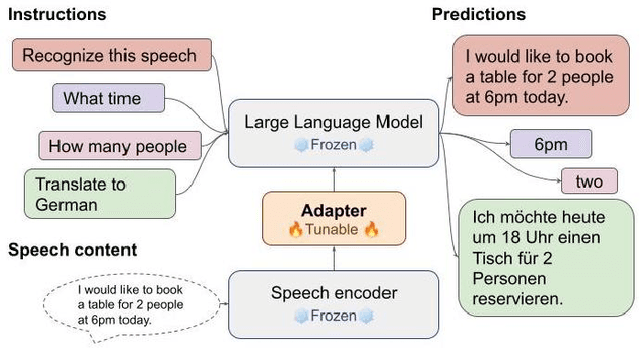
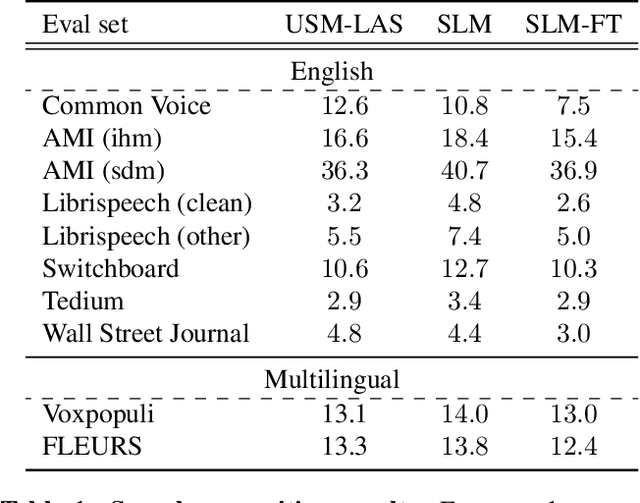

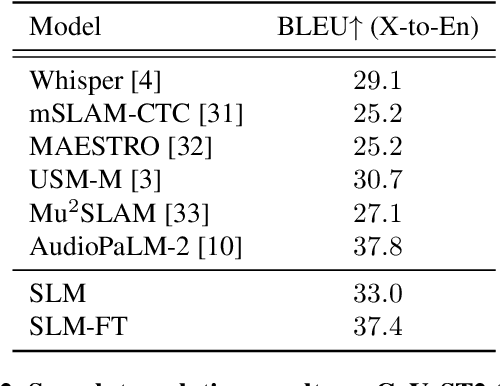
We present a joint Speech and Language Model (SLM), a multitask, multilingual, and dual-modal model that takes advantage of pretrained foundational speech and language models. SLM freezes the pretrained foundation models to maximally preserves their capabilities, and only trains a simple adapter with just 1\% (156M) of the foundation models' parameters. This adaptation not only leads SLM to achieve strong performance on conventional tasks such as speech recognition (ASR) and speech translation (AST), but also introduces the novel capability of zero-shot instruction-following for more diverse tasks: given a speech input and a text instruction, SLM is able to perform unseen generation tasks including contextual biasing ASR using real-time context, dialog generation, speech continuation, and question answering, etc. Our approach demonstrates that the representational gap between pretrained speech and language models might be narrower than one would expect, and can be bridged by a simple adaptation mechanism. As a result, SLM is not only efficient to train, but also inherits strong capabilities already acquired in foundation models of different modalities.