 Add to Chrome
 Add to Firefox
 Add to Edge
SemGS: Feed-Forward Semantic 3D Gaussian Splatting from Sparse Views for Generalizable Scene Understanding
Mar 03, 2026
Semantic understanding of 3D scenes is essential for robots to operate effectively and safely in complex environments. Existing methods for semantic scene reconstruction and semantic-aware novel view synthesis often rely on dense multi-view inputs and require scene-specific optimization, limiting their practicality and scalability in real-world applications. To address these challenges, we propose SemGS, a feed-forward framework for reconstructing generalizable semantic fields from sparse image inputs. SemGS uses a dual-branch architecture to extract color and semantic features, where the two branches share shallow CNN layers, allowing semantic reasoning to leverage textural and structural cues in color appearance. We also incorporate a camera-aware attention mechanism into the feature extractor to explicitly model geometric relationships between camera viewpoints. The extracted features are decoded into dual-Gaussians that share geometric consistency while preserving branch-specific attributes, and further rasterized to synthesize semantic maps under novel viewpoints. Additionally, we introduce a regional smoothness loss to enhance semantic coherence. Experiments show that SemGS achieves state-of-the-art performance on benchmark datasets, while providing rapid inference and strong generalization capabilities across diverse synthetic and real-world scenarios.

Towards Better Robustness: Progressively Joint Pose-3DGS Learning for Arbitrarily Long Videos
Jan 25, 2025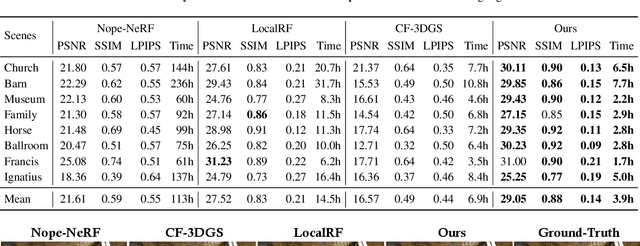


3D Gaussian Splatting (3DGS) has emerged as a powerful representation due to its efficiency and high-fidelity rendering. However, 3DGS training requires a known camera pose for each input view, typically obtained by Structure-from-Motion (SfM) pipelines. Pioneering works have attempted to relax this restriction but still face difficulties when handling long sequences with complex camera trajectories. In this work, we propose Rob-GS, a robust framework to progressively estimate camera poses and optimize 3DGS for arbitrarily long video sequences. Leveraging the inherent continuity of videos, we design an adjacent pose tracking method to ensure stable pose estimation between consecutive frames. To handle arbitrarily long inputs, we adopt a "divide and conquer" scheme that adaptively splits the video sequence into several segments and optimizes them separately. Extensive experiments on the Tanks and Temples dataset and our collected real-world dataset show that our Rob-GS outperforms the state-of-the-arts.
Gaussian in the Dark: Real-Time View Synthesis From Inconsistent Dark Images Using Gaussian Splatting
Aug 20, 2024
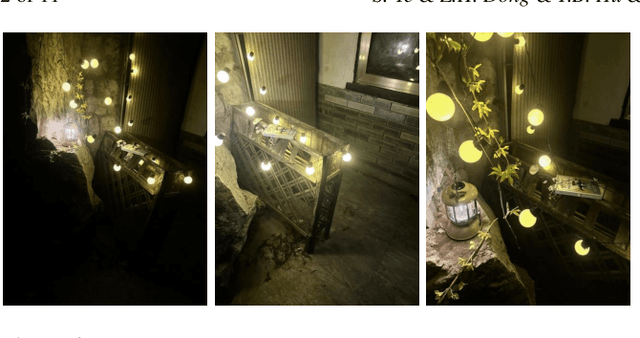
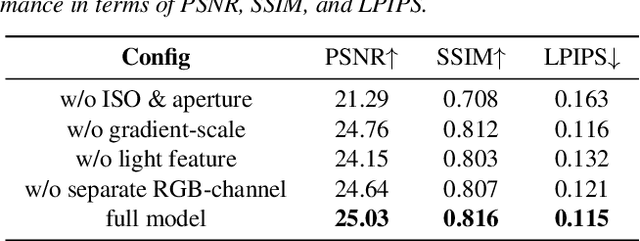

3D Gaussian Splatting has recently emerged as a powerful representation that can synthesize remarkable novel views using consistent multi-view images as input. However, we notice that images captured in dark environments where the scenes are not fully illuminated can exhibit considerable brightness variations and multi-view inconsistency, which poses great challenges to 3D Gaussian Splatting and severely degrades its performance. To tackle this problem, we propose Gaussian-DK. Observing that inconsistencies are mainly caused by camera imaging, we represent a consistent radiance field of the physical world using a set of anisotropic 3D Gaussians, and design a camera response module to compensate for multi-view inconsistencies. We also introduce a step-based gradient scaling strategy to constrain Gaussians near the camera, which turn out to be floaters, from splitting and cloning. Experiments on our proposed benchmark dataset demonstrate that Gaussian-DK produces high-quality renderings without ghosting and floater artifacts and significantly outperforms existing methods. Furthermore, we can also synthesize light-up images by controlling exposure levels that clearly show details in shadow areas.