 Add to Chrome
 Add to Firefox
 Add to Edge
Fine-Tuning Flow Matching via Maximum Likelihood Estimation of Reconstructions
Oct 02, 2025
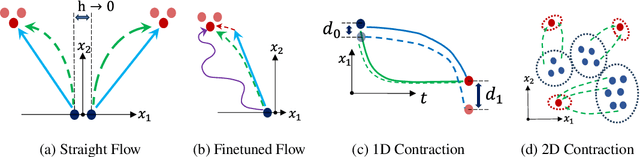
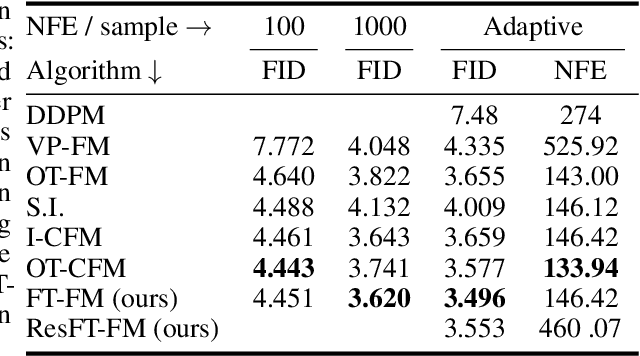
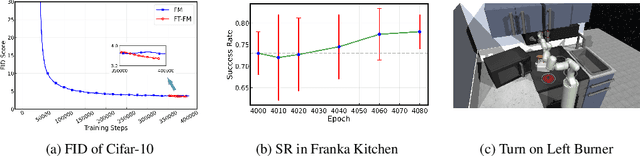
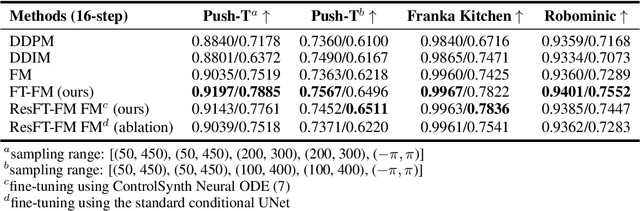
Flow Matching (FM) algorithm achieves remarkable results in generative tasks especially in robotic manipulation. Building upon the foundations of diffusion models, the simulation-free paradigm of FM enables simple and efficient training, but inherently introduces a train-inference gap. Specifically, we cannot assess the model's output during the training phase. In contrast, other generative models including Variational Autoencoder (VAE), Normalizing Flow and Generative Adversarial Networks (GANs) directly optimize on the reconstruction loss. Such a gap is particularly evident in scenarios that demand high precision, such as robotic manipulation. Moreover, we show that FM's over-pursuit of straight predefined paths may introduce some serious problems such as stiffness into the system. These motivate us to fine-tune FM via Maximum Likelihood Estimation of reconstructions - an approach made feasible by FM's underlying smooth ODE formulation, in contrast to the stochastic differential equations (SDEs) used in diffusion models. This paper first theoretically analyzes the relation between training loss and inference error in FM. Then we propose a method of fine-tuning FM via Maximum Likelihood Estimation of reconstructions, which includes both straightforward fine-tuning and residual-based fine-tuning approaches. Furthermore, through specifically designed architectures, the residual-based fine-tuning can incorporate the contraction property into the model, which is crucial for the model's robustness and interpretability. Experimental results in image generation and robotic manipulation verify that our method reliably improves the inference performance of FM.

MoveFM-R: Advancing Mobility Foundation Models via Language-driven Semantic Reasoning
Sep 26, 2025Mobility Foundation Models (MFMs) have advanced the modeling of human movement patterns, yet they face a ceiling due to limitations in data scale and semantic understanding. While Large Language Models (LLMs) offer powerful semantic reasoning, they lack the innate understanding of spatio-temporal statistics required for generating physically plausible mobility trajectories. To address these gaps, we propose MoveFM-R, a novel framework that unlocks the full potential of mobility foundation models by leveraging language-driven semantic reasoning capabilities. It tackles two key challenges: the vocabulary mismatch between continuous geographic coordinates and discrete language tokens, and the representation gap between the latent vectors of MFMs and the semantic world of LLMs. MoveFM-R is built on three core innovations: a semantically enhanced location encoding to bridge the geography-language gap, a progressive curriculum to align the LLM's reasoning with mobility patterns, and an interactive self-reflection mechanism for conditional trajectory generation. Extensive experiments demonstrate that MoveFM-R significantly outperforms existing MFM-based and LLM-based baselines. It also shows robust generalization in zero-shot settings and excels at generating realistic trajectories from natural language instructions. By synthesizing the statistical power of MFMs with the deep semantic understanding of LLMs, MoveFM-R pioneers a new paradigm that enables a more comprehensive, interpretable, and powerful modeling of human mobility. The implementation of MoveFM-R is available online at https://anonymous.4open.science/r/MoveFM-R-CDE7/.
BrainPro: Towards Large-scale Brain State-aware EEG Representation Learning
Sep 26, 2025


Electroencephalography (EEG) is a non-invasive technique for recording brain electrical activity, widely used in brain-computer interface (BCI) and healthcare. Recent EEG foundation models trained on large-scale datasets have shown improved performance and generalizability over traditional decoding methods, yet significant challenges remain. Existing models often fail to explicitly capture channel-to-channel and region-to-region interactions, which are critical sources of information inherently encoded in EEG signals. Due to varying channel configurations across datasets, they either approximate spatial structure with self-attention or restrict training to a limited set of common channels, sacrificing flexibility and effectiveness. Moreover, although EEG datasets reflect diverse brain states such as emotion, motor, and others, current models rarely learn state-aware representations during self-supervised pre-training. To address these gaps, we propose BrainPro, a large EEG model that introduces a retrieval-based spatial learning block to flexibly capture channel- and region-level interactions across varying electrode layouts, and a brain state-decoupling block that enables state-aware representation learning through parallel encoders with decoupling and region-aware reconstruction losses. This design allows BrainPro to adapt seamlessly to diverse tasks and hardware settings. Pre-trained on an extensive EEG corpus, BrainPro achieves state-of-the-art performance and robust generalization across nine public BCI datasets. Our codes and the pre-trained weights will be released.
The Thinking Spectrum: An Emperical Study of Tunable Reasoning in LLMs through Model Merging
Sep 26, 2025The growing demand for large language models (LLMs) with tunable reasoning capabilities in many real-world applications highlights a critical need for methods that can efficiently produce a spectrum of models balancing reasoning depth and computational cost. Model merging has emerged as a promising, training-free technique to address this challenge by arithmetically combining the weights of a general-purpose model with a specialized reasoning model. While various merging techniques exist, their potential to create a spectrum of models with fine-grained control over reasoning abilities remains largely unexplored. This work presents a large-scale empirical study evaluating a range of model merging techniques across multiple reasoning benchmarks. We systematically vary merging strengths to construct accuracy-efficiency curves, providing the first comprehensive view of the tunable performance landscape. Our findings reveal that model merging offers an effective and controllable method for calibrating the trade-off between reasoning accuracy and token efficiency, even when parent models have highly divergent weight spaces. Crucially, we identify instances of Pareto Improvement, where a merged model achieves both higher accuracy and lower token consumption than one of its parents. Our study provides the first comprehensive analysis of this tunable space, offering practical guidelines for creating LLMs with specific reasoning profiles to meet diverse application demands.
Secure Multicast Communications with Pinching-Antenna Systems (PASS)
Sep 19, 2025This article investigates secure multicast communications in pinching-antenna systems (PASS), where pinching beamforming is enabled by adaptively adjusting pinching antenna (PAs) positions along waveguides to improve multicast security. Specifically, a PASS-based secure multicast framework is proposed, in which joint optimization of transmit and pinching beamforming is conducted to maximize the secrecy multicast rate. i) For the single-group multicast scenario, an alternating optimization (AO) framework is employed, where the pinching beamformer is updated via an element-wise sequential optimization method. The transmit beamformer is designed via a semidefinite relaxation (SDR) formulation for an upper-bound solution, while a Dinkelbach-alternating direction method of multipliers (ADMM) offers a low-complexity alternative. ii) For the multi-group multicast scenario, transmit and pinching beamformers are alternately optimized under a majorization-minimization (MM) framework. The transmit beamformer is obtained via SDR or an efficient second-order cone programming (SOCP) method, while the pinching beamformer is updated through MM-based element-wise sequential update strategy. Numerical results are provided to demonstrate that: (i) PASS consistently outperform conventional fixed-location antenna architectures in terms of secrecy performance across various configurations; and (ii) the performance advantage of PASS over fixed-location architectures becomes more significant with increased service region, larger antenna arrays, and higher user and eavesdropper densities.
Rationality Check! Benchmarking the Rationality of Large Language Models
Sep 18, 2025Large language models (LLMs), a recent advance in deep learning and machine intelligence, have manifested astonishing capacities, now considered among the most promising for artificial general intelligence. With human-like capabilities, LLMs have been used to simulate humans and serve as AI assistants across many applications. As a result, great concern has arisen about whether and under what circumstances LLMs think and behave like real human agents. Rationality is among the most important concepts in assessing human behavior, both in thinking (i.e., theoretical rationality) and in taking action (i.e., practical rationality). In this work, we propose the first benchmark for evaluating the omnibus rationality of LLMs, covering a wide range of domains and LLMs. The benchmark includes an easy-to-use toolkit, extensive experimental results, and analysis that illuminates where LLMs converge and diverge from idealized human rationality. We believe the benchmark can serve as a foundational tool for both developers and users of LLMs.
AMFT: Aligning LLM Reasoners by Meta-Learning the Optimal Imitation-Exploration Balance
Aug 12, 2025Large Language Models (LLMs) are typically fine-tuned for reasoning tasks through a two-stage pipeline of Supervised Fine-Tuning (SFT) followed by Reinforcement Learning (RL), a process fraught with catastrophic forgetting and suboptimal trade-offs between imitation and exploration. Recent single-stage methods attempt to unify SFT and RL using heuristics, but lack a principled mechanism for dynamically balancing the two paradigms. In this paper, we reframe this challenge through the theoretical lens of \textbf{implicit rewards}, viewing SFT and RL not as distinct methods but as complementary reward signals. We introduce \textbf{Adaptive Meta Fine-Tuning (AMFT)}, a novel single-stage algorithm that learns the optimal balance between SFT's implicit, path-level reward and RL's explicit, outcome-based reward. The core of AMFT is a \textbf{meta-gradient adaptive weight controller} that treats the SFT-RL balance as a learnable parameter, dynamically optimizing it to maximize long-term task performance. This forward-looking approach, regularized by policy entropy for stability, autonomously discovers an effective training curriculum. We conduct a comprehensive evaluation on challenging benchmarks spanning mathematical reasoning, abstract visual reasoning (General Points), and vision-language navigation (V-IRL). AMFT consistently establishes a new state-of-the-art and demonstrats superior generalization on out-of-distribution (OOD) tasks. Ablation studies and training dynamic analysis confirm that the meta-learning controller is crucial for AMFT's stability, sample efficiency, and performance, offering a more principled and effective paradigm for LLM alignment. Our codes are open-sourced via https://github.com/hlxtsyj/AMFT.
Simulating Generative Social Agents via Theory-Informed Workflow Design
Aug 12, 2025Recent advances in large language models have demonstrated strong reasoning and role-playing capabilities, opening new opportunities for agent-based social simulations. However, most existing agents' implementations are scenario-tailored, without a unified framework to guide the design. This lack of a general social agent limits their ability to generalize across different social contexts and to produce consistent, realistic behaviors. To address this challenge, we propose a theory-informed framework that provides a systematic design process for LLM-based social agents. Our framework is grounded in principles from Social Cognition Theory and introduces three key modules: motivation, action planning, and learning. These modules jointly enable agents to reason about their goals, plan coherent actions, and adapt their behavior over time, leading to more flexible and contextually appropriate responses. Comprehensive experiments demonstrate that our theory-driven agents reproduce realistic human behavior patterns under complex conditions, achieving up to 75% lower deviation from real-world behavioral data across multiple fidelity metrics compared to classical generative baselines. Ablation studies further show that removing motivation, planning, or learning modules increases errors by 1.5 to 3.2 times, confirming their distinct and essential contributions to generating realistic and coherent social behaviors.
The Roots of International Perceptions: Simulating US Attitude Changes Towards China with LLM Agents
Aug 12, 2025The rise of LLMs poses new possibilities in modeling opinion evolution, a long-standing task in simulation, by leveraging advanced reasoning abilities to recreate complex, large-scale human cognitive trends. While most prior works focus on opinion evolution surrounding specific isolated events or the views within a country, ours is the first to model the large-scale attitude evolution of a population representing an entire country towards another -- US citizens' perspectives towards China. To tackle the challenges of this broad scenario, we propose a framework that integrates media data collection, user profile creation, and cognitive architecture for opinion updates to successfully reproduce the real trend of US attitudes towards China over a 20-year period from 2005 to today. We also leverage LLMs' capabilities to introduce debiased media exposure, extracting neutral events from typically subjective news contents, to uncover the roots of polarized opinion formation, as well as a devils advocate agent to help explain the rare reversal from negative to positive attitudes towards China, corresponding with changes in the way Americans obtain information about the country. The simulation results, beyond validating our framework architecture, also reveal the impact of biased framing and selection bias in shaping attitudes. Overall, our work contributes to a new paradigm for LLM-based modeling of cognitive behaviors in a large-scale, long-term, cross-border social context, providing insights into the formation of international biases and offering valuable implications for media consumers to better understand the factors shaping their perspectives, and ultimately contributing to the larger social need for bias reduction and cross-cultural tolerance.
UniMove: A Unified Model for Multi-city Human Mobility Prediction
Aug 09, 2025Human mobility prediction is vital for urban planning, transportation optimization, and personalized services. However, the inherent randomness, non-uniform time intervals, and complex patterns of human mobility, compounded by the heterogeneity introduced by varying city structures, infrastructure, and population densities, present significant challenges in modeling. Existing solutions often require training separate models for each city due to distinct spatial representations and geographic coverage. In this paper, we propose UniMove, a unified model for multi-city human mobility prediction, addressing two challenges: (1) constructing universal spatial representations for effective token sharing across cities, and (2) modeling heterogeneous mobility patterns from varying city characteristics. We propose a trajectory-location dual-tower architecture, with a location tower for universal spatial encoding and a trajectory tower for sequential mobility modeling. We also design MoE Transformer blocks to adaptively select experts to handle diverse movement patterns. Extensive experiments across multiple datasets from diverse cities demonstrate that UniMove truly embodies the essence of a unified model. By enabling joint training on multi-city data with mutual data enhancement, it significantly improves mobility prediction accuracy by over 10.2\%. UniMove represents a key advancement toward realizing a true foundational model with a unified architecture for human mobility. We release the implementation at https://github.com/tsinghua-fib-lab/UniMove/.