 Add to Chrome
 Add to Firefox
 Add to Edge
EEG-PRIME: Prototype-Aligned Representation Learning with Multi-Level Conditioning for EEG Decoding
Aug 13, 2026
Electroencephalography (EEG) decoding models often generalize poorly across datasets and subjects due to domain shifts in acquisition protocols and individual neurophysiology. We propose EEG-PRIME, a two-stage EEG foundation model for cross-dataset multi-task decoding. EEG-PRIME combines masked pretraining with prototype-aligned instruction tuning to enable instruction-aware and subject-invariant decoding across diverse BCI paradigms. During pretraining, an EEG encoder learns transferable representations through masked reconstruction with frequency-cutoff spectral augmentation. During instruction tuning, EEG-PRIME incorporates task-semantic, dataset-specific, and subject-invariant conditioning. The resulting conditioning signal modulates the Q-Former through Layer-wise Query Modulation, while frozen text embeddings of class labels serve as prototypes for cosine-similarity-based prediction across heterogeneous label spaces. Experiments on sixteen datasets covering motor imagery, emotion recognition, ADHD detection, covert speech, and mental workload show consistent improvements over state-of-the-art baselines and prior EEG foundation models under cross-subject settings. On two additional held-out datasets, EEG-PRIME achieves balanced accuracy comparable to within-session calibration models without target-domain optimization, calibration, or linear probing, demonstrating promising zero-shot transfer capability.

HandEdit: A Unified Benchmark for Egocentric Human-to-Robot Dexterous Hand Image Editing
Aug 12, 2026Robotic manipulation with dexterous hands is a cornerstone of Embodied AI, yet its progress is stifled by the high cost of collecting embodiment-aware teleoperation data. While abundant egocentric videos of human hands offer a scalable alternative, the profound discrepancies in appearance, articulation, and camera viewpoints between human and robotic data raise significant challenges for co-training. Though existing general image-editing models demonstrate strong capabilities, they lack necessary embodiment-specific priors to fully bridge this gap. In this work, we present HandEdit, a unified large-scale embodiment-aware image-editing dataset and benchmark specifically designed to transform human hands and arms into various dexterous robotic embodiments within egocentric frames. HandEdit comprises over 200M editing instances derived from five diverse source datasets, covering 26 distinct URDFs, including 13 hand-only and 13 hand-arm configurations. Alongside the dataset, we establish a unified benchmark protocol with two tracks: Hand-only and Hand-Arm, supporting URDF-conditioned evaluation. We conduct extensive evaluations of 11 representative image-editing baselines using a multi-dimensional metric suite, including generic similarity metrics, VLM-based judgment, and embodiment-aware metrics. HandEdit serves as a critical resource at the intersection of image editing and robotics: it advances embodiment-aware editing models while enabling scalable dexterous robotic learning from abundant human video data, paving the way for more generalizable Embodied AI.
Hierarchical Vision-Language Interaction for Facial Action Unit Detection
Feb 16, 2026Facial Action Unit (AU) detection seeks to recognize subtle facial muscle activations as defined by the Facial Action Coding System (FACS). A primary challenge w.r.t AU detection is the effective learning of discriminative and generalizable AU representations under conditions of limited annotated data. To address this, we propose a Hierarchical Vision-language Interaction for AU Understanding (HiVA) method, which leverages textual AU descriptions as semantic priors to guide and enhance AU detection. Specifically, HiVA employs a large language model to generate diverse and contextually rich AU descriptions to strengthen language-based representation learning. To capture both fine-grained and holistic vision-language associations, HiVA introduces an AU-aware dynamic graph module that facilitates the learning of AU-specific visual representations. These features are further integrated within a hierarchical cross-modal attention architecture comprising two complementary mechanisms: Disentangled Dual Cross-Attention (DDCA), which establishes fine-grained, AU-specific interactions between visual and textual features, and Contextual Dual Cross-Attention (CDCA), which models global inter-AU dependencies. This collaborative, cross-modal learning paradigm enables HiVA to leverage multi-grained vision-based AU features in conjunction with refined language-based AU details, culminating in robust and semantically enriched AU detection capabilities. Extensive experiments show that HiVA consistently surpasses state-of-the-art approaches. Besides, qualitative analyses reveal that HiVA produces semantically meaningful activation patterns, highlighting its efficacy in learning robust and interpretable cross-modal correspondences for comprehensive facial behavior analysis.
* Accepted to IEEE Transaction on Affective Computing 2026
BrainPro: Towards Large-scale Brain State-aware EEG Representation Learning
Sep 26, 2025


Electroencephalography (EEG) is a non-invasive technique for recording brain electrical activity, widely used in brain-computer interface (BCI) and healthcare. Recent EEG foundation models trained on large-scale datasets have shown improved performance and generalizability over traditional decoding methods, yet significant challenges remain. Existing models often fail to explicitly capture channel-to-channel and region-to-region interactions, which are critical sources of information inherently encoded in EEG signals. Due to varying channel configurations across datasets, they either approximate spatial structure with self-attention or restrict training to a limited set of common channels, sacrificing flexibility and effectiveness. Moreover, although EEG datasets reflect diverse brain states such as emotion, motor, and others, current models rarely learn state-aware representations during self-supervised pre-training. To address these gaps, we propose BrainPro, a large EEG model that introduces a retrieval-based spatial learning block to flexibly capture channel- and region-level interactions across varying electrode layouts, and a brain state-decoupling block that enables state-aware representation learning through parallel encoders with decoupling and region-aware reconstruction losses. This design allows BrainPro to adapt seamlessly to diverse tasks and hardware settings. Pre-trained on an extensive EEG corpus, BrainPro achieves state-of-the-art performance and robust generalization across nine public BCI datasets. Our codes and the pre-trained weights will be released.
EmT: A Novel Transformer for Generalized Cross-subject EEG Emotion Recognition
Jun 26, 2024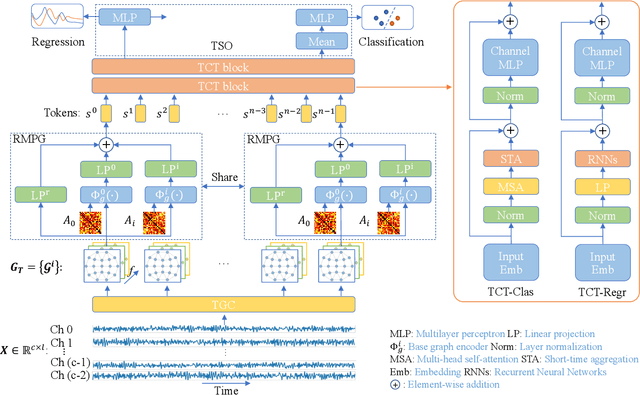
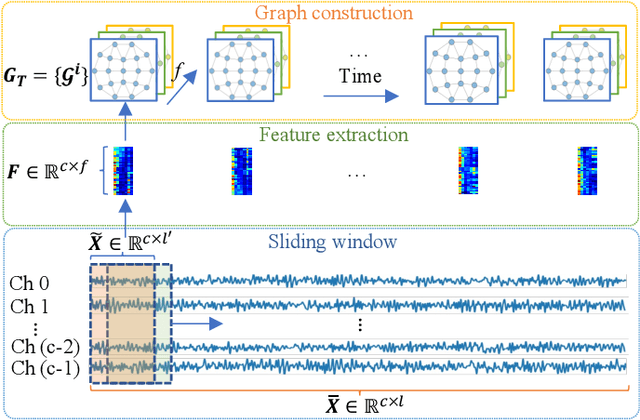
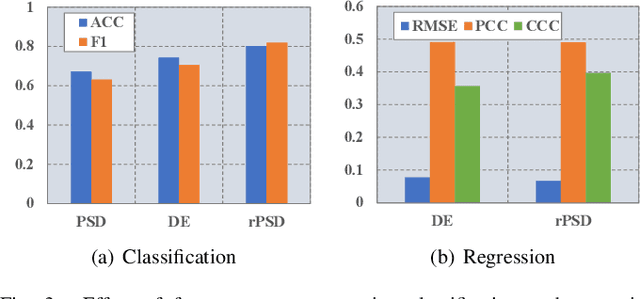
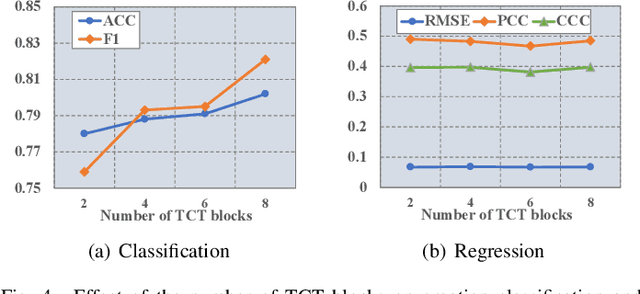
Integrating prior knowledge of neurophysiology into neural network architecture enhances the performance of emotion decoding. While numerous techniques emphasize learning spatial and short-term temporal patterns, there has been limited emphasis on capturing the vital long-term contextual information associated with emotional cognitive processes. In order to address this discrepancy, we introduce a novel transformer model called emotion transformer (EmT). EmT is designed to excel in both generalized cross-subject EEG emotion classification and regression tasks. In EmT, EEG signals are transformed into a temporal graph format, creating a sequence of EEG feature graphs using a temporal graph construction module (TGC). A novel residual multi-view pyramid GCN module (RMPG) is then proposed to learn dynamic graph representations for each EEG feature graph within the series, and the learned representations of each graph are fused into one token. Furthermore, we design a temporal contextual transformer module (TCT) with two types of token mixers to learn the temporal contextual information. Finally, the task-specific output module (TSO) generates the desired outputs. Experiments on four publicly available datasets show that EmT achieves higher results than the baseline methods for both EEG emotion classification and regression tasks. The code is available at https://github.com/yi-ding-cs/EmT.