 Add to Chrome
 Add to Firefox
 Add to Edge
EEG-DLite: Dataset Distillation for Efficient Large EEG Model Training
Dec 13, 2025
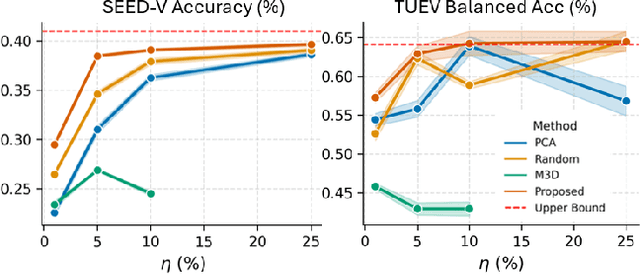
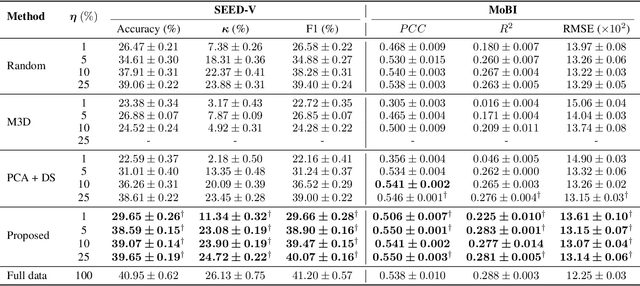
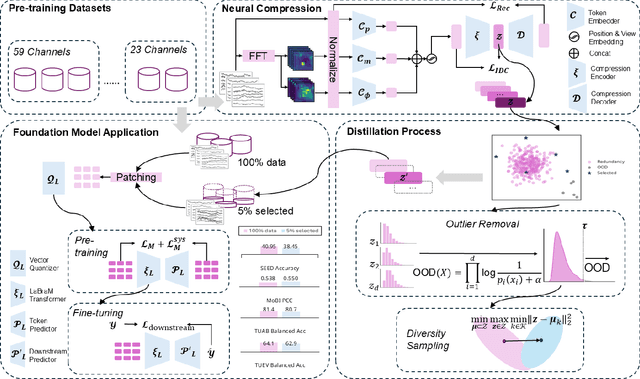
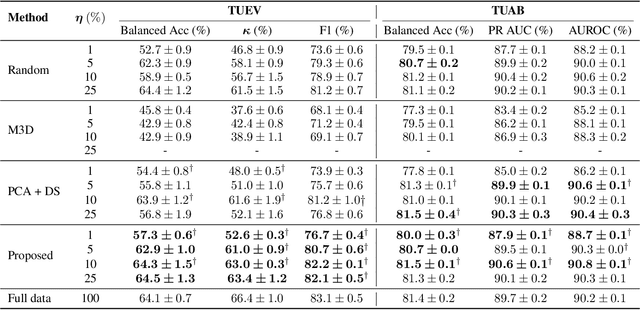
Large-scale EEG foundation models have shown strong generalization across a range of downstream tasks, but their training remains resource-intensive due to the volume and variable quality of EEG data. In this work, we introduce EEG-DLite, a data distillation framework that enables more efficient pre-training by selectively removing noisy and redundant samples from large EEG datasets. EEG-DLite begins by encoding EEG segments into compact latent representations using a self-supervised autoencoder, allowing sample selection to be performed efficiently and with reduced sensitivity to noise. Based on these representations, EEG-DLite filters out outliers and minimizes redundancy, resulting in a smaller yet informative subset that retains the diversity essential for effective foundation model training. Through extensive experiments, we demonstrate that training on only 5 percent of a 2,500-hour dataset curated with EEG-DLite yields performance comparable to, and in some cases better than, training on the full dataset across multiple downstream tasks. To our knowledge, this is the first systematic study of pre-training data distillation in the context of EEG foundation models. EEG-DLite provides a scalable and practical path toward more effective and efficient physiological foundation modeling. The code is available at https://github.com/t170815518/EEG-DLite.

BrainPro: Towards Large-scale Brain State-aware EEG Representation Learning
Sep 26, 2025


Electroencephalography (EEG) is a non-invasive technique for recording brain electrical activity, widely used in brain-computer interface (BCI) and healthcare. Recent EEG foundation models trained on large-scale datasets have shown improved performance and generalizability over traditional decoding methods, yet significant challenges remain. Existing models often fail to explicitly capture channel-to-channel and region-to-region interactions, which are critical sources of information inherently encoded in EEG signals. Due to varying channel configurations across datasets, they either approximate spatial structure with self-attention or restrict training to a limited set of common channels, sacrificing flexibility and effectiveness. Moreover, although EEG datasets reflect diverse brain states such as emotion, motor, and others, current models rarely learn state-aware representations during self-supervised pre-training. To address these gaps, we propose BrainPro, a large EEG model that introduces a retrieval-based spatial learning block to flexibly capture channel- and region-level interactions across varying electrode layouts, and a brain state-decoupling block that enables state-aware representation learning through parallel encoders with decoupling and region-aware reconstruction losses. This design allows BrainPro to adapt seamlessly to diverse tasks and hardware settings. Pre-trained on an extensive EEG corpus, BrainPro achieves state-of-the-art performance and robust generalization across nine public BCI datasets. Our codes and the pre-trained weights will be released.