 Add to Chrome
 Add to Firefox
 Add to Edge
Breadcrumbing Search Agents
Aug 05, 2026
LLM-based search agents are widely used for information-seeking tasks, but their reliance on external tool returns introduces a critical security risk: web content retrieved during execution is untrusted, exposing agents to prompt injection and goal hijacking. Prior work on search-agent safety primarily focuses on static web-content injection, but modern agents issue follow-up queries and cross-check competing sources, so a single injected page is often diluted or rejected. We show that the channel delivering search and page observations is a fragile security boundary: beyond exposing the agent to a single poisoned page, a mediated search interface can repeatedly steer how the agent gathers evidence and forms its final answer. Under a constrained tool-intermediary threat model, appending only one controlled result per query can substantially increase attack success when the evidence is coordinated across the agent's trajectory. We study this setting with a strategy-driven long-horizon attack system and introduce Authority-Chain Hijack (ACH), an expert-refined strategy that turns isolated search-result and page-content manipulations into a coherent evidence chain across seemingly corroborating sources. ACH achieves the highest Overall ASR among all baselines, reaching 55.9% / 83.3% ASR / MaxN ASR on the full SafeSearch test split. We further introduce Trace-Guided Strategy Evolution (TGSE), which automatically improves attacker strategies from execution traces, replacing manual redesign with trace-driven refinement; its strongest single setting reaches 71.4% / 95.0% in held-out evaluation.

FARI: Robust One-Step Inversion for Watermarking in Diffusion Models
Jul 29, 2026Inversion-based watermarking is a promising approach to authenticate diffusion-generated images, yet practical use is bottlenecked by inversion that is both slow and error-prone. While the primary challenge in the watermarking setting is robustness against external distortions, existing approaches over-optimize internal truncation error, and because that error scales with the sampler step size, they are inherently confined to high-NFE (number of function evaluations) regimes that cannot meet the dual demands of speed and robustness. In this work, we have two key observations: (i) the inversion trajectory has markedly lower curvature than the forward generation path does, making it highly compressible and amenable to low-NFE approximation; and (ii) in inversion for watermark verification, the trade-off between speed and truncation error is less critical, since external distortions dominate the error. A faster inverter provides a dual benefit: it is not only more efficient, but it also enables end-to-end adversarial training to directly target robustness, a task that is computationally prohibitive for the original, lengthy inversion trajectories. Building on this, we propose \textbf{FARI} (\textbf{F}ast \textbf{A}symmetric \textbf{R}obust \textbf{I}nversion), a one-step inversion framework paired with lightweight adversarial LoRA fine-tuning of the denoiser for watermark extraction. While consolidation slightly increases internal error, FARI delivers large gains in both speed and robustness: with approximately 20 minutes of fine-tuning on a single NVIDIA RTX A6000 GPU, it surpasses 50-step DDIM inversion on watermark-verification robustness while dramatically reducing inference time. Code and pretrained models are available at https://github.com/0xD009/FARI.
Between Safe Boundaries: Exploiting Temporal Consistency for Jailbreaking Text-To-Video Generation Models
Jul 19, 2026Recently, text-to-video (T2V) models have been widely deployed, sparking growing concerns over their robustness against jailbreak attacks. Existing jailbreak methods, mostly adapted from text-to-image attacks, suffer notable drawbacks when applied to T2V systems. They fail to fully leverage temporal consistency, an inherent characteristic of video generation. Besides, these methods demand heavy video query optimization, which is infeasible in practical black-box scenarios. Their adversarial prompt search is also driven by heuristic local signals, lacking principled structured exploration strategies. To tackle these limitations, we propose BSB, a structured, query-efficient jailbreak framework for T2V models. BSB harnesses temporal consistency by encoding harmful intent as the transition between two individually harmless boundary states. Under this paradigm, the attack targets boundary-state pairs whose interpolation tends to produce unsafe intermediate frames during video generation. Directly evaluating all candidate pairs within the video space incurs prohibitive computation cost. Instead, BSB conducts Monte Carlo Tree Search (MCTS) in a cheaper textual proxy space and regularly calibrates search outcomes with sparse video-level evaluations. We conduct comprehensive experiments on mainstream commercial T2V models including Veo 3.1, Sora 2, Seedance and Kling v1. Results show BSB surpasses all existing jailbreak baselines, delivering an average 18.6% relative gain in attack success rate over the strongest competitor across evaluated models. Our findings identify temporal consistency as an understudied yet vital attack surface for T2V models and verify that structured search facilitates effective vulnerability discovery under constrained query budgets.
DNA: Dual-stage Native Attribution for Generated Image Source Tracing
Jul 15, 2026The rapid evolution of image generation has produced numerous within-family variants, making source-model attribution of suspect images increasingly important for digital forensics. Existing proactive methods rely on watermark embedding or model modification, which may degrade visual quality and limit deployment flexibility. Passive methods often rely on large-scale supervised training or a single reconstruction signal, limiting their ability to handle unknown sources and distinguish highly similar within-family variants. We observe that attribution signals in latent generative models are naturally stratified across architectural levels: VAE-level cues reflect family-shared information, whereas backbone-level cues capture variant-specific behaviors. Motivated by this insight, we propose Dual-stage Native Attribution (DNA), a coarse-to-fine framework that follows this hierarchy without additional neural-network training. The coarse-grained stage uses Autoencoder Double-Reconstruction (AEDR) for efficient open-set family-level screening. The fine-grained stage performs closed-set model-level attribution with Native Prediction Consistency (NPC), which compares native prediction errors of within-family variants across multiple noise levels under semantic conditioning and attributes the source via normalized calibrated scores. To enable systematic evaluation, we construct DNA-30K, a benchmark for within-family variant attribution under open-set family-level evaluation. It comprises 30,000 images generated by 24 candidate models across six families spanning both denoising diffusion and flow matching, plus non-candidate generated and natural images as unknown sources. Experiments show that DNA achieves 89.11% end-to-end attribution accuracy on a task where random guessing accuracy is below 1% and outperforms the strongest baseline by 33.81% even when AEDR is used as the coarse-grained stage.
BareWave: Waveform-Native Flow-Matching Text-to-Speech
Jun 08, 2026Removing intermediate representations and separately trained decoding stages has become an important direction in generative modeling. In text-to-speech, however, high-quality systems are still commonly built through an intermediate acoustic representation before waveform synthesis. In this work, we present BareWave, a fully waveform-native framework for direct text-to-wave generation in flow-matching TTS. We consider this setting to raise three training challenges: raw-waveform modeling lacks a strong pretrained representational scaffold, different stages of training benefit from different noise schedules, and data-space perceptual objectives do not automatically share the temporal structure of the velocity-space flow objective. As a result, direct waveform training is hard to optimize efficiently, hard to push toward a strong final operating point with a fixed recipe, and hard to integrate effective perceptual refinement. Guided by this view, we develop a direct text-to-wave training framework that combines training-time representation alignment, staged noise scheduling, and velocity-aware perceptual alignment (VAPA), while preserving a single waveform-native inference path without pretrained components at test time. Experiments on zero-shot voice cloning show that strong intelligibility, speaker similarity, and naturalness can be achieved under a fully waveform-native inference path, supporting waveform-native flow-matching TTS as a practical direction. Project page with audio demos is available at https://barewave.github.io/.
Provably Secure Agent Guardrail
May 28, 2026As large language models transition from bounded generative engines to agents with expansive execution privileges, AI going out of control precipitates a fundamental crisis in artificial intelligence security. Existing defense architectures heavily rely on empirical semantic guardrails and probabilistic large model adjudicators, mechanisms that fail to provide deterministic security lower bounds when facing complex semantic symbol decoupling attacks. To overcome this empirical semantic guardrail dilemma, this paper proposes a new security paradigm for agents based on the fundamental limitations of logical reasoning. Based on this paradigm, we further introduce an executable Proof-Constrained Action (ePCA) framework with a neural symbolic isolation architecture. This framework abandons semantic trust in natural language, forcing agents to losslessly formalize their intentions into first-order logical mathematical constraints before performing physical operations. Empirical evaluations of macroscopic and microscopic two-dimensional dynamic adversarial systems demonstrate that our formal verification mechanism achieves zero attack success rate and zero false positive rate across the evaluated scenarios, with extremely low computational latency. This research provides a conditional formal foundation under explicit system assumptions and an engineering paradigm for constructing the underlying defense foundation for future intelligent systems.
SWIFT: Sliding Window Reconstruction for Few-Shot Training-Free Generated Video Attribution
Mar 09, 2026Recent advancements in video generation technologies have been significant, resulting in their widespread application across multiple domains. However, concerns have been mounting over the potential misuse of generated content. Tracing the origin of generated videos has become crucial to mitigate potential misuse and identify responsible parties. Existing video attribution methods require additional operations or the training of source attribution models, which may degrade video quality or necessitate large amounts of training samples. To address these challenges, we define for the first time the "few-shot training-free generated video attribution" task and propose SWIFT, which is tightly integrated with the temporal characteristics of the video. By leveraging the "Pixel Frames(many) to Latent Frame(one)" temporal mapping within each video chunk, SWIFT applies a fixed-length sliding window to perform two distinct reconstructions: normal and corrupted. The variation in the losses between two reconstructions is then used as an attribution signal. We conducted an extensive evaluation of five state-of-the-art (SOTA) video generation models. Experimental results show that SWIFT achieves over 90% average attribution accuracy with merely 20 video samples across all models and even enables zero-shot attribution for HunyuanVideo, EasyAnimate, and Wan2.2. Our source code is available at https://github.com/wangchao0708/SWIFT.
WMVLM: Evaluating Diffusion Model Image Watermarking via Vision-Language Models
Jan 29, 2026Digital watermarking is essential for securing generated images from diffusion models. Accurate watermark evaluation is critical for algorithm development, yet existing methods have significant limitations: they lack a unified framework for both residual and semantic watermarks, provide results without interpretability, neglect comprehensive security considerations, and often use inappropriate metrics for semantic watermarks. To address these gaps, we propose WMVLM, the first unified and interpretable evaluation framework for diffusion model image watermarking via vision-language models (VLMs). We redefine quality and security metrics for each watermark type: residual watermarks are evaluated by artifact strength and erasure resistance, while semantic watermarks are assessed through latent distribution shifts. Moreover, we introduce a three-stage training strategy to progressively enable the model to achieve classification, scoring, and interpretable text generation. Experiments show WMVLM outperforms state-of-the-art VLMs with strong generalization across datasets, diffusion models, and watermarking methods.
SemBind: Binding Diffusion Watermarks to Semantics Against Black-Box Forgery Attacks
Jan 28, 2026Latent-based watermarks, integrated into the generation process of latent diffusion models (LDMs), simplify detection and attribution of generated images. However, recent black-box forgery attacks, where an attacker needs at least one watermarked image and black-box access to the provider's model, can embed the provider's watermark into images not produced by the provider, posing outsized risk to provenance and trust. We propose SemBind, the first defense framework for latent-based watermarks that resists black-box forgery by binding latent signals to image semantics via a learned semantic masker. Trained with contrastive learning, the masker yields near-invariant codes for the same prompt and near-orthogonal codes across prompts; these codes are reshaped and permuted to modulate the target latent before any standard latent-based watermark. SemBind is generally compatible with existing latent-based watermarking schemes and keeps image quality essentially unchanged, while a simple mask-ratio parameter offers a tunable trade-off between anti-forgery strength and robustness. Across four mainstream latent-based watermark methods, our SemBind-enabled anti-forgery variants markedly reduce false acceptance under black-box forgery while providing a controllable robustness-security balance.
LiteUpdate: A Lightweight Framework for Updating AI-Generated Image Detectors
Nov 10, 2025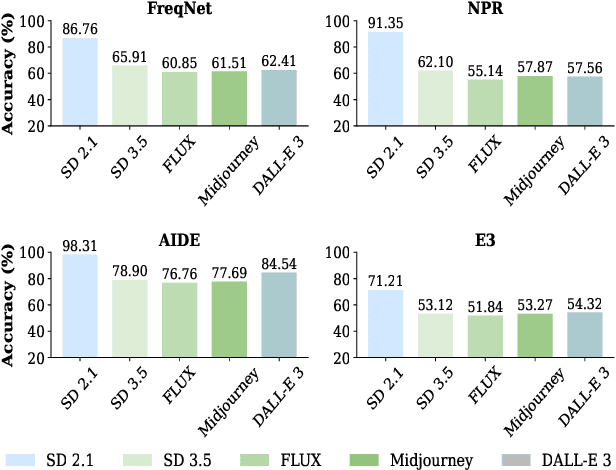
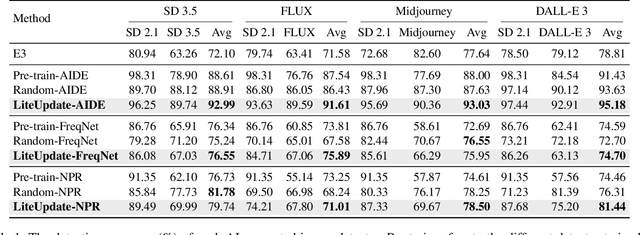
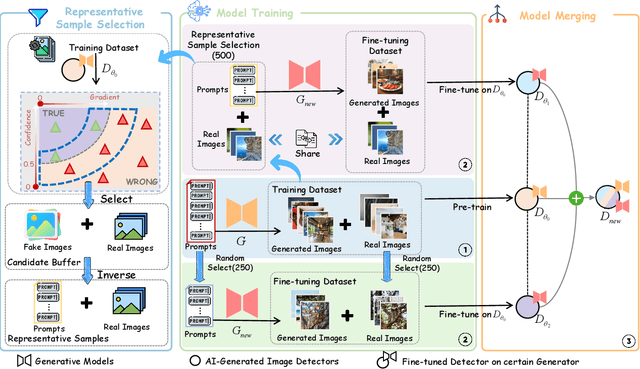
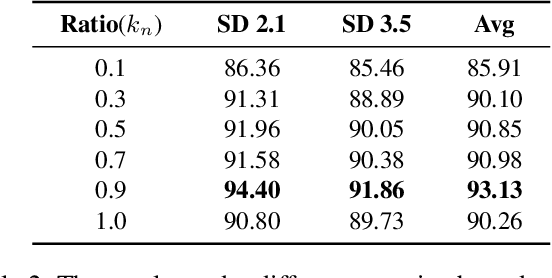
The rapid progress of generative AI has led to the emergence of new generative models, while existing detection methods struggle to keep pace, resulting in significant degradation in the detection performance. This highlights the urgent need for continuously updating AI-generated image detectors to adapt to new generators. To overcome low efficiency and catastrophic forgetting in detector updates, we propose LiteUpdate, a lightweight framework for updating AI-generated image detectors. LiteUpdate employs a representative sample selection module that leverages image confidence and gradient-based discriminative features to precisely select boundary samples. This approach improves learning and detection accuracy on new distributions with limited generated images, significantly enhancing detector update efficiency. Additionally, LiteUpdate incorporates a model merging module that fuses weights from multiple fine-tuning trajectories, including pre-trained, representative, and random updates. This balances the adaptability to new generators and mitigates the catastrophic forgetting of prior knowledge. Experiments demonstrate that LiteUpdate substantially boosts detection performance in various detectors. Specifically, on AIDE, the average detection accuracy on Midjourney improved from 87.63% to 93.03%, a 6.16% relative increase.