 Add to Chrome
 Add to Firefox
 Add to Edge
PolarSym: Polar Geometry-aware Attention for CAD Floorplan Parsing
Aug 12, 2026
CAD plan parsing is a fundamental task in Building Information Modeling (BIM), aiming to automatically extract architectural elements including walls, doors, windows, and furniture from 2D engineering drawings. Existing Transformer-based methods capture global semantic dependencies via self-attention, yet they infer spatial relationships merely from semantic features without explicitly characterizing the intrinsic geometric symmetry of building layouts. Such methods tend to produce mismatched correspondences in long-range matching and complex symmetric spatial layouts. To tackle this limitation, we propose PolarSym, a polar-coordinate geometry-aware attention framework for CAD plan parsing. The framework decouples geometric relationships of buildings into two complementary components, direction and distance, which are modeled independently. Structural consistency is strengthened by directional constraints, while long-range symmetric correspondences are built with distance constraints. A dynamic gating mechanism is adopted to synergistically fuse the two geometric information branches while maintaining the vanilla Transformer architecture. This design boosts geometric modeling capacity with negligible extra computation. Experiments on a public CAD plan parsing dataset show that PolarSym surpasses the reproduced SymPoint V2 baseline by 1.73% PQ, 1.54% RQ and 4.31% mIoU under identical training settings. PolarSym also converges faster and yields more stable optimization. Ablation experiments verify the complementary effects of direction and distance modeling. Our results reveal that PolarSym improves the geometric awareness of Transformers at low computational cost, offering an effective geometric modeling paradigm for CAD plan parsing.

Governing Generative AI Across Financial Institutions: An SR 26-2-Compatible Framework for Generative AI Risk Control
Jul 05, 2026The release of SR 26-2 marks a significant modernization of U.S. model risk management by replacing SR 11-7 with a more risk-based and materiality-sensitive supervisory framework. However, generative and agentic AI are excluded, creating an important governance challenge for banking organizations and other financial institutions. Although generative AI may not directly estimate credit risk or make underwriting decisions, its outputs can materially affect the surrounding control environment through monitoring interpretation, policy analysis, or adverse-action language drafting. These uses may influence how regulated financial decisions are explained, challenged, documented, and governed. This paper proposes the Generative AI Control Framework (GAICF), an SR 26-2-compatible governance framework for generative AI-enabled financial workflows. The framework translates core model risk management principles into a layered control structure for generative AI applications that operate outside the formal model boundary but remain embedded within regulated banking processes. GAICF provides a practical approach for financial institutions seeking to align emerging generative AI governance practices with the risk-based supervisory expectations reflected in SR 26-2.
Triple-Phase Multimodal Knowledge Aggregation Framework for Microbial Keratitis Subtype Diagnosis on Slit-Lamp Photography
Jul 04, 2026Microbial keratitis requires rapid pathogen identification to guide treatment, but culture- and PCR-based diagnostics are slow and resource-intensive. We developed a triple-phase multimodal framework for bacterial-versus-fungal keratitis classification using slit-lamp photographs acquired under blue-light, sclerotic-scatter, and white-light illumination, together with clinical metadata. The model combines cross-modality contrastive learning, modality-specific fine-tuning, and feature-level multimodal ensemble learning for patient-level prediction. We evaluated the framework on a multicenter dataset of 1,645 patients and 17,158 images from India and the United States. The model achieved 85.84% accuracy, 84.46% average F1-score, and 0.885 AUC. Site-specific evaluation showed that pooled results were overly optimistic, whereas resampling- and balance-based re-evaluation provided a more realistic assessment of cross-site generalization. Under all settings, our framework remained the top-performing approach. Upon acceptance, the code will be released and dataset access will be provided subject to University of Michigan data-sharing clearance.
HGenPush: A Heterogeneous Generative Recommendation Architecture for Industrial Push Notification Systems
Jul 03, 2026With the explosive growth of content platforms, recommendation systems need to better satisfy user demands to enhance user satisfaction and retention. Taking short-video platforms as an example, users not only seek high-quality content but also trusted authors. Although generative recommendation systems have achieved breakthroughs in recent years, existing methods primarily generate single-type recommendation content and typically employ the inefficient autoregressive paradigm to generate semantic IDs. In this paper, we propose an end-to-end heterogeneous generative recommendation architecture called HGenPush. First, we design a hybrid user behavior understanding module that integrates multi-scenario and multi-perspective behaviors to capture precise user interest. Then, we design a dual-branch heterogeneous generative recommendation module that integrates video recommendation and author recommendation within a unified framework. In addition, to improve generation efficiency, we design a lightweight multi-token prediction method that discards the autoregressive paradigm. Finally, we design a user consumption preference alignment module, which leverages user feedback as reward signals to guide the model toward generating higher-quality content, thereby enhancing user experience and engagement. Through these designs, HGenPush simultaneously fulfills users' demands for high-quality content and trusted authors. We have deployed HGenPush on the push notification system of Kuaishou, a large-scale short-video platform, achieving a significant 0.181% increase in daily active users.
Reflect-Guard: Enhancing LLM Safeguards against Adversarial Prompts via Logical Self-Reflection
May 24, 2026Large language model (LLM) safety classifiers such as Llama Guard are effective at detecting overtly harmful prompts but remain vulnerable to adversarial jailbreak attacks that disguise malicious intent through role-play scenarios, fictional framing, and indirect requests. We present Reflect-Guard, a method that augments LLM-based safety classifiers with chain-of-thought self-reflection capabilities through parameter-efficient fine-tuning. Our approach distills analytical reasoning from GPT-4o-mini into structured reflection annotations, then trains Llama-Guard-3-8B via QLoRA to generate logical self-reflections before issuing safety verdicts. Using only 1000 training examples and updating just 0.5% of model parameters (~42M), Reflect-Guard achieves substantial improvements on two challenging benchmarks. On WildGuardTest, F1 score improves from 0.770 to 0.842 (+7.2 pp), with recall on adversarial prompts increasing from 0.513 to 0.921 (+40.8 pp). On JailbreakBench, the attack success rate drops from 10.3% to 1.8%, representing an 82.5% relative reduction. These gains are especially pronounced on adversarial inputs, where the explicit reasoning step enables the model to see through obfuscation techniques that defeat standard pattern-matching approaches. Our results demonstrate that teaching safety classifiers to reason about adversarial intent, rather than simply classify surface patterns, is a promising direction for robust LLM safety.
ArtHOI: Taming Foundation Models for Monocular 4D Reconstruction of Hand-Articulated-Object Interactions
Mar 26, 2026Existing hand-object interactions (HOI) methods are largely limited to rigid objects, while 4D reconstruction methods of articulated objects generally require pre-scanning the object or even multi-view videos. It remains an unexplored but significant challenge to reconstruct 4D human-articulated-object interactions from a single monocular RGB video. Fortunately, recent advancements in foundation models present a new opportunity to address this highly ill-posed problem. To this end, we introduce ArtHOI, an optimization-based framework that integrates and refines priors from multiple foundation models. Our key contribution is a suite of novel methodologies designed to resolve the inherent inaccuracies and physical unreality of these priors. In particular, we introduce an Adaptive Sampling Refinement (ASR) method to optimize object's metric scale and pose for grounding its normalized mesh in world space. Furthermore, we propose a Multimodal Large Language Model (MLLM) guided hand-object alignment method, utilizing contact reasoning information as constraints of hand-object mesh composition optimization. To facilitate a comprehensive evaluation, we also contribute two new datasets, ArtHOI-RGBD and ArtHOI-Wild. Extensive experiments validate the robustness and effectiveness of our ArtHOI across diverse objects and interactions. Project: https://arthoi-reconstruction.github.io.
Beyond Polarity: Multi-Dimensional LLM Sentiment Signals for WTI Crude Oil Futures Return Prediction
Mar 12, 2026Forecasting crude oil prices remains challenging because market-relevant information is embedded in large volumes of unstructured news and is not fully captured by traditional polarity-based sentiment measures. This paper examines whether multi-dimensional sentiment signals extracted by large language models improve the prediction of weekly WTI crude oil futures returns. Using energy-sector news articles from 2020 to 2025, we construct five sentiment dimensions covering relevance, polarity, intensity, uncertainty, and forwardness based on GPT-4o, Llama 3.2-3b, and two benchmark models, FinBERT and AlphaVantage. We aggregate article-level signals to the weekly level and evaluate their predictive performance in a classification framework. The best results are achieved by combining GPT-4o and FinBERT, suggesting that LLM-based and conventional financial sentiment models provide complementary predictive information. SHAP analysis further shows that intensity- and uncertainty-related features are among the most important predictors, indicating that the predictive value of news sentiment extends beyond simple polarity. Overall, the results suggest that multi-dimensional LLM-based sentiment measures can improve commodity return forecasting and support energy-market risk monitoring.
PRIMA: Pre-training with Risk-integrated Image-Metadata Alignment for Medical Diagnosis via LLM
Feb 26, 2026Medical diagnosis requires the effective synthesis of visual manifestations and clinical metadata. However, existing methods often treat metadata as isolated tags, failing to exploit the rich semantic knowledge embedded in clinical descriptions. We propose PRIMA (Pre-training with Risk-integrated Image-Metadata Alignment), a framework that integrates domain-specific knowledge into multi-modal representation learning. We first curate an expert corpus of risk-disease correlations via Retrieval-Augmented Generation (RAG) to refine Clinical ModernBERT, embedding diagnostic priors into the text encoder. To bridge the modality gap, we introduce a dual-encoder pre-training strategy utilizing DINOv3 and our refined BERT, optimized by a suite of four complementary loss functions. These losses are designed to capture multi-granular semantic alignment and handle the ambiguity of clinical correlations through soft labels. Finally, we leverage Qwen-3 to fuse these aligned features for precise disease classification. Extensive experiments demonstrate that PRIMA effectively harmonizes pixel-level features with abstract clinical expertise, significantly outperforming other state-of-the-art methods. Notably, our framework achieves superior robustness without the need for massive data collection or exhaustive computational resources. Our code will be made public upon acceptance.
Being-H0.5: Scaling Human-Centric Robot Learning for Cross-Embodiment Generalization
Jan 19, 2026We introduce Being-H0.5, a foundational Vision-Language-Action (VLA) model designed for robust cross-embodiment generalization across diverse robotic platforms. While existing VLAs often struggle with morphological heterogeneity and data scarcity, we propose a human-centric learning paradigm that treats human interaction traces as a universal "mother tongue" for physical interaction. To support this, we present UniHand-2.0, the largest embodied pre-training recipe to date, comprising over 35,000 hours of multimodal data across 30 distinct robotic embodiments. Our approach introduces a Unified Action Space that maps heterogeneous robot controls into semantically aligned slots, enabling low-resource robots to bootstrap skills from human data and high-resource platforms. Built upon this human-centric foundation, we design a unified sequential modeling and multi-task pre-training paradigm to bridge human demonstrations and robotic execution. Architecturally, Being-H0.5 utilizes a Mixture-of-Transformers design featuring a novel Mixture-of-Flow (MoF) framework to decouple shared motor primitives from specialized embodiment-specific experts. Finally, to make cross-embodiment policies stable in the real world, we introduce Manifold-Preserving Gating for robustness under sensory shift and Universal Async Chunking to universalize chunked control across embodiments with different latency and control profiles. We empirically demonstrate that Being-H0.5 achieves state-of-the-art results on simulated benchmarks, such as LIBERO (98.9%) and RoboCasa (53.9%), while also exhibiting strong cross-embodiment capabilities on five robotic platforms.
MARS2 2025 Challenge on Multimodal Reasoning: Datasets, Methods, Results, Discussion, and Outlook
Sep 17, 2025
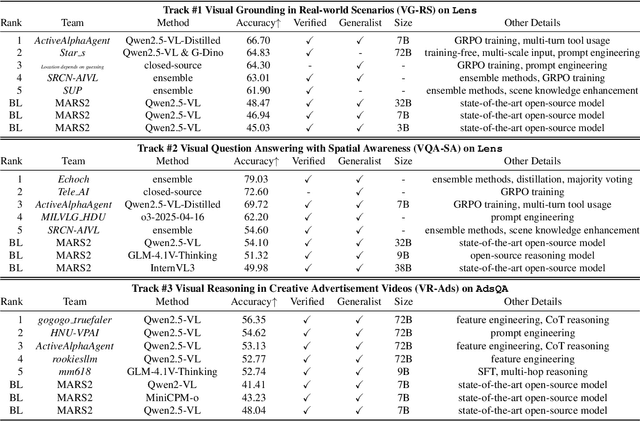

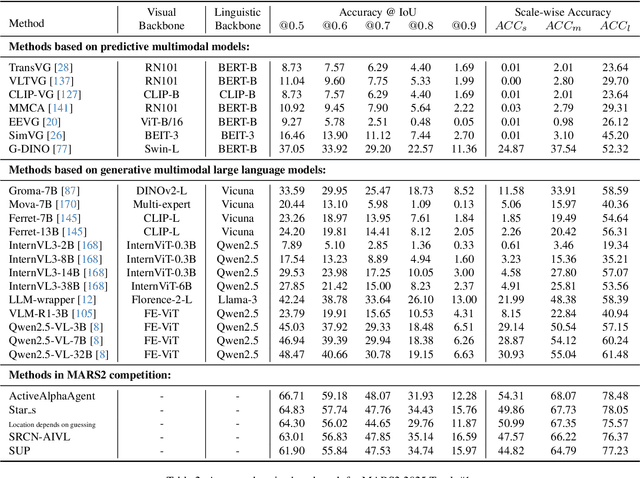
This paper reviews the MARS2 2025 Challenge on Multimodal Reasoning. We aim to bring together different approaches in multimodal machine learning and LLMs via a large benchmark. We hope it better allows researchers to follow the state-of-the-art in this very dynamic area. Meanwhile, a growing number of testbeds have boosted the evolution of general-purpose large language models. Thus, this year's MARS2 focuses on real-world and specialized scenarios to broaden the multimodal reasoning applications of MLLMs. Our organizing team released two tailored datasets Lens and AdsQA as test sets, which support general reasoning in 12 daily scenarios and domain-specific reasoning in advertisement videos, respectively. We evaluated 40+ baselines that include both generalist MLLMs and task-specific models, and opened up three competition tracks, i.e., Visual Grounding in Real-world Scenarios (VG-RS), Visual Question Answering with Spatial Awareness (VQA-SA), and Visual Reasoning in Creative Advertisement Videos (VR-Ads). Finally, 76 teams from the renowned academic and industrial institutions have registered and 40+ valid submissions (out of 1200+) have been included in our ranking lists. Our datasets, code sets (40+ baselines and 15+ participants' methods), and rankings are publicly available on the MARS2 workshop website and our GitHub organization page https://github.com/mars2workshop/, where our updates and announcements of upcoming events will be continuously provided.