 Add to Chrome
 Add to Firefox
 Add to Edge
Geometry-Aware Camera Localization for Bronchoscopy
Aug 07, 2026
Camera localization in bronchoscopy remains a challenging problem due to stringent accuracy requirements, real-time constraints, and limited training data. Compared to natural scenes, the confined anatomical structures demand millimeter-level precision, while intraoperative guidance necessitates low-latency inference. However, existing methods often fail to effectively exploit preoperative geometric priors, limiting their robustness and accuracy. To address these limitations, we propose a unified geometry-aware bronchoscope localization framework (GABL) that effectively fuses preoperative structural priors with paired intraoperative video to estimate 6-DoF camera poses. Specifically, to address visual ambiguity in complex airways, we propose a graph-guided coarse-to-fine localization scheme that effectively leverages structural priors for precise pose estimation. Furthermore, to mitigate pose jitter and bridge the visual-structural gap, we integrate a Transformer-based tracking model with a novel RGB-depth matching objective, jointly enforcing spatio-temporal and geometric consistency. Extensive experiments demonstrate that our method yields remarkable reductions of 8.37% and 31.76% in translation and rotation errors over the prior state-of-the-art, alongside 4 times inference speedup (33.6 FPS) for robust real-time bronchoscope localization. Project website: https://paulili08.github.io/GABL/.

TextSLIP: Text Self-Supervised CLIP for Medical Report Generation
Jul 24, 2026Automating radiology report generation is important for improving reporting consistency and clinical workflows . While Contrastive Language--Image Pretraining (CLIP) has advanced medical vision language modeling, existing CLIP-style approaches may still provide insufficient fine-grained semantic supervision for complex report generation. Standard CLIP primarily optimizes cross-modal alignment, without explicitly structuring the textual embedding space that guides visual representation learning. To address this limitation, we propose TextSLIP, a general medical vision-language pretraining framework that augments CLIP with intra-modal text contrastive learning. By improving textual embedding discriminability through self-supervised augmented text pairs, TextSLIP is designed to provide finer-grained linguistic supervision to the visual encoder. As an initial validation, we pretrain TextSLIP on a curated dataset of 7 million brain MRI image-text pairs and fine-tune the pretrained visual encoder within a report generation architecture. In controlled comparisons with CLIP-style baselines, TextSLIP shows consistent improvements on report generation metrics. Ablation studies further suggest that text-side self-supervision contributes to the observed gains. These results indicate that text-level contrastive learning is a promising direction for improving medical visual-textual alignment, while broader validation across additional medical domains remains an important next step.
Low-Altitude UAV-Assisted Bistatic ISAC: Closed-form 3D CRLB and Coverage Analysis
Jul 21, 2026This paper investigates the fundamental performance limits of three-dimensional (3D) localization in unmanned aerial vehicle (UAV)-assisted integrated sensing and communication (ISAC) systems. Specifically, a base station (BS) estimates the 3D position of a sensing target with the aid of a UAV acting as a flexible aerial anchor node. We derive a closed-form expression for the 3D Cramer-Rao lower bound (CRLB), which explicitly quantifies the achievable localization accuracy as a function of both the UAV's location and the target's position. The CRLB is shown to decompose naturally into three distinct components, arising from signal propagation delay, angular measurements, and their coupling effect, respectively. To validate the analytical results, we consider a representative orthogonal frequency-division multiplexing (OFDM)-based ISAC system and demonstrate that the derived CRLB closely predicts the performance of maximum-likelihood estimation across diverse geometric configurations and UAV mobility patterns. Furthermore, we introduce the notion of CRLB-constrained sensing coverage to characterize the spatial region within which a prescribed localization accuracy can be guaranteed. Through local boundary approximations and coverage-size evaluations, we reveal how UAV displacement, altitude, and the CRLB threshold jointly shape the extent and geometry of the reliable sensing region.
3D Spherical Directly-Connected Antenna Array for Low-Altitude UAV Swarm ISAC
Mar 18, 2026Recently a novel multi-antenna architecture termed ray antenna array (RAA) was proposed, where several simple uniform linear arrays (sULAs) are arranged in a ray-like structure to enhance communication and sensing performance. By eliminating the need for phase shifters, it also significantly reduces hardware costs. However, RAA is prone to signal blockage and has no elevation angle resolution capability in three-dimensional (3D) scenarios. To address such issues, in this paper we propose a novel spherical directly-connected antenna array (DCAA), which composes of multiple simple uniform planar arrays (sUPAs) placed over a spherical surface. All elements within each sUPA are directly connected. Compared to conventional arrays with hybrid analog/digital beamforming (HBF), DCAA significantly reduces hardware cost, improves energy focusing, and provides superior and uniform angular res olution for 3D space. These advantages make DCAA particularly suitable for integrated sensing and communication (ISAC) in low-altitude unmanned aerial vehicles (UAV) swarm scenarios, where targets may frequently move away from the boresight of traditional arrays, degrading both communication and sensing performance. Simulation results demonstrate that the proposed spherical DCAA achieves significantly better angular resolution and higher spectral efficiency than conventional array with HBF, highlighting its strong potential for UAV swarm ISAC systems.
Helios: A Foundational Language Model for Smart Energy Knowledge Reasoning and Application
Dec 22, 2025In the global drive toward carbon neutrality, deeply coordinated smart energy systems underpin industrial transformation. However, the interdisciplinary, fragmented, and fast-evolving expertise in this domain prevents general-purpose LLMs, which lack domain knowledge and physical-constraint awareness, from delivering precise engineering-aligned inference and generation. To address these challenges, we introduce Helios, a large language model tailored to the smart energy domain, together with a comprehensive suite of resources to advance LLM research in this field. Specifically, we develop Enersys, a multi-agent collaborative framework for end-to-end dataset construction, through which we produce: (1) a smart energy knowledge base, EnerBase, to enrich the model's foundational expertise; (2) an instruction fine-tuning dataset, EnerInstruct, to strengthen performance on domain-specific downstream tasks; and (3) an RLHF dataset, EnerReinforce, to align the model with human preferences and industry standards. Leveraging these resources, Helios undergoes large-scale pretraining, SFT, and RLHF. We also release EnerBench, a benchmark for evaluating LLMs in smart energy scenarios, and demonstrate that our approach significantly enhances domain knowledge mastery, task execution accuracy, and alignment with human preferences.
HyperLoad: A Cross-Modality Enhanced Large Language Model-Based Framework for Green Data Center Cooling Load Prediction
Dec 22, 2025The rapid growth of artificial intelligence is exponentially escalating computational demand, inflating data center energy use and carbon emissions, and spurring rapid deployment of green data centers to relieve resource and environmental stress. Achieving sub-minute orchestration of renewables, storage, and loads, while minimizing PUE and lifecycle carbon intensity, hinges on accurate load forecasting. However, existing methods struggle to address small-sample scenarios caused by cold start, load distortion, multi-source data fragmentation, and distribution shifts in green data centers. We introduce HyperLoad, a cross-modality framework that exploits pre-trained large language models (LLMs) to overcome data scarcity. In the Cross-Modality Knowledge Alignment phase, textual priors and time-series data are mapped to a common latent space, maximizing the utility of prior knowledge. In the Multi-Scale Feature Modeling phase, domain-aligned priors are injected through adaptive prefix-tuning, enabling rapid scenario adaptation, while an Enhanced Global Interaction Attention mechanism captures cross-device temporal dependencies. The public DCData dataset is released for benchmarking. Under both data sufficient and data scarce settings, HyperLoad consistently surpasses state-of-the-art (SOTA) baselines, demonstrating its practicality for sustainable green data center management.
Data Fusion for BS-UE Cooperative MIMO-OFDM ISAC
Sep 16, 2025Integrated sensing and communication (ISAC) is a promising technique for expanding the functionalities of wireless networks with enhanced spectral efficiency. The 3rd Generation Partnership Project (3GPP) has defined six basic sensing operation modes in wireless networks. To further enhance the sensing capability of wireless networks, this paper proposes a new sensing operation mode, i.e., the base station (BS) and user equipment (UE) cooperative sensing. Specifically, after decoding the communication data, the UE further processes the received signal to extract the target sensing information. We propose an efficient algorithm for fusing the sensing results obtained by the BS and UE, by exploiting the geometric relationship among BS, UE and targets as well as the expected sensing quality in the BS monostatic and BS-UE bistatic sensing. The results show that the proposed data fusion method for cooperative sensing can effectively improve the position and velocity estimation accuracy of multiple targets, and provide a new approach on the expansion of the sensing pattern.
Simulation-based Inference via Langevin Dynamics with Score Matching
Sep 04, 2025Simulation-based inference (SBI) enables Bayesian analysis when the likelihood is intractable but model simulations are available. Recent advances in statistics and machine learning, including Approximate Bayesian Computation and deep generative models, have expanded the applicability of SBI, yet these methods often face challenges in moderate to high-dimensional parameter spaces. Motivated by the success of gradient-based Monte Carlo methods in Bayesian sampling, we propose a novel SBI method that integrates score matching with Langevin dynamics to explore complex posterior landscapes more efficiently in such settings. Our approach introduces tailored score-matching procedures for SBI, including a localization scheme that reduces simulation costs and an architectural regularization that embeds the statistical structure of log-likelihood scores to improve score-matching accuracy. We provide theoretical analysis of the method and illustrate its practical benefits on benchmark tasks and on more challenging problems in moderate to high dimensions, where it performs favorably compared to existing approaches.
Ray Antenna Array Achieves Uniform Angular Resolution Cost-Effectively for Low-Altitude UAV Swarm ISAC
May 15, 2025Ray antenna array (RAA) is a novel multi-antenna architecture comprising massive low-cost antenna elements and a few radio-frequency (RF) chains. The antenna elements are arranged in a novel ray-like structure, where each ray corresponds to a simple uniform linear array (sULA) with deliberately designed orientation and all its antenna elements are directly connected. By further designing a ray selection network (RSN), appropriate sULAs are selected to connect to the RF chains for further baseband processing. RAA has three appealing advantages: (i) dramatically reduced hardware cost since no phase shifters are needed; (ii) enhanced beamforming gain as antenna elements with higher directivity can be used; (iii) uniform angular resolution across all signal directions. Such benefits make RAA especially appealing for integrated sensing and communication (ISAC), particularly for low-altitude unmanned aerial vehicle (UAV) swarm ISAC, where high-mobility aerial targets may easily move away from the boresight of conventional antenna arrays, causing severe communication and sensing performance degradation. Therefore, this paper studies RAA-based ISAC for low-altitude UAV swarm systems. First, we establish an input-output mathematical model for RAA-based UAV ISAC and rigorously show that RAA achieves uniform angular resolution for all directions. Besides, we design the RAA orientation and RSN. Furthermore, RAA-based ISAC with orthogonal frequency division multiplexing (OFDM) for UAV swarm is studied, and efficient algorithm is proposed for sensing target parameter estimation. Extensive simulation results demonstrate the significant performance improvement by RAA system over the conventional antenna arrays, in terms of sensing angular resolution and communication spectral efficiency, highlighting the great potential of the novel RAA system to meet the growing demands of low-altitude UAV ISAC.
UCDR-Adapter: Exploring Adaptation of Pre-Trained Vision-Language Models for Universal Cross-Domain Retrieval
Dec 14, 2024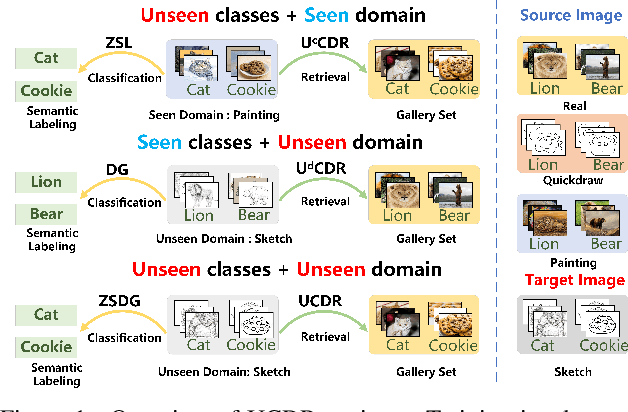

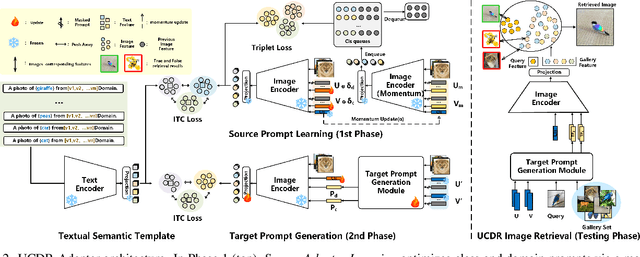

Universal Cross-Domain Retrieval (UCDR) retrieves relevant images from unseen domains and classes without semantic labels, ensuring robust generalization. Existing methods commonly employ prompt tuning with pre-trained vision-language models but are inherently limited by static prompts, reducing adaptability. We propose UCDR-Adapter, which enhances pre-trained models with adapters and dynamic prompt generation through a two-phase training strategy. First, Source Adapter Learning integrates class semantics with domain-specific visual knowledge using a Learnable Textual Semantic Template and optimizes Class and Domain Prompts via momentum updates and dual loss functions for robust alignment. Second, Target Prompt Generation creates dynamic prompts by attending to masked source prompts, enabling seamless adaptation to unseen domains and classes. Unlike prior approaches, UCDR-Adapter dynamically adapts to evolving data distributions, enhancing both flexibility and generalization. During inference, only the image branch and generated prompts are used, eliminating reliance on textual inputs for highly efficient retrieval. Extensive benchmark experiments show that UCDR-Adapter consistently outperforms ProS in most cases and other state-of-the-art methods on UCDR, U(c)CDR, and U(d)CDR settings.