 Add to Chrome
 Add to Firefox
 Add to Edge
Argus: A General-Purpose Agentic Reasoning Runtime for Long-Horizon Tasks
Aug 07, 2026
Long-horizon reasoning requires an agentic runtime that can persist when evidence supports its current approach and pivot when measurements reveal failure, hidden constraints, or a misspecified objective. We present Argus, a persistent, self-evolving runtime in which Manager, Planner, Engineer, and Reviewer execute bounded missions over durable project state. Argus separates stable user intent from operational objectives, constraints, and verification criteria, and admits memories, skills, procedures, verifiers, routing decisions, and rejected routes only after role-owned review and, when available, task-native verification. Model weights remain fixed; self-evolution occurs through persistent runtime state and control policy, with autonomous execution between operator-owned escalation points. Across seven GPT-5.5 benchmark arenas, Argus achieves about 78% on SWE-Bench Pro versus 59% for Direct Copilot while using 1.41 times the aggregate tokens. After verification-gated self-evolution, mature SWE-Bench waves use 21% fewer solve-input tokens and 15% less active workflow time per task than startup waves, while recording 34 verifier recoveries and 22 strict review-loop rescues. Argus also reaches 76.8% on AARRI-Bench and a 28.0-point gap on mathematical data synthesis, with competitive GPU-kernel and language-model-training results. Beyond benchmarks, an optimized RWKV6 kernel was merged upstream; a multi-day mathematics campaign retained falsified routes and proof-backed frontier updates; and six paper pipelines completed 254 missions with 16 stage rollbacks. These results show that a fixed-weight, self-evolving harness can revise, recover, and accumulate verified approaches while producing structured trajectories for future supervised and reinforcement learning.

Argus: A General-Purpose Agentic Runtime for Long-Horizon Reasoning
Aug 05, 2026Long-horizon reasoning requires an agentic runtime that can persist when evidence supports its current approach and pivot when measurements reveal failure, hidden constraints, or a misspecified objective. We present Argus, a persistent, self-evolving runtime in which Manager, Planner, Engineer, and Reviewer execute bounded missions over durable project state. Argus separates stable user intent from operational objectives, constraints, and verification criteria, and admits memories, skills, procedures, verifiers, routing decisions, and rejected routes only after role-owned review and, when available, task-native verification. Model weights remain fixed; self-evolution occurs through persistent runtime state and control policy, with autonomous execution between operator-owned escalation points. Across seven GPT-5.5 benchmark arenas, Argus achieves about 78% on SWE-Bench Pro versus 59% for Direct Copilot while using 1.41 times the aggregate tokens. After verification-gated self-evolution, mature SWE-Bench waves use 21% fewer solve-input tokens and 15% less active workflow time per task than startup waves, while recording 34 verifier recoveries and 22 strict review-loop rescues. Argus also reaches 76.8% on AARRI-Bench and a 28.0-point gap on mathematical data synthesis, with competitive GPU-kernel and language-model-training results. Beyond benchmarks, an optimized RWKV6 kernel was merged upstream; a multi-day mathematics campaign retained falsified routes and proof-backed frontier updates; and six paper pipelines completed 254 missions with 16 stage rollbacks. These results show that a fixed-weight, self-evolving harness can revise, recover, and accumulate verified approaches while producing structured trajectories for future supervised and reinforcement learning.
MESH: Scaling Up Retrieval with Heterogeneous Content Unification
Jul 14, 2026Optimizing large-scale retrieval hinges on the ability to efficiently surface candidates across diverse content tiers. However, to capture segments such as fresh and long-tail content, modern systems typically resort to a fragmented "zoo" of specialized retrieval models. This operational complexity is attributed to a fundamental challenge in heterogeneous retrieval systems, the Scaling Bias of Heterogeneity, where model capacity gains do not apply equally across diverse content tiers. To bridge this gap, we propose MESH as a unified retrieval scaling framework that mitigates this bias through a modularized architecture integrated with gated bias correction. By partitioning the feature space into independent domains, MESH enforces a structural inductive bias that reduces interference between sparse-item signals and high-frequency engagement features. This protected gradient path leads to improved scaling behavior for sparse content, empirically validated by a 14 times improvement in the power-law scaling exponent for fresh items. In online evaluations on Pinterest's Related Pins platform, a billion scale item-to-item recommendation system, these improvements translate into a +5.5% lift in fresh-item repins, alongside with 55% improvement in funnel efficiency and +0.46% improvement in user retention. Finally, our asynchronous serving strategy ensures production viability by delivering a 2.87 times improvement in system throughput. Our findings suggest MESH as a promising paradigm for consolidating fragmented retrieval infrastructures into more scalable and ecosystem-aware backbones.
Multi-Segment Attention: Enabling Efficient KV-Cache Management for Faster Large Language Model Serving
Jun 01, 2026Large Language Model (LLM) inference relies on key-value (KV) caches to avoid redundant attention computation. While approximate KV cache retention techniques reduce memory usage by sacrificing model accuracy, lossless approaches instead evict KV cache blocks from GPU memory and reconstruct them on demand to preserve exact outputs. Existing lossless KV cache management systems primarily base eviction decisions on access frequency or positional heuristics, without considering how different KV cache blocks affect the execution efficiency of GPU attention kernels. In this paper, we propose AsymCache, a computation-latency-aware KV cache management system for LLM inference that explicitly aligns cache residency decisions with GPU attention kernel performance, including three key components: Multi-Segment Attention (MSA) for efficient non-contiguous KV context processing, a cache eviction policy that jointly optimizes hit rate and position-aware recomputation cost, and an adaptive chunking scheduler for high hardware utilization. Experiments show that AsymCache reduces TTFT by up to 1.90-2.03x and time-per-output-token (TPOT) by 1.62-1.71x over latest baselines, confirming the effectiveness of the method in common workloads and validating its design goal of balancing computational efficiency with cache hit rate. Moreover, the low-level design of AsymCache allows seamless integration into agent serving systems such as Continuum, where it further reduces average job latency by up to 18.1%.
When Can Digital Personas Reliably Approximate Human Survey Findings?
May 11, 2026Digital personas powered by Large Language Models (LLMs) are increasingly proposed as substitutes for human survey respondents, yet it remains unclear when they can reliably approximate human survey findings. We answer this question using the LISS panel, constructing personas from respondents' background variables and pre-2023 survey histories, then testing them against the same respondents' held-out post-cutoff answers. Across four persona architectures, three LLMs, and two prediction tasks, we assess performance at the question, respondent, distributional, equity, and clustering levels. Digital personas improve alignment with human response distributions, especially in domains tied to stable attributes and values, but remain limited for individual prediction and fail to recover multivariate respondent structure. Retrieval-augmented architectures provide the clearest gains, but performance depends more on human response structure than on model choice: personas perform best for low-variability questions and common respondent patterns, and worst for subjective, heterogeneous, or rare responses. Our results provide practical guidance on when digital personas could be appropriate for survey research and when human validation remains necessary.
Towards Robust Process Reward Modeling via Noise-aware Learning
Jan 19, 2026Process Reward Models (PRMs) have achieved strong results in complex reasoning, but are bottlenecked by costly process-level supervision. A widely used alternative, Monte Carlo Estimation (MCE), defines process rewards as the probability that a policy model reaches the correct final answer from a given reasoning step. However, step correctness is an intrinsic property of the reasoning trajectory, and should be invariant to policy choice. Our empirical findings show that MCE producing policy-dependent rewards that induce label noise, including false positives that reward incorrect steps and false negatives that penalize correct ones. To address above challenges, we propose a two-stage framework to mitigate noisy supervision. In the labeling stage, we introduce a reflection-aware label correction mechanism that uses a large language model (LLM) as a judge to detect reflection and self-correction behaviors related to the current reasoning step, thereby suppressing overestimated rewards. In the training stage, we further propose a \underline{\textbf{N}}oise-\underline{\textbf{A}}ware \underline{\textbf{I}}terative \underline{\textbf{T}}raining framework that enables the PRM to progressively refine noisy labels based on its own confidence. Extensive Experiments show that our method substantially improves step-level correctness discrimination, achieving up to a 27\% absolute gain in average F1 over PRMs trained with noisy supervision.
Efficiently Transforming Neural Networks into Decision Trees: A Path to Ground Truth Explanations with RENTT
Nov 12, 2025Although neural networks are a powerful tool, their widespread use is hindered by the opacity of their decisions and their black-box nature, which result in a lack of trustworthiness. To alleviate this problem, methods in the field of explainable Artificial Intelligence try to unveil how such automated decisions are made. But explainable AI methods are often plagued by missing faithfulness/correctness, meaning that they sometimes provide explanations that do not align with the neural network's decision and logic. Recently, transformations to decision trees have been proposed to overcome such problems. Unfortunately, they typically lack exactness, scalability, or interpretability as the size of the neural network grows. Thus, we generalize these previous results, especially by considering convolutional neural networks, recurrent neural networks, non-ReLU activation functions, and bias terms. Our findings are accompanied by rigorous proofs and we present a novel algorithm RENTT (Runtime Efficient Network to Tree Transformation) designed to compute an exact equivalent decision tree representation of neural networks in a manner that is both runtime and memory efficient. The resulting decision trees are multivariate and thus, possibly too complex to understand. To alleviate this problem, we also provide a method to calculate the ground truth feature importance for neural networks via the equivalent decision trees - for entire models (global), specific input regions (regional), or single decisions (local). All theoretical results are supported by detailed numerical experiments that emphasize two key aspects: the computational efficiency and scalability of our algorithm, and that only RENTT succeeds in uncovering ground truth explanations compared to conventional approximation methods like LIME and SHAP. All code is available at https://github.com/HelenaM23/RENTT .
Harnessing Rule-Based Reinforcement Learning for Enhanced Grammatical Error Correction
Aug 26, 2025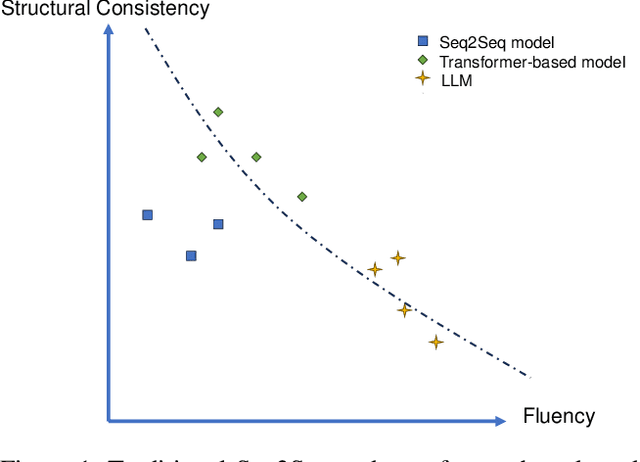
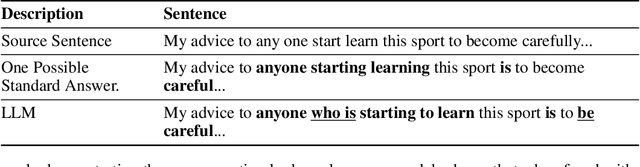
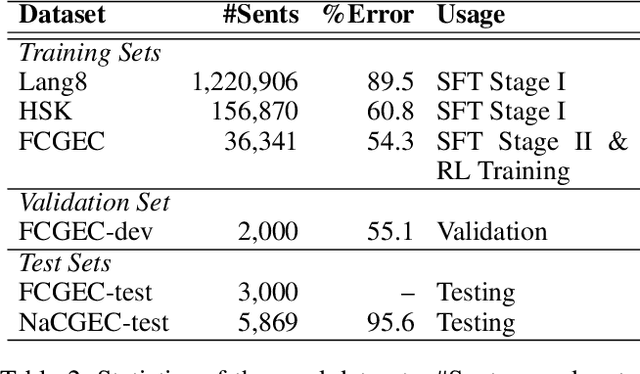
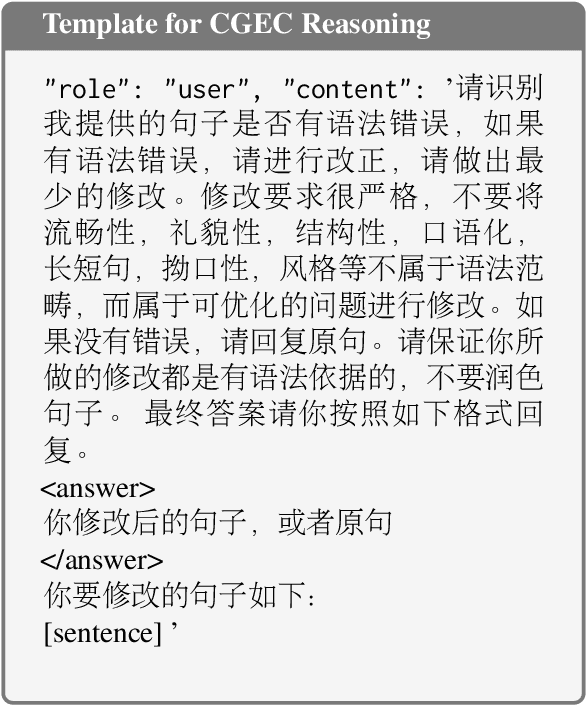
Grammatical error correction is a significant task in NLP. Traditional methods based on encoder-decoder models have achieved certain success, but the application of LLMs in this field is still underexplored. Current research predominantly relies on supervised fine-tuning to train LLMs to directly generate the corrected sentence, which limits the model's powerful reasoning ability. To address this limitation, we propose a novel framework based on Rule-Based RL. Through experiments on the Chinese datasets, our Rule-Based RL framework achieves \textbf{state-of-the-art }performance, with a notable increase in \textbf{recall}. This result clearly highlights the advantages of using RL to steer LLMs, offering a more controllable and reliable paradigm for future development in GEC.
PointSCNet: Point Cloud Structure and Correlation Learning Based on Space Filling Curve-Guided Sampling
Feb 21, 2022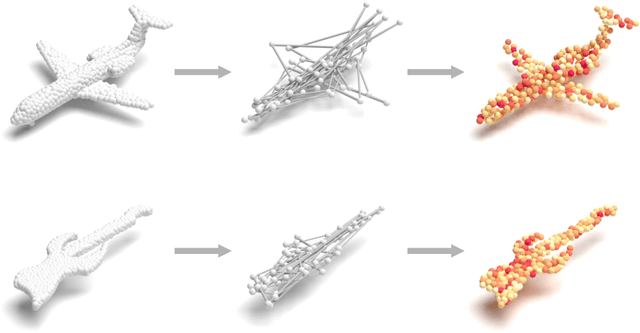
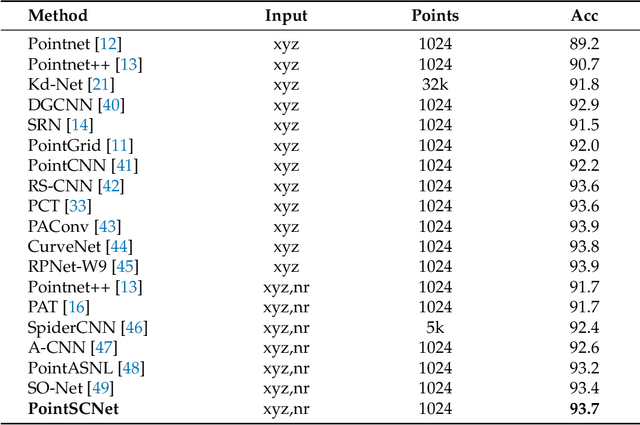
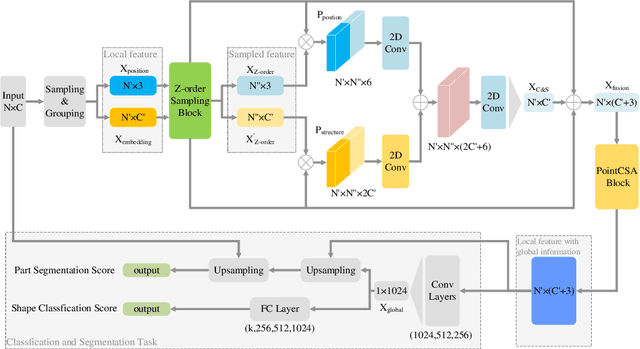
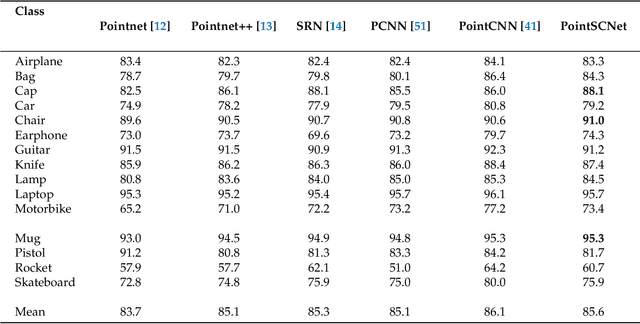
Geometrical structures and the internal local region relationship, such as symmetry, regular array, junction, etc., are essential for understanding a 3D shape. This paper proposes a point cloud feature extraction network named PointSCNet, to capture the geometrical structure information and local region correlation information of a point cloud. The PointSCNet consists of three main modules: the space-filling curve-guided sampling module, the information fusion module, and the channel-spatial attention module. The space-filling curve-guided sampling module uses Z-order curve coding to sample points that contain geometrical correlation. The information fusion module uses a correlation tensor and a set of skip connections to fuse the structure and correlation information. The channel-spatial attention module enhances the representation of key points and crucial feature channels to refine the network. The proposed PointSCNet is evaluated on shape classification and part segmentation tasks. The experimental results demonstrate that the PointSCNet outperforms or is on par with state-of-the-art methods by learning the structure and correlation of point clouds effectively.
Multi-Constitutive Neural Network for Large Deformation Poromechanics Problem
Oct 11, 2020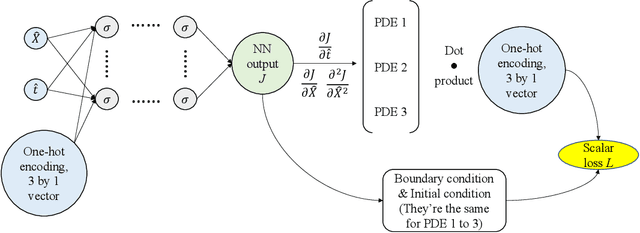

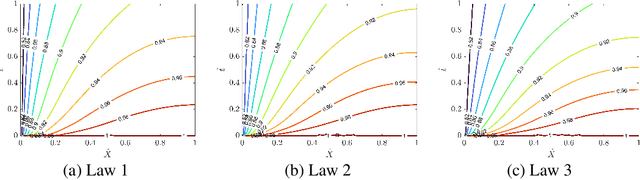
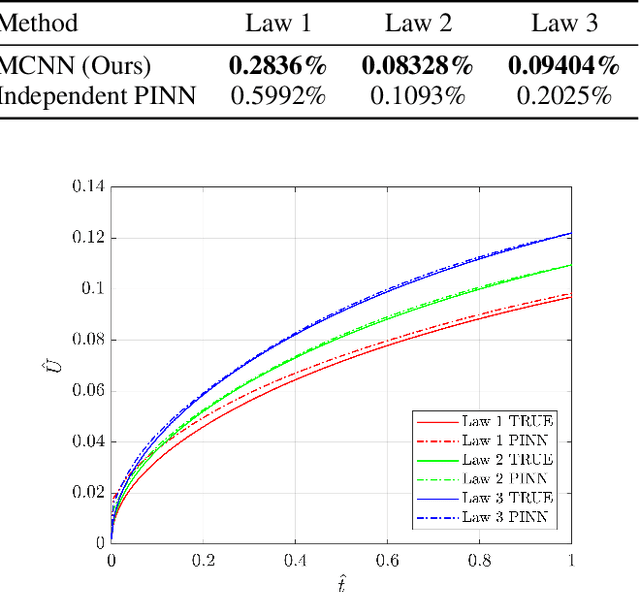
In this paper, we study the problem of large-strain consolidation in poromechanics with deep neural networks. Given different material properties and different loading conditions, the goal is to predict pore pressure and settlement. We propose a novel method "multi-constitutive neural network" (MCNN) such that one model can solve several different constitutive laws. We introduce a one-hot encoding vector as an additional input vector, which is used to label the constitutive law we wish to solve. Then we build a DNN which takes as input (X, t) along with a constitutive model label and outputs the corresponding solution. It is the first time, to our knowledge, that we can evaluate multi-constitutive laws through only one training process while still obtaining good accuracies. We found that MCNN trained to solve multiple PDEs outperforms individual neural network solvers trained with PDE.