 Add to Chrome
 Add to Firefox
 Add to Edge
PinEqualizer: Full Funnel Content Exploration and Debiasing System at Pinterest
Jul 24, 2026
In this paper, we propose a new solution for addressing the content cold-start problem in industry-scale search and recommender systems. Compared to prior approaches, we have made the following new contributions: 1) our solution spans the entire multi-stage funnel and generalizes well for both search and recommendation surfaces, 2) our solution reduces bias favoring existing content, allowing more accurate model prediction across content types and reducing short-term tradeoffs associated with high volumes of explicit content exploration, 3) our solution is evaluated with a scalable measurement framework that enables fast short-term experimentation while validating long-term impact. We have iteratively built and successfully deployed this new system at Pinterest in the past two years and observed significant improvements in fresh content exploration, overall user engagement, and content ecosystem health.

MESH: Scaling Up Retrieval with Heterogeneous Content Unification
Jul 14, 2026Optimizing large-scale retrieval hinges on the ability to efficiently surface candidates across diverse content tiers. However, to capture segments such as fresh and long-tail content, modern systems typically resort to a fragmented "zoo" of specialized retrieval models. This operational complexity is attributed to a fundamental challenge in heterogeneous retrieval systems, the Scaling Bias of Heterogeneity, where model capacity gains do not apply equally across diverse content tiers. To bridge this gap, we propose MESH as a unified retrieval scaling framework that mitigates this bias through a modularized architecture integrated with gated bias correction. By partitioning the feature space into independent domains, MESH enforces a structural inductive bias that reduces interference between sparse-item signals and high-frequency engagement features. This protected gradient path leads to improved scaling behavior for sparse content, empirically validated by a 14 times improvement in the power-law scaling exponent for fresh items. In online evaluations on Pinterest's Related Pins platform, a billion scale item-to-item recommendation system, these improvements translate into a +5.5% lift in fresh-item repins, alongside with 55% improvement in funnel efficiency and +0.46% improvement in user retention. Finally, our asynchronous serving strategy ensures production viability by delivering a 2.87 times improvement in system throughput. Our findings suggest MESH as a promising paradigm for consolidating fragmented retrieval infrastructures into more scalable and ecosystem-aware backbones.
Breaking the Context Bottleneck on Long Time Series Forecasting
Dec 21, 2024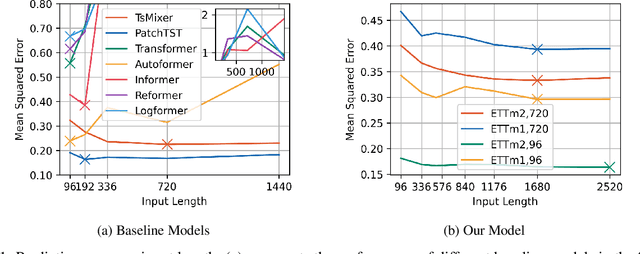

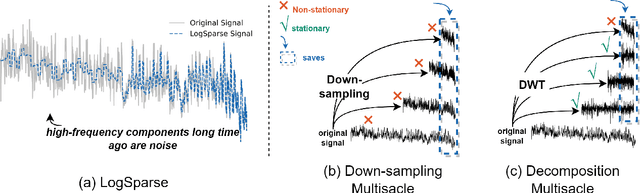
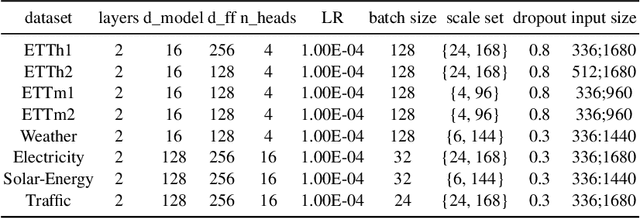
Long-term time-series forecasting is essential for planning and decision-making in economics, energy, and transportation, where long foresight is required. To obtain such long foresight, models must be both efficient and effective in processing long sequence. Recent advancements have enhanced the efficiency of these models; however, the challenge of effectively leveraging longer sequences persists. This is primarily due to the tendency of these models to overfit when presented with extended inputs, necessitating the use of shorter input lengths to maintain tolerable error margins. In this work, we investigate the multiscale modeling method and propose the Logsparse Decomposable Multiscaling (LDM) framework for the efficient and effective processing of long sequences. We demonstrate that by decoupling patterns at different scales in time series, we can enhance predictability by reducing non-stationarity, improve efficiency through a compact long input representation, and simplify the architecture by providing clear task assignments. Experimental results demonstrate that LDM not only outperforms all baselines in long-term forecasting benchmarks, but also reducing both training time and memory costs.
Leveraging Language Representation for Material Recommendation, Ranking, and Exploration
May 01, 2023Data-driven approaches for material discovery and design have been accelerated by emerging efforts in machine learning. While there is enormous progress towards learning the structure to property relationship of materials, methods that allow for general representations of crystals to effectively explore the vast material search space and identify high-performance candidates remain limited. In this work, we introduce a material discovery framework that uses natural language embeddings derived from material science-specific language models as representations of compositional and structural features. The discovery framework consists of a joint scheme that, given a query material, first recalls candidates based on representational similarity, and ranks the candidates based on target properties through multi-task learning. The contextual knowledge encoded in language representations is found to convey information about material properties and structures, enabling both similarity analysis for recall, and multi-task learning to share information for related properties. By applying the discovery framework to thermoelectric materials, we demonstrate diversified recommendations of prototype structures and identify under-studied high-performance material spaces, including halide perovskite, delafossite-like, and spinel-like structures. By leveraging material language representations, our framework provides a generalized means for effective material recommendation, which is task-agnostic and can be applied to various material systems.