 Add to Chrome
 Add to Firefox
 Add to Edge
From Image to Video: An Empirical Study of Diffusion Representations
Feb 10, 2025
Diffusion models have revolutionized generative modeling, enabling unprecedented realism in image and video synthesis. This success has sparked interest in leveraging their representations for visual understanding tasks. While recent works have explored this potential for image generation, the visual understanding capabilities of video diffusion models remain largely uncharted. To address this gap, we systematically compare the same model architecture trained for video versus image generation, analyzing the performance of their latent representations on various downstream tasks including image classification, action recognition, depth estimation, and tracking. Results show that video diffusion models consistently outperform their image counterparts, though we find a striking range in the extent of this superiority. We further analyze features extracted from different layers and with varying noise levels, as well as the effect of model size and training budget on representation and generation quality. This work marks the first direct comparison of video and image diffusion objectives for visual understanding, offering insights into the role of temporal information in representation learning.

DreamDPO: Aligning Text-to-3D Generation with Human Preferences via Direct Preference Optimization
Feb 05, 2025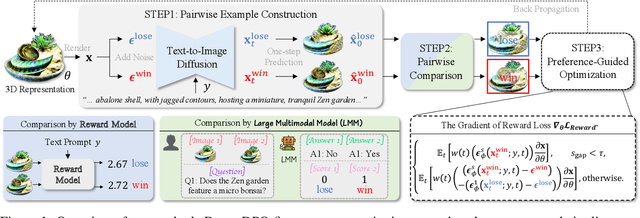
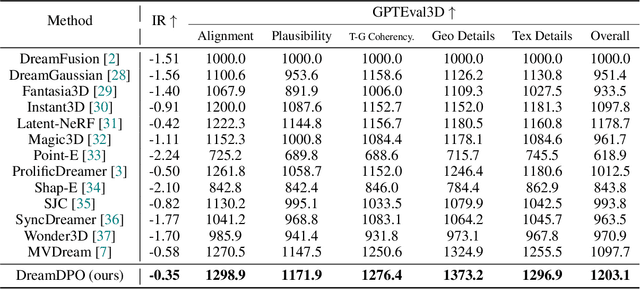
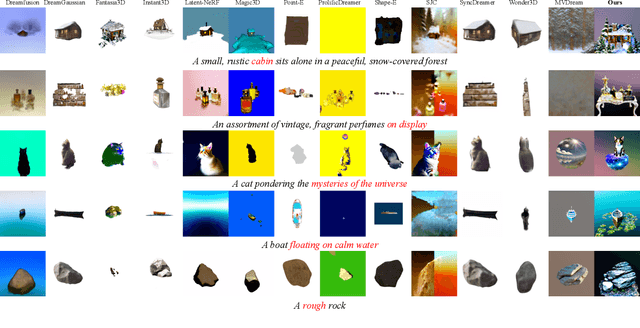
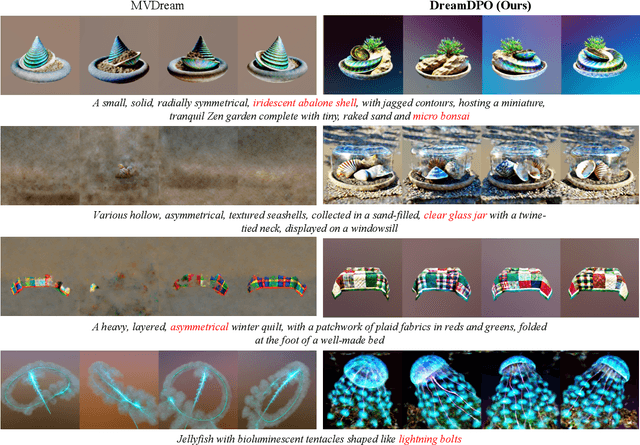
Text-to-3D generation automates 3D content creation from textual descriptions, which offers transformative potential across various fields. However, existing methods often struggle to align generated content with human preferences, limiting their applicability and flexibility. To address these limitations, in this paper, we propose DreamDPO, an optimization-based framework that integrates human preferences into the 3D generation process, through direct preference optimization. Practically, DreamDPO first constructs pairwise examples, then compare their alignment with human preferences using reward or large multimodal models, and lastly optimizes the 3D representation with a preference-driven loss function. By leveraging pairwise comparison to reflect preferences, DreamDPO reduces reliance on precise pointwise quality evaluations while enabling fine-grained controllability through preference-guided optimization. Experiments demonstrate that DreamDPO achieves competitive results, and provides higher-quality and more controllable 3D content compared to existing methods. The code and models will be open-sourced.
BVINet: Unlocking Blind Video Inpainting with Zero Annotations
Feb 03, 2025


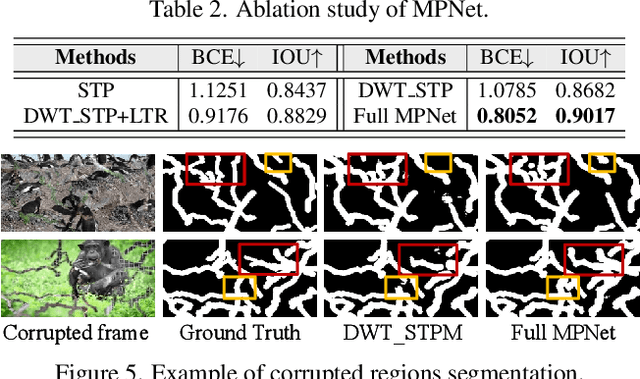
Video inpainting aims to fill in corrupted regions of the video with plausible contents. Existing methods generally assume that the locations of corrupted regions are known, focusing primarily on the "how to inpaint". This reliance necessitates manual annotation of the corrupted regions using binary masks to indicate "whereto inpaint". However, the annotation of these masks is labor-intensive and expensive, limiting the practicality of current methods. In this paper, we expect to relax this assumption by defining a new blind video inpainting setting, enabling the networks to learn the mapping from corrupted video to inpainted result directly, eliminating the need of corrupted region annotations. Specifically, we propose an end-to-end blind video inpainting network (BVINet) to address both "where to inpaint" and "how to inpaint" simultaneously. On the one hand, BVINet can predict the masks of corrupted regions by detecting semantic-discontinuous regions of the frame and utilizing temporal consistency prior of the video. On the other hand, the predicted masks are incorporated into the BVINet, allowing it to capture valid context information from uncorrupted regions to fill in corrupted ones. Besides, we introduce a consistency loss to regularize the training parameters of BVINet. In this way, mask prediction and video completion mutually constrain each other, thereby maximizing the overall performance of the trained model. Furthermore, we customize a dataset consisting of synthetic corrupted videos, real-world corrupted videos, and their corresponding completed videos. This dataset serves as a valuable resource for advancing blind video inpainting research. Extensive experimental results demonstrate the effectiveness and superiority of our method.
Prompt-Aware Controllable Shadow Removal
Jan 25, 2025


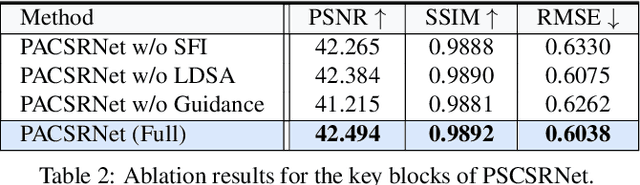
Shadow removal aims to restore the image content in shadowed regions. While deep learning-based methods have shown promising results, they still face key challenges: 1) uncontrolled removal of all shadows, or 2) controllable removal but heavily relies on precise shadow region masks.To address these issues, we introduce a novel paradigm: prompt-aware controllable shadow removal. Unlike existing approaches, our paradigm allows for targeted shadow removal from specific subjects based on user prompts (e.g., dots, lines, or subject masks). This approach eliminates the need for shadow annotations and offers flexible, user-controlled shadow removal.Specifically, we propose an end-to-end learnable model, the \emph{\textbf{P}}rompt-\emph{\textbf{A}}ware \emph{\textbf{C}}ntrollable \emph{\textbf{S}}hadow \emph{\textbf{R}}emoval \emph{\textbf{Net}}work (PACSRNet). PACSRNet consists of two key modules: a prompt-aware module that generates shadow masks for the specified subject based on the user prompt, and a shadow removal module that uses the shadow prior from the first module to restore the content in the shadowed regions.Additionally, we enhance the shadow removal module by incorporating feature information from the prompt-aware module through a linear operation, providing prompt-guided support for shadow removal.Recognizing that existing shadow removal datasets lack diverse user prompts, we contribute a new dataset specifically designed for prompt-based controllable shadow removal.Extensive experimental results demonstrate the effectiveness and superiority of PACSRNet.
BrainGuard: Privacy-Preserving Multisubject Image Reconstructions from Brain Activities
Jan 24, 2025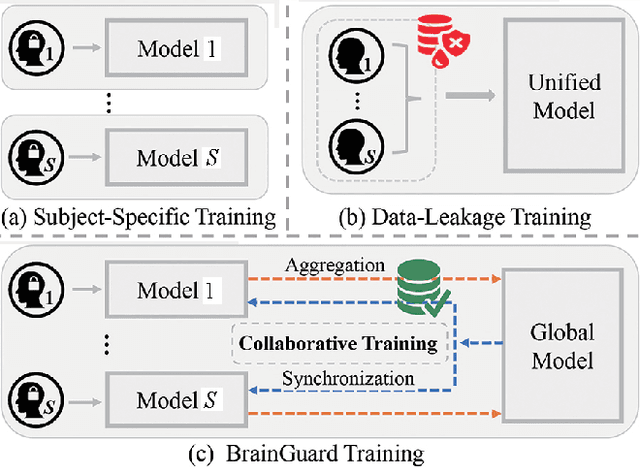
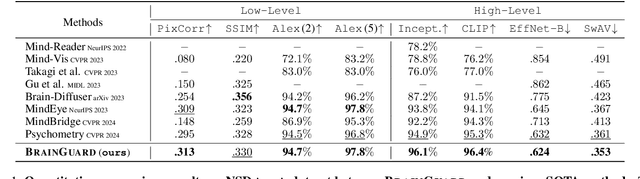
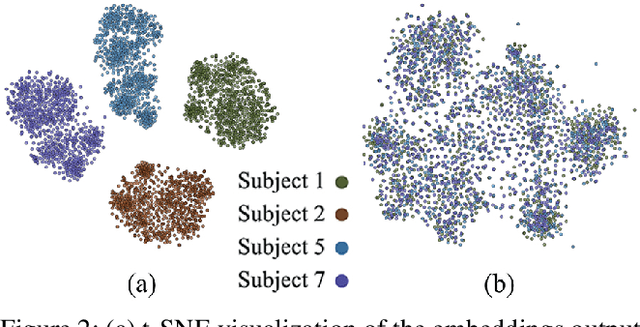

Reconstructing perceived images from human brain activity forms a crucial link between human and machine learning through Brain-Computer Interfaces. Early methods primarily focused on training separate models for each individual to account for individual variability in brain activity, overlooking valuable cross-subject commonalities. Recent advancements have explored multisubject methods, but these approaches face significant challenges, particularly in data privacy and effectively managing individual variability. To overcome these challenges, we introduce BrainGuard, a privacy-preserving collaborative training framework designed to enhance image reconstruction from multisubject fMRI data while safeguarding individual privacy. BrainGuard employs a collaborative global-local architecture where individual models are trained on each subject's local data and operate in conjunction with a shared global model that captures and leverages cross-subject patterns. This architecture eliminates the need to aggregate fMRI data across subjects, thereby ensuring privacy preservation. To tackle the complexity of fMRI data, BrainGuard integrates a hybrid synchronization strategy, enabling individual models to dynamically incorporate parameters from the global model. By establishing a secure and collaborative training environment, BrainGuard not only protects sensitive brain data but also improves the image reconstructions accuracy. Extensive experiments demonstrate that BrainGuard sets a new benchmark in both high-level and low-level metrics, advancing the state-of-the-art in brain decoding through its innovative design.
A Survey of World Models for Autonomous Driving
Jan 20, 2025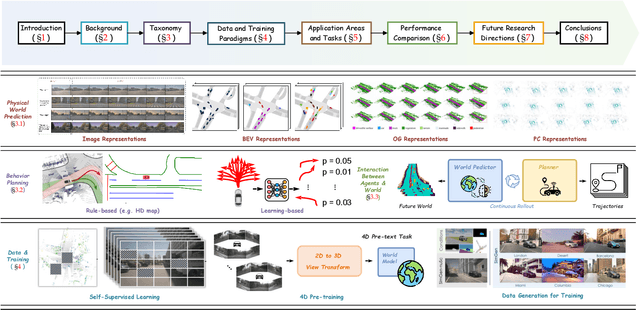
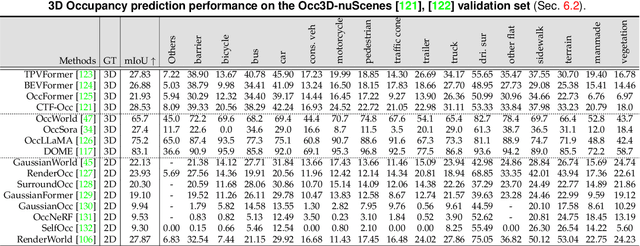
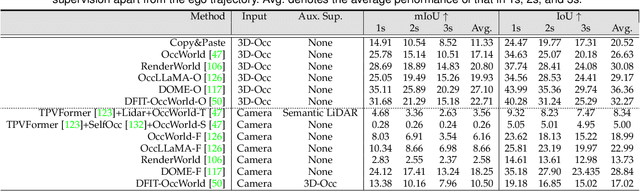
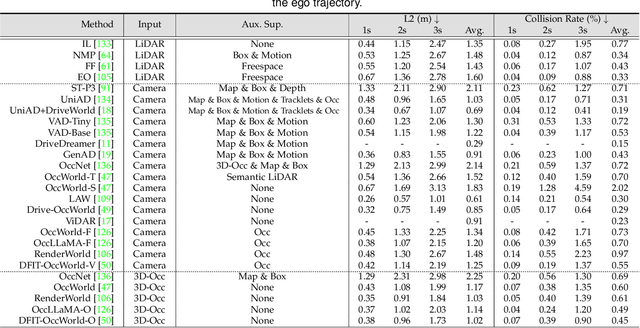
Recent breakthroughs in autonomous driving have revolutionized the way vehicles perceive and interact with their surroundings. In particular, world models have emerged as a linchpin technology, offering high-fidelity representations of the driving environment that integrate multi-sensor data, semantic cues, and temporal dynamics. Such models unify perception, prediction, and planning, thereby enabling autonomous systems to make rapid, informed decisions under complex and often unpredictable conditions. Research trends span diverse areas, including 4D occupancy prediction and generative data synthesis, all of which bolster scene understanding and trajectory forecasting. Notably, recent works exploit large-scale pretraining and advanced self-supervised learning to scale up models' capacity for rare-event simulation and real-time interaction. In addressing key challenges -- ranging from domain adaptation and long-tail anomaly detection to multimodal fusion -- these world models pave the way for more robust, reliable, and adaptable autonomous driving solutions. This survey systematically reviews the state of the art, categorizing techniques by their focus on future prediction, behavior planning, and the interaction between the two. We also identify potential directions for future research, emphasizing holistic integration, improved computational efficiency, and advanced simulation. Our comprehensive analysis underscores the transformative role of world models in driving next-generation autonomous systems toward safer and more equitable mobility.
Adaptive Sampled Softmax with Inverted Multi-Index: Methods, Theory and Applications
Jan 15, 2025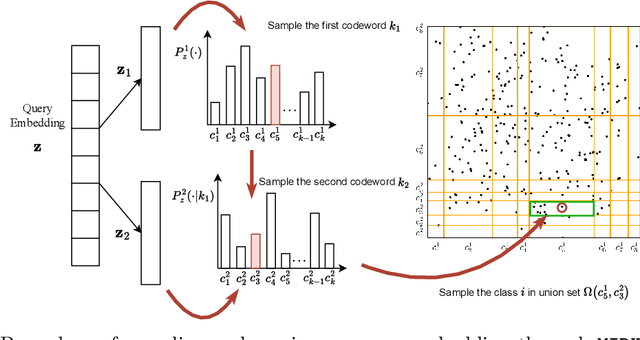


The softmax function is a cornerstone of multi-class classification, integral to a wide range of machine learning applications, from large-scale retrieval and ranking models to advanced large language models. However, its computational cost grows linearly with the number of classes, which becomes prohibitively expensive in scenarios with millions or even billions of classes. The sampled softmax, which relies on self-normalized importance sampling, has emerged as a powerful alternative, significantly reducing computational complexity. Yet, its estimator remains unbiased only when the sampling distribution matches the true softmax distribution. To improve both approximation accuracy and sampling efficiency, we propose the MIDX Sampler, a novel adaptive sampling strategy based on an inverted multi-index approach. Concretely, we decompose the softmax probability into several multinomial probabilities, each associated with a specific set of codewords and the last associated with the residual score of queries, thus reducing time complexity to the number of codewords instead of the number of classes. To further boost efficiency, we replace the query-specific residual probability with a simple uniform distribution, simplifying the computation while retaining high performance. Our method is backed by rigorous theoretical analysis, addressing key concerns such as sampling bias, gradient bias, convergence rates, and generalization error bounds. The results demonstrate that a smaller divergence from the ideal softmax distribution leads to faster convergence and improved generalization. Extensive experiments on large-scale language models, sequential recommenders, and extreme multi-class classification tasks confirm that the MIDX-Sampler delivers superior effectiveness and efficiency compared to existing approaches.
3DIS-FLUX: simple and efficient multi-instance generation with DiT rendering
Jan 09, 2025The growing demand for controllable outputs in text-to-image generation has driven significant advancements in multi-instance generation (MIG), enabling users to define both instance layouts and attributes. Currently, the state-of-the-art methods in MIG are primarily adapter-based. However, these methods necessitate retraining a new adapter each time a more advanced model is released, resulting in significant resource consumption. A methodology named Depth-Driven Decoupled Instance Synthesis (3DIS) has been introduced, which decouples MIG into two distinct phases: 1) depth-based scene construction and 2) detail rendering with widely pre-trained depth control models. The 3DIS method requires adapter training solely during the scene construction phase, while enabling various models to perform training-free detail rendering. Initially, 3DIS focused on rendering techniques utilizing U-Net architectures such as SD1.5, SD2, and SDXL, without exploring the potential of recent DiT-based models like FLUX. In this paper, we present 3DIS-FLUX, an extension of the 3DIS framework that integrates the FLUX model for enhanced rendering capabilities. Specifically, we employ the FLUX.1-Depth-dev model for depth map controlled image generation and introduce a detail renderer that manipulates the Attention Mask in FLUX's Joint Attention mechanism based on layout information. This approach allows for the precise rendering of fine-grained attributes of each instance. Our experimental results indicate that 3DIS-FLUX, leveraging the FLUX model, outperforms the original 3DIS method, which utilized SD2 and SDXL, and surpasses current state-of-the-art adapter-based methods in terms of both performance and image quality. Project Page: https://limuloo.github.io/3DIS/.
Noise-Tolerant Hybrid Prototypical Learning with Noisy Web Data
Jan 05, 2025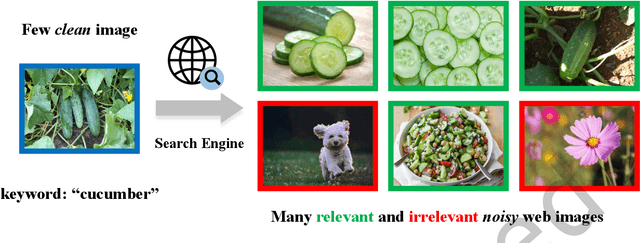
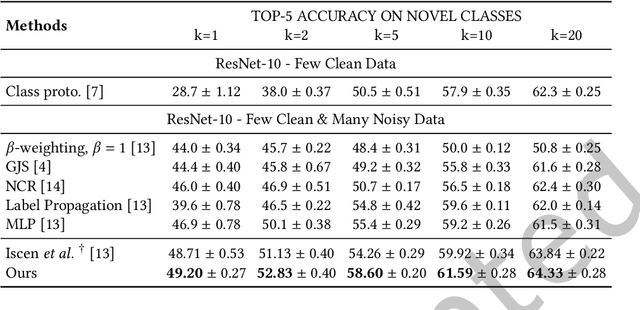
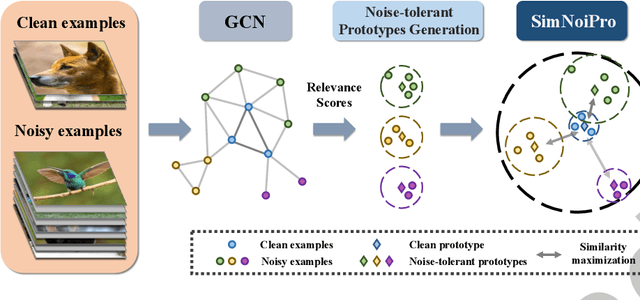
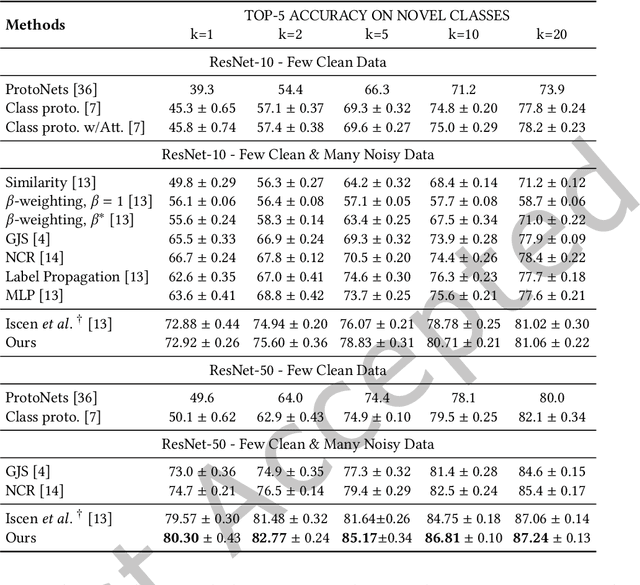
We focus on the challenging problem of learning an unbiased classifier from a large number of potentially relevant but noisily labeled web images given only a few clean labeled images. This problem is particularly practical because it reduces the expensive annotation costs by utilizing freely accessible web images with noisy labels. Typically, prototypes are representative images or features used to classify or identify other images. However, in the few clean and many noisy scenarios, the class prototype can be severely biased due to the presence of irrelevant noisy images. The resulting prototypes are less compact and discriminative, as previous methods do not take into account the diverse range of images in the noisy web image collections. On the other hand, the relation modeling between noisy and clean images is not learned for the class prototype generation in an end-to-end manner, which results in a suboptimal class prototype. In this article, we introduce a similarity maximization loss named SimNoiPro. Our SimNoiPro first generates noise-tolerant hybrid prototypes composed of clean and noise-tolerant prototypes and then pulls them closer to each other. Our approach considers the diversity of noisy images by explicit division and overcomes the optimization discrepancy issue. This enables better relation modeling between clean and noisy images and helps extract judicious information from the noisy image set. The evaluation results on two extended few-shot classification benchmarks confirm that our SimNoiPro outperforms prior methods in measuring image relations and cleaning noisy data.
Generalizable Origin Identification for Text-Guided Image-to-Image Diffusion Models
Jan 04, 2025
Text-guided image-to-image diffusion models excel in translating images based on textual prompts, allowing for precise and creative visual modifications. However, such a powerful technique can be misused for spreading misinformation, infringing on copyrights, and evading content tracing. This motivates us to introduce the task of origin IDentification for text-guided Image-to-image Diffusion models (ID$^2$), aiming to retrieve the original image of a given translated query. A straightforward solution to ID$^2$ involves training a specialized deep embedding model to extract and compare features from both query and reference images. However, due to visual discrepancy across generations produced by different diffusion models, this similarity-based approach fails when training on images from one model and testing on those from another, limiting its effectiveness in real-world applications. To solve this challenge of the proposed ID$^2$ task, we contribute the first dataset and a theoretically guaranteed method, both emphasizing generalizability. The curated dataset, OriPID, contains abundant Origins and guided Prompts, which can be used to train and test potential IDentification models across various diffusion models. In the method section, we first prove the existence of a linear transformation that minimizes the distance between the pre-trained Variational Autoencoder (VAE) embeddings of generated samples and their origins. Subsequently, it is demonstrated that such a simple linear transformation can be generalized across different diffusion models. Experimental results show that the proposed method achieves satisfying generalization performance, significantly surpassing similarity-based methods ($+31.6\%$ mAP), even those with generalization designs.