 Add to Chrome
 Add to Firefox
 Add to Edge
Global-to-Local Modeling for Video-based 3D Human Pose and Shape Estimation
Mar 26, 2023
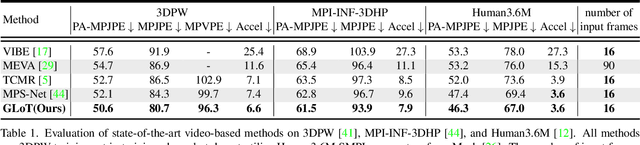
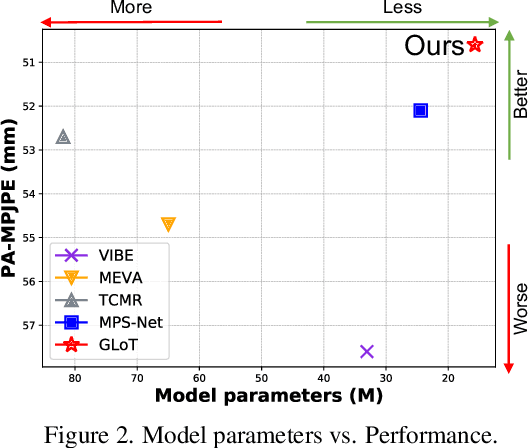
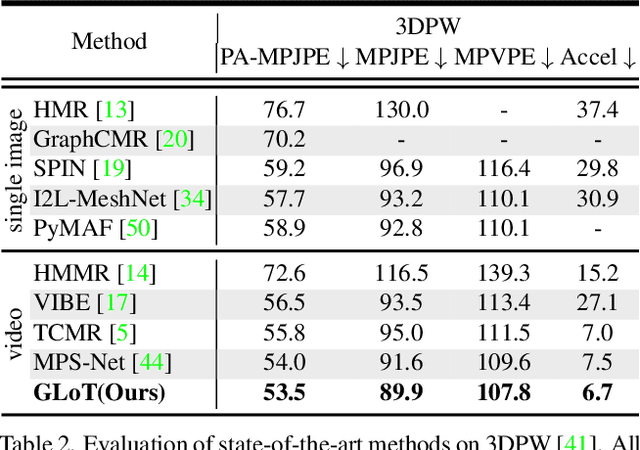
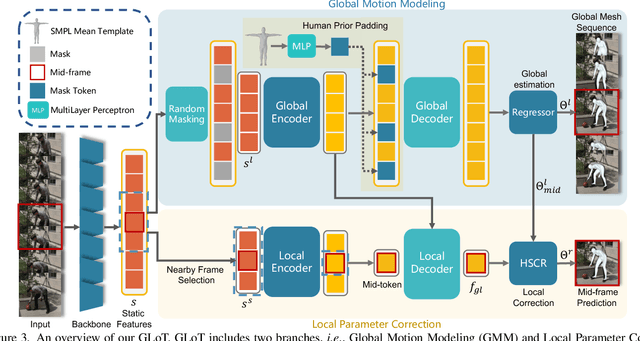
Video-based 3D human pose and shape estimations are evaluated by intra-frame accuracy and inter-frame smoothness. Although these two metrics are responsible for different ranges of temporal consistency, existing state-of-the-art methods treat them as a unified problem and use monotonous modeling structures (e.g., RNN or attention-based block) to design their networks. However, using a single kind of modeling structure is difficult to balance the learning of short-term and long-term temporal correlations, and may bias the network to one of them, leading to undesirable predictions like global location shift, temporal inconsistency, and insufficient local details. To solve these problems, we propose to structurally decouple the modeling of long-term and short-term correlations in an end-to-end framework, Global-to-Local Transformer (GLoT). First, a global transformer is introduced with a Masked Pose and Shape Estimation strategy for long-term modeling. The strategy stimulates the global transformer to learn more inter-frame correlations by randomly masking the features of several frames. Second, a local transformer is responsible for exploiting local details on the human mesh and interacting with the global transformer by leveraging cross-attention. Moreover, a Hierarchical Spatial Correlation Regressor is further introduced to refine intra-frame estimations by decoupled global-local representation and implicit kinematic constraints. Our GLoT surpasses previous state-of-the-art methods with the lowest model parameters on popular benchmarks, i.e., 3DPW, MPI-INF-3DHP, and Human3.6M. Codes are available at https://github.com/sxl142/GLoT.

CRRS: Concentric Rectangles Regression Strategy for Multi-point Representation on Fisheye Images
Mar 26, 2023Modern object detectors take advantage of rectangular bounding boxes as a conventional way to represent objects. When it comes to fisheye images, rectangular boxes involve more background noise rather than semantic information. Although multi-point representation has been proposed, both the regression accuracy and convergence still perform inferior to the widely used rectangular boxes. In order to further exploit the advantages of multi-point representation for distorted images, Concentric Rectangles Regression Strategy(CRRS) is proposed in this work. We adopt smoother mean loss to allocate weights and discuss the effect of hyper-parameter to prediction results. Moreover, an accurate pixel-level method is designed to obtain irregular IoU for estimating detector performance. Compared with the previous work for muti-point representation, the experiments show that CRRS can improve the training performance both in accurate and stability. We also prove that multi-task weighting strategy facilitates regression process in this design.
Taking A Closer Look at Visual Relation: Unbiased Video Scene Graph Generation with Decoupled Label Learning
Mar 23, 2023Current video-based scene graph generation (VidSGG) methods have been found to perform poorly on predicting predicates that are less represented due to the inherent biased distribution in the training data. In this paper, we take a closer look at the predicates and identify that most visual relations (e.g. sit_above) involve both actional pattern (sit) and spatial pattern (above), while the distribution bias is much less severe at the pattern level. Based on this insight, we propose a decoupled label learning (DLL) paradigm to address the intractable visual relation prediction from the pattern-level perspective. Specifically, DLL decouples the predicate labels and adopts separate classifiers to learn actional and spatial patterns respectively. The patterns are then combined and mapped back to the predicate. Moreover, we propose a knowledge-level label decoupling method to transfer non-target knowledge from head predicates to tail predicates within the same pattern to calibrate the distribution of tail classes. We validate the effectiveness of DLL on the commonly used VidSGG benchmark, i.e. VidVRD. Extensive experiments demonstrate that the DLL offers a remarkably simple but highly effective solution to the long-tailed problem, achieving the state-of-the-art VidSGG performance.
Decomposed Prototype Learning for Few-Shot Scene Graph Generation
Mar 20, 2023Today's scene graph generation (SGG) models typically require abundant manual annotations to learn new predicate types. Thus, it is difficult to apply them to real-world applications with a long-tailed distribution of predicates. In this paper, we focus on a new promising task of SGG: few-shot SGG (FSSGG). FSSGG encourages models to be able to quickly transfer previous knowledge and recognize novel predicates well with only a few examples. Although many advanced approaches have achieved great success on few-shot learning (FSL) tasks, straightforwardly extending them into FSSGG is not applicable due to two intrinsic characteristics of predicate concepts: 1) Each predicate category commonly has multiple semantic meanings under different contexts. 2) The visual appearance of relation triplets with the same predicate differs greatly under different subject-object pairs. Both issues make it hard to model conventional latent representations for predicate categories with state-of-the-art FSL methods. To this end, we propose a novel Decomposed Prototype Learning (DPL). Specifically, we first construct a decomposable prototype space to capture intrinsic visual patterns of subjects and objects for predicates, and enhance their feature representations with these decomposed prototypes. Then, we devise an intelligent metric learner to assign adaptive weights to each support sample by considering the relevance of their subject-object pairs. We further re-split the VG dataset and compare DPL with various FSL methods to benchmark this task. Extensive results show that DPL achieves excellent performance in both base and novel categories.
Exploring Expression-related Self-supervised Learning for Affective Behaviour Analysis
Mar 18, 2023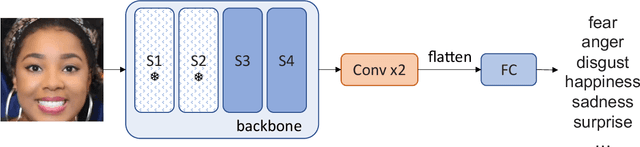
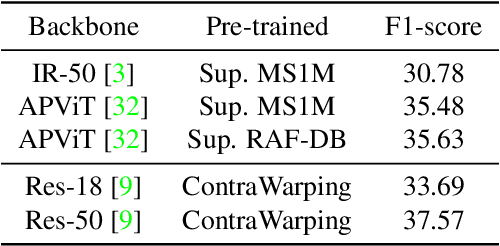
This paper explores an expression-related self-supervised learning (SSL) method (ContraWarping) to perform expression classification in the 5th Affective Behavior Analysis in-the-wild (ABAW) competition. Affective datasets are expensive to annotate, and SSL methods could learn from large-scale unlabeled data, which is more suitable for this task. By evaluating on the Aff-Wild2 dataset, we demonstrate that ContraWarping outperforms most existing supervised methods and shows great application potential in the affective analysis area. Codes will be released on: https://github.com/youqingxiaozhua/ABAW5.
Unified Mask Embedding and Correspondence Learning for Self-Supervised Video Segmentation
Mar 17, 2023The objective of this paper is self-supervised learning of video object segmentation. We develop a unified framework which simultaneously models cross-frame dense correspondence for locally discriminative feature learning and embeds object-level context for target-mask decoding. As a result, it is able to directly learn to perform mask-guided sequential segmentation from unlabeled videos, in contrast to previous efforts usually relying on an oblique solution - cheaply "copying" labels according to pixel-wise correlations. Concretely, our algorithm alternates between i) clustering video pixels for creating pseudo segmentation labels ex nihilo; and ii) utilizing the pseudo labels to learn mask encoding and decoding for VOS. Unsupervised correspondence learning is further incorporated into this self-taught, mask embedding scheme, so as to ensure the generic nature of the learnt representation and avoid cluster degeneracy. Our algorithm sets state-of-the-arts on two standard benchmarks (i.e., DAVIS17 and YouTube-VOS), narrowing the gap between self- and fully-supervised VOS, in terms of both performance and network architecture design.
Unsupervised Facial Expression Representation Learning with Contrastive Local Warping
Mar 16, 2023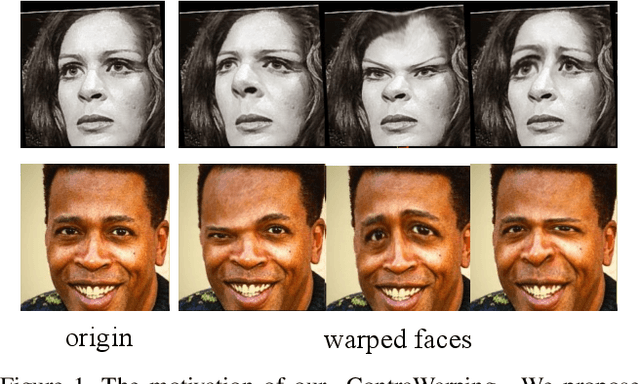
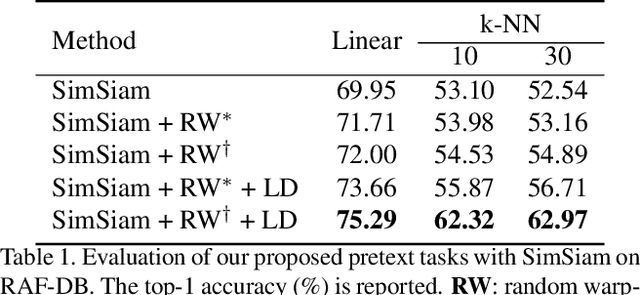
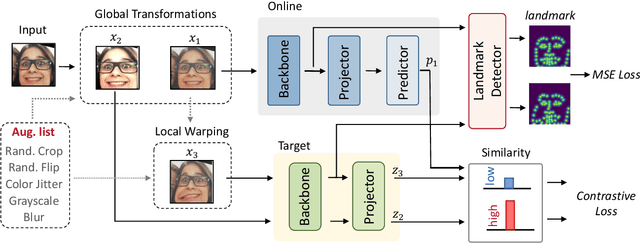
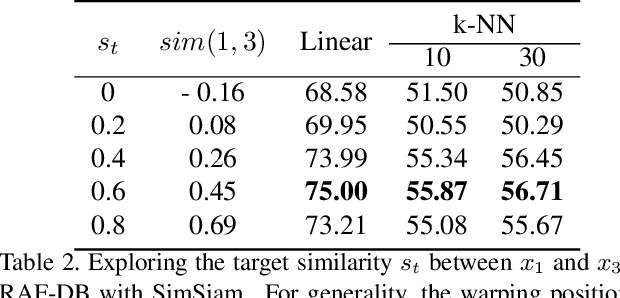
This paper investigates unsupervised representation learning for facial expression analysis. We think Unsupervised Facial Expression Representation (UFER) deserves exploration and has the potential to address some key challenges in facial expression analysis, such as scaling, annotation bias, the discrepancy between discrete labels and continuous emotions, and model pre-training. Such motivated, we propose a UFER method with contrastive local warping (ContraWarping), which leverages the insight that the emotional expression is robust to current global transformation (affine transformation, color jitter, etc.) but can be easily changed by random local warping. Therefore, given a facial image, ContraWarping employs some global transformations and local warping to generate its positive and negative samples and sets up a novel contrastive learning framework. Our in-depth investigation shows that: 1) the positive pairs from global transformations may be exploited with general self-supervised learning (e.g., BYOL) and already bring some informative features, and 2) the negative pairs from local warping explicitly introduce expression-related variation and further bring substantial improvement. Based on ContraWarping, we demonstrate the benefit of UFER under two facial expression analysis scenarios: facial expression recognition and image retrieval. For example, directly using ContraWarping features for linear probing achieves 79.14% accuracy on RAF-DB, significantly reducing the gap towards the full-supervised counterpart (88.92% / 84.81% with/without pre-training).
Lana: A Language-Capable Navigator for Instruction Following and Generation
Mar 15, 2023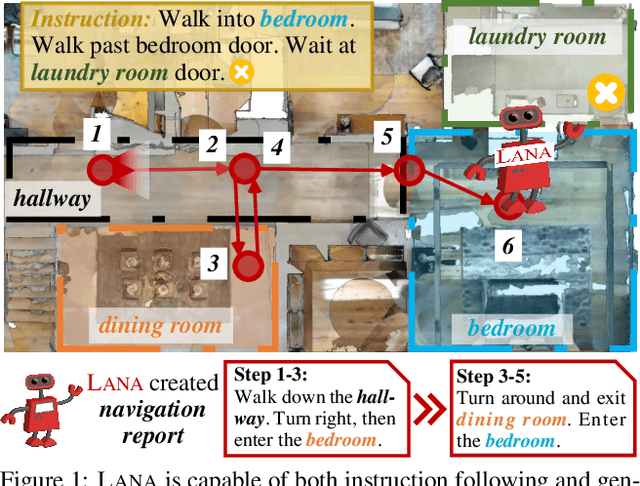
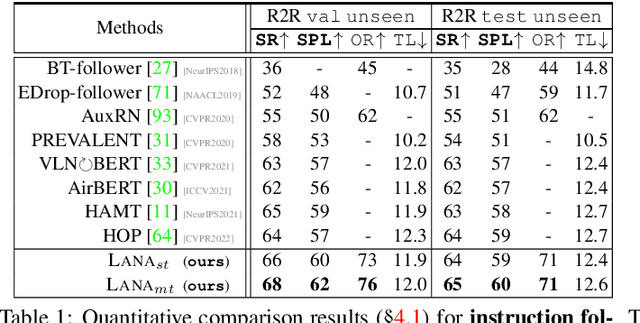

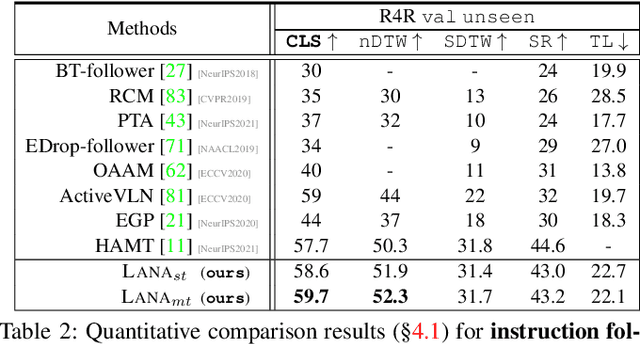
Recently, visual-language navigation (VLN) -- entailing robot agents to follow navigation instructions -- has shown great advance. However, existing literature put most emphasis on interpreting instructions into actions, only delivering "dumb" wayfinding agents. In this article, we devise LANA, a language-capable navigation agent which is able to not only execute human-written navigation commands, but also provide route descriptions to humans. This is achieved by simultaneously learning instruction following and generation with only one single model. More specifically, two encoders, respectively for route and language encoding, are built and shared by two decoders, respectively, for action prediction and instruction generation, so as to exploit cross-task knowledge and capture task-specific characteristics. Throughout pretraining and fine-tuning, both instruction following and generation are set as optimization objectives. We empirically verify that, compared with recent advanced task-specific solutions, LANA attains better performances on both instruction following and route description, with nearly half complexity. In addition, endowed with language generation capability, LANA can explain to humans its behaviors and assist human's wayfinding. This work is expected to foster future efforts towards building more trustworthy and socially-intelligent navigation robots.
DeCap: Decoding CLIP Latents for Zero-Shot Captioning via Text-Only Training
Mar 06, 2023Large-scale pre-trained multi-modal models (e.g., CLIP) demonstrate strong zero-shot transfer capability in many discriminative tasks. Their adaptation to zero-shot image-conditioned text generation tasks has drawn increasing interest. Prior arts approach to zero-shot captioning by either utilizing the existing large language models (e.g., GPT-2) or pre-training the encoder-decoder network in an end-to-end manner. In this work, we propose a simple framework, named DeCap, for zero-shot captioning. We introduce a lightweight visual-aware language decoder. This decoder is both data-efficient and computation-efficient: 1) it only requires the text data for training, easing the burden on the collection of paired data. 2) it does not require end-to-end training. When trained with text-only data, the decoder takes the text embedding extracted from the off-the-shelf CLIP encoder as a prefix embedding. The challenge is that the decoder is trained on the text corpus but at the inference stage, it needs to generate captions based on visual inputs. The modality gap issue is widely observed in multi-modal contrastive models that prevents us from directly taking the visual embedding as the prefix embedding. We propose a training-free mechanism to reduce the modality gap. We project the visual embedding into the CLIP text embedding space, while the projected embedding retains the information of the visual input. Taking the projected embedding as the prefix embedding, the decoder generates high-quality descriptions that match the visual input. The experiments show that DeCap outperforms other zero-shot captioning methods and unpaired captioning methods on the typical image captioning benchmarks, i.e., MSCOCO and NoCaps.
Soft Prompt Guided Joint Learning for Cross-Domain Sentiment Analysis
Mar 01, 2023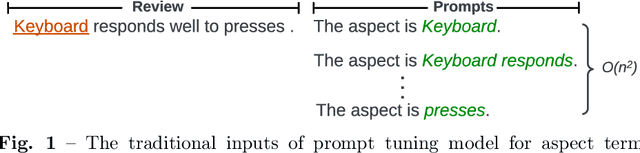
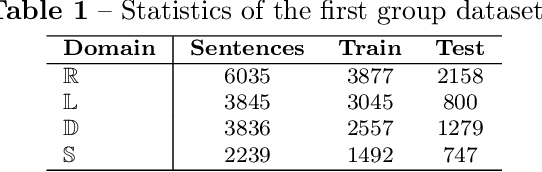
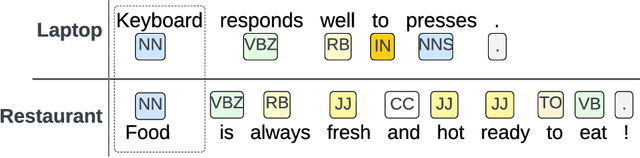
Aspect term extraction is a fundamental task in fine-grained sentiment analysis, which aims at detecting customer's opinion targets from reviews on product or service. The traditional supervised models can achieve promising results with annotated datasets, however, the performance dramatically decreases when they are applied to the task of cross-domain aspect term extraction. Existing cross-domain transfer learning methods either directly inject linguistic features into Language models, making it difficult to transfer linguistic knowledge to target domain, or rely on the fixed predefined prompts, which is time-consuming to construct the prompts over all potential aspect term spans. To resolve the limitations, we propose a soft prompt-based joint learning method for cross domain aspect term extraction in this paper. Specifically, by incorporating external linguistic features, the proposed method learn domain-invariant representations between source and target domains via multiple objectives, which bridges the gap between domains with varied distributions of aspect terms. Further, the proposed method interpolates a set of transferable soft prompts consisted of multiple learnable vectors that are beneficial to detect aspect terms in target domain. Extensive experiments are conducted on the benchmark datasets and the experimental results demonstrate the effectiveness of the proposed method for cross-domain aspect terms extraction.