 Add to Chrome
 Add to Firefox
 Add to Edge
Latent Graph Inference with Limited Supervision
Oct 06, 2023
Latent graph inference (LGI) aims to jointly learn the underlying graph structure and node representations from data features. However, existing LGI methods commonly suffer from the issue of supervision starvation, where massive edge weights are learned without semantic supervision and do not contribute to the training loss. Consequently, these supervision-starved weights, which may determine the predictions of testing samples, cannot be semantically optimal, resulting in poor generalization. In this paper, we observe that this issue is actually caused by the graph sparsification operation, which severely destroys the important connections established between pivotal nodes and labeled ones. To address this, we propose to restore the corrupted affinities and replenish the missed supervision for better LGI. The key challenge then lies in identifying the critical nodes and recovering the corrupted affinities. We begin by defining the pivotal nodes as $k$-hop starved nodes, which can be identified based on a given adjacency matrix. Considering the high computational burden, we further present a more efficient alternative inspired by CUR matrix decomposition. Subsequently, we eliminate the starved nodes by reconstructing the destroyed connections. Extensive experiments on representative benchmarks demonstrate that reducing the starved nodes consistently improves the performance of state-of-the-art LGI methods, especially under extremely limited supervision (6.12% improvement on Pubmed with a labeling rate of only 0.3%).

NeuRBF: A Neural Fields Representation with Adaptive Radial Basis Functions
Sep 27, 2023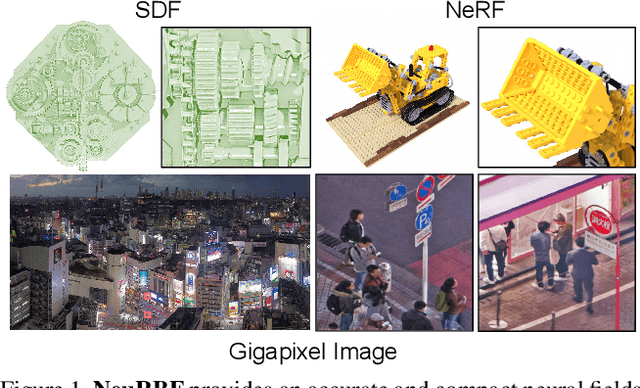
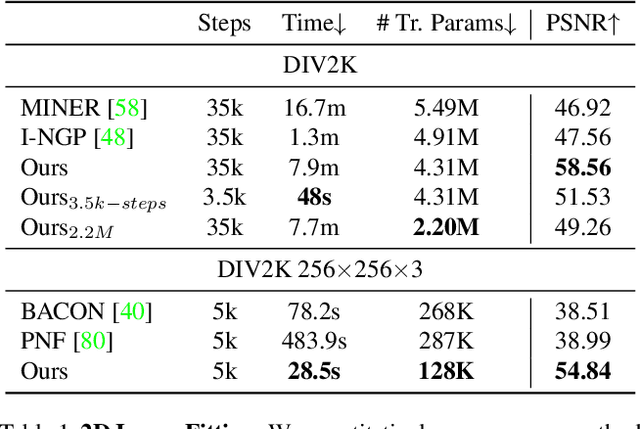
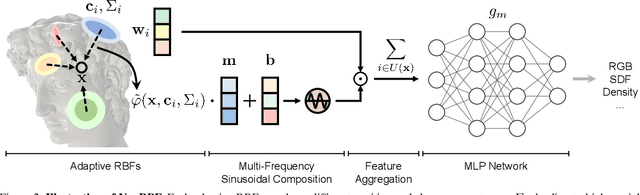
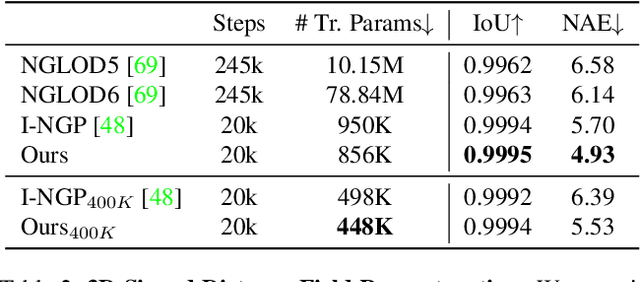
We present a novel type of neural fields that uses general radial bases for signal representation. State-of-the-art neural fields typically rely on grid-based representations for storing local neural features and N-dimensional linear kernels for interpolating features at continuous query points. The spatial positions of their neural features are fixed on grid nodes and cannot well adapt to target signals. Our method instead builds upon general radial bases with flexible kernel position and shape, which have higher spatial adaptivity and can more closely fit target signals. To further improve the channel-wise capacity of radial basis functions, we propose to compose them with multi-frequency sinusoid functions. This technique extends a radial basis to multiple Fourier radial bases of different frequency bands without requiring extra parameters, facilitating the representation of details. Moreover, by marrying adaptive radial bases with grid-based ones, our hybrid combination inherits both adaptivity and interpolation smoothness. We carefully designed weighting schemes to let radial bases adapt to different types of signals effectively. Our experiments on 2D image and 3D signed distance field representation demonstrate the higher accuracy and compactness of our method than prior arts. When applied to neural radiance field reconstruction, our method achieves state-of-the-art rendering quality, with small model size and comparable training speed.
Multi-turn Dialogue Comprehension from a Topic-aware Perspective
Sep 18, 2023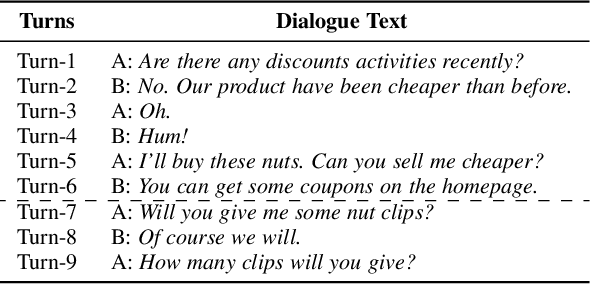
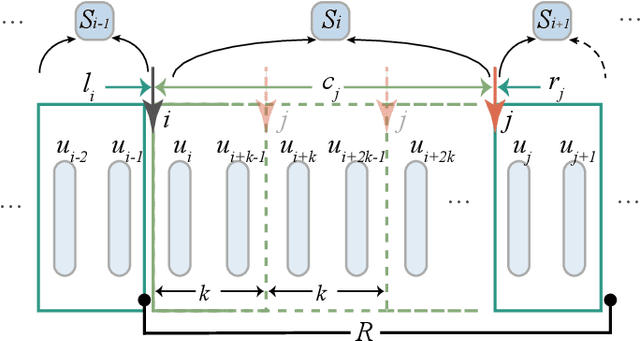
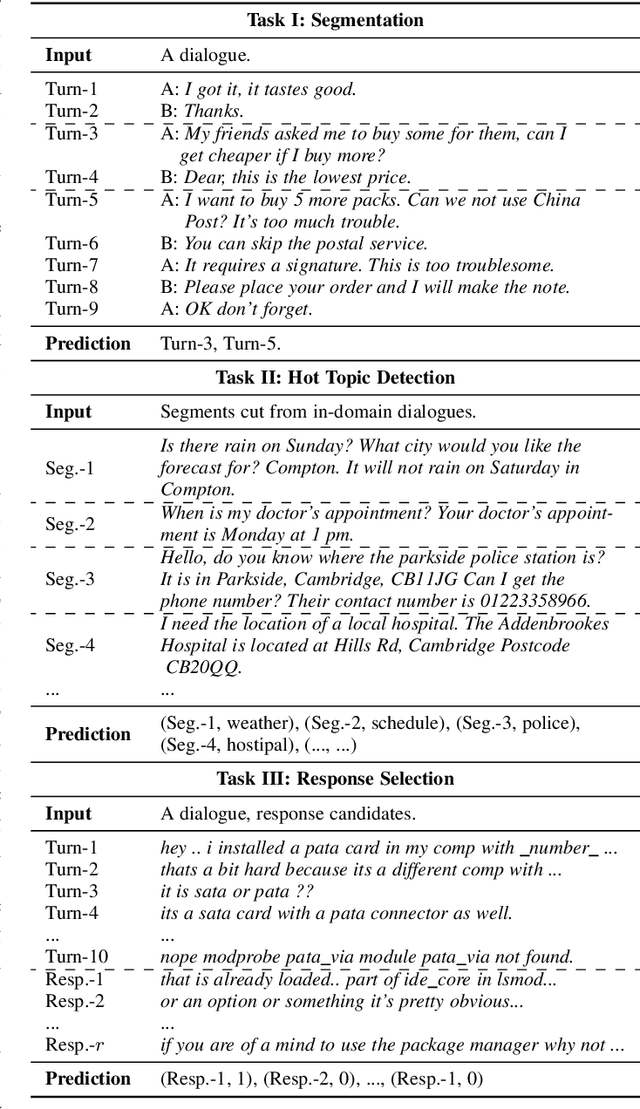
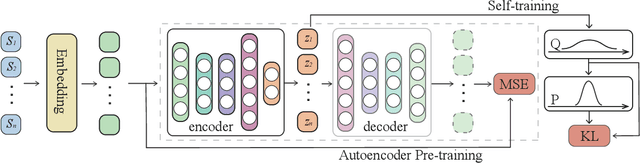
Dialogue related Machine Reading Comprehension requires language models to effectively decouple and model multi-turn dialogue passages. As a dialogue development goes after the intentions of participants, its topic may not keep constant through the whole passage. Hence, it is non-trivial to detect and leverage the topic shift in dialogue modeling. Topic modeling, although has been widely studied in plain text, deserves far more utilization in dialogue reading comprehension. This paper proposes to model multi-turn dialogues from a topic-aware perspective. We start with a dialogue segmentation algorithm to split a dialogue passage into topic-concentrated fragments in an unsupervised way. Then we use these fragments as topic-aware language processing units in further dialogue comprehension. On one hand, the split segments indict specific topics rather than mixed intentions, thus showing convenient on in-domain topic detection and location. For this task, we design a clustering system with a self-training auto-encoder, and we build two constructed datasets for evaluation. On the other hand, the split segments are an appropriate element of multi-turn dialogue response selection. For this purpose, we further present a novel model, Topic-Aware Dual-Attention Matching (TADAM) Network, which takes topic segments as processing elements and matches response candidates with a dual cross-attention. Empirical studies on three public benchmarks show great improvements over baselines. Our work continues the previous studies on document topic, and brings the dialogue modeling to a novel topic-aware perspective with exhaustive experiments and analyses.
OpenIllumination: A Multi-Illumination Dataset for Inverse Rendering Evaluation on Real Objects
Sep 14, 2023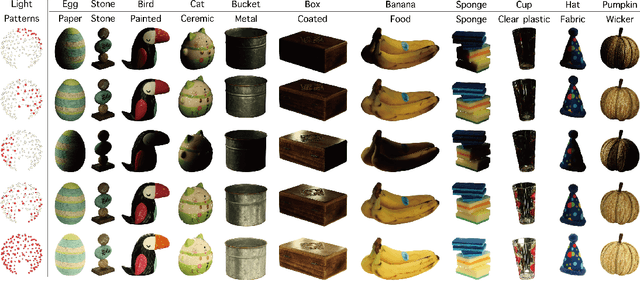
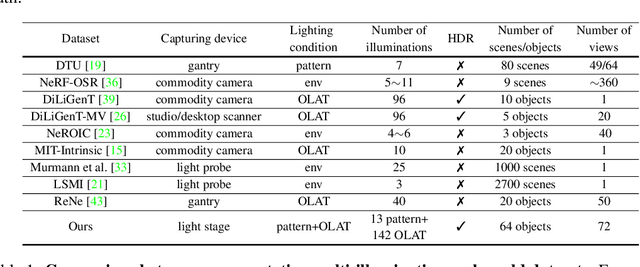
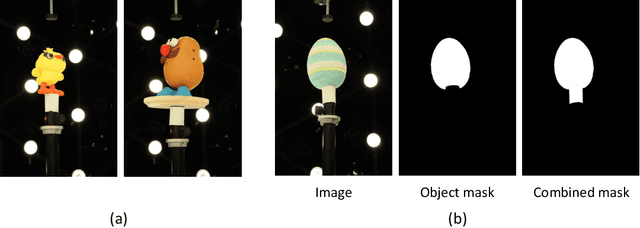
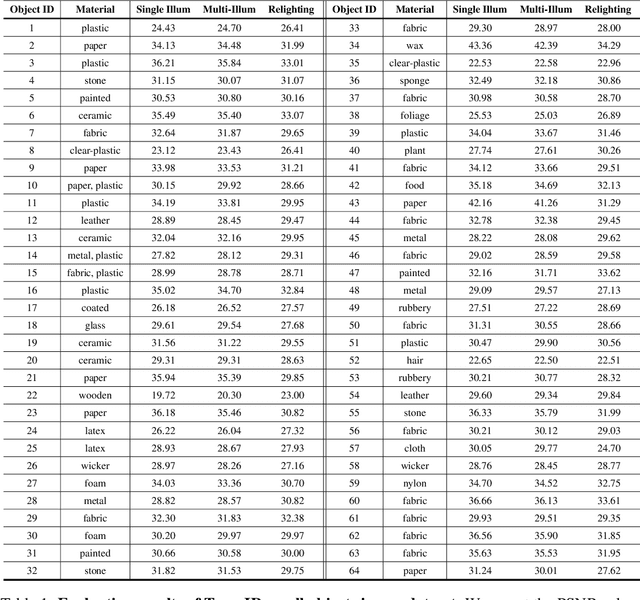
We introduce OpenIllumination, a real-world dataset containing over 108K images of 64 objects with diverse materials, captured under 72 camera views and a large number of different illuminations. For each image in the dataset, we provide accurate camera parameters, illumination ground truth, and foreground segmentation masks. Our dataset enables the quantitative evaluation of most inverse rendering and material decomposition methods for real objects. We examine several state-of-the-art inverse rendering methods on our dataset and compare their performances. The dataset and code can be found on the project page: https://oppo-us-research.github.io/OpenIllumination.
Context-Aware Prompt Tuning for Vision-Language Model with Dual-Alignment
Sep 08, 2023
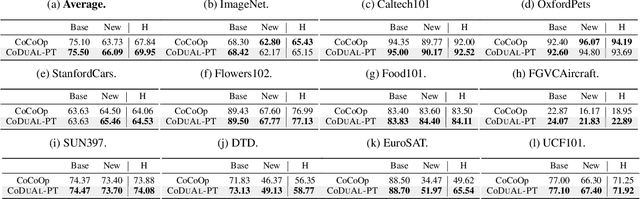

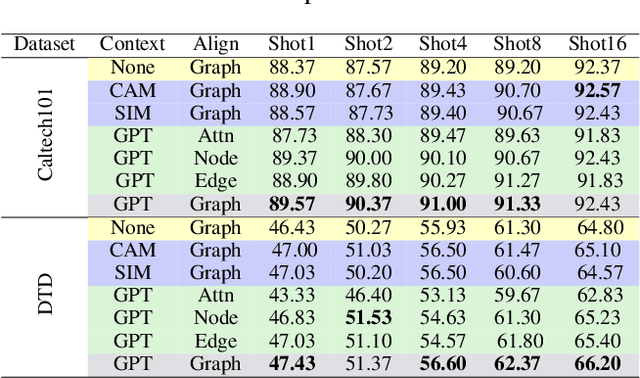
Large-scale vision-language models (VLMs), e.g., CLIP, learn broad visual concepts from tedious training data, showing superb generalization ability. Amount of prompt learning methods have been proposed to efficiently adapt the VLMs to downstream tasks with only a few training samples. We introduce a novel method to improve the prompt learning of vision-language models by incorporating pre-trained large language models (LLMs), called Dual-Aligned Prompt Tuning (DuAl-PT). Learnable prompts, like CoOp, implicitly model the context through end-to-end training, which are difficult to control and interpret. While explicit context descriptions generated by LLMs, like GPT-3, can be directly used for zero-shot classification, such prompts are overly relying on LLMs and still underexplored in few-shot domains. With DuAl-PT, we propose to learn more context-aware prompts, benefiting from both explicit and implicit context modeling. To achieve this, we introduce a pre-trained LLM to generate context descriptions, and we encourage the prompts to learn from the LLM's knowledge by alignment, as well as the alignment between prompts and local image features. Empirically, DuAl-PT achieves superior performance on 11 downstream datasets on few-shot recognition and base-to-new generalization. Hopefully, DuAl-PT can serve as a strong baseline. Code will be available.
WeaverBird: Empowering Financial Decision-Making with Large Language Model, Knowledge Base, and Search Engine
Aug 30, 2023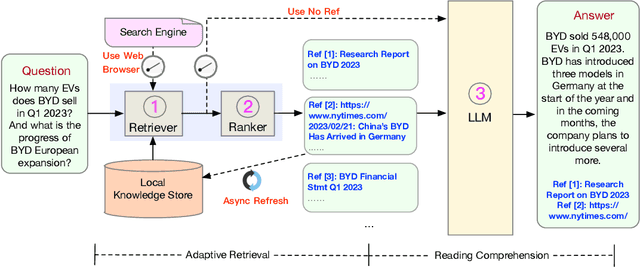


We present WeaverBird, an intelligent dialogue system designed specifically for the finance domain. Our system harnesses a large language model of GPT architecture that has been tuned using extensive corpora of finance-related text. As a result, our system possesses the capability to understand complex financial queries, such as "How should I manage my investments during inflation?", and provide informed responses. Furthermore, our system incorporates a local knowledge base and a search engine to retrieve relevant information. The final responses are conditioned on the search results and include proper citations to the sources, thus enjoying an enhanced credibility. Through a range of finance-related questions, we have demonstrated the superior performance of our system compared to other models. To experience our system firsthand, users can interact with our live demo at https://weaverbird.ttic.edu, as well as watch our 2-min video illustration at https://www.youtube.com/watch?v=fyV2qQkX6Tc.
Exploring the Limits of Historical Information for Temporal Knowledge Graph Extrapolation
Aug 29, 2023Temporal knowledge graphs, representing the dynamic relationships and interactions between entities over time, have been identified as a promising approach for event forecasting. However, a limitation of most temporal knowledge graph reasoning methods is their heavy reliance on the recurrence or periodicity of events, which brings challenges to inferring future events related to entities that lack historical interaction. In fact, the current state of affairs is often the result of a combination of historical information and underlying factors that are not directly observable. To this end, we investigate the limits of historical information for temporal knowledge graph extrapolation and propose a new event forecasting model called Contrastive Event Network (CENET) based on a novel training framework of historical contrastive learning. CENET learns both the historical and non-historical dependency to distinguish the most potential entities that best match the given query. Simultaneously, by launching contrastive learning, it trains representations of queries to probe whether the current moment is more dependent on historical or non-historical events. These representations further help train a binary classifier, whose output is a boolean mask, indicating the related entities in the search space. During the inference process, CENET employs a mask-based strategy to generate the final results. We evaluate our proposed model on five benchmark graphs. The results demonstrate that CENET significantly outperforms all existing methods in most metrics, achieving at least 8.3% relative improvement of Hits@1 over previous state-of-the-art baselines on event-based datasets.
Breast Lesion Diagnosis Using Static Images and Dynamic Video
Aug 19, 2023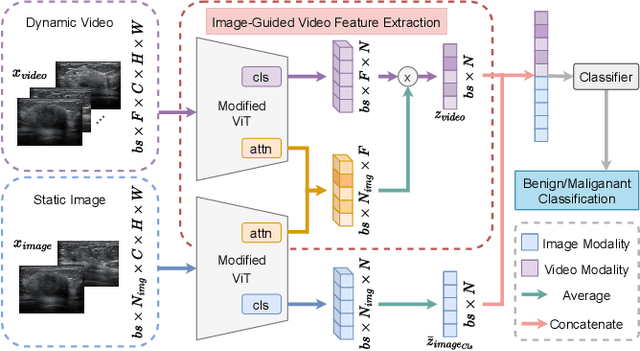
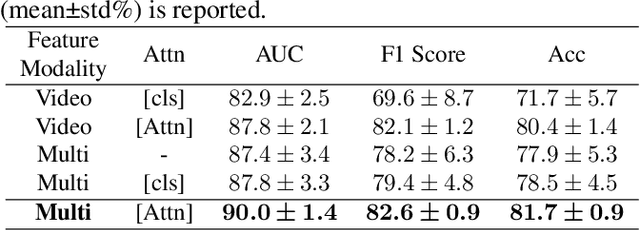
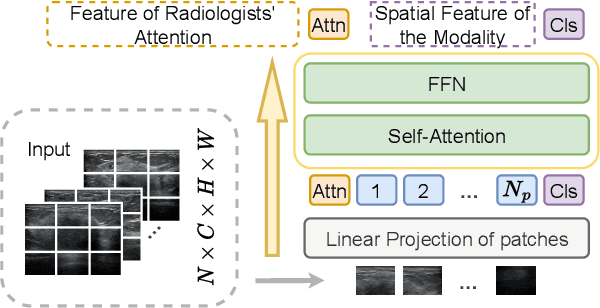
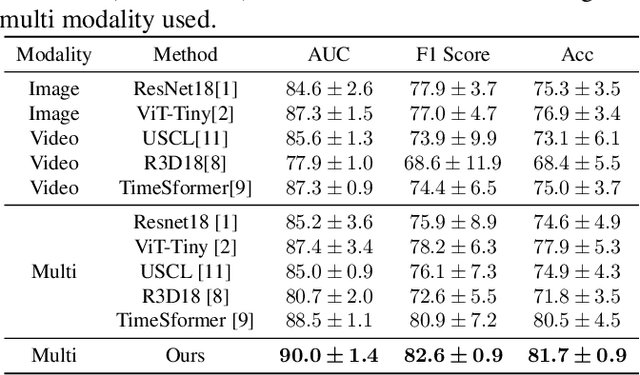
Deep learning based Computer Aided Diagnosis (CAD) systems have been developed to treat breast ultrasound. Most of them focus on a single ultrasound imaging modality, either using representative static images or the dynamic video of a real-time scan. In fact, these two image modalities are complementary for lesion diagnosis. Dynamic videos provide detailed three-dimensional information about the lesion, while static images capture the typical sections of the lesion. In this work, we propose a multi-modality breast tumor diagnosis model to imitate the diagnosing process of radiologists, which learns the features of both static images and dynamic video and explores the potential relationship between the two modalities. Considering that static images are carefully selected by professional radiologists, we propose to aggregate dynamic video features under the guidance of domain knowledge from static images before fusing multi-modality features. Our work is validated on a breast ultrasound dataset composed of 897 sets of ultrasound images and videos. Experimental results show that our model boosts the performance of Benign/Malignant classification, achieving 90.0% in AUC and 81.7% in accuracy.
Relational Contrastive Learning for Scene Text Recognition
Aug 01, 2023Context-aware methods achieved great success in supervised scene text recognition via incorporating semantic priors from words. We argue that such prior contextual information can be interpreted as the relations of textual primitives due to the heterogeneous text and background, which can provide effective self-supervised labels for representation learning. However, textual relations are restricted to the finite size of dataset due to lexical dependencies, which causes the problem of over-fitting and compromises representation robustness. To this end, we propose to enrich the textual relations via rearrangement, hierarchy and interaction, and design a unified framework called RCLSTR: Relational Contrastive Learning for Scene Text Recognition. Based on causality, we theoretically explain that three modules suppress the bias caused by the contextual prior and thus guarantee representation robustness. Experiments on representation quality show that our method outperforms state-of-the-art self-supervised STR methods. Code is available at https://github.com/ThunderVVV/RCLSTR.
HiREN: Towards Higher Supervision Quality for Better Scene Text Image Super-Resolution
Jul 31, 2023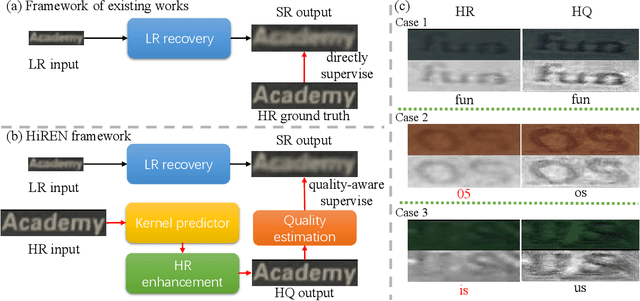
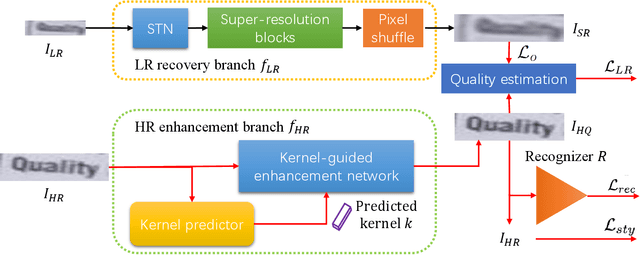
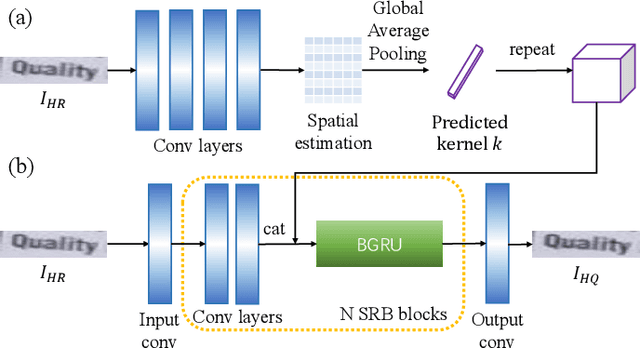
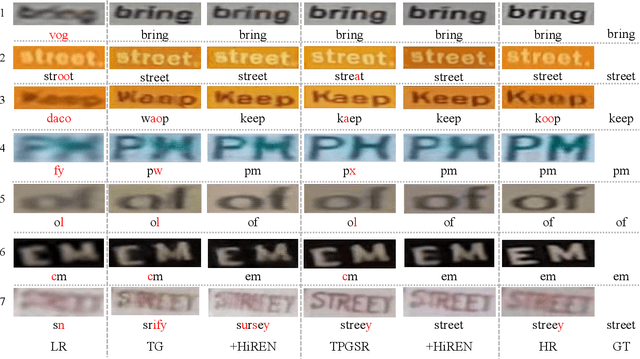
Scene text image super-resolution (STISR) is an important pre-processing technique for text recognition from low-resolution scene images. Nowadays, various methods have been proposed to extract text-specific information from high-resolution (HR) images to supervise STISR model training. However, due to uncontrollable factors (e.g. shooting equipment, focus, and environment) in manually photographing HR images, the quality of HR images cannot be guaranteed, which unavoidably impacts STISR performance. Observing the quality issue of HR images, in this paper we propose a novel idea to boost STISR by first enhancing the quality of HR images and then using the enhanced HR images as supervision to do STISR. Concretely, we develop a new STISR framework, called High-Resolution ENhancement (HiREN) that consists of two branches and a quality estimation module. The first branch is developed to recover the low-resolution (LR) images, and the other is an HR quality enhancement branch aiming at generating high-quality (HQ) text images based on the HR images to provide more accurate supervision to the LR images. As the degradation from HQ to HR may be diverse, and there is no pixel-level supervision for HQ image generation, we design a kernel-guided enhancement network to handle various degradation, and exploit the feedback from a recognizer and text-level annotations as weak supervision signal to train the HR enhancement branch. Then, a quality estimation module is employed to evaluate the qualities of HQ images, which are used to suppress the erroneous supervision information by weighting the loss of each image. Extensive experiments on TextZoom show that HiREN can work well with most existing STISR methods and significantly boost their performances.