 Add to Chrome
 Add to Firefox
 Add to Edge
GraphBU: MILP Instance Generation with Graph-Native Block Units
Jul 07, 2026
Mixed-integer linear programming (MILP) instances used for solver development are hard to obtain when models come from private or application-specific pipelines. A generator must keep the structure that solvers and learned policies rely on. Existing general generators usually choose their generation unit from a formulation template, summary statistics, local graph edits, or blocks found after recombination. These units do not explicitly record how a local part of the MILP is coupled to the rest of the instance. We propose GraphBU, a graph-native generator whose basic unit is a local subproblem plus its interface. The method promotes coupling nodes into master constraints or boundary variables and uses the resulting block units for compatibility-checked replacement. The analysis focuses on the properties needed by this construction: promotion separates interfaces, replacement can preserve feasibility under an interface-slack condition, and the graph construction is invariant to row-column permutations. On MILP instances generation, this unit keeps graph statistics close to the source family, preserves feasibility on most datasets, and improves downstream Predict-and-Search training. Genrated by GraphBU, The average graph-statistical similarity was approximately 0.934, the average feasibility was approximately 96.7%, and the average increase in the main index of downstream PS was approximately 8.0%.

DynaKRAG: A Unified Framework for Learnable Evidence Control in Multi-Hop Retrieval-Augmented Generation
Jul 07, 2026Multi-hop retrieval-augmented generation (RAG) acquires evidence sequentially, with each new document potentially revealing missing facts, bridge entities, query defects, or sufficient support for answering. Existing methods provide useful operations such as iterative retrieval, query reformulation, evidence critique, and sufficiency judging, but typically organize them within method-specific pipelines or predefined control topologies. This leaves underexplored how to learn a shared state-conditioned policy that chooses among currently valid evidence operations. We introduce DynaKRAG, which formulates multi-hop evidence acquisition as state-conditioned control over atomic evidence operations. At each step, a validity layer constructs the executable action set, and a learned controller selects the next operation. The resulting transition updates the evidence state and may enable new operations at subsequent steps. With Qwen2.5-7B-Instruct, DynaKRAG achieves F1 scores of 0.5998 on HotpotQA, 0.5340 on 2Wiki, and 0.3061 on MuSiQue, outperforming the strongest controlled baseline on all three benchmarks. Replacing the learned controller with a uniform-valid policy reduces F1 by 3.96--5.78 points, while removing sufficiency feedback hurts all three datasets. Controlled retrieval-cap experiments further show that additional retrieval is not uniformly beneficial. Together, these results demonstrate the benefit of coordinating retrieval, diagnosis, and gap-directed acquisition under an evolving evidence state.
OR-Space: A Full-Lifecycle Workspace Benchmark for Industrial Optimization Agents
May 27, 2026Large language model (LLM) agents are increasingly used to assist with operations research (OR) modeling, yet existing OR-oriented benchmarks often reduce evaluation to one-shot translation from a self-contained problem statement into a mathematical formulation or solver program. Such settings abstract away two characteristics of real industrial OR workflows: persistent multi-artifact workspaces and multi-stage task lifecycles. We introduce OR-Space, a full-lifecycle workspace benchmark for evaluating industrial optimization agents across model construction, model revision, and grounded explanation. Each instance is an executable workspace containing business documents, structured data, optional code artifacts, solver outputs, and task-specific evaluators distributed across interdependent files. OR-Space defines three task modes: Build, where agents construct solver-ready optimization models from heterogeneous artifacts; Revise, where agents modify existing models under changing requirements or solver feedback while preserving valid prior logic; and Explain, where agents answer grounded questions about solutions, constraints, and business implications using evidence spread across workspace artifacts. By combining persistent workspaces with lifecycle-oriented tasks, OR-Space evaluates whether agents can perform reliable optimization work beyond end-to-end text generation. We describe the benchmark design, evaluation protocol, and quality-control pipeline, and position OR-Space as a benchmark for studying the reliability, failure modes, and practical readiness of LLM agents in industrial OR workflows.
OSDN: Improving Delta Rule with Provable Online Preconditioning in Linear Attention
May 13, 2026Linear attention and state-space models offer constant-memory alternatives to softmax attention, but often struggle with in-context associative recall. The Delta Rule mitigates this by writing each token via one step of online gradient descent. However, its step size relies on a single scalar gate that ignores the feature-wise curvature of the inner objective. We propose Online Scaled DeltaNet (OSDN), which augments the scalar gate with a diagonal preconditioner updated online via hypergradient feedback. Crucially, this right-preconditioning is algebraically equivalent to a per-feature scaling of the write-side key. This equivalence allows OSDN to strictly preserve the hardware-friendly chunkwise parallel pipeline of DeltaNet without incurring high-dimensional state overhead. Theoretically, by exploiting the exact-quadratic structure of the inner regression loss, we establish super-geometric convergence against a right-Newton comparator and prove an algorithm-aligned token-local residual contraction bound. To handle non-stationary contexts, we further introduce Adaptive Preconditioner Forgetting (APF) to dynamically refresh stale calibration. Empirically, OSDN demonstrates strong performance across scales. At the 340M-parameter scale, OSDN improves JRT-style in-context recall by 32% over DeltaNet. Scaling to 1.3B parameters, it achieves a 39% reduction in the recall residual ratio while maintaining parity on general downstream tasks (e.g., perplexity and LongBench) -- demonstrating that our online-preconditioning mechanism effectively transfers and amplifies at the billion-parameter scale.
From Soliloquy to Agora: Memory-Enhanced LLM Agents with Decentralized Debate for Optimization Modeling
Apr 28, 2026Optimization modeling underpins real-world decision-making in logistics, manufacturing, energy, and public services, but reliably solving such problems from natural-language requirements remains challenging for current large language models (LLMs). In this paper, we propose \emph{Agora-Opt}, a modular agentic framework for optimization modeling that combines decentralized debate with a read-write memory bank. Agora-Opt allows multiple agent teams to independently produce end-to-end solutions and reconcile them through an outcome-grounded debate protocol, while memory stores solver-verified artifacts and past disagreement resolutions to support training-free improvement over time. This design is flexible across both backbones and methods: it reduces base-model lock-in, transfers across different LLM families, and can be layered onto existing pipelines with minimal coupling. Across public benchmarks, Agora-Opt achieves the strongest overall performance among all compared methods, outperforming strong zero-shot LLMs, training-centric approaches, and prior agentic baselines. Further analyses show robust gains across backbone choices and component variants, and demonstrate that decentralized debate offers a structural advantage over centralized selection by enabling agents to refine candidate solutions through interaction and even recover correct formulations when all initial candidates are flawed. These results suggest that reliable optimization modeling benefits from combining collaborative cross-checking with reusable experience, and position Agora-Opt as a practical and extensible foundation for trustworthy optimization modeling assistance. Our code and data are available at https://github.com/CHIANGEL/Agora-Opt.
StepORLM: A Self-Evolving Framework With Generative Process Supervision For Operations Research Language Models
Sep 26, 2025Large Language Models (LLMs) have shown promising capabilities for solving Operations Research (OR) problems. While reinforcement learning serves as a powerful paradigm for LLM training on OR problems, existing works generally face two key limitations. First, outcome reward suffers from the credit assignment problem, where correct final answers can reinforce flawed reasoning. Second, conventional discriminative process supervision is myopic, failing to evaluate the interdependent steps of OR modeling holistically. To this end, we introduce StepORLM, a novel self-evolving framework with generative process supervision. At its core, StepORLM features a co-evolutionary loop where a policy model and a generative process reward model (GenPRM) iteratively improve on each other. This loop is driven by a dual-feedback mechanism: definitive, outcome-based verification from an external solver, and nuanced, holistic process evaluation from the GenPRM. The combined signal is used to align the policy via Weighted Direct Preference Optimization (W-DPO) and simultaneously refine the GenPRM. Our resulting 8B-parameter StepORLM establishes a new state-of-the-art across six benchmarks, significantly outperforming vastly larger generalist models, agentic methods, and specialized baselines. Moreover, the co-evolved GenPRM is able to act as a powerful and universally applicable process verifier, substantially boosting the inference scaling performance of both our own model and other existing LLMs.
Auto-Formulating Dynamic Programming Problems with Large Language Models
Jul 15, 2025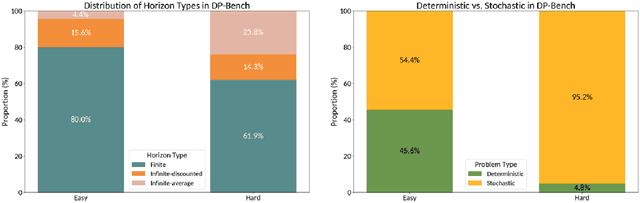
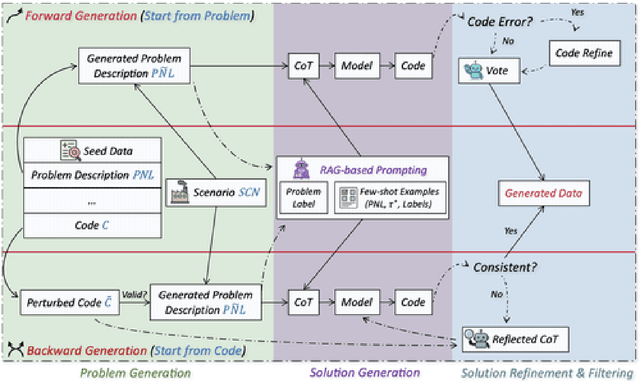
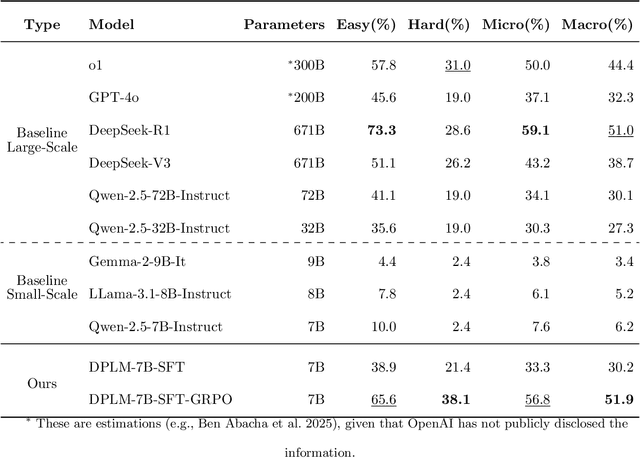
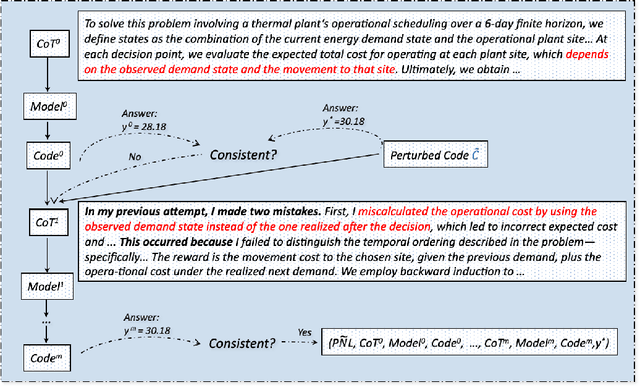
Dynamic programming (DP) is a fundamental method in operations research, but formulating DP models has traditionally required expert knowledge of both the problem context and DP techniques. Large Language Models (LLMs) offer the potential to automate this process. However, DP problems pose unique challenges due to their inherently stochastic transitions and the limited availability of training data. These factors make it difficult to directly apply existing LLM-based models or frameworks developed for other optimization problems, such as linear or integer programming. We introduce DP-Bench, the first benchmark covering a wide range of textbook-level DP problems to enable systematic evaluation. We present Dynamic Programming Language Model (DPLM), a 7B-parameter specialized model that achieves performance comparable to state-of-the-art LLMs like OpenAI's o1 and DeepSeek-R1, and surpasses them on hard problems. Central to DPLM's effectiveness is DualReflect, our novel synthetic data generation pipeline, designed to scale up training data from a limited set of initial examples. DualReflect combines forward generation for diversity and backward generation for reliability. Our results reveal a key insight: backward generation is favored in low-data regimes for its strong correctness guarantees, while forward generation, though lacking such guarantees, becomes increasingly valuable at scale for introducing diverse formulations. This trade-off highlights the complementary strengths of both approaches and the importance of combining them.
Solver-Informed RL: Grounding Large Language Models for Authentic Optimization Modeling
May 17, 2025Optimization modeling is fundamental to decision-making across diverse domains.Despite progress in automating optimization formulation from natural language descriptions, Large Language Models (LLMs) often struggle to generate formally correct and usable models due to hallucinations, posing a challenge for reliable automation. Inspired by the success of Reinforcement Learning (RL) in enhancing Large Reasoning Models, we present Solver-Informed Reinforcement Learning (SIRL).This novel framework leverages external optimization solvers as verifiable reward mechanisms to significantly improve the authenticity of LLMs for optimization modeling.Acting as precise verifiers, these solvers automatically assess the executable code and the instance-level mathematical model represented by the associated LP file, yielding precise and comprehensive feedback signals -- including syntax, feasibility, and solution quality that directly inform the RL process. This automated verification process, powered by classic optimization solvers, also underpins our instance-enhanced self-consistency method to synthesize high-quality training data. Extensive experiments on diverse public benchmarks demonstrate that SIRL achieves state-of-the-art performance, substantially outperforming existing methods in generating accurate and executable optimization models.
Beyond $\mathcal{O}(\sqrt{T})$ Regret: Decoupling Learning and Decision-making in Online Linear Programming
Jan 06, 2025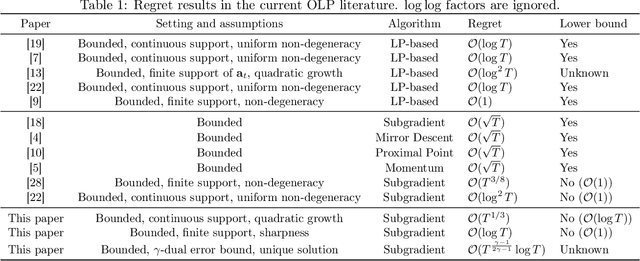



Online linear programming plays an important role in both revenue management and resource allocation, and recent research has focused on developing efficient first-order online learning algorithms. Despite the empirical success of first-order methods, they typically achieve a regret no better than $\mathcal{O} ( \sqrt{T} )$, which is suboptimal compared to the $\mathcal{O} (\log T)$ bound guaranteed by the state-of-the-art linear programming (LP)-based online algorithms. This paper establishes a general framework that improves upon the $\mathcal{O} ( \sqrt{T} )$ result when the LP dual problem exhibits certain error bound conditions. For the first time, we show that first-order learning algorithms achieve $o( \sqrt{T} )$ regret in the continuous support setting and $\mathcal{O} (\log T)$ regret in the finite support setting beyond the non-degeneracy assumption. Our results significantly improve the state-of-the-art regret results and provide new insights for sequential decision-making.
A Robust Anchor-based Method for Multi-Camera Pedestrian Localization
Oct 25, 2024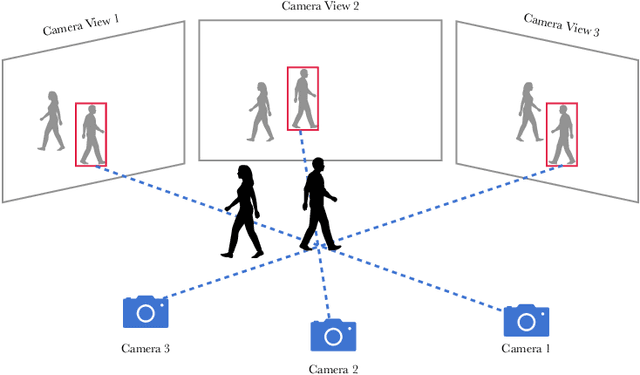



This paper addresses the problem of vision-based pedestrian localization, which estimates a pedestrian's location using images and camera parameters. In practice, however, calibrated camera parameters often deviate from the ground truth, leading to inaccuracies in localization. To address this issue, we propose an anchor-based method that leverages fixed-position anchors to reduce the impact of camera parameter errors. We provide a theoretical analysis that demonstrates the robustness of our approach. Experiments conducted on simulated, real-world, and public datasets show that our method significantly improves localization accuracy and remains resilient to noise in camera parameters, compared to methods without anchors.