 Add to Chrome
 Add to Firefox
 Add to Edge
Kimi K2.5: Visual Agentic Intelligence
Feb 02, 2026
We introduce Kimi K2.5, an open-source multimodal agentic model designed to advance general agentic intelligence. K2.5 emphasizes the joint optimization of text and vision so that two modalities enhance each other. This includes a series of techniques such as joint text-vision pre-training, zero-vision SFT, and joint text-vision reinforcement learning. Building on this multimodal foundation, K2.5 introduces Agent Swarm, a self-directed parallel agent orchestration framework that dynamically decomposes complex tasks into heterogeneous sub-problems and executes them concurrently. Extensive evaluations show that Kimi K2.5 achieves state-of-the-art results across various domains including coding, vision, reasoning, and agentic tasks. Agent Swarm also reduces latency by up to $4.5\times$ over single-agent baselines. We release the post-trained Kimi K2.5 model checkpoint to facilitate future research and real-world applications of agentic intelligence.

TriPlay-RL: Tri-Role Self-Play Reinforcement Learning for LLM Safety Alignment
Jan 26, 2026In recent years, safety risks associated with large language models have become increasingly prominent, highlighting the urgent need to mitigate the generation of toxic and harmful content. The mainstream paradigm for LLM safety alignment typically adopts a collaborative framework involving three roles: an attacker for adversarial prompt generation, a defender for safety defense, and an evaluator for response assessment. In this paper, we propose a closed-loop reinforcement learning framework called TriPlay-RL that enables iterative and co-improving collaboration among three roles with near-zero manual annotation. Experimental results show that the attacker preserves high output diversity while achieving a 20%-50% improvement in adversarial effectiveness; the defender attains 10%-30% gains in safety performance without degrading general reasoning capability; and the evaluator continuously refines its fine-grained judgment ability through iterations, accurately distinguishing unsafe responses, simple refusals, and useful guidance. Overall, our framework establishes an efficient and scalable paradigm for LLM safety alignment, enabling continuous co-evolution within a unified learning loop.
Kimi Linear: An Expressive, Efficient Attention Architecture
Oct 30, 2025We introduce Kimi Linear, a hybrid linear attention architecture that, for the first time, outperforms full attention under fair comparisons across various scenarios -- including short-context, long-context, and reinforcement learning (RL) scaling regimes. At its core lies Kimi Delta Attention (KDA), an expressive linear attention module that extends Gated DeltaNet with a finer-grained gating mechanism, enabling more effective use of limited finite-state RNN memory. Our bespoke chunkwise algorithm achieves high hardware efficiency through a specialized variant of the Diagonal-Plus-Low-Rank (DPLR) transition matrices, which substantially reduces computation compared to the general DPLR formulation while remaining more consistent with the classical delta rule. We pretrain a Kimi Linear model with 3B activated parameters and 48B total parameters, based on a layerwise hybrid of KDA and Multi-Head Latent Attention (MLA). Our experiments show that with an identical training recipe, Kimi Linear outperforms full MLA with a sizeable margin across all evaluated tasks, while reducing KV cache usage by up to 75% and achieving up to 6 times decoding throughput for a 1M context. These results demonstrate that Kimi Linear can be a drop-in replacement for full attention architectures with superior performance and efficiency, including tasks with longer input and output lengths. To support further research, we open-source the KDA kernel and vLLM implementations, and release the pre-trained and instruction-tuned model checkpoints.
Kimi K2: Open Agentic Intelligence
Jul 28, 2025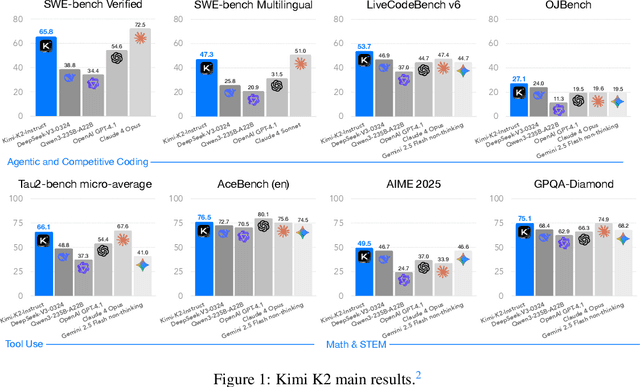
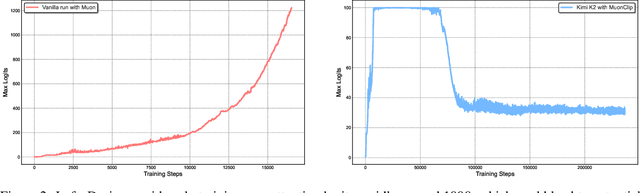
We introduce Kimi K2, a Mixture-of-Experts (MoE) large language model with 32 billion activated parameters and 1 trillion total parameters. We propose the MuonClip optimizer, which improves upon Muon with a novel QK-clip technique to address training instability while enjoying the advanced token efficiency of Muon. Based on MuonClip, K2 was pre-trained on 15.5 trillion tokens with zero loss spike. During post-training, K2 undergoes a multi-stage post-training process, highlighted by a large-scale agentic data synthesis pipeline and a joint reinforcement learning (RL) stage, where the model improves its capabilities through interactions with real and synthetic environments. Kimi K2 achieves state-of-the-art performance among open-source non-thinking models, with strengths in agentic capabilities. Notably, K2 obtains 66.1 on Tau2-Bench, 76.5 on ACEBench (En), 65.8 on SWE-Bench Verified, and 47.3 on SWE-Bench Multilingual -- surpassing most open and closed-sourced baselines in non-thinking settings. It also exhibits strong capabilities in coding, mathematics, and reasoning tasks, with a score of 53.7 on LiveCodeBench v6, 49.5 on AIME 2025, 75.1 on GPQA-Diamond, and 27.1 on OJBench, all without extended thinking. These results position Kimi K2 as one of the most capable open-source large language models to date, particularly in software engineering and agentic tasks. We release our base and post-trained model checkpoints to facilitate future research and applications of agentic intelligence.
Existing LLMs Are Not Self-Consistent For Simple Tasks
Jun 23, 2025Large Language Models (LLMs) have grown increasingly powerful, yet ensuring their decisions remain transparent and trustworthy requires self-consistency -- no contradictions in their internal reasoning. Our study reveals that even on simple tasks, such as comparing points on a line or a plane, or reasoning in a family tree, all smaller models are highly inconsistent, and even state-of-the-art models like DeepSeek-R1 and GPT-o4-mini are not fully self-consistent. To quantify and mitigate these inconsistencies, we introduce inconsistency metrics and propose two automated methods -- a graph-based and an energy-based approach. While these fixes provide partial improvements, they also highlight the complexity and importance of self-consistency in building more reliable and interpretable AI. The code and data are available at https://github.com/scorpio-nova/llm-self-consistency.