 Add to Chrome
 Add to Firefox
 Add to Edge
GDPevo: Evaluating Agent Self-Evolution on Real Business Tasks
Aug 04, 2026
Agent self-evolution updates an agent's persistent state from prior experience and reuses it to solve related tasks more effectively. Evaluating self-evolution is difficult: existing benchmarks provide limited coverage of economically valuable task domains, do not always design training and test tasks such that test-time gains can be attributed to training experience, and remain vulnerable to data contamination. We present GDPevo, an evolution-native benchmark grounded in GDP-related enterprise workflows, together with the fully automated data pipeline that generates it. Its core mechanism, rule hybridization, decomposes each enterprise workflow into atomic business rules, distributes subsets of these rules across training tasks, and recombines them in held-out test tasks so that test-time gains are attributable. GDPevo spans CRM, ERP, finance, healthcare, legal, and data-centric workflows. Its V1 release contains 120 tasks in 12 groups, with five training and five held-out test tasks per group. Full automation enables the pipeline to expand the suite to 240 tasks in 24 groups (V2) within two days, providing a practical response to contamination. Using GDPevo, we evaluate four agents, each comprising a harness and a model, under four supervision types. Self-evolution consistently improves held-out accuracy by up to 16.44 percentage points. But the best evolved agents remain far below the fully informed oracle ceiling of 91.6%, indicating that the self-evolution ability of current agents remains far from fully realized. We publicly release the pipeline, benchmark, and full evaluation results at https://github.com/Prism-Shadow/GDPevo.

Hy-MultiTurn: A Six-Dimensional Benchmark for Deep Multi-Turn Dialogue Understanding
Jul 31, 2026Long-running multi-turn interactions with chatbots and agents are now common, and a correct response often depends on remembering earlier details, tracking later revisions, identifying intended objects or referents, and withholding action when required conditions are unmet. Existing multi-turn benchmarks typically cover short exchanges and do not fully evaluate these capabilities in long multi-turn interactions, particularly in Chinese, while offering limited insight into how and why models fail. To address these limitations, we analyze real chatbot failures to identify six recurring mechanisms and use them to define six controlled evaluation modes in Hy-MultiTurn, a Chinese benchmark for deep multi-turn dialogue understanding. The six modes evaluate constraint memory, precise execution, constraint synthesis, object localization, action suppression, and reference resolution. Across the six modes, we construct 209 controlled tasks spanning 12-76 turns, with dialogue length, irrelevant-topic distraction, and colloquial phrasing adding further difficulty. Evaluation of 22 frontier model configurations shows that Hy-MultiTurn is broadly challenging, as even GPT-5.5, the strongest overall configuration, satisfies all requirements in only 41.1 percent of responses and no model performs best in all six modes.
Lil: Less is Less When Applying Post-Training Sparse-Attention Algorithms in Long-Decode Stage
Jan 06, 2026Large language models (LLMs) demonstrate strong capabilities across a wide range of complex tasks and are increasingly deployed at scale, placing significant demands on inference efficiency. Prior work typically decomposes inference into prefill and decode stages, with the decode stage dominating total latency. To reduce time and memory complexity in the decode stage, a line of work introduces sparse-attention algorithms. In this paper, we show, both empirically and theoretically, that sparse attention can paradoxically increase end-to-end complexity: information loss often induces significantly longer sequences, a phenomenon we term ``Less is Less'' (Lil). To mitigate the Lil problem, we propose an early-stopping algorithm that detects the threshold where information loss exceeds information gain during sparse decoding. Our early-stopping algorithm reduces token consumption by up to 90% with a marginal accuracy degradation of less than 2% across reasoning-intensive benchmarks.
WebCoderBench: Benchmarking Web Application Generation with Comprehensive and Interpretable Evaluation Metrics
Jan 05, 2026Web applications (web apps) have become a key arena for large language models (LLMs) to demonstrate their code generation capabilities and commercial potential. However, building a benchmark for LLM-generated web apps remains challenging due to the need for real-world user requirements, generalizable evaluation metrics without relying on ground-truth implementations or test cases, and interpretable evaluation results. To address these challenges, we introduce WebCoderBench, the first real-world-collected, generalizable, and interpretable benchmark for web app generation. WebCoderBench comprises 1,572 real user requirements, covering diverse modalities and expression styles that reflect realistic user intentions. WebCoderBench provides 24 fine-grained evaluation metrics across 9 perspectives, combining rule-based and LLM-as-a-judge paradigm for fully automated, objective, and general evaluation. Moreover, WebCoderBench adopts human-preference-aligned weights over metrics to yield interpretable overall scores. Experiments across 12 representative LLMs and 2 LLM-based agents show that there exists no dominant model across all evaluation metrics, offering an opportunity for LLM developers to optimize their models in a targeted manner for a more powerful version.
DGSense: A Domain Generalization Framework for Wireless Sensing
Feb 12, 2025Wireless sensing is of great benefits to our daily lives. However, wireless signals are sensitive to the surroundings. Various factors, e.g. environments, locations, and individuals, may induce extra impact on wireless propagation. Such a change can be regarded as a domain, in which the data distribution shifts. A vast majority of the sensing schemes are learning-based. They are dependent on the training domains, resulting in performance degradation in unseen domains. Researchers have proposed various solutions to address this issue. But these solutions leverage either semi-supervised or unsupervised domain adaptation techniques. They still require some data in the target domains and do not perform well in unseen domains. In this paper, we propose a domain generalization framework DGSense, to eliminate the domain dependence problem in wireless sensing. The framework is a general solution working across diverse sensing tasks and wireless technologies. Once the sensing model is built, it can generalize to unseen domains without any data from the target domain. To achieve the goal, we first increase the diversity of the training set by a virtual data generator, and then extract the domain independent features via episodic training between the main feature extractor and the domain feature extractors. The feature extractors employ a pre-trained Residual Network (ResNet) with an attention mechanism for spatial features, and a 1D Convolutional Neural Network (1DCNN) for temporal features. To demonstrate the effectiveness and generality of DGSense, we evaluated on WiFi gesture recognition, Millimeter Wave (mmWave) activity recognition, and acoustic fall detection. All the systems exhibited high generalization capability to unseen domains, including new users, locations, and environments, free of new data and retraining.
Comparing Quantum Encoding Techniques
Oct 11, 2024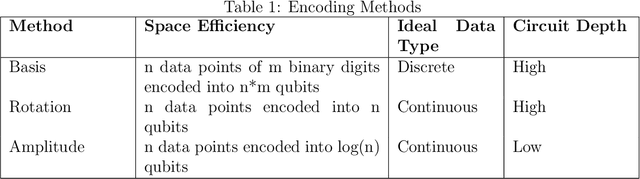
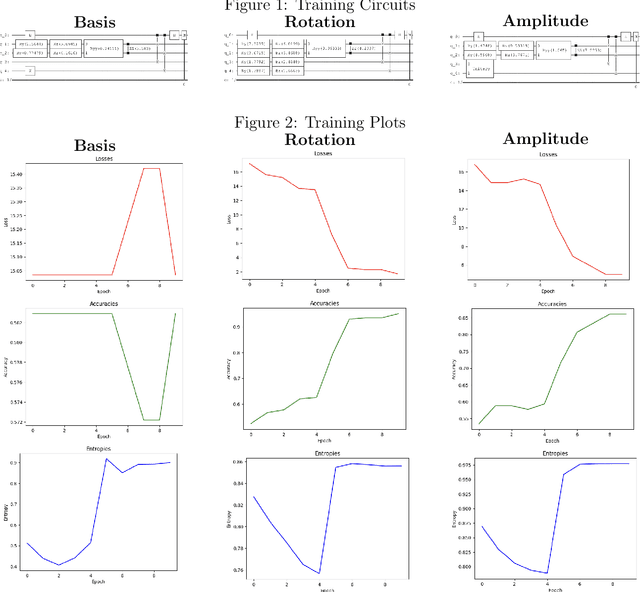
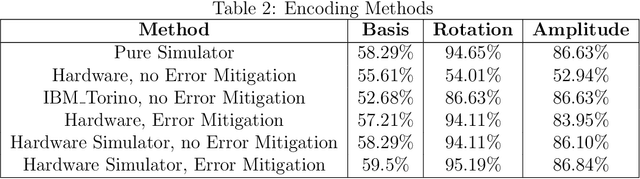
As quantum computers continue to become more capable, the possibilities of their applications increase. For example, quantum techniques are being integrated with classical neural networks to perform machine learning. In order to be used in this way, or for any other widespread use like quantum chemistry simulations or cryptographic applications, classical data must be converted into quantum states through quantum encoding. There are three fundamental encoding methods: basis, amplitude, and rotation, as well as several proposed combinations. This study explores the encoding methods, specifically in the context of hybrid quantum-classical machine learning. Using the QuClassi quantum neural network architecture to perform binary classification of the `3' and `6' digits from the MNIST datasets, this study obtains several metrics such as accuracy, entropy, loss, and resistance to noise, while considering resource usage and computational complexity to compare the three main encoding methods.