 Add to Chrome
 Add to Firefox
 Add to Edge
SAHG: Sector-Anisotropic Hyperbolic Graph Model for Social Bot Detection
May 28, 2026
LLM-driven social bots can generate fluent, human-like text, reducing the discriminative advantage of content-based detection alone. However, coordinated campaigns still leave relational patterns -- interactions, behavioral similarity, shared neighborhoods, community positions, and coordinated activity -- that graph-based methods can exploit. Existing graph detectors face two challenges when exploiting such evidence. First, Euclidean GNNs distort hierarchical and scale-free social graphs; while hyperbolic geometry addresses this volume-growth mismatch, fixed-curvature models still assign uniform geometric resolution to structural directions with different densities and separation needs. Second, relational evidence is not always reliable: sophisticated bots forge heterophilic connections with genuine users, causing neighborhood aggregation to mix bot and human signals and dilute account-level evidence. We propose \textsc{SAHG} (Sector-Anisotropic Hyperbolic Graph), addressing both challenges. \textsc{SAHG} learns a direction-dependent curvature field $γ(u)$ that adapts geometric resolution across structural directions, and uses sector prototypes to convert angular concentration and alignment into classifier-readable features. To prevent contaminated aggregation from overwhelming account-level evidence, \textsc{SAHG} encodes per-account features and graph-neighborhood representations in two independent SAH channels, fusing them only at the classifier. Experiments on Fox8-23, BotSim-24, and MGTAB show that \textsc{SAHG} achieves the highest accuracy and F1 on all three benchmarks, outperforming feature-based, graph-based, LLM-based, and isotropic hyperbolic baselines. Ablation and geometric analyses confirm the effectiveness of the anisotropic geometry and dual-channel design.

ComfySearch: Autonomous Exploration and Reasoning for ComfyUI Workflows
Jan 07, 2026AI-generated content has progressed from monolithic models to modular workflows, especially on platforms like ComfyUI, allowing users to customize complex creative pipelines. However, the large number of components in ComfyUI and the difficulty of maintaining long-horizon structural consistency under strict graph constraints frequently lead to low pass rates and workflows of limited quality. To tackle these limitations, we present ComfySearch, an agentic framework that can effectively explore the component space and generate functional ComfyUI pipelines via validation-guided workflow construction. Experiments demonstrate that ComfySearch substantially outperforms existing methods on complex and creative tasks, achieving higher executability (pass) rates, higher solution rates, and stronger generalization.
DebFlow: Automating Agent Creation via Agent Debate
Mar 31, 2025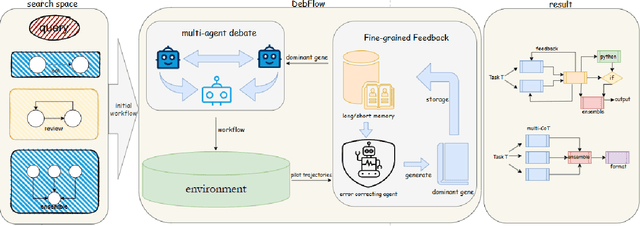
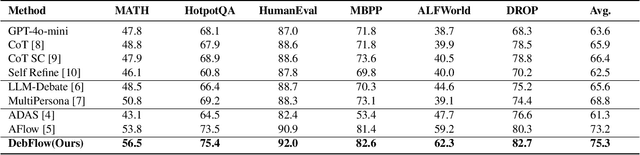
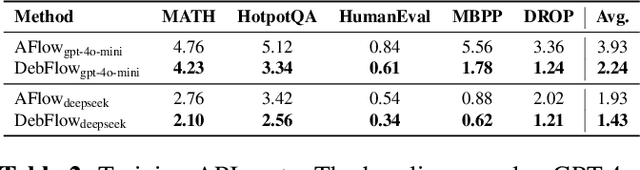
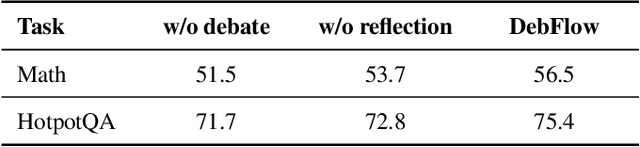
Large language models (LLMs) have demonstrated strong potential and impressive performance in automating the generation and optimization of workflows. However, existing approaches are marked by limited reasoning capabilities, high computational demands, and significant resource requirements. To address these issues, we propose DebFlow, a framework that employs a debate mechanism to optimize workflows and integrates reflexion to improve based on previous experiences. We evaluated our method across six benchmark datasets, including HotpotQA, MATH, and ALFWorld. Our approach achieved a 3\% average performance improvement over the latest baselines, demonstrating its effectiveness in diverse problem domains. In particular, during training, our framework reduces resource consumption by 37\% compared to the state-of-the-art baselines. Additionally, we performed ablation studies. Removing the Debate component resulted in a 4\% performance drop across two benchmark datasets, significantly greater than the 2\% drop observed when the Reflection component was removed. These findings strongly demonstrate the critical role of Debate in enhancing framework performance, while also highlighting the auxiliary contribution of reflexion to overall optimization.