 Add to Chrome
 Add to Firefox
 Add to Edge
FEnc$^2$: Unifying Data Packing for Efficient Private Inference via Convolution and Architecture-Aware Fragment Encoding
Jun 15, 2026
Fully Homomorphic Encryption (FHE) enables privacy-preserving machine learning but incurs extreme computational and memory overhead. These costs come not only from expensive low-level primitives, including Number Theoretic Transform (NTT), rotation, and key-switching, but also from inefficient ciphertext packing at the application level. Existing packing strategies typically preserve either neighboring data elements or feature grouping, but not both, leading to wasted ciphertext slots, excessive rotations, and inflated ciphertext counts. We propose FEnc2, a unified and principled fragment-based encoding framework for CKKS-based private convolutional neural network inference. FEnc2 optimizes slot utilization, rotation complexity, and ciphertext density through two components: 1)Conv-aware Encoding, which analytically selects an optimal fragment size to decouple spatial dependencies and jointly minimize inner-outer rotations across layers, and 2)Arch-aware Ct Compression, which restores ciphertext density after feature- or channel-reduction layers. Together, these transformations reshape encrypted workload structure and reduce homomorphic operations by one to two orders of magnitude. With full memory capacity utilized, i.e., at maximum batch size, FEnc2 achieves end-to-end latency speedups over the state-of-the-art Orion of up to 228.83x on GPU and 226.06x on CPU for LeNet on MNIST, and up to 4.55x on GPU and 9.43x on CPU for MobileNet on ImageNet. FEnc2 is hardware-agnostic yet architecturally transformative: by optimizing encrypted tensor layout before execution, it reduces ciphertext count and workload pressure on hardware, complementing primitive-level optimizations such as NTT and keyswitch accelerators. These results show that application-level data layout is a first-order architectural design dimension for encrypted inference and an important enabler for next-generation FHE systems.

SAHG: Sector-Anisotropic Hyperbolic Graph Model for Social Bot Detection
May 28, 2026LLM-driven social bots can generate fluent, human-like text, reducing the discriminative advantage of content-based detection alone. However, coordinated campaigns still leave relational patterns -- interactions, behavioral similarity, shared neighborhoods, community positions, and coordinated activity -- that graph-based methods can exploit. Existing graph detectors face two challenges when exploiting such evidence. First, Euclidean GNNs distort hierarchical and scale-free social graphs; while hyperbolic geometry addresses this volume-growth mismatch, fixed-curvature models still assign uniform geometric resolution to structural directions with different densities and separation needs. Second, relational evidence is not always reliable: sophisticated bots forge heterophilic connections with genuine users, causing neighborhood aggregation to mix bot and human signals and dilute account-level evidence. We propose \textsc{SAHG} (Sector-Anisotropic Hyperbolic Graph), addressing both challenges. \textsc{SAHG} learns a direction-dependent curvature field $γ(u)$ that adapts geometric resolution across structural directions, and uses sector prototypes to convert angular concentration and alignment into classifier-readable features. To prevent contaminated aggregation from overwhelming account-level evidence, \textsc{SAHG} encodes per-account features and graph-neighborhood representations in two independent SAH channels, fusing them only at the classifier. Experiments on Fox8-23, BotSim-24, and MGTAB show that \textsc{SAHG} achieves the highest accuracy and F1 on all three benchmarks, outperforming feature-based, graph-based, LLM-based, and isotropic hyperbolic baselines. Ablation and geometric analyses confirm the effectiveness of the anisotropic geometry and dual-channel design.
LEGO: LoRA-Enabled Generator-Oriented Framework for Synthetic Image Detection
May 06, 2026The rapid advancement of generative technologies has made synthetic images nearly indistinguishable from real ones, thereby creating an urgent need for robust detectors to counter misinformation. However, existing methods mainly rely on universal artifact features that are shared across multiple generators. We observe that as the diversity of generators increases, the overlap of these common features gradually decreases. This severely undermines model generalization. In contrast, focusing only on unique artifacts tends to cause overfitting to specific forgery patterns. To address this challenge, we propose LEGO (LoRA-Enabled Generator-Oriented Framework). The core mechanism of LEGO employs an MLP to modulate multiple LoRA (Low-Rank Adaptation) blocks, each pretrained to capture the unique artifacts of a specific generator, followed by attention-based feature fusion. Unlike conventional methods that seek a single universal solution, LEGO delegates unique artifact extraction to specialized LoRA modules by dividing its training procedure into two stages. Each LoRA module is individually trained on a single-generator dataset to learn generator-specific representations, then MLP and attention layers are trained on mixed datasets to dynamically regulate the contribution of each module. Benefiting from its modular yet robust design, LEGO can be naturally extended by incorporating new LoRA modules for adaptation to newly emerging next-generation datasets, while still achieving substantially better performance than prior SOTA methods with fewer than 30,000 training images, less than 10% of their training data, and only 5 epochs in each training stage.
MASRA: MLLM-Assisted Semantic-Relational Consistent Alignment for Video Temporal Grounding
May 05, 2026Video Temporal Grounding (VTG) faces a cross-modal semantic gap that often leads to background features being incorrectly aligned with the query, while directly matching the query to moments results in insufficient discriminability and consistency of temporal semantics. To address this issue, we propose MLLM-Assisted Semantic-Relational Consistent Alignment (MASRA), a training-time MLLM-based optimization framework for VTG. MASRA leverages an MLLM during training to produce two forms of textual priors, namely event-level descriptions with temporal spans and clip-level captions, and instantiates two MLLM-assisted alignments. Event Semantic Temporal Alignment (ESTA) aligns temporal context with event semantics to explicitly strengthen the correspondence between semantics and temporal events and improve span-level separability. Local Relational Consistency Alignment (LRCA) constructs a textual relation matrix derived from clip-level captions and aligns it with the temporal feature similarity matrix in the model, enhancing temporal consistency while capturing local structural information. MASRA includes two simple supporting modules, semantic-guided enhancement and second-order relational attention, to better utilize the learned semantic context and relational structure. Moreover, we introduce Decoupled Alignment Interaction (DAI) with a context-aware codebook to adaptively absorb query-irrelevant semantics and alleviate the cross-modal gap. The MLLM is only invoked during training and is not used at inference. Extensive experiments show that MASRA outperforms existing methods, and ablation studies validate its effectiveness.
AEGIS: Scaling Long-Sequence Homomorphic Encrypted Transformer Inference via Hybrid Parallelism on Multi-GPU Systems
Apr 03, 2026Fully Homomorphic Encryption (FHE) enables privacy-preserving Transformer inference, but long-sequence encrypted Transformers quickly exceed single-GPU memory capacity because encoded weights are already large and encrypted activations grow rapidly with sequence length. Multi-GPU execution therefore becomes unavoidable, yet scaling remains challenging because communication is jointly induced by application-level aggregation and encryption-level RNS coupling. Existing approaches either synchronize between devices frequently or replicate encrypted tensors across devices, leading to excessive communication and latency. We present AEGIS, an Application-Encryption Guided Inference System for scalable long-sequence encrypted Transformer inference on multi-GPU platforms. AEGIS derives device placement from ciphertext dependencies jointly induced by Transformer dataflow and CKKS polynomial coupling, co-locating modulus-coherent and token-coherent data so that communication is introduced only when application dependencies require it, while reordering polynomial operators to overlap the remaining collectives with computation. On 2048-token inputs, AEGIS reduces inter-GPU communication by up to 57.9% in feed-forward networks and 81.3% in self-attention versus prior state-of-the-art designs. On four GPUs, it achieves up to 96.62% scaling efficiency, 3.86x end-to-end speedup, and 69.1% per-device memory reduction. These results establish coordinated application-encryption parallelism as a practical foundation for scalable homomorphic Transformer inference.
Two-Stage Random Alternation Framework for Zero-Shot Pansharpening
May 10, 2025In recent years, pansharpening has seen rapid advancements with deep learning methods, which have demonstrated impressive fusion quality. However, the challenge of acquiring real high-resolution images limits the practical applicability of these methods. To address this, we propose a two-stage random alternating framework (TRA-PAN) that effectively integrates strong supervision constraints from reduced-resolution images with the physical characteristics of full-resolution images. The first stage introduces a pre-training procedure, which includes Degradation-Aware Modeling (DAM) to capture spatial-spectral degradation mappings, alongside a warm-up procedure designed to reduce training time and mitigate the negative effects of reduced-resolution data. In the second stage, Random Alternation Optimization (RAO) is employed, where random alternating training leverages the strengths of both reduced- and full-resolution images, further optimizing the fusion model. By primarily relying on full-resolution images, our method enables zero-shot training with just a single image pair, obviating the need for large datasets. Experimental results demonstrate that TRA-PAN outperforms state-of-the-art (SOTA) methods in both quantitative metrics and visual quality in real-world scenarios, highlighting its strong practical applicability.
LoLDU: Low-Rank Adaptation via Lower-Diag-Upper Decomposition for Parameter-Efficient Fine-Tuning
Oct 17, 2024


The rapid growth of model scale has necessitated substantial computational resources for fine-tuning. Existing approach such as Low-Rank Adaptation (LoRA) has sought to address the problem of handling the large updated parameters in full fine-tuning. However, LoRA utilize random initialization and optimization of low-rank matrices to approximate updated weights, which can result in suboptimal convergence and an accuracy gap compared to full fine-tuning. To address these issues, we propose LoLDU, a Parameter-Efficient Fine-Tuning (PEFT) approach that significantly reduces trainable parameters by 2600 times compared to regular PEFT methods while maintaining comparable performance. LoLDU leverages Lower-Diag-Upper Decomposition (LDU) to initialize low-rank matrices for faster convergence and orthogonality. We focus on optimizing the diagonal matrix for scaling transformations. To the best of our knowledge, LoLDU has the fewest parameters among all PEFT approaches. We conducted extensive experiments across 4 instruction-following datasets, 6 natural language understanding (NLU) datasets, 8 image classification datasets, and image generation datasets with multiple model types (LLaMA2, RoBERTa, ViT, and Stable Diffusion), providing a comprehensive and detailed analysis. Our open-source code can be accessed at \href{https://github.com/SKDDJ/LoLDU}{https://github.com/SKDDJ/LoLDU}.
An Evidential-enhanced Tri-Branch Consistency Learning Method for Semi-supervised Medical Image Segmentation
Apr 10, 2024Semi-supervised segmentation presents a promising approach for large-scale medical image analysis, effectively reducing annotation burdens while achieving comparable performance. This methodology holds substantial potential for streamlining the segmentation process and enhancing its feasibility within clinical settings for translational investigations. While cross-supervised training, based on distinct co-training sub-networks, has become a prevalent paradigm for this task, addressing critical issues such as predication disagreement and label-noise suppression requires further attention and progress in cross-supervised training. In this paper, we introduce an Evidential Tri-Branch Consistency learning framework (ETC-Net) for semi-supervised medical image segmentation. ETC-Net employs three branches: an evidential conservative branch, an evidential progressive branch, and an evidential fusion branch. The first two branches exhibit complementary characteristics, allowing them to address prediction diversity and enhance training stability. We also integrate uncertainty estimation from the evidential learning into cross-supervised training, mitigating the negative impact of erroneous supervision signals. Additionally, the evidential fusion branch capitalizes on the complementary attributes of the first two branches and leverages an evidence-based Dempster-Shafer fusion strategy, supervised by more reliable and accurate pseudo-labels of unlabeled data. Extensive experiments conducted on LA, Pancreas-CT, and ACDC datasets demonstrate that ETC-Net surpasses other state-of-the-art methods for semi-supervised segmentation. The code will be made available in the near future at https://github.com/Medsemiseg.
LinGCN: Structural Linearized Graph Convolutional Network for Homomorphically Encrypted Inference
Sep 30, 2023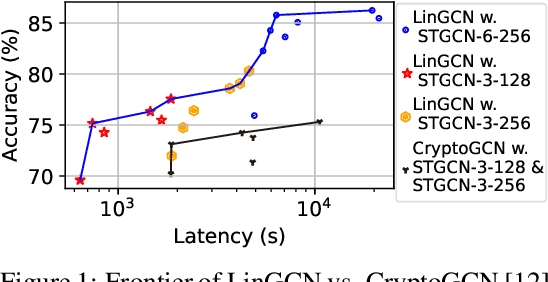

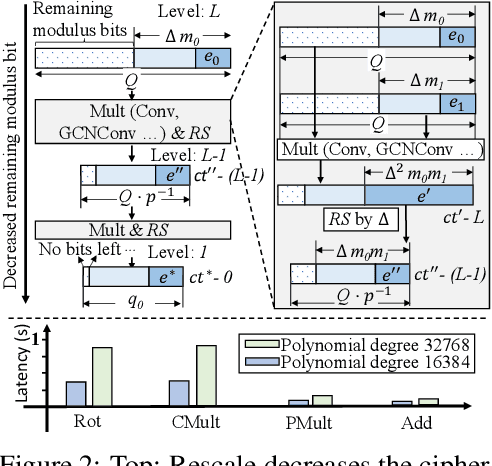
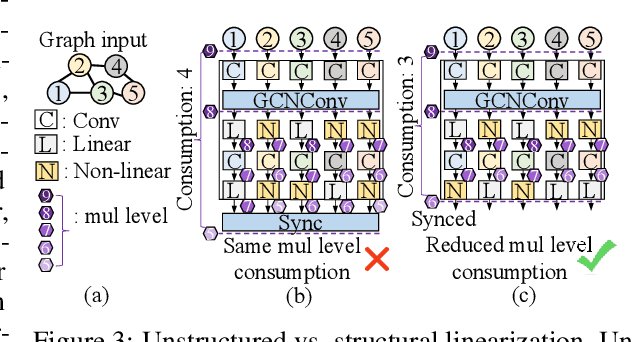
The growth of Graph Convolution Network (GCN) model sizes has revolutionized numerous applications, surpassing human performance in areas such as personal healthcare and financial systems. The deployment of GCNs in the cloud raises privacy concerns due to potential adversarial attacks on client data. To address security concerns, Privacy-Preserving Machine Learning (PPML) using Homomorphic Encryption (HE) secures sensitive client data. However, it introduces substantial computational overhead in practical applications. To tackle those challenges, we present LinGCN, a framework designed to reduce multiplication depth and optimize the performance of HE based GCN inference. LinGCN is structured around three key elements: (1) A differentiable structural linearization algorithm, complemented by a parameterized discrete indicator function, co-trained with model weights to meet the optimization goal. This strategy promotes fine-grained node-level non-linear location selection, resulting in a model with minimized multiplication depth. (2) A compact node-wise polynomial replacement policy with a second-order trainable activation function, steered towards superior convergence by a two-level distillation approach from an all-ReLU based teacher model. (3) an enhanced HE solution that enables finer-grained operator fusion for node-wise activation functions, further reducing multiplication level consumption in HE-based inference. Our experiments on the NTU-XVIEW skeleton joint dataset reveal that LinGCN excels in latency, accuracy, and scalability for homomorphically encrypted inference, outperforming solutions such as CryptoGCN. Remarkably, LinGCN achieves a 14.2x latency speedup relative to CryptoGCN, while preserving an inference accuracy of 75% and notably reducing multiplication depth.
Implicit Neural Feature Fusion Function for Multispectral and Hyperspectral Image Fusion
Jul 14, 2023Multispectral and Hyperspectral Image Fusion (MHIF) is a practical task that aims to fuse a high-resolution multispectral image (HR-MSI) and a low-resolution hyperspectral image (LR-HSI) of the same scene to obtain a high-resolution hyperspectral image (HR-HSI). Benefiting from powerful inductive bias capability, CNN-based methods have achieved great success in the MHIF task. However, they lack certain interpretability and require convolution structures be stacked to enhance performance. Recently, Implicit Neural Representation (INR) has achieved good performance and interpretability in 2D tasks due to its ability to locally interpolate samples and utilize multimodal content such as pixels and coordinates. Although INR-based approaches show promise, they require extra construction of high-frequency information (\emph{e.g.,} positional encoding). In this paper, inspired by previous work of MHIF task, we realize that HR-MSI could serve as a high-frequency detail auxiliary input, leading us to propose a novel INR-based hyperspectral fusion function named Implicit Neural Feature Fusion Function (INF). As an elaborate structure, it solves the MHIF task and addresses deficiencies in the INR-based approaches. Specifically, our INF designs a Dual High-Frequency Fusion (DHFF) structure that obtains high-frequency information twice from HR-MSI and LR-HSI, then subtly fuses them with coordinate information. Moreover, the proposed INF incorporates a parameter-free method named INR with cosine similarity (INR-CS) that uses cosine similarity to generate local weights through feature vectors. Based on INF, we construct an Implicit Neural Fusion Network (INFN) that achieves state-of-the-art performance for MHIF tasks of two public datasets, \emph{i.e.,} CAVE and Harvard. The code will soon be made available on GitHub.