 Add to Chrome
 Add to Firefox
 Add to Edge
Hy-MultiTurn: A Six-Dimensional Benchmark for Deep Multi-Turn Dialogue Understanding
Jul 31, 2026
Long-running multi-turn interactions with chatbots and agents are now common, and a correct response often depends on remembering earlier details, tracking later revisions, identifying intended objects or referents, and withholding action when required conditions are unmet. Existing multi-turn benchmarks typically cover short exchanges and do not fully evaluate these capabilities in long multi-turn interactions, particularly in Chinese, while offering limited insight into how and why models fail. To address these limitations, we analyze real chatbot failures to identify six recurring mechanisms and use them to define six controlled evaluation modes in Hy-MultiTurn, a Chinese benchmark for deep multi-turn dialogue understanding. The six modes evaluate constraint memory, precise execution, constraint synthesis, object localization, action suppression, and reference resolution. Across the six modes, we construct 209 controlled tasks spanning 12-76 turns, with dialogue length, irrelevant-topic distraction, and colloquial phrasing adding further difficulty. Evaluation of 22 frontier model configurations shows that Hy-MultiTurn is broadly challenging, as even GPT-5.5, the strongest overall configuration, satisfies all requirements in only 41.1 percent of responses and no model performs best in all six modes.

Beyond Rephrasing: Book-Level Organization Improves Synthetic Textbook Data for Mid-Training
Jul 30, 2026Synthetic textbook data has improved language model pre-training, but prior work largely treats the benefit as a property of generated content or local rewriting style. We study a different factor: whether related content is organized into coherent book-level documents. We contribute both a scalable synthesis pipeline and controlled evidence that this organization matters. The pipeline retrieves source material from a pre-training corpus, clusters it into topical units, plans hierarchical tables of contents, and assembles source-grounded sections into complete books (our Full setting), yielding 686K textbooks (32B tokens) across 15,000+ disciplines. Replacing natural books in a mid-training mix with this corpus improves downstream performance by +1.09 on average. Controlled comparisons then disentangle the relevant design factors. A content-matched Split condition holds generated text and tokens fixed but treats each section as an independent document; Full's +1.02 mean gain isolates document packaging. A length-matched RandomConcat control that joins sections from different books remains below Full, ruling out document length alone. A retrieval-pool-matched Rephrase condition independently rewrites individual retrieved documents under the same audience-by-style scheme, without clustering, TOC planning, or book assembly; Full's +1.17 gain demonstrates the value of structured synthesis. On Llama3-8B, Full likewise outperforms both RandomConcat and Natural Books, supporting book-level organization as a useful axis for synthetic pre-training data design.
Kimi K2.5: Visual Agentic Intelligence
Feb 02, 2026We introduce Kimi K2.5, an open-source multimodal agentic model designed to advance general agentic intelligence. K2.5 emphasizes the joint optimization of text and vision so that two modalities enhance each other. This includes a series of techniques such as joint text-vision pre-training, zero-vision SFT, and joint text-vision reinforcement learning. Building on this multimodal foundation, K2.5 introduces Agent Swarm, a self-directed parallel agent orchestration framework that dynamically decomposes complex tasks into heterogeneous sub-problems and executes them concurrently. Extensive evaluations show that Kimi K2.5 achieves state-of-the-art results across various domains including coding, vision, reasoning, and agentic tasks. Agent Swarm also reduces latency by up to $4.5\times$ over single-agent baselines. We release the post-trained Kimi K2.5 model checkpoint to facilitate future research and real-world applications of agentic intelligence.
TriPlay-RL: Tri-Role Self-Play Reinforcement Learning for LLM Safety Alignment
Jan 26, 2026In recent years, safety risks associated with large language models have become increasingly prominent, highlighting the urgent need to mitigate the generation of toxic and harmful content. The mainstream paradigm for LLM safety alignment typically adopts a collaborative framework involving three roles: an attacker for adversarial prompt generation, a defender for safety defense, and an evaluator for response assessment. In this paper, we propose a closed-loop reinforcement learning framework called TriPlay-RL that enables iterative and co-improving collaboration among three roles with near-zero manual annotation. Experimental results show that the attacker preserves high output diversity while achieving a 20%-50% improvement in adversarial effectiveness; the defender attains 10%-30% gains in safety performance without degrading general reasoning capability; and the evaluator continuously refines its fine-grained judgment ability through iterations, accurately distinguishing unsafe responses, simple refusals, and useful guidance. Overall, our framework establishes an efficient and scalable paradigm for LLM safety alignment, enabling continuous co-evolution within a unified learning loop.
EntroCoT: Enhancing Chain-of-Thought via Adaptive Entropy-Guided Segmentation
Jan 08, 2026Chain-of-Thought (CoT) prompting has significantly enhanced the mathematical reasoning capabilities of Large Language Models. We find existing fine-tuning datasets frequently suffer from the "answer right but reasoning wrong" probelm, where correct final answers are derived from hallucinated, redundant, or logically invalid intermediate steps. This paper proposes EntroCoT, a unified framework for automatically identifying and refining low-quality CoT supervision traces. EntroCoT first proposes an entropy-based mechanism to segment the reasoning trace into multiple steps at uncertain junctures, and then introduces a Monte Carlo rollout-based mechanism to evaluate the marginal contribution of each step. By accurately filtering deceptive reasoning samples, EntroCoT constructs a high-quality dataset where every intermediate step in each reasoning trace facilitates the final answer. Extensive experiments on mathematical benchmarks demonstrate that fine-tuning on the subset constructed by EntroCoT consistently outperforms the baseslines of full-dataset supervision.
Kimi-VL Technical Report
Apr 10, 2025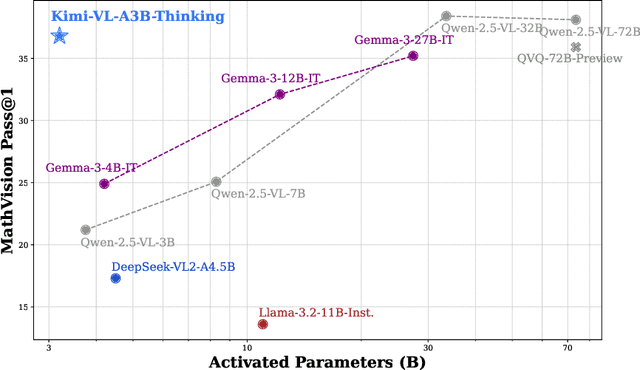
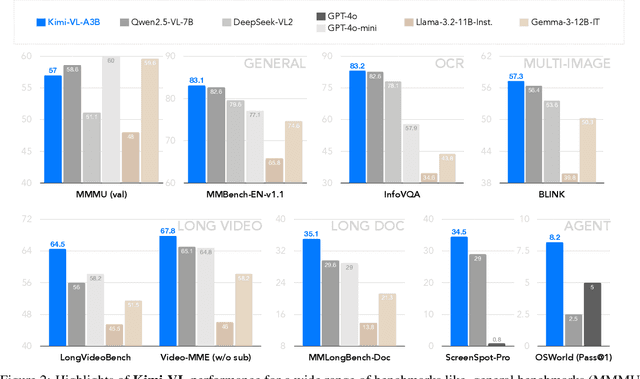

We present Kimi-VL, an efficient open-source Mixture-of-Experts (MoE) vision-language model (VLM) that offers advanced multimodal reasoning, long-context understanding, and strong agent capabilities - all while activating only 2.8B parameters in its language decoder (Kimi-VL-A3B). Kimi-VL demonstrates strong performance across challenging domains: as a general-purpose VLM, Kimi-VL excels in multi-turn agent tasks (e.g., OSWorld), matching flagship models. Furthermore, it exhibits remarkable capabilities across diverse challenging vision language tasks, including college-level image and video comprehension, OCR, mathematical reasoning, and multi-image understanding. In comparative evaluations, it effectively competes with cutting-edge efficient VLMs such as GPT-4o-mini, Qwen2.5-VL-7B, and Gemma-3-12B-IT, while surpassing GPT-4o in several key domains. Kimi-VL also advances in processing long contexts and perceiving clearly. With a 128K extended context window, Kimi-VL can process diverse long inputs, achieving impressive scores of 64.5 on LongVideoBench and 35.1 on MMLongBench-Doc. Its native-resolution vision encoder, MoonViT, further allows it to see and understand ultra-high-resolution visual inputs, achieving 83.2 on InfoVQA and 34.5 on ScreenSpot-Pro, while maintaining lower computational cost for common tasks. Building upon Kimi-VL, we introduce an advanced long-thinking variant: Kimi-VL-Thinking. Developed through long chain-of-thought (CoT) supervised fine-tuning (SFT) and reinforcement learning (RL), this model exhibits strong long-horizon reasoning capabilities. It achieves scores of 61.7 on MMMU, 36.8 on MathVision, and 71.3 on MathVista while maintaining the compact 2.8B activated LLM parameters, setting a new standard for efficient multimodal thinking models. Code and models are publicly accessible at https://github.com/MoonshotAI/Kimi-VL.