 Add to Chrome
 Add to Firefox
 Add to Edge
Vorch-IR: Long-Form Unified Multimodal Identity Replacement Video Generation
Aug 06, 2026
Video identity replacement seeks to transfer the identities of one or more subjects while preserving the motion, expressions, and temporal structure of a driving video. Existing methods largely target single-person settings and often require task-specific structural controls, such as masks or pose representations, limiting their flexibility in general multimodal editing systems. Progress on multi-person replacement is further constrained by the scarcity of paired training data. We present Vorch-IR, a unified framework that supports single- and dual-person identity replacement, with optional background replacement, in a single model. Built on LTX2, Vorch-IR jointly conditions on a driving video, indexed reference images, and a textual editing instruction. The reference images need not match the pose, layout, or spatial configuration of the driving video: their roles as subject or background references are specified through the instruction. Dense visual conditions are fused through self-attention, while a vision-language context establishes semantic correspondence through cross-attention. We further develop an automatic data construction pipeline that synthesizes paired supervision for all four editing settings. Experiments using automatic metrics and pairwise human evaluation demonstrate strong identity preservation, motion fidelity, and temporal coherence across diverse scenarios. A temporal overlapping inference strategy additionally extends the short-clip model to minute-long generation without autoregressive continuation.

Vorch-Omni: Multi-Task Orchestration of Sight and Sound
Aug 06, 2026Recent advances in generative video modeling have enabled diverse generation, reference-based synthesis, extension, and editing, but existing approaches often rely on fragmented task-specific models. A general model must distinguish heterogeneous target, source, and reference signals to determine what to generate, preserve, or use as guidance, while reducing interference among tasks. Joint audio-visual generation further increases this challenge by introducing diverse conditioning and output configurations across modalities. We present Vorch-Omni, a unified multi-task framework for audio-visual synthesis based on an arbitrary-condition-to-arbitrary-output formulation. It flexibly treats video and audio signals as either conditioning inputs or generation targets. Token-level conditioning masks and task identifiers distinguish targets, source content, and references, while position types separate temporal context from independent conditions. To capture semantic and structural information, Vorch-Omni employs complementary visual conditioning pathways: a vision-language model interprets sampled frames with text instructions, and a video VAE encodes conditions into latent tokens for direct guidance. We further build a distributed data pipeline to curate diverse temporally aligned audio-visual clips, generate structured captions and metadata, and balance heterogeneous task distributions. Built on a single flow-matching diffusion transformer without task-specific architectural changes, Vorch-Omni supports over 10 tasks, including text-to-video, text-to-audio-video, image- and reference-conditioned generation, temporal extension, audio-driven generation, video transformation, and audio-visual editing. This unified framework provides a scalable foundation for general-purpose audio-visual generation and manipulation.
TIDE: Task-Isolated Diffusion for Unified Video Editing and Generation
Jun 06, 2026Recent advances in Diffusion Transformers have driven rapid progress in video generation and editing, yet these capabilities are still handled by separate, task-specific models. Building a unified framework that supports diverse video tasks remains an open challenge: existing unified attempts either require dedicated auxiliary encoders or lack explicit mechanisms to distinguish heterogeneous conditioning tokens, struggling when the number and type of visual conditions vary across tasks. We propose TIDE, a unified framework that integrates instruction-based editing, reference-guided editing, and multi-reference generation. At its core, we introduce per-token task embeddings that assign each input token a task-specific identifier, enabling the model to explicitly disambiguate target, source, and reference tokens. To simultaneously capture high-level semantic understanding and fine-grained structural fidelity, we design a dual-path conditioning scheme that couples a vision-language model with a VAE latent path for complementary signals. We further devise a multi-task progressive training strategy that incrementally introduces tasks of increasing complexity, effectively harmonizing diverse objectives and enabling smooth generalization across heterogeneous task distributions. Extensive experiments on multiple video editing and generation benchmarks demonstrate that TIDE achieves state-of-the-art performance across all evaluated tasks. Our project page is available at https://LittleWork123.github.io/tide.
Vidu: a Highly Consistent, Dynamic and Skilled Text-to-Video Generator with Diffusion Models
May 07, 2024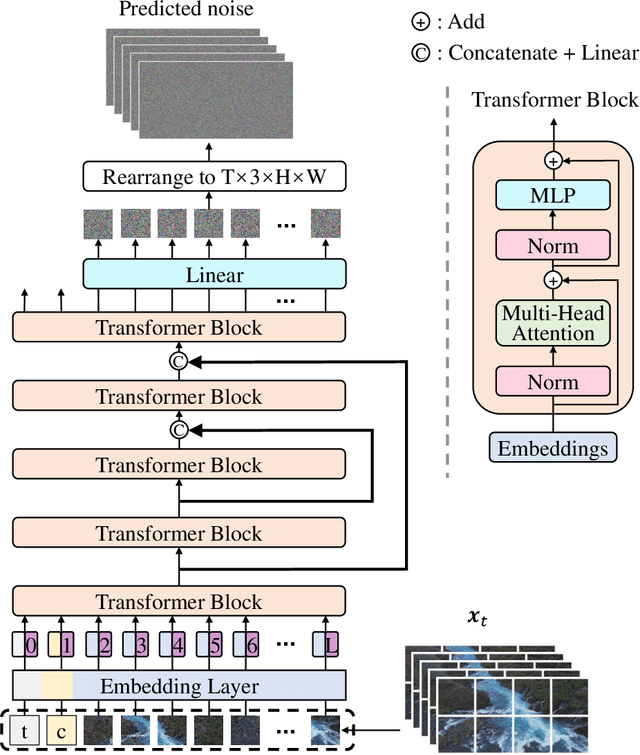
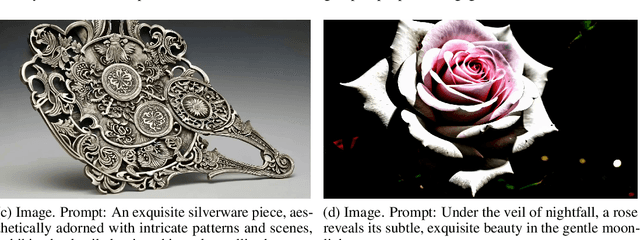


We introduce Vidu, a high-performance text-to-video generator that is capable of producing 1080p videos up to 16 seconds in a single generation. Vidu is a diffusion model with U-ViT as its backbone, which unlocks the scalability and the capability for handling long videos. Vidu exhibits strong coherence and dynamism, and is capable of generating both realistic and imaginative videos, as well as understanding some professional photography techniques, on par with Sora -- the most powerful reported text-to-video generator. Finally, we perform initial experiments on other controllable video generation, including canny-to-video generation, video prediction and subject-driven generation, which demonstrate promising results.
One Transformer Fits All Distributions in Multi-Modal Diffusion at Scale
Mar 12, 2023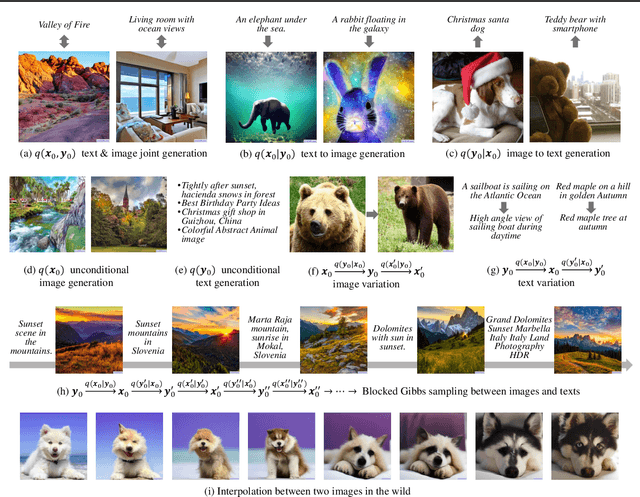
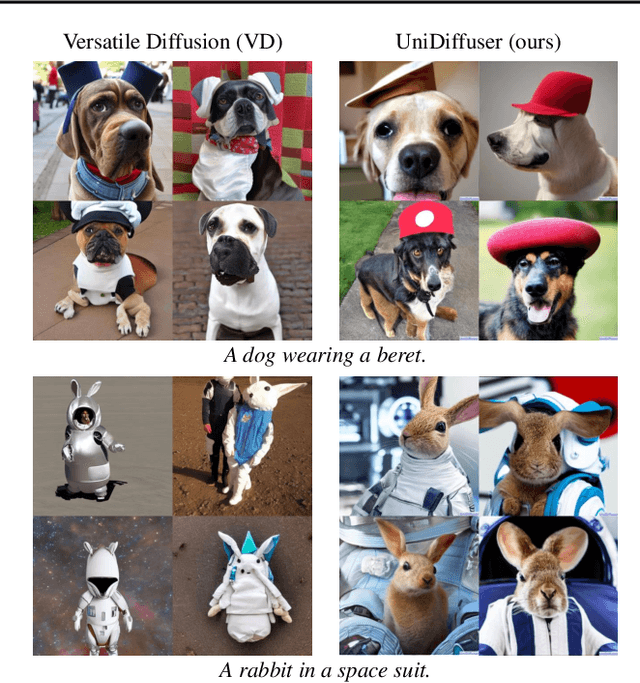

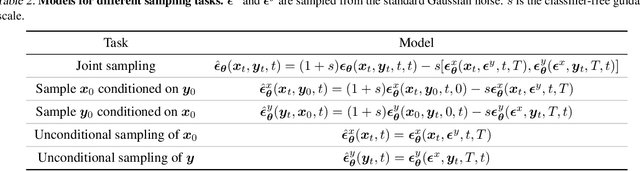
This paper proposes a unified diffusion framework (dubbed UniDiffuser) to fit all distributions relevant to a set of multi-modal data in one model. Our key insight is -- learning diffusion models for marginal, conditional, and joint distributions can be unified as predicting the noise in the perturbed data, where the perturbation levels (i.e. timesteps) can be different for different modalities. Inspired by the unified view, UniDiffuser learns all distributions simultaneously with a minimal modification to the original diffusion model -- perturbs data in all modalities instead of a single modality, inputs individual timesteps in different modalities, and predicts the noise of all modalities instead of a single modality. UniDiffuser is parameterized by a transformer for diffusion models to handle input types of different modalities. Implemented on large-scale paired image-text data, UniDiffuser is able to perform image, text, text-to-image, image-to-text, and image-text pair generation by setting proper timesteps without additional overhead. In particular, UniDiffuser is able to produce perceptually realistic samples in all tasks and its quantitative results (e.g., the FID and CLIP score) are not only superior to existing general-purpose models but also comparable to the bespoken models (e.g., Stable Diffusion and DALL-E 2) in representative tasks (e.g., text-to-image generation).