 Add to Chrome
 Add to Firefox
 Add to Edge
Adapting Large Language Model with Speech for Fully Formatted End-to-End Speech Recognition
Aug 03, 2023


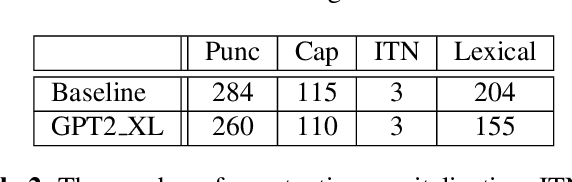
Most end-to-end (E2E) speech recognition models are composed of encoder and decoder blocks that perform acoustic and language modeling functions. Pretrained large language models (LLMs) have the potential to improve the performance of E2E ASR. However, integrating a pretrained language model into an E2E speech recognition model has shown limited benefits due to the mismatches between text-based LLMs and those used in E2E ASR. In this paper, we explore an alternative approach by adapting a pretrained LLMs to speech. Our experiments on fully-formatted E2E ASR transcription tasks across various domains demonstrate that our approach can effectively leverage the strengths of pretrained LLMs to produce more readable ASR transcriptions. Our model, which is based on the pretrained large language models with either an encoder-decoder or decoder-only structure, surpasses strong ASR models such as Whisper, in terms of recognition error rate, considering formats like punctuation and capitalization as well.

Adapting Multi-Lingual ASR Models for Handling Multiple Talkers
May 30, 2023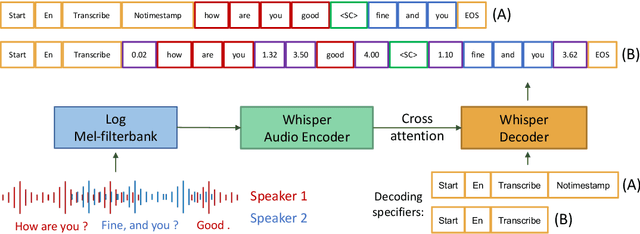
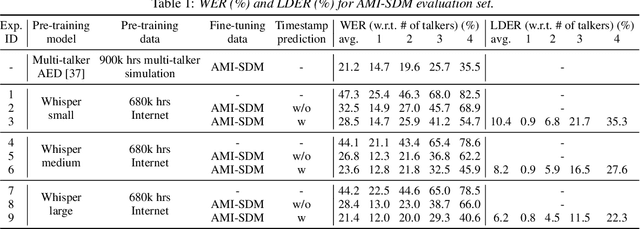
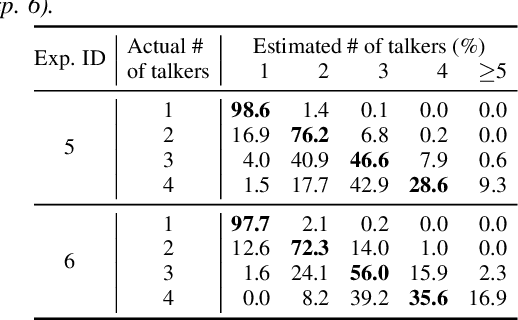
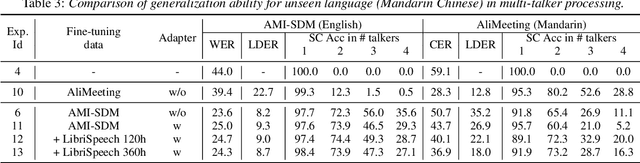
State-of-the-art large-scale universal speech models (USMs) show a decent automatic speech recognition (ASR) performance across multiple domains and languages. However, it remains a challenge for these models to recognize overlapped speech, which is often seen in meeting conversations. We propose an approach to adapt USMs for multi-talker ASR. We first develop an enhanced version of serialized output training to jointly perform multi-talker ASR and utterance timestamp prediction. That is, we predict the ASR hypotheses for all speakers, count the speakers, and estimate the utterance timestamps at the same time. We further introduce a lightweight adapter module to maintain the multilingual property of the USMs even when we perform the adaptation with only a single language. Experimental results obtained using the AMI and AliMeeting corpora show that our proposed approach effectively transfers the USMs to a strong multilingual multi-talker ASR model with timestamp prediction capability.
ComSL: A Composite Speech-Language Model for End-to-End Speech-to-Text Translation
May 24, 2023
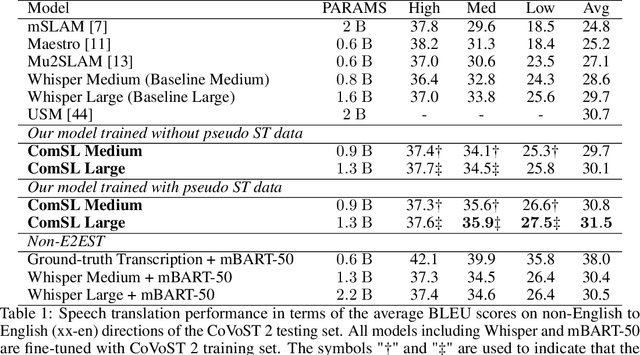
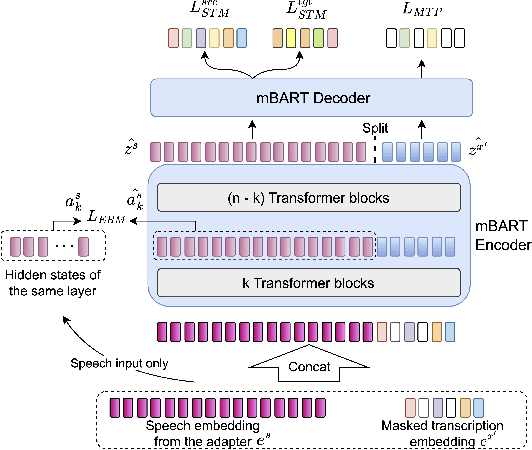

Joint speech-language training is challenging due to the large demand for training data and GPU consumption, as well as the modality gap between speech and language. We present ComSL, a speech-language model built atop a composite architecture of public pretrained speech-only and language-only models and optimized data-efficiently for spoken language tasks. Particularly, we propose to incorporate cross-modality learning into transfer learning and conduct them simultaneously for downstream tasks in a multi-task learning manner. Our approach has demonstrated effectiveness in end-to-end speech-to-text translation tasks, achieving a new state-of-the-art average BLEU score of 31.5 on the multilingual speech to English text translation task for 21 languages, as measured on the public CoVoST2 evaluation set.
i-Code Studio: A Configurable and Composable Framework for Integrative AI
May 23, 2023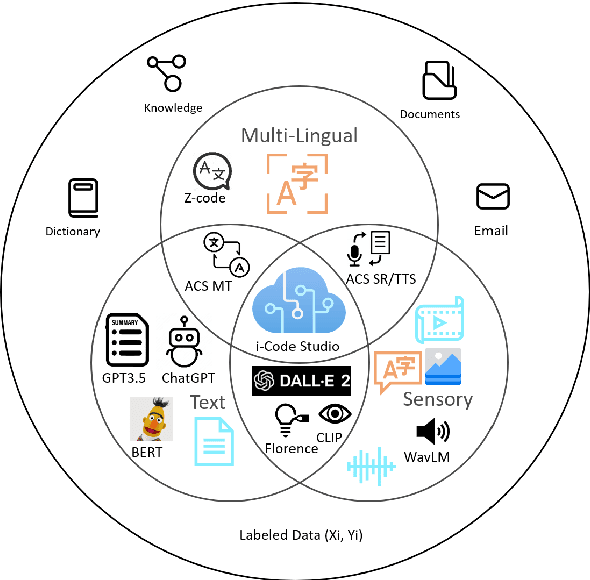
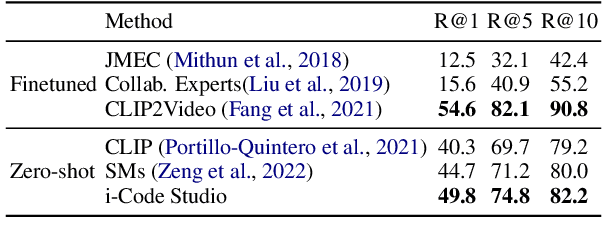
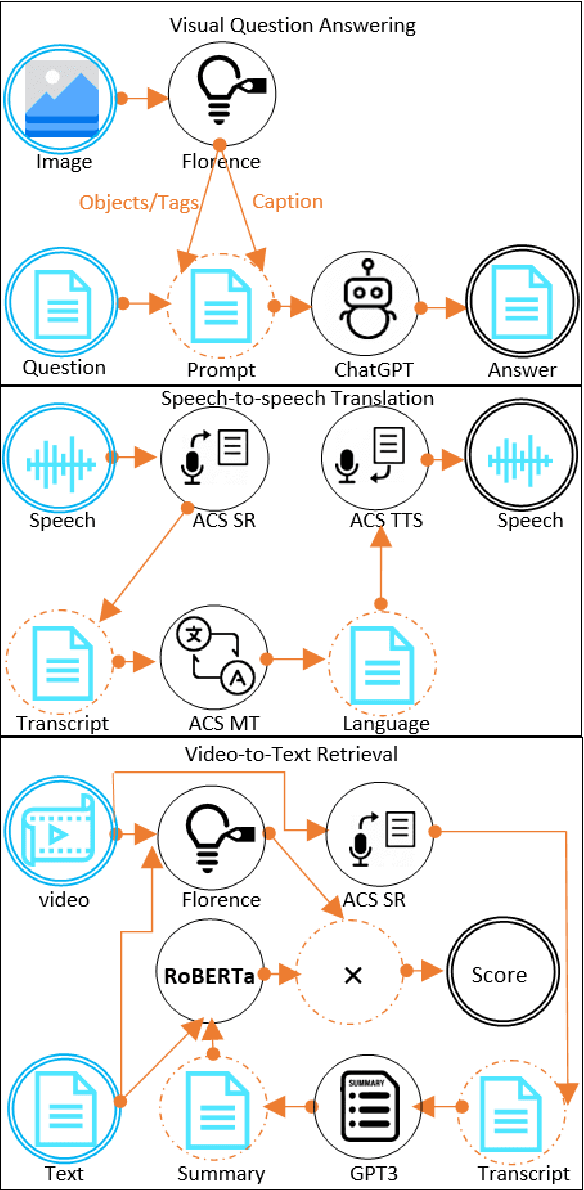
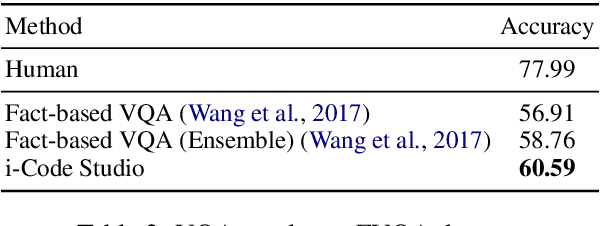
Artificial General Intelligence (AGI) requires comprehensive understanding and generation capabilities for a variety of tasks spanning different modalities and functionalities. Integrative AI is one important direction to approach AGI, through combining multiple models to tackle complex multimodal tasks. However, there is a lack of a flexible and composable platform to facilitate efficient and effective model composition and coordination. In this paper, we propose the i-Code Studio, a configurable and composable framework for Integrative AI. The i-Code Studio orchestrates multiple pre-trained models in a finetuning-free fashion to conduct complex multimodal tasks. Instead of simple model composition, the i-Code Studio provides an integrative, flexible, and composable setting for developers to quickly and easily compose cutting-edge services and technologies tailored to their specific requirements. The i-Code Studio achieves impressive results on a variety of zero-shot multimodal tasks, such as video-to-text retrieval, speech-to-speech translation, and visual question answering. We also demonstrate how to quickly build a multimodal agent based on the i-Code Studio that can communicate and personalize for users.
i-Code V2: An Autoregressive Generation Framework over Vision, Language, and Speech Data
May 21, 2023
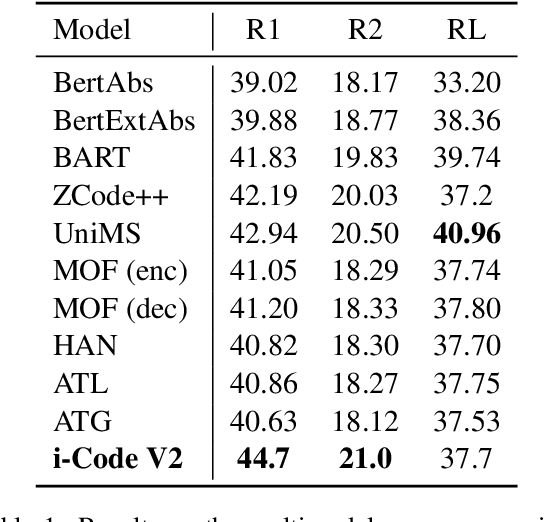
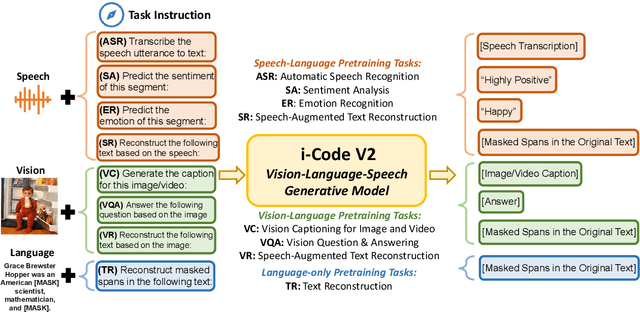
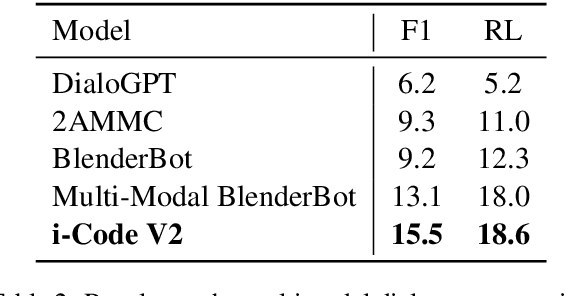
The convergence of text, visual, and audio data is a key step towards human-like artificial intelligence, however the current Vision-Language-Speech landscape is dominated by encoder-only models which lack generative abilities. We propose closing this gap with i-Code V2, the first model capable of generating natural language from any combination of Vision, Language, and Speech data. i-Code V2 is an integrative system that leverages state-of-the-art single-modality encoders, combining their outputs with a new modality-fusing encoder in order to flexibly project combinations of modalities into a shared representational space. Next, language tokens are generated from these representations via an autoregressive decoder. The whole framework is pretrained end-to-end on a large collection of dual- and single-modality datasets using a novel text completion objective that can be generalized across arbitrary combinations of modalities. i-Code V2 matches or outperforms state-of-the-art single- and dual-modality baselines on 7 multimodal tasks, demonstrating the power of generative multimodal pretraining across a diversity of tasks and signals.
Code-Switching Text Generation and Injection in Mandarin-English ASR
Mar 20, 2023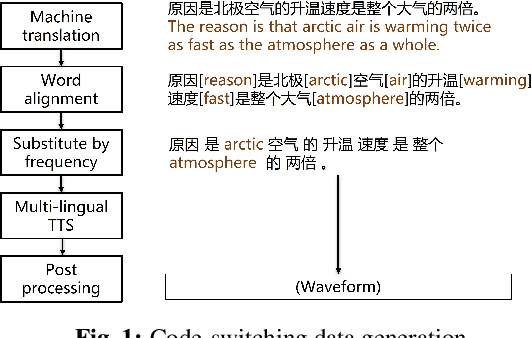
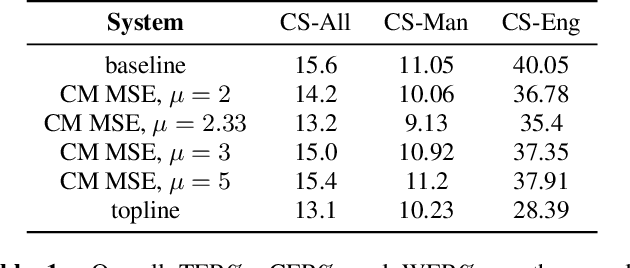
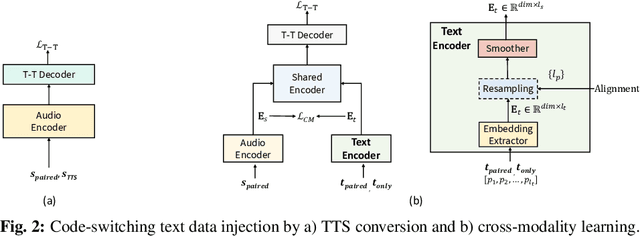

Code-switching speech refers to a means of expression by mixing two or more languages within a single utterance. Automatic Speech Recognition (ASR) with End-to-End (E2E) modeling for such speech can be a challenging task due to the lack of data. In this study, we investigate text generation and injection for improving the performance of an industry commonly-used streaming model, Transformer-Transducer (T-T), in Mandarin-English code-switching speech recognition. We first propose a strategy to generate code-switching text data and then investigate injecting generated text into T-T model explicitly by Text-To-Speech (TTS) conversion or implicitly by tying speech and text latent spaces. Experimental results on the T-T model trained with a dataset containing 1,800 hours of real Mandarin-English code-switched speech show that our approaches to inject generated code-switching text significantly boost the performance of T-T models, i.e., 16% relative Token-based Error Rate (TER) reduction averaged on three evaluation sets, and the approach of tying speech and text latent spaces is superior to that of TTS conversion on the evaluation set which contains more homogeneous data with the training set.
Target Sound Extraction with Variable Cross-modality Clues
Mar 15, 2023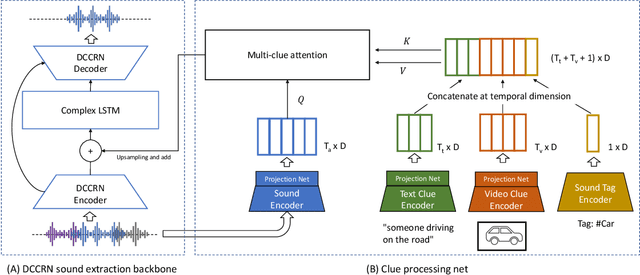
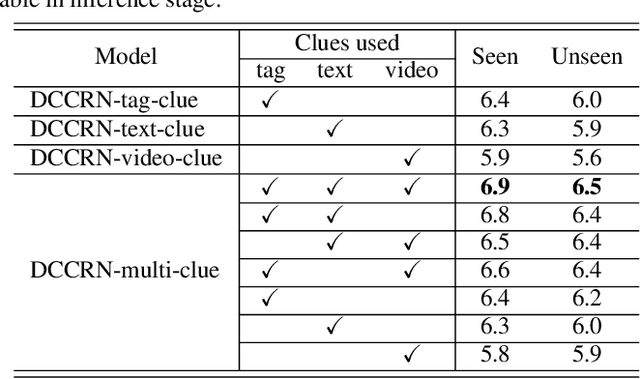
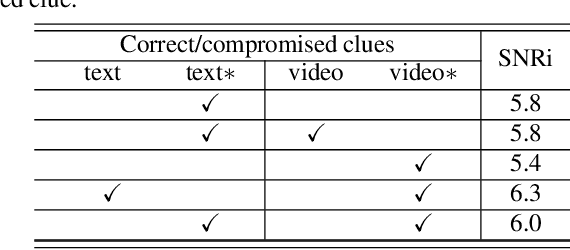
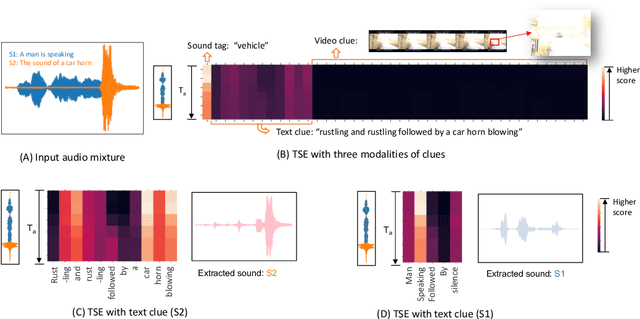
Automatic target sound extraction (TSE) is a machine learning approach to mimic the human auditory perception capability of attending to a sound source of interest from a mixture of sources. It often uses a model conditioned on a fixed form of target sound clues, such as a sound class label, which limits the ways in which users can interact with the model to specify the target sounds. To leverage variable number of clues cross modalities available in the inference phase, including a video, a sound event class, and a text caption, we propose a unified transformer-based TSE model architecture, where a multi-clue attention module integrates all the clues across the modalities. Since there is no off-the-shelf benchmark to evaluate our proposed approach, we build a dataset based on public corpora, Audioset and AudioCaps. Experimental results for seen and unseen target-sound evaluation sets show that our proposed TSE model can effectively deal with a varying number of clues which improves the TSE performance and robustness against partially compromised clues.
A comprehensive study on self-supervised distillation for speaker representation learning
Oct 28, 2022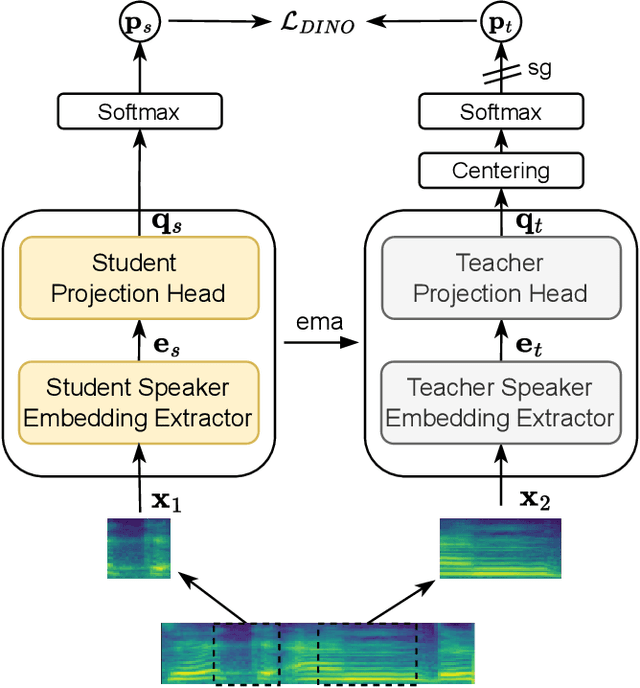
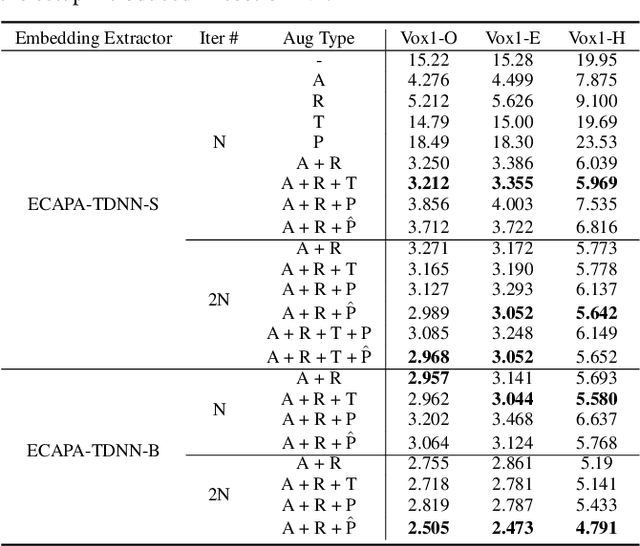
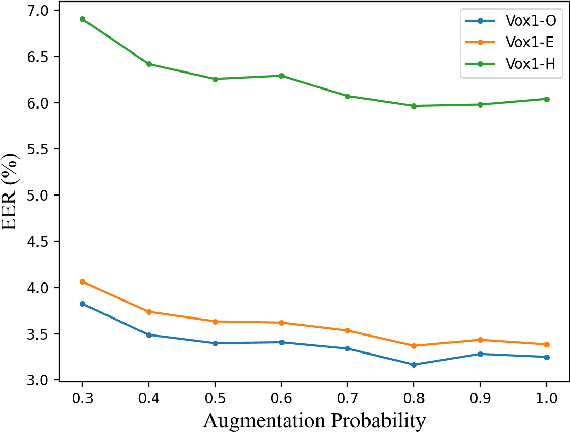

In real application scenarios, it is often challenging to obtain a large amount of labeled data for speaker representation learning due to speaker privacy concerns. Self-supervised learning with no labels has become a more and more promising way to solve it. Compared with contrastive learning, self-distilled approaches use only positive samples in the loss function and thus are more attractive. In this paper, we present a comprehensive study on self-distilled self-supervised speaker representation learning, especially on critical data augmentation. Our proposed strategy of audio perturbation augmentation has pushed the performance of the speaker representation to a new limit. The experimental results show that our model can achieve a new SoTA on Voxceleb1 speaker verification evaluation benchmark ( i.e., equal error rate (EER) 2.505%, 2.473%, and 4.791% for trial Vox1-O, Vox1-E and Vox1-H , respectively), discarding any speaker labels in the training phase.
Deploying self-supervised learning in the wild for hybrid automatic speech recognition
May 17, 2022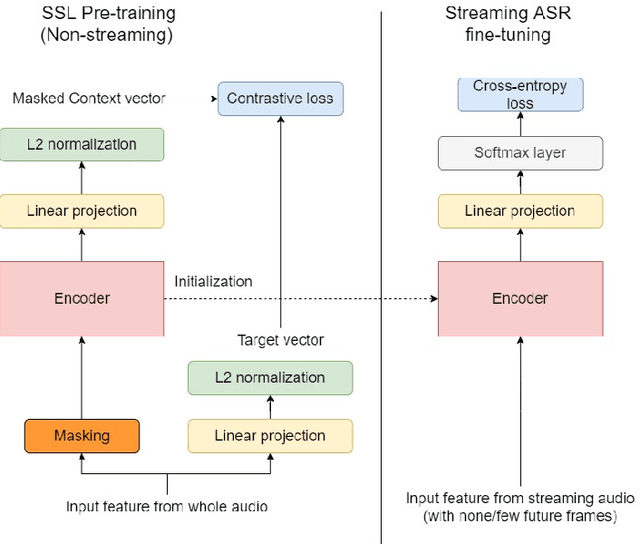
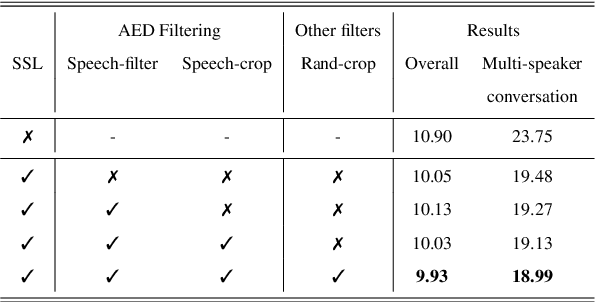
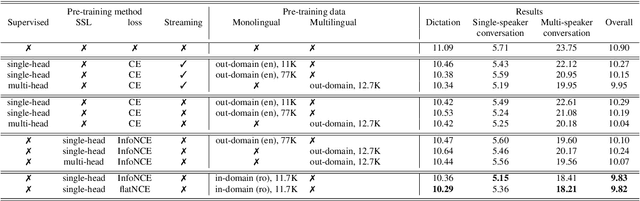
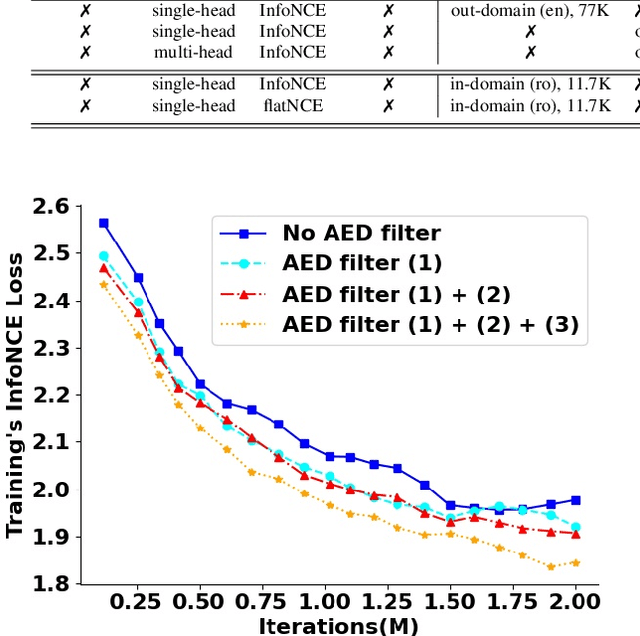
Self-supervised learning (SSL) methods have proven to be very successful in automatic speech recognition (ASR). These great improvements have been reported mostly based on highly curated datasets such as LibriSpeech for non-streaming End-to-End ASR models. However, the pivotal characteristics of SSL is to be utilized for any untranscribed audio data. In this paper, we provide a full exploration on how to utilize uncurated audio data in SSL from data pre-processing to deploying an streaming hybrid ASR model. More specifically, we present (1) the effect of Audio Event Detection (AED) model in data pre-processing pipeline (2) analysis on choosing optimizer and learning rate scheduling (3) comparison of recently developed contrastive losses, (4) comparison of various pre-training strategies such as utilization of in-domain versus out-domain pre-training data, monolingual versus multilingual pre-training data, multi-head multilingual SSL versus single-head multilingual SSL and supervised pre-training versus SSL. The experimental results show that SSL pre-training with in-domain uncurated data can achieve better performance in comparison to all the alternative out-domain pre-training strategies.
i-Code: An Integrative and Composable Multimodal Learning Framework
May 05, 2022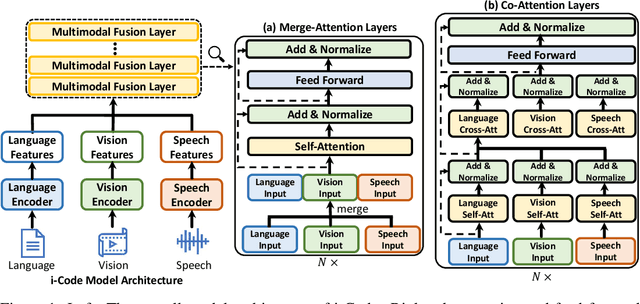
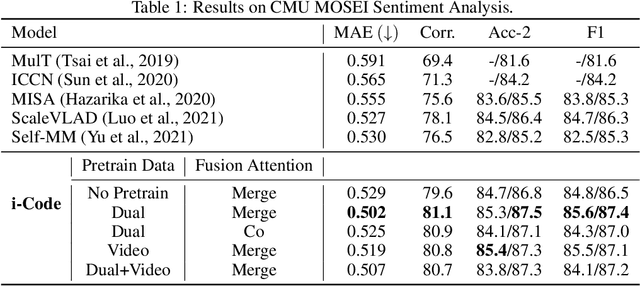
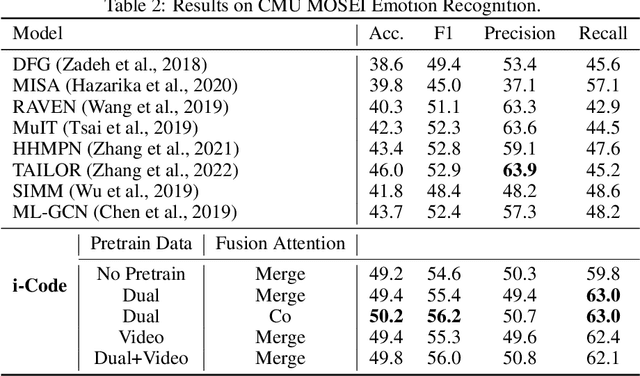

Human intelligence is multimodal; we integrate visual, linguistic, and acoustic signals to maintain a holistic worldview. Most current pretraining methods, however, are limited to one or two modalities. We present i-Code, a self-supervised pretraining framework where users may flexibly combine the modalities of vision, speech, and language into unified and general-purpose vector representations. In this framework, data from each modality are first given to pretrained single-modality encoders. The encoder outputs are then integrated with a multimodal fusion network, which uses novel attention mechanisms and other architectural innovations to effectively combine information from the different modalities. The entire system is pretrained end-to-end with new objectives including masked modality unit modeling and cross-modality contrastive learning. Unlike previous research using only video for pretraining, the i-Code framework can dynamically process single, dual, and triple-modality data during training and inference, flexibly projecting different combinations of modalities into a single representation space. Experimental results demonstrate how i-Code can outperform state-of-the-art techniques on five video understanding tasks and the GLUE NLP benchmark, improving by as much as 11% and demonstrating the power of integrative multimodal pretraining.