 Add to Chrome
 Add to Firefox
 Add to Edge
Model Merging by Output-Space Projection
May 27, 2026
Model merging combines fine-tuned checkpoints into a single multi-task model without retraining. Existing methods - such as task arithmetic, model soups, TIES, and DARE - are computationally efficient and empirically successful, but rely on heuristic design choices and lack formal optimality guarantees. We show that merging can be formulated as a convex quadratic programme over residual updates, yielding weights that minimise a squared-output calibration objective using calibration inputs and fine-tuned model outputs, and subsuming existing methods as special cases. Our framework yields a closed-form diagnostic - the fraction of residual energy captured by a chosen basis - that predicts downstream merge quality using only the calibration set. Empirically, the QP matches or outperforms existing methods in the single-layer setting, and we characterise when the optimal basis provides significant gains over the cheaper diagonal QP. We extend to multi-layer merging via a sequential layer-wise algorithm and demonstrate consistent gains across language and vision benchmarks.

BioDCASE 2026 Challenge Baseline for Cross-Domain Mosquito Species Classification
Mar 20, 2026Mosquito-borne diseases affect more than one billion people each year and cause close to one million deaths. Traditional surveillance methods rely on traps and manual identification that are slow, labor-intensive, and difficult to scale. Audio-based mosquito monitoring offers a non-destructive, lower-cost, and more scalable complement to trap-based surveillance, but reliable species classification remains difficult under real-world recording conditions. Mosquito flight tones are narrow-band, often low in signal-to-noise ratio, and easily masked by background noise, and recordings for several epidemiologically relevant species remain limited, creating pronounced class imbalance. Variation across devices, environments, and collection protocols further increases the difficulty of robust classification. Such variation can cause models to rely on domain-specific recording artefacts rather than species-relevant acoustic cues, which makes transfer to new acquisition settings difficult. The BioDCASE 2026 Cross-Domain Mosquito Species Classification (CD-MSC) challenge is designed around this deployment problem by evaluating performance on both seen and unseen domains. This paper presents the official baseline system and evaluation pipeline as a simple, fully reproducible reference for the CD-MSC challenge task. The baseline uses log-mel features and a multitemporal resolution convolutional neural network (MTRCNN) with species and auxiliary domain outputs, together with complete training and test scripts. The baseline system performs strongly on seen domains but degrades markedly on unseen domains, showing that cross-domain generalisation, rather than within-domain recognition, is the central challenge for practical mosquito species classification from multi-source bioacoustic recordings.
Geo-ATBench: A Benchmark for Geospatial Audio Tagging with Geospatial Semantic Context
Mar 11, 2026Environmental sound understanding in computational auditory scene analysis (CASA) is often formulated as an audio-only recognition problem. This formulation leaves a persistent drawback in multi-label audio tagging (AT): acoustic similarity can make certain events difficult to separate from waveforms alone. In such cases, disambiguating cues often lie outside the waveform. Geospatial semantic context (GSC), derived from geographic information system data, e.g., points of interest (POI), provides location-tied environmental priors that can help reduce this ambiguity. A systematic study of this direction is enabled through the proposed geospatial audio tagging (Geo-AT) task, which conditions multi-label sound event tagging on GSC alongside audio. To benchmark Geo-AT, Geo-ATBench is introduced as a polyphonic audio benchmark with geographical annotations, containing 10.71 hours of audio across 28 event categories; each clip is paired with a GSC representation from 11 semantic context categories. GeoFusion-AT is proposed as a unified geo-audio fusion framework that evaluates feature-, representation-, and decision-level fusion on representative audio backbones, with audio- and GSC-only baselines. Results show that incorporating GSC improves AT performance, especially on acoustically confounded labels, indicating geospatial semantics provide effective priors beyond audio alone. A crowdsourced listening study with 10 participants on 579 samples shows that there is no significant difference in performance between models on Geo-ATBench labels and aggregated human labels, supporting Geo-ATBench as a human-aligned benchmark. The Geo-AT task, benchmark Geo-ATBench, and reproducible geo-audio fusion framework GeoFusion-AT provide a foundation for studying AT with geospatial semantic context within the CASA community. Dataset, code, models are on homepage (https://github.com/WuYanru2002/Geo-ATBench).
Toward Expert Investment Teams:A Multi-Agent LLM System with Fine-Grained Trading Tasks
Feb 26, 2026The advancement of large language models (LLMs) has accelerated the development of autonomous financial trading systems. While mainstream approaches deploy multi-agent systems mimicking analyst and manager roles, they often rely on abstract instructions that overlook the intricacies of real-world workflows, which can lead to degraded inference performance and less transparent decision-making. Therefore, we propose a multi-agent LLM trading framework that explicitly decomposes investment analysis into fine-grained tasks, rather than providing coarse-grained instructions. We evaluate the proposed framework using Japanese stock data, including prices, financial statements, news, and macro information, under a leakage-controlled backtesting setting. Experimental results show that fine-grained task decomposition significantly improves risk-adjusted returns compared to conventional coarse-grained designs. Crucially, further analysis of intermediate agent outputs suggests that alignment between analytical outputs and downstream decision preferences is a critical driver of system performance. Moreover, we conduct standard portfolio optimization, exploiting low correlation with the stock index and the variance of each system's output. This approach achieves superior performance. These findings contribute to the design of agent structure and task configuration when applying LLM agents to trading systems in practical settings.
Prediction-Oriented Subsampling from Data Streams
Aug 05, 2025Data is often generated in streams, with new observations arriving over time. A key challenge for learning models from data streams is capturing relevant information while keeping computational costs manageable. We explore intelligent data subsampling for offline learning, and argue for an information-theoretic method centred on reducing uncertainty in downstream predictions of interest. Empirically, we demonstrate that this prediction-oriented approach performs better than a previously proposed information-theoretic technique on two widely studied problems. At the same time, we highlight that reliably achieving strong performance in practice requires careful model design.
First observations of the seiche that shook the world
Nov 04, 2024

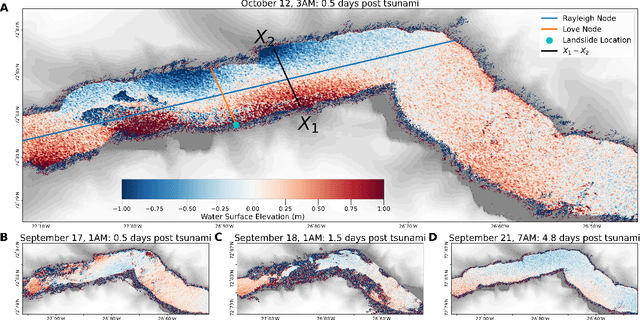

On September 16th, 2023, an anomalous 10.88 mHz seismic signal was observed globally, persisting for 9 days. One month later an identical signal appeared, lasting for another week. Several studies have theorized that these signals were produced by seiches which formed after two landslide generated mega-tsunamis in an East-Greenland fjord. This theory is supported by seismic inversions, and analytical and numerical modeling, but no direct observations have been made -- until now. Using data from the new Surface Water Ocean Topography mission, we present the first observations of this phenomenon. By ruling out other oceanographic processes, we validate the seiche theory of previous authors and independently estimate its initial amplitude at 7.9 m using Bayesian machine learning and seismic data. This study demonstrates the value of satellite altimetry for studying extreme events, while also highlighting the need for specialized methods to address the altimetric data's limitations, namely temporal sparsity. These data and approaches will help in understanding future unseen extremes driven by climate change.
Deep Learning for Options Trading: An End-To-End Approach
Jul 31, 2024
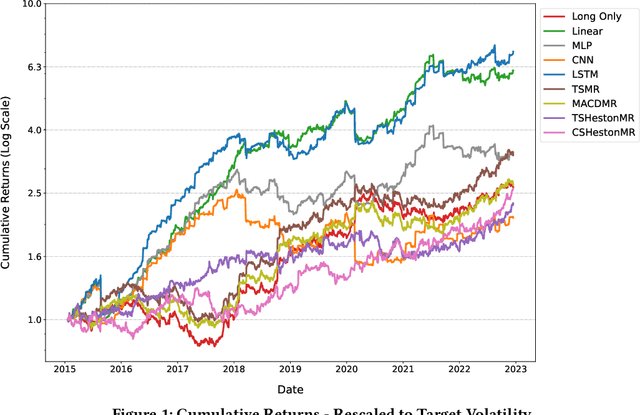


We introduce a novel approach to options trading strategies using a highly scalable and data-driven machine learning algorithm. In contrast to traditional approaches that often require specifications of underlying market dynamics or assumptions on an option pricing model, our models depart fundamentally from the need for these prerequisites, directly learning non-trivial mappings from market data to optimal trading signals. Backtesting on more than a decade of option contracts for equities listed on the S&P 100, we demonstrate that deep learning models trained according to our end-to-end approach exhibit significant improvements in risk-adjusted performance over existing rules-based trading strategies. We find that incorporating turnover regularization into the models leads to further performance enhancements at prohibitively high levels of transaction costs.
Learning to Learn Financial Networks for Optimising Momentum Strategies
Aug 23, 2023Network momentum provides a novel type of risk premium, which exploits the interconnections among assets in a financial network to predict future returns. However, the current process of constructing financial networks relies heavily on expensive databases and financial expertise, limiting accessibility for small-sized and academic institutions. Furthermore, the traditional approach treats network construction and portfolio optimisation as separate tasks, potentially hindering optimal portfolio performance. To address these challenges, we propose L2GMOM, an end-to-end machine learning framework that simultaneously learns financial networks and optimises trading signals for network momentum strategies. The model of L2GMOM is a neural network with a highly interpretable forward propagation architecture, which is derived from algorithm unrolling. The L2GMOM is flexible and can be trained with diverse loss functions for portfolio performance, e.g. the negative Sharpe ratio. Backtesting on 64 continuous future contracts demonstrates a significant improvement in portfolio profitability and risk control, with a Sharpe ratio of 1.74 across a 20-year period.
Network Momentum across Asset Classes
Aug 22, 2023We investigate the concept of network momentum, a novel trading signal derived from momentum spillover across assets. Initially observed within the confines of pairwise economic and fundamental ties, such as the stock-bond connection of the same company and stocks linked through supply-demand chains, momentum spillover implies a propagation of momentum risk premium from one asset to another. The similarity of momentum risk premium, exemplified by co-movement patterns, has been spotted across multiple asset classes including commodities, equities, bonds and currencies. However, studying the network effect of momentum spillover across these classes has been challenging due to a lack of readily available common characteristics or economic ties beyond the company level. In this paper, we explore the interconnections of momentum features across a diverse range of 64 continuous future contracts spanning these four classes. We utilise a linear and interpretable graph learning model with minimal assumptions to reveal the intricacies of the momentum spillover network. By leveraging the learned networks, we construct a network momentum strategy that exhibits a Sharpe ratio of 1.5 and an annual return of 22%, after volatility scaling, from 2000 to 2022. This paper pioneers the examination of momentum spillover across multiple asset classes using only pricing data, presents a multi-asset investment strategy based on network momentum, and underscores the effectiveness of this strategy through robust empirical analysis.
The instabilities of large learning rate training: a loss landscape view
Jul 22, 2023Modern neural networks are undeniably successful. Numerous works study how the curvature of loss landscapes can affect the quality of solutions. In this work we study the loss landscape by considering the Hessian matrix during network training with large learning rates - an attractive regime that is (in)famously unstable. We characterise the instabilities of gradient descent, and we observe the striking phenomena of \textit{landscape flattening} and \textit{landscape shift}, both of which are intimately connected to the instabilities of training.