 Add to Chrome
 Add to Firefox
 Add to Edge
AXIS: A Growable Community-Driven Data Engine for Scalable Robot Manipulation
Jul 23, 2026
Learning effective robot manipulation policies requires diverse, high-quality demonstrations, yet existing data pipelines are often difficult to scale because they rely on specialized hardware, centralized operators, or fixed task suites. We present AXIS, a growable community-driven data engine and benchmark for scalable robot learning, which enables browser-based teleoperation for large-scale demonstration collection, automatically generates and validates new manipulation tasks, and transforms community-collected demonstrations into training-ready data through automated success checking, quality filtering, trajectory smoothing, and visual and physics-based augmentation. The AXIS dataset currently contains 207 diverse tasks and 50K+ trajectories. Meanwhile, AXIS organizes data into task snapshots and evaluates policies with a systematic held-out protocol. We compare vision-language-action (VLA) policies under a unified AXIS evaluation suite and analyze scaling behavior across different data volumes. Continual pretraining on AXIS substantially improves the overall success rate of $π_{0.5}$ by 5.8%, outperforms the model pretrained on RoboCasa365 by 37.3%, and exhibits consistent scaling with increasing data volume, with the largest gains observed under layout, sensor-noise, and camera perturbations.

Fishbone: From One 3D Asset to a Million Controllable Edits
May 24, 2026Large-scale controllable 3D assets are critical for computer graphics, embodied AI, robotics, and interactive content creation, yet creating diverse 3D assets remains challenging due to the high cost of manual modeling and rigging. Shape deformation offers a natural way to generate variations from existing meshes, but existing data-driven methods often rely on sparse user inputs, while parametric editing frameworks require manually designed control structures and category-specific configurations. Inspired by natural creatures, where a central spine governs global shape and cross-sectional ribs control local variation, we introduce Fishbone, a unified rib-spine representation for general shapes that supports controllable parametric mesh deformation, reduced-space dynamics, and animation. Given an input mesh, Fishbone computes a geodesic scalar field with an adaptive heat method, extracts iso-contours as cross-sectional ribs, constructs a smooth geometry-aware spine through rib centers, and associates surface vertices with nearby rib and spine structures using Gaussian-weighted skinning. The resulting representation enables real-time and predictable deformation: ribs control local profiles such as thickness, orientation, and cross-sectional variation, while the spine controls global bending, twisting, and stretching. The same structure also supports reduced-space simulation and keyframe animation. We further construct Fishbone-136K by augmenting Hunyuan3D with rib-spine structures, and demonstrate applications in controllable 3D generation, deformation-based data augmentation for robot learning, interactive mesh editing, and agentic generation. Experiments demonstrate the effectiveness, efficiency, and versatility of the proposed framework.
VISTA: Generative Visual Imagination for Vision-and-Language Navigation
May 17, 2025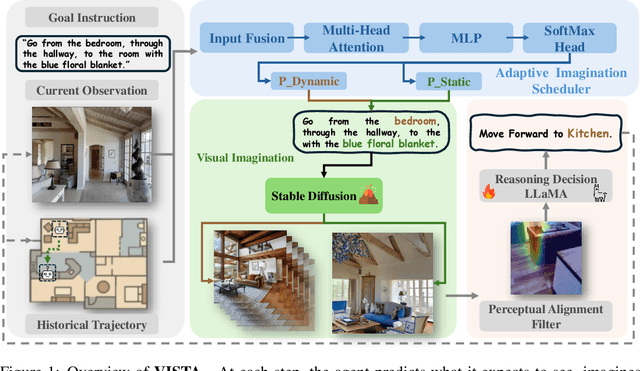
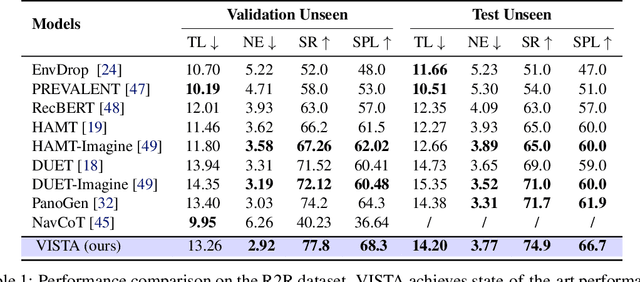
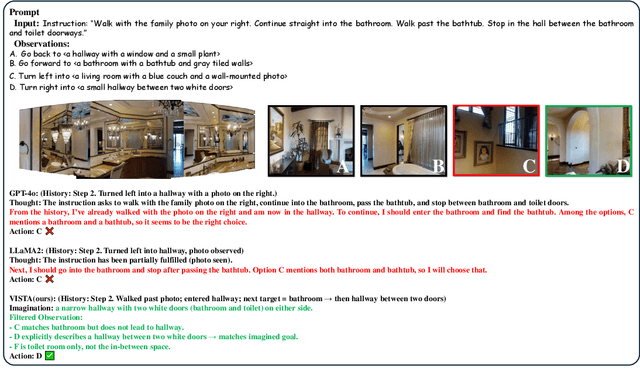
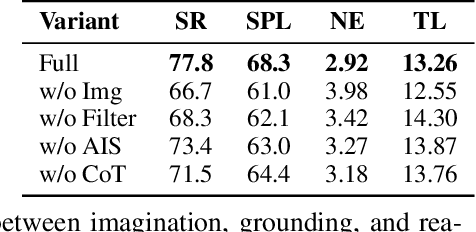
Vision-and-Language Navigation (VLN) tasks agents with locating specific objects in unseen environments using natural language instructions and visual cues. Many existing VLN approaches typically follow an 'observe-and-reason' schema, that is, agents observe the environment and decide on the next action to take based on the visual observations of their surroundings. They often face challenges in long-horizon scenarios due to limitations in immediate observation and vision-language modality gaps. To overcome this, we present VISTA, a novel framework that employs an 'imagine-and-align' navigation strategy. Specifically, we leverage the generative prior of pre-trained diffusion models for dynamic visual imagination conditioned on both local observations and high-level language instructions. A Perceptual Alignment Filter module then grounds these goal imaginations against current observations, guiding an interpretable and structured reasoning process for action selection. Experiments show that VISTA sets new state-of-the-art results on Room-to-Room (R2R) and RoboTHOR benchmarks, e.g.,+3.6% increase in Success Rate on R2R. Extensive ablation analysis underscores the value of integrating forward-looking imagination, perceptual alignment, and structured reasoning for robust navigation in long-horizon environments.
Can Large Vision Language Models Read Maps Like a Human?
Mar 18, 2025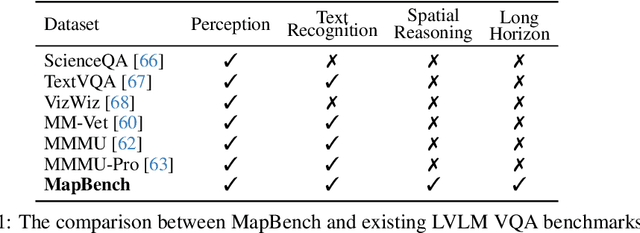
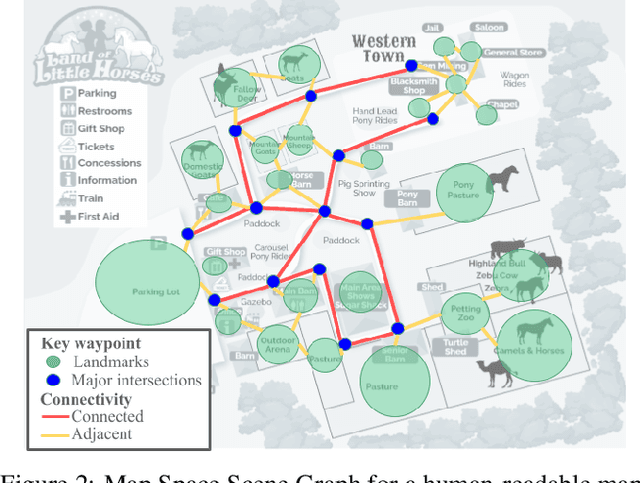
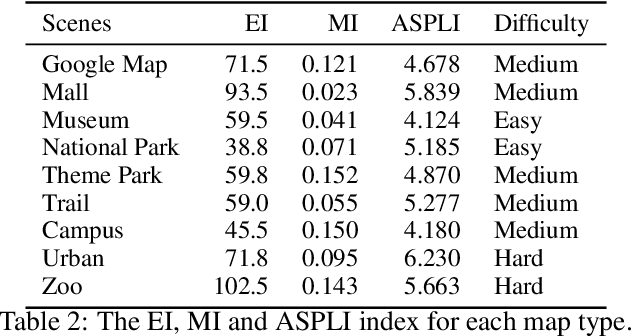
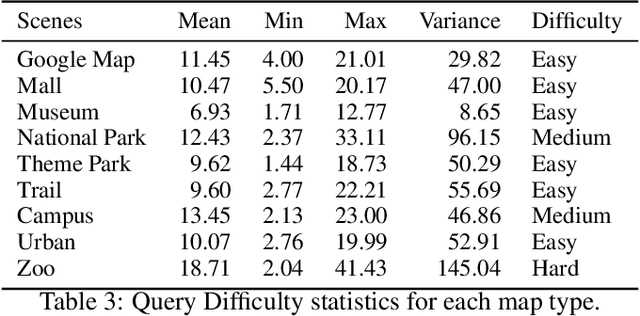
In this paper, we introduce MapBench-the first dataset specifically designed for human-readable, pixel-based map-based outdoor navigation, curated from complex path finding scenarios. MapBench comprises over 1600 pixel space map path finding problems from 100 diverse maps. In MapBench, LVLMs generate language-based navigation instructions given a map image and a query with beginning and end landmarks. For each map, MapBench provides Map Space Scene Graph (MSSG) as an indexing data structure to convert between natural language and evaluate LVLM-generated results. We demonstrate that MapBench significantly challenges state-of-the-art LVLMs both zero-shot prompting and a Chain-of-Thought (CoT) augmented reasoning framework that decomposes map navigation into sequential cognitive processes. Our evaluation of both open-source and closed-source LVLMs underscores the substantial difficulty posed by MapBench, revealing critical limitations in their spatial reasoning and structured decision-making capabilities. We release all the code and dataset in https://github.com/taco-group/MapBench.
PANDORA: Diffusion Policy Learning for Dexterous Robotic Piano Playing
Mar 17, 2025We present PANDORA, a novel diffusion-based policy learning framework designed specifically for dexterous robotic piano performance. Our approach employs a conditional U-Net architecture enhanced with FiLM-based global conditioning, which iteratively denoises noisy action sequences into smooth, high-dimensional trajectories. To achieve precise key execution coupled with expressive musical performance, we design a composite reward function that integrates task-specific accuracy, audio fidelity, and high-level semantic feedback from a large language model (LLM) oracle. The LLM oracle assesses musical expressiveness and stylistic nuances, enabling dynamic, hand-specific reward adjustments. Further augmented by a residual inverse-kinematics refinement policy, PANDORA achieves state-of-the-art performance in the ROBOPIANIST environment, significantly outperforming baselines in both precision and expressiveness. Ablation studies validate the critical contributions of diffusion-based denoising and LLM-driven semantic feedback in enhancing robotic musicianship. Videos available at: https://taco-group.github.io/PANDORA
Zero-shot Object Navigation with Vision-Language Models Reasoning
Oct 24, 2024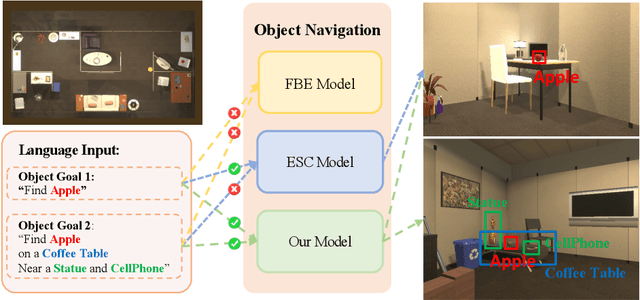

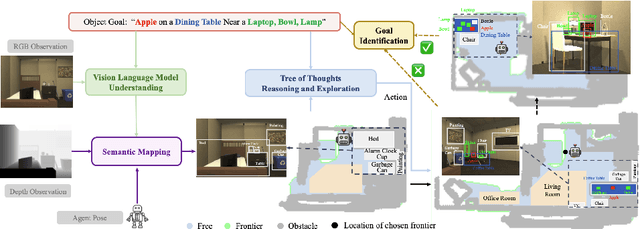

Object navigation is crucial for robots, but traditional methods require substantial training data and cannot be generalized to unknown environments. Zero-shot object navigation (ZSON) aims to address this challenge, allowing robots to interact with unknown objects without specific training data. Language-driven zero-shot object navigation (L-ZSON) is an extension of ZSON that incorporates natural language instructions to guide robot navigation and interaction with objects. In this paper, we propose a novel Vision Language model with a Tree-of-thought Network (VLTNet) for L-ZSON. VLTNet comprises four main modules: vision language model understanding, semantic mapping, tree-of-thought reasoning and exploration, and goal identification. Among these modules, Tree-of-Thought (ToT) reasoning and exploration module serves as a core component, innovatively using the ToT reasoning framework for navigation frontier selection during robot exploration. Compared to conventional frontier selection without reasoning, navigation using ToT reasoning involves multi-path reasoning processes and backtracking when necessary, enabling globally informed decision-making with higher accuracy. Experimental results on PASTURE and RoboTHOR benchmarks demonstrate the outstanding performance of our model in LZSON, particularly in scenarios involving complex natural language as target instructions.