 Add to Chrome
 Add to Firefox
 Add to Edge
ProxyUp: Training-Free Proxy-Conditioned Video Generation for Controllable Dynamics
Jul 04, 2026
Precise control over complex dynamics remains challenging for modern video generative models, as text prompts alone often cannot specify physically plausible, fine-grained motion and interactions. We introduce $\textit{proxy-conditioned video generation}$, where a coarse proxy video from physics-based simulation or real-world recording serves as a dynamics carrier to control foreground object motion. Given a proxy video and a text prompt, the goal is to synthesize a new video that preserves the proxy dynamics while generating novel content and plausible interactions aligned with the prompt. Since paired proxy-target videos are difficult to obtain, we propose $\textbf{ProxyUp}$, a training-free framework built on pretrained video generative models. ProxyUp first inverts the proxy video into an intermediate latent representation and applies $\textbf{region-wise latent noising}$, preserving motion-critical proxy latents while injecting noise into regions intended for text-driven regeneration. To mitigate the distribution mismatch and weak foreground-background coupling introduced by this heuristic latent composition, we further propose $\textbf{Stochastic Flow Relaxation (SFR)}$, which progressively relaxes the composed latent toward the model's learned distribution before ODE sampling. Experiments on both simulation and real-world proxies show that ProxyUp outperforms strong video editing and motion transfer baselines in dynamic fidelity and text alignment.

Fishbone: From One 3D Asset to a Million Controllable Edits
May 24, 2026Large-scale controllable 3D assets are critical for computer graphics, embodied AI, robotics, and interactive content creation, yet creating diverse 3D assets remains challenging due to the high cost of manual modeling and rigging. Shape deformation offers a natural way to generate variations from existing meshes, but existing data-driven methods often rely on sparse user inputs, while parametric editing frameworks require manually designed control structures and category-specific configurations. Inspired by natural creatures, where a central spine governs global shape and cross-sectional ribs control local variation, we introduce Fishbone, a unified rib-spine representation for general shapes that supports controllable parametric mesh deformation, reduced-space dynamics, and animation. Given an input mesh, Fishbone computes a geodesic scalar field with an adaptive heat method, extracts iso-contours as cross-sectional ribs, constructs a smooth geometry-aware spine through rib centers, and associates surface vertices with nearby rib and spine structures using Gaussian-weighted skinning. The resulting representation enables real-time and predictable deformation: ribs control local profiles such as thickness, orientation, and cross-sectional variation, while the spine controls global bending, twisting, and stretching. The same structure also supports reduced-space simulation and keyframe animation. We further construct Fishbone-136K by augmenting Hunyuan3D with rib-spine structures, and demonstrate applications in controllable 3D generation, deformation-based data augmentation for robot learning, interactive mesh editing, and agentic generation. Experiments demonstrate the effectiveness, efficiency, and versatility of the proposed framework.
SeeClear: Reliable Transparent Object Depth Estimation via Generative Opacification
Mar 20, 2026Monocular depth estimation remains challenging for transparent objects, where refraction and transmission are difficult to model and break the appearance assumptions used by depth networks. As a result, state-of-the-art estimators often produce unstable or incorrect depth predictions for transparent materials. We propose SeeClear, a novel framework that converts transparent objects into generative opaque images, enabling stable monocular depth estimation for transparent objects. Given an input image, we first localize transparent regions and transform their refractive appearance into geometrically consistent opaque shapes using a diffusion-based generative opacification module. The processed image is then fed into an off-the-shelf monocular depth estimator without retraining or architectural changes. To train the opacification model, we construct SeeClear-396k, a synthetic dataset containing 396k paired transparent-opaque renderings. Experiments on both synthetic and real-world datasets show that SeeClear significantly improves depth estimation for transparent objects. Project page: https://heyumeng.com/SeeClear-web/
Birth of a Painting: Differentiable Brushstroke Reconstruction
Nov 17, 2025Painting embodies a unique form of visual storytelling, where the creation process is as significant as the final artwork. Although recent advances in generative models have enabled visually compelling painting synthesis, most existing methods focus solely on final image generation or patch-based process simulation, lacking explicit stroke structure and failing to produce smooth, realistic shading. In this work, we present a differentiable stroke reconstruction framework that unifies painting, stylized texturing, and smudging to faithfully reproduce the human painting-smudging loop. Given an input image, our framework first optimizes single- and dual-color Bezier strokes through a parallel differentiable paint renderer, followed by a style generation module that synthesizes geometry-conditioned textures across diverse painting styles. We further introduce a differentiable smudge operator to enable natural color blending and shading. Coupled with a coarse-to-fine optimization strategy, our method jointly optimizes stroke geometry, color, and texture under geometric and semantic guidance. Extensive experiments on oil, watercolor, ink, and digital paintings demonstrate that our approach produces realistic and expressive stroke reconstructions, smooth tonal transitions, and richly stylized appearances, offering a unified model for expressive digital painting creation. See our project page for more demos: https://yingjiang96.github.io/DiffPaintWebsite/.
GS-Phong: Meta-Learned 3D Gaussians for Relightable Novel View Synthesis
May 31, 2024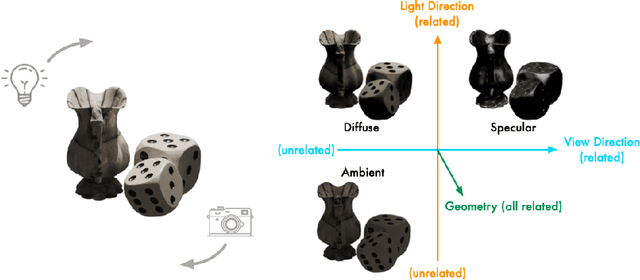
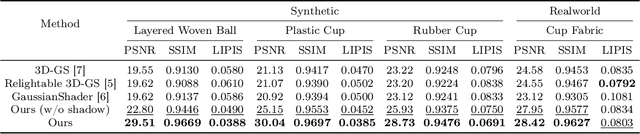
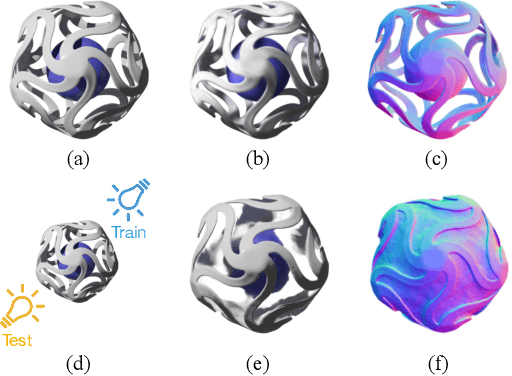
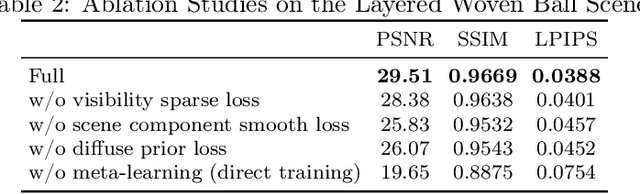
Decoupling the illumination in 3D scenes is crucial for novel view synthesis and relighting. In this paper, we propose a novel method for representing a scene illuminated by a point light using a set of relightable 3D Gaussian points. Inspired by the Blinn-Phong model, our approach decomposes the scene into ambient, diffuse, and specular components, enabling the synthesis of realistic lighting effects. To facilitate the decomposition of geometric information independent of lighting conditions, we introduce a novel bilevel optimization-based meta-learning framework. The fundamental idea is to view the rendering tasks under various lighting positions as a multi-task learning problem, which our meta-learning approach effectively addresses by generalizing the learned Gaussian geometries not only across different viewpoints but also across diverse light positions. Experimental results demonstrate the effectiveness of our approach in terms of training efficiency and rendering quality compared to existing methods for free-viewpoint relighting.